
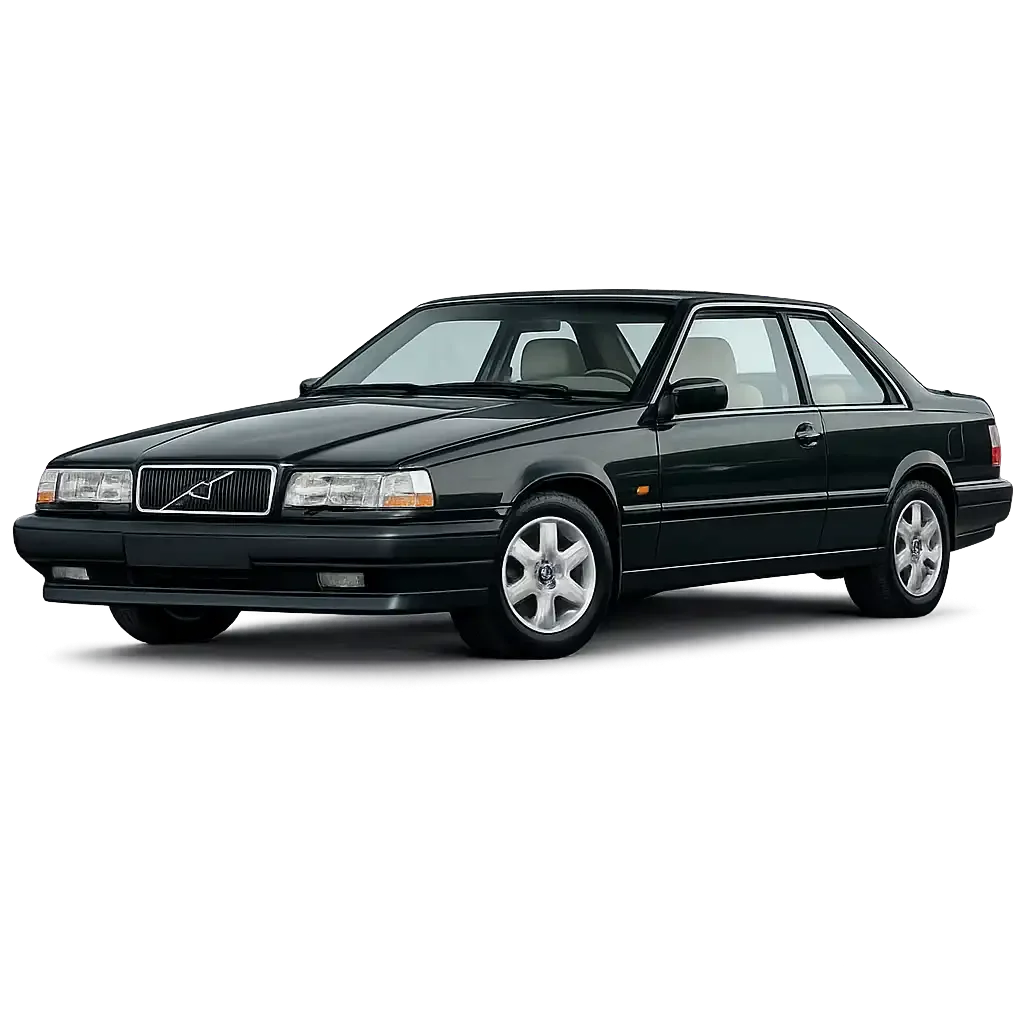
The Volvo 780 (1986 to 1991) is a 2-door, 2+2 coupe designed by Marc Deschamps and built by Carrozzeria Bertone in Turin, Italy. It is the rarest and most exclusive model in the Volvo 700 series, with an official total production of approximately 8,518 units across all markets from 1985 to 1990 (with a final run of approximately 400 cars for the 1991 model year). The 780 debuted at the 1985 Geneva Auto Show, entered European markets in 1986, and arrived in the US market for the 1987 model year. Mechanically, the 780 is based on the Volvo 760 chassis, sharing its drivetrain, suspension, and most underbody components, but the body panels are entirely unique to the 780 and were hand-finished at Bertone's facility in Italy before being shipped to Sweden for final assembly. Unlike the earlier 262 C (which used a chopped roof), the 780 retained full headroom with a uniquely raked C-pillar that gave it a distinctive coupe profile. The 780 was Volvo's flagship model, offered exclusively with leather interior, wood trim, and a comprehensive standard equipment list. For its final 1991 model year, the 780 was rebadged simply as the "Volvo Coupe" and received a small plaque above the ashtray bearing the embossed signature of Nuccio Bertone. This guide covers the US-market Volvo 780 for the 1987 to 1991 model years and maps every fitment split required to prevent returns on Volvo's rarest production model of the era.
Generation Overview (1987 to 1991 US Market)
The 780 was the top of the Volvo range throughout its production run, positioned above the 760 sedan and wagon. It shared the 760's 109.1-inch (277.0 cm) wheelbase and the same basic rear-wheel-drive platform, but every exterior body panel was unique to the 780, designed and fabricated by Bertone. The 780 was offered in the US with two engines across its production run: the B280F 2.8-liter PRV V-6 (1987 to 1990) and the B230FT turbocharged 2.3-liter inline-4 (1989 to 1991). The only transmission available in the US was the Aisin-Warner AW71 4-speed automatic. No manual transmission was offered on the US-market 780.
The 780 underwent significant mechanical evolution during its short production life, most notably the switch from a live rear axle (1987) to a multilink independent rear suspension (1988 onward), and the addition of the turbocharged inline-4 engine option beginning in 1989. These changes closely tracked the upgrades applied to the 760 lineup and are critical for parts fitment.
Year-by-Year Changes (US Market, 1987 to 1991)
1987 Model Year (US Debut)
The 780 arrives in the US market as a 1987 model, branded as the 780 GLE. Available exclusively with the B280F 2.8L PRV V-6 (145 hp) and AW71 4-speed automatic. Solid live rear axle with coil springs, anti-roll bar, and Nivomat automatic self-leveling rear shocks. MacPherson strut front suspension with coil springs and anti-roll bar. Power-assisted 4-wheel disc brakes with Bosch ABS standard. Leather interior, wood trim, power everything, and electronic climate control (single control lever system, pre-ECC). Tires: 205/60 HR-15.
1988 Model Year
The most significant mechanical upgrade year. Multilink independent rear suspension replaces the solid live rear axle, dramatically improving ride and handling. This is the same multilink system introduced on the 760 sedan for 1988. The new rear suspension also required a new saddle-type fuel tank (sitting over the driveshaft), reducing fuel capacity by approximately 2 liters compared to the live-axle tank. New Electronic Climate Control (ECC) replaces the old single-lever system, adding separate controls for A/C, fan speed, airflow direction, and temperature. PRV V-6 remains the only engine option. AW71 automatic continues.
1989 Model Year
Introduction of the 780 Turbo alongside the continued 780 GLE (V-6). The 780 Turbo is powered by the B230FT 2.3L turbocharged inline-4 with the Turbo+ system (relay and vacuum-controlled valve that raises boost at specified RPM), producing 175 hp. The 780 Turbo features distinctive 15-inch "Multi-X" pattern alloy wheels to differentiate it from the V-6 model. "Volvo" badges now appear on the sides of US-market cars (these positions were used for side marker lights on European models). Garrett T3 or Mitsubishi TD05 turbocharger. Both engine options continue with the AW71 automatic and multilink rear suspension.
1990 Model Year
The B230FT engine is upgraded to Generation 3 specification with a new turbocharger (Garrett T25 or Mitsubishi TD04H replacing the T3/TD05), increasing output to 188 hp and 206 lb-ft of torque. The PRV V-6 remains available as the 780 GLE for its final year. Tire specification changes to 195/65 HR-15 (from 205/60 HR-15). The 780 receives a locking rear differential, slightly larger front anti-roll bar, and a rear anti-roll bar integrated into the multilink suspension (upgrades carried over from the newly introduced 940 SE).
1991 Model Year (Final Year)
The 780 is rebadged simply as the "Volvo Coupe" (no "780" badging). Available only with the B230FT Generation 3 turbo engine (188 hp); the PRV V-6 is discontinued along with the entire 760 series. New stereo receiver with anti-theft circuitry and optional CD changer capability; seven-band graphic equalizer dropped. ECC carried over with one change: the A/C button is relabeled "A/C OFF" (illuminated state now means A/C is disengaged, reversed from prior years). Approximately 400 units produced for the final model year. Each 1991 Coupe features a small plaque above the ashtray with the embossed signature of Nuccio Bertone, commemorating the car's final production run.
Platform and Engineering
Key Platform Facts
• Platform: Volvo 700 series (shared with 760/740)
• Architecture: Rear-wheel drive, longitudinal engine, front-mounted
• Body style: 2-door coupe (2+2 seating)
• Body construction: Designed and built by Carrozzeria Bertone, Turin, Italy; shipped to Sweden for final mechanical assembly
• Designer: Marc Deschamps (Bertone)
• Wheelbase: 109.1 inches (277.0 cm)
• Overall length: 188.7 inches (479.4 cm)
• Overall width: 68.9 inches (175.0 cm)
• Curb weight (GLE/V-6): 3,415 lbs (1,549 kg)
• Curb weight (Turbo): 3,439 lbs (1,560 kg)
• Fuel tank: Approximately 80 liters (1987 live axle); approximately 78 liters (1988+ multilink, saddle-type tank)
• Wheel bolt pattern: 5x10⁸
• Tires: 205/60 HR-15 (1987 to 1989); 195/65 HR-15 (1990 to 1991)
• Total production: Approximately 8,518 units (1985 to 1990) plus approximately 400 for 1991
Suspension
Front (all years): MacPherson struts with coil springs and anti-roll bar. The front suspension is shared with the 760 of the same model year.
Rear (1987 only): Constant-track rigid live axle with subframe, coil springs, anti-roll bar, and Nivomat automatic self-leveling shock absorbers. This is the same live rear axle used on pre-1988 760 sedans.
Rear (1988 to 1991): Multilink independent rear suspension with coil springs and Nivomat automatic self-leveling shock absorbers. Anti-roll bar added for 1990 to 1991. This is the same multilink IRS used on the 760 (1988+) and the 960 pre-facelift sedan.
Brakes (all years): Power-assisted four-wheel disc brakes with Bosch ABS and split hydraulic circuits. ABS was standard on all 780 models from the US debut.
Engine Reference (Detailed)
B280F: 2.8L SOHC V-6 (PRV) (780 GLE, 1987 to 1990)
The PRV (Peugeot-Renault-Volvo) V-6 was a joint venture engine shared between the three manufacturers. It is an all-aluminum unit with a single overhead camshaft per bank, 12 valves total. The PRV was used in a wide range of European vehicles including the Renault Alpine, DeLorean DMC-12, and Peugeot 604. In the Volvo 780, it served as the sole engine from 1987 to 1988, and continued alongside the B230FT turbo for 1989 and 1990 before being discontinued. The PRV V-6 is a completely different engine family from the Redblock inline-4 and the Whiteblock inline-5/6. No components interchange between the PRV and Redblock engines.
• Type: Single overhead cam, all-aluminum V-6
• Displacement: 2,849 cc (2.8 liters)
• Bore x stroke: 91 mm x 73 mm (3.58 x 2.87 inches)
• Compression ratio: 8.8:1
• Fuel injection: Bosch LH-Jetronic
• Power: 145 hp at 5,100 rpm
• Torque: 173 lb-ft at 3,750 rpm
PRV V-6 sourcing note: Because the PRV V-6 was shared between Volvo, Peugeot, and Renault, some replacement parts may be sourced from non-Volvo suppliers or listed under different manufacturer part numbers. However, the Volvo application may have unique accessories, mounting brackets, intake manifold, exhaust manifold, and ECU calibration. Always verify Volvo-specific fitment when ordering PRV components from cross-reference sources.
B230FT (Turbo+): 2.3L SOHC Inline-4 Turbo (780 Turbo, 1989)
The Redblock turbocharged inline-4, offered on the 780 beginning in 1989 with the Turbo+ boost system. This is the same basic engine used in the 740 Turbo and 940 Turbo of the era, but with the Turbo+ relay and vacuum-controlled valve system that raises boost pressure at a specified RPM.
• Type: Single overhead cam, inline-4, cast-iron block, aluminum head
• Displacement: 2,316 cc (2.3 liters)
• Bore x stroke: 96 mm x 80 mm (3.78 x 3.15 inches)
• Compression ratio: 8.7:1
• Turbocharger: Garrett T3 or Mitsubishi TD05, water-cooled, intercooled
• Fuel injection: Bosch LH-Jetronic
• Power: 175 hp at 5,400 rpm
• Torque: 187 lb-ft at 2,900 rpm
B230FT Generation 3: 2.3L SOHC Inline-4 Turbo (780 Turbo 1990, Coupe 1991)
An upgraded version of the B230FT with a revised turbocharger (smaller, faster-spooling unit) and recalibrated fuel and boost management for more power and improved low-end response.
• Type: Single overhead cam, inline-4, cast-iron block, aluminum head
• Displacement: 2,316 cc (2.3 liters)
• Bore x stroke: 96 mm x 80 mm
• Compression ratio: 8.7:1
• Turbocharger: Garrett T25 or Mitsubishi TD04H (replaced T3/TD05)
• Fuel injection: Bosch LH-Jetronic
• Power: 188 hp at 5,100 rpm
• Torque: 206 lb-ft at 3,900 rpm
Turbo upgrade note: The Generation 3 turbo (T25/TD04H) and the earlier Turbo+ (T3/TD05) are not direct replacements for each other. Oil feed lines, oil return lines, coolant lines, wastegate actuators, and exhaust manifold connections differ between the two generations. Always match the turbocharger generation to the model year when ordering replacement turbo components.
Transmission Reference
AW71 (Aisin-Warner) 4-Speed Automatic
The only transmission offered on the US-market 780. The AW71 is a heavy-duty 4-speed automatic with an overdrive fourth gear, designed for longitudinal rear-wheel-drive applications. It is shared with the 760 and 740 automatic models of the same era.
• Type: 4-speed automatic with overdrive fourth, torque converter
• Fluid type: Dexron II ATF
• Features: Overdrive lockout switch, sport/economy mode (later years)
AW71 vs. AW72: The AW71 was used in both V-6 and turbo-4 applications in the 780, but the torque converter and internal calibration may differ between the two engine types. When ordering a replacement AW71 or seeking a rebuild, always specify the engine (PRV V-6 or B230FT turbo) to ensure the correct torque converter and valve body calibration.
Catalog Accuracy: The Fitment Splits That Matter
The 780 is a low-production, niche vehicle that is frequently miscataloged or lumped together with the 760 in parts databases. While it shares its mechanical underpinnings with the 760, every exterior body panel on the 780 is unique and cannot be sourced from a 760. The 780's short production run, split engine lineup, and mid-run suspension change create a surprisingly complex fitment landscape for such a rare car.
Split 1: 780 vs. 760 (Unique Body, Shared Mechanicals)
This is the most common error in 780 parts ordering. The 780 shares its chassis, drivetrain, suspension, brakes, steering, and most underbody components with the 760 of the same model year. However, every exterior body panel (hood, trunk lid, fenders, doors, roof, quarter panels, bumpers, headlights, taillights, glass) is unique to the 780 and was manufactured by Bertone. Interior trim is also unique (leather only, specific wood trim, specific door panels, specific seats).
• Shared with 760 (same model year): Engine, transmission, driveshaft, differential, front suspension, rear suspension, brakes, steering rack, wheel bearings, CV joints, fuel system (plumbing and injection), electrical system (most wiring, relays, fuses), radiator, cooling system, exhaust system (downpipe to tailpipe), wheels, tires.
• NOT shared with 760: Hood, trunk lid, fenders, doors, roof panel, quarter panels, front bumper, rear bumper, headlight assemblies, taillight assemblies, all glass (windshield, rear glass, side glass), door mirrors, exterior trim/moldings, all interior trim, seats, door panels, dashboard overlay (some unique trim elements), center console, B-pillar and C-pillar trim.
Split 2: Live Rear Axle (1987) vs. Multilink IRS (1988 to 1991)
The 1987 780 uses a solid live rear axle with coil springs, anti-roll bar, and Nivomat self-leveling shocks. Starting with the 1988 model year, the 780 switched to a multilink independent rear suspension (IRS) with coil springs and Nivomat shocks. This change also required a different fuel tank (saddle-type for IRS, conventional for live axle), different rear floor pan geometry, and different exhaust routing. No rear suspension components interchange between the 1987 live-axle and 1988+ multilink cars. This split mirrors the same change that occurred on the 760 sedan for the same model years.
• 1987 rear parts: Live axle housing, trailing arms, Panhard rod, coil springs (axle-specific), Nivomat shocks (axle-specific), fuel tank (conventional type).
• 1988+ rear parts: Multilink arms (upper, lower, trailing, transverse), coil springs (IRS-specific), Nivomat shocks (IRS-specific), rear anti-roll bar (1990+), saddle-type fuel tank.
Split 3: PRV V-6 (B280F) vs. Redblock Turbo-4 (B230FT)
These are fundamentally different engines with zero parts interchange between them. The PRV V-6 is an all-aluminum 60-degree V-6 designed jointly by Peugeot, Renault, and Volvo. The B230FT is a cast-iron-block inline-4 from Volvo's Redblock family. Everything engine-specific differs: motor mounts, exhaust manifold, intake manifold, fuel injection calibration, accessory drive layout, cooling hose routing, engine wiring harness, and flywheel/flex plate.
• Available combinations: 1987 to 1988 = V-6 only. 1989 to 1990 = V-6 or Turbo-4. 1991 = Turbo-4 only.
• Transmission: Both engines use the AW71, but with different torque converter specifications. Verify engine type when ordering transmission components.
• Exhaust system: Different from engine to catalytic converter. Shared from catalytic converter to tailpipe (verify by model year due to rear suspension changes).
Split 4: Turbocharger Generation (1989 vs. 1990 to 1991)
The B230FT in the 780 used two different turbocharger generations during its three-year run. The 1989 780 Turbo uses the Garrett T3 or Mitsubishi TD05 ("Turbo+" system, 175 hp). The 1990 and 1991 models use the Garrett T25 or Mitsubishi TD04H ("Generation 3" system, 188 hp). These turbochargers have different physical dimensions, different oil and coolant connections, different wastegate actuator configurations, and different boost control systems. They are not direct replacements for each other.
• 1989: Garrett T3 or Mitsubishi TD05. Turbo+ relay/vacuum boost system. 175 hp.
• 1990 to 1991: Garrett T25 or Mitsubishi TD04H. Generation 3 boost management. 188 hp.
Split 5: Tire Size (1987 to 1989 vs. 1990 to 1991)
The factory tire specification changed during the 780's production run. 1987 to 1989 models were fitted with 205/60 HR-15 tires. 1990 and 1991 models were fitted with 195/65 HR-15 tires. While both sizes fit the same 15-inch wheels, the overall diameter and sidewall profile differ slightly, which affects speedometer calibration, ride height, and turn-in response. When ordering replacement tires, match the factory specification for the model year unless the customer has intentionally changed wheel/tire packages.
Split 6: Climate Control System (Pre-ECC vs. ECC)
The 1987 780 used an older single-control-lever climate control system inherited from earlier 760s. Starting in 1988, the 780 received the new Electronic Climate Control (ECC) with separate pushbutton controls for A/C, fan speed, airflow direction, and temperature setting. The two systems use completely different control heads, blend door actuators, and wiring. For 1991, the ECC A/C button was relabeled "A/C OFF" (illuminated state means A/C is disengaged, reversed from 1988 to 1990). Control head and wiring are the same between 1988 to 1990 and 1991; the button labeling is the only change.
Split 7: 780 GLE (V-6) Wheels vs. 780 Turbo Wheels
The 780 GLE (V-6) and 780 Turbo used different factory alloy wheel designs. The 780 Turbo featured distinctive 15-inch "Multi-X" pattern alloy wheels not available on the V-6 GLE model. Both use the same 5x10⁸ bolt pattern and fit the same hubs, so wheels physically interchange, but the designs are trim-specific and a parts listing for "780 wheels" without specifying trim will cause confusion. Aftermarket suppliers should specify GLE or Turbo pattern.
Split 8: 1991 "Coupe" vs. 1987 to 1990 "780"
The 1991 model was rebadged from "780" to "Coupe" and received minor equipment changes (new stereo, deleted equalizer, A/C button relabeling, Nuccio Bertone signature plaque). Mechanically, the 1991 Coupe is essentially identical to the 1990 780 Turbo. Parts catalogs may list the 1991 under "Coupe" or "780" depending on the source, and some databases do not recognize the 1991 model year at all because official Volvo production numbers often stop at 1990. When ordering parts for a 1991 Volvo Coupe, use 1990 780 Turbo as the reference, as the mechanical specifications are the same.
Common Wear Items and Fitment Notes
• Timing belt (B230FT only): The Redblock inline-4 is an interference engine. Timing belt, tensioner, and idler should be replaced together. Recommended interval: 50,000 miles. The PRV V-6 uses a timing chain, not a belt.
• PRV V-6 timing chain: The B280F uses a duplex timing chain. Chain stretch is a known issue at high mileage, causing timing drift and rough running. Chain replacement is a significant job requiring engine removal in most cases.
• Turbocharger (B230FT): Verify generation: T3/TD05 (1989) vs. T25/TD04H (1990 to 1991). Oil feed/return lines are wear items and differ between generations.
• Nivomat rear shocks: Self-leveling rear shocks are standard on all 780 models. Nivomat shocks for the live axle (1987) and multilink IRS (1988+) are different parts. Nivomat shocks are self-contained hydraulic/gas units that cannot be rebuilt; they must be replaced as complete assemblies. Standard (non-Nivomat) shocks are NOT a direct replacement without also addressing ride height.
• Multilink bushings (1988+): Rear suspension bushings wear over time and cause vague handling and clunking over bumps. These are shared with the 760/960 multilink IRS of the same era.
• Brake rotors and pads: Shared with the 760 of the same model year. Verify front vs. rear and model year. All 780s have 4-wheel disc brakes with ABS.
• Door seals and weatherstripping: Unique to the 780 (Bertone-specific coupe door openings). Cannot be sourced from 760 sedans or wagons. Deterioration is common on older examples and can cause wind noise and water leaks.
• Exterior trim and moldings: 780-specific. These are becoming increasingly difficult to source as the car ages. No interchange with 760.
• Window regulators: 780-specific due to the unique coupe door geometry. Not shared with 760 4-door.
• Headlights and taillights: 780-specific. The headlight assemblies are unique to the 780. Taillights are shared with the late-model 740 (1990+) which received 780-style taillights.
• Leather interior: All 780s were leather-equipped. Seat covers, door panel inserts, and trim pieces are 780-specific. The seats themselves have unique frames for the coupe body. Not shared with 760.
Ordering Quick-Reference Checklist
• Model year: 1987, 1988, 1989, 1990, or 1991 ("Coupe")?
• Engine: B280F PRV V-6 (1987 to 1990) or B230FT Redblock Turbo-4 (1989 to 1991)?
• Rear suspension: Live axle (1987 only) or multilink IRS (1988 to 1991)?
• Turbo generation (if turbo): T3/TD05 Turbo+ (1989) or T25/TD04H Gen 3 (1990 to 1991)?
• Body panel or mechanical?: Body panels are 780-unique (Bertone). Mechanical components generally cross-reference to 760 of the same model year.
• Climate control: Pre-ECC single lever (1987) or ECC pushbutton (1988 to 1991)?
• Tire size: 205/60 HR-15 (1987 to 1989) or 195/65 HR-15 (1990 to 1991)?
• Wheel design: GLE (V-6) pattern or Turbo "Multi-X" pattern?
• VIN: Always verify by VIN. The 780's low production volume means running changes may occur at non-standard points in the production sequence.
Three Questions to Always Ask
• "Body panel or mechanical part?" This is the single most important question for any 780 parts order. If the part is a body panel, exterior trim, glass, interior trim, seat, door panel, or weatherstrip, it is 780-unique and was manufactured by Bertone. It cannot be sourced from a 760. If the part is mechanical (engine, transmission, suspension, brakes, steering, cooling, exhaust), it is almost certainly shared with the 760 of the same model year and can be cross-referenced accordingly. Getting this wrong in either direction causes problems: ordering a 760 fender for a 780 will not fit, and ordering a 780-specific brake rotor when a standard 760 rotor is correct wastes time and money.
• "V-6 or turbo?" The two engines have zero parts interchange and use different motor mounts, exhaust systems, accessory drives, and engine wiring harnesses. For 1989 and 1990 models, both engines were available, so do not assume the engine based on model year alone. The 1987 and 1988 are always V-6. The 1991 is always turbo. For 1989 and 1990, ask.
• "What year, and does it have the multilink rear?" Only the 1987 model has the live rear axle. All 1988 to 1991 models have the multilink IRS. But customer uncertainty about model years, combined with the possibility of prior repairs or modifications on these now 35+ year old cars, means this should always be confirmed. The rear suspension type affects shocks, springs, fuel tank, exhaust routing, and rear subframe components.
Disclaimer: This guide is based on publicly available specifications, Volvo press materials, and independent research. Part interchangeability should always be confirmed via VIN and OEM part number lookup. Specifications may change without notice. This document does not constitute official Volvo parts catalog data. Visuals and illustrations in this article were generated using AI for representative purposes and may not reflect exact technical schematics.