
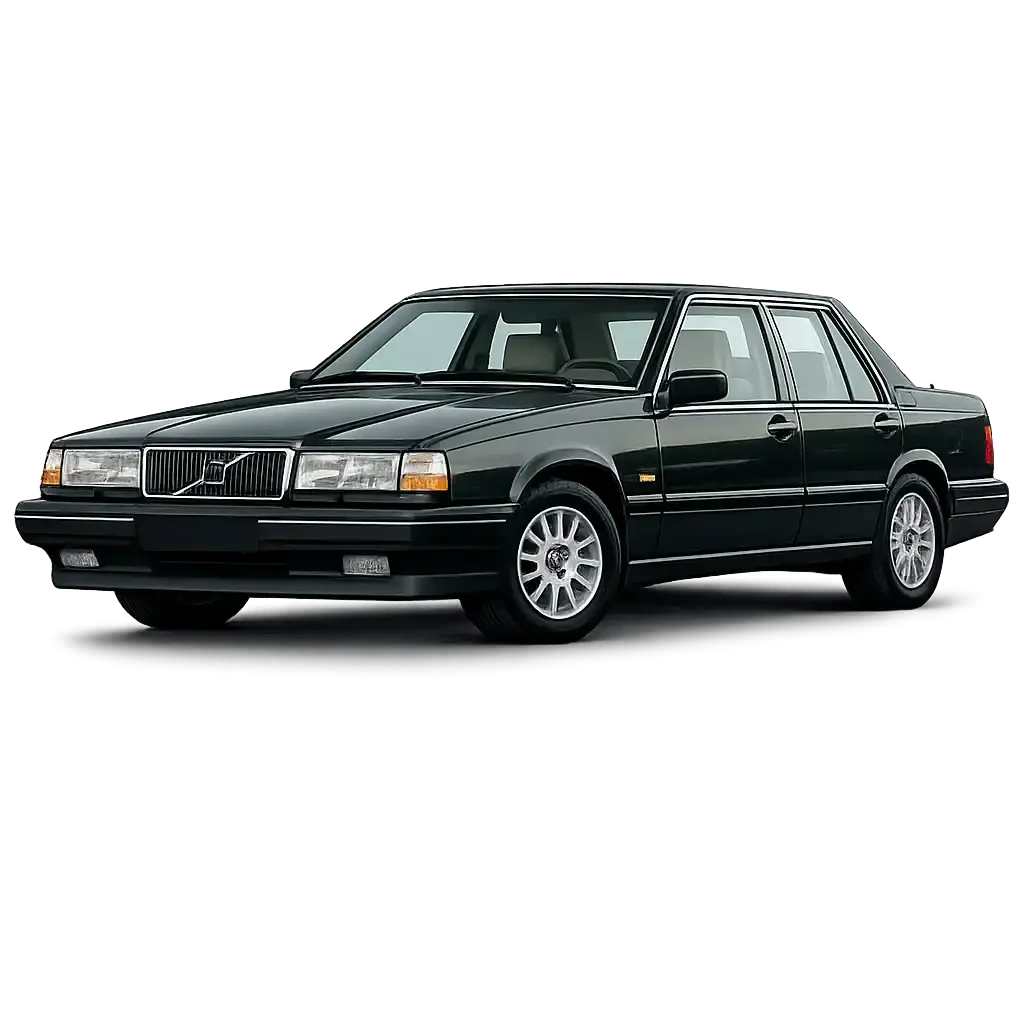
The Volvo 760 received a comprehensive facelift for the 1988 model year that introduced over 2,000 changes, making it effectively a new car underneath the familiar 700-series silhouette. The most significant mechanical change was the introduction of the multilink independent rear suspension (IRS) on sedans, replacing the solid live rear axle used since the 760's 1982 debut. The facelift also brought revised front sheetmetal (including an aluminum hood), aerodynamic headlights with recessed windshield wipers, a new driver-angled dashboard, the Electronic Climate Control (ECC) system, 3-position tilt steering, and a new stereo system. The wagon (765) received most of the interior and front-end updates but retained the solid live rear axle through the end of production. The 760 continued through the 1990 model year before being replaced by the Volvo 960 for 1991. This guide covers the facelift Volvo 760 for the 1988 to 1990 US model years and maps every fitment split required to prevent returns during this final phase of the 760's production. The 760 was built in Kalmar, Sweden; Ghent, Belgium; Halifax, Nova Scotia, Canada; and Clayton, Victoria, Australia.
Generation Overview (Facelift, 1988 to 1990 US Market)
The facelift 760 represented Volvo's effort to modernize its flagship before the eventual transition to the 900 series. The 1988 update was the most significant change to the 760 since its introduction. It brought the 760 closer to the mechanical sophistication of its European competitors while retaining the Volvo identity of safety, durability, and practicality. The same mechanical updates applied to the 780 Coupe (covered in a separate guide). The facelift 760 shared its multilink IRS (sedan) with the 780 and would pass this suspension design forward to the 960.
Year-by-Year Changes (US Market, 1988 to 1990)
1988 Model Year (Major Facelift)
Over 2,000 changes from the pre-1988 760. Revised front sheetmetal: new aluminum hood, new fenders, new grille, aerodynamic headlights replacing the older rectangular units, recessed windshield wipers. Multilink independent rear suspension on sedans replacing the solid live rear axle (wagons retain the live axle). New saddle-type fuel tank required by the IRS (sedan only), reducing fuel capacity by approximately 2 liters. New driver-angled dashboardreplacing the flat-faced pre-1988 layout. New Electronic Climate Control (ECC) with separate controls for A/C, fan speed, airflow direction, and temperature, replacing the single-lever system. 3-position tilt steering. New stereo system. Engines continue: B280F 2.8L PRV V-6 (145 hp) and B230FT 2.3L Redblock turbo-4 (160 hp). Transmissions continue: AW71 automatic, ZF 4HP22 automatic, M46 manual with electric overdrive.
1989 Model Year
The 760 receives the new-generation low-friction B230FT engine with improved turbocharger response (reduced turbo lag by approximately 40%), redesigned exhaust manifold, and improved low and mid-range torque. The turbocharged engine now produces 162 hp (up from 160 hp). The PRV V-6 continues alongside the turbo. New front sheetmetal with slightly smoother bodywork and revised alloy wheels. Leather interior option returns on the 760 Turbo after being dropped in 1986. Power driver's seat standard on equipped models. ABS standard on most 760 models.
1990 Model Year (Final Year)
The final year for the 760 before replacement by the 960. Sedans receive 780-style taillights (replacing the original squared taillights), giving the rear end a more upscale appearance. Minor interior trim changes. The PRV V-6 and B230FT turbo continue. The 760 receives a locking rear differential on some models. Traction control system continues as an option. For 1990, its final year, 760 sedans received the 780-style taillights and minor interior updates. Production of the 760 ended on June 27, 1990, replaced by the Volvo 960 which arrived as a 1991 model year.
Platform and Engineering
Key Platform Facts
• Platform: Volvo 700 series (shared with 740 and 780)
• Architecture: Rear-wheel drive, longitudinal engine, front-mounted
• Body styles: 4-door sedan (764); 5-door wagon/estate (765)
• Assembly: Kalmar, Sweden; Ghent, Belgium; Halifax, Nova Scotia; Clayton, Australia
• Wheelbase: 109.1 inches (277.0 cm)
• Overall length (sedan): 188.2 inches (478.0 cm)
• Overall length (wagon): 188.4 inches (478.5 cm)
• Width: 68.9 inches (175.0 cm)
• Height (sedan): 55.5 inches (141.0 cm)
• Curb weight: Approximately 3,000 to 3,400 lbs depending on engine and body style
• Fuel tank (sedan, 1988+): Approximately 78 liters (20.6 US gallons), saddle-type (required by multilink IRS)
• Fuel tank (wagon): Approximately 80 liters (21.1 US gallons), conventional type (live rear axle)
• Wheel bolt pattern: 5x10⁸
• Tires: 195/60 HR-15 (standard)
Suspension
Front (all facelift models): MacPherson struts with coil springs and anti-roll bar. Shared with the 740 and 780 of the same model year.
Rear (sedan, 1988 to 1990): Multilink independent rear suspension with coil springs and Nivomat automatic self-leveling shock absorbers. This is a 4-link design with upper, lower, trailing, and transverse arms per side. The multilink IRS was introduced on the 760 sedan for 1988 and is the same basic design used on the 780 (1988+) and later the 960 sedan (pre-facelift). Anti-roll bar integrated into the multilink from 1990.
Rear (wagon, 1988 to 1990): Solid (live) rear axle with coil springs and Nivomat self-leveling shocks. The 760 wagon did NOT receive the multilink IRS. Wagons retained the Constant Track solid rear axle through the end of 760 production. This is a critical fitment split: sedan rear suspension components do not fit wagons and vice versa.
Brakes: Power-assisted four-wheel disc brakes with Bosch ABS standard on most models.
Engine Reference (Detailed)
B280F: 2.8L SOHC V-6 (PRV, Even-Fire, 1988 to 1990)
The revised PRV V-6 with even-fire crankshaft and Bosch LH-Jetronic electronic fuel injection, introduced on the 760 for the 1987 model year. This engine solved the chronic camshaft wear problems of the earlier B28F. The B280F continued through the final year of 760 production.
• Type: SOHC V-6, all-aluminum, even-fire crankshaft
• Displacement: 2,849 cc (2.8 liters)
• Bore x stroke: 91 mm x 73 mm
• Compression ratio: 8.8:1
• Fuel injection: Bosch LH-Jetronic (electronic)
• Ignition: Bosch EZ-K electronic ignition
• Power: 145 hp at 5,100 rpm
• Torque: 173 lb-ft at 3,750 rpm
• Timing: Duplex timing chain (not a belt)
B230FT: 2.3L SOHC Inline-4 Turbo (Redblock, 1988 to 1990)
The turbocharged Redblock inline-4 continued through the facelift era with progressive improvements. The engine was updated for 1989 with a new-generation turbocharger that reduced turbo lag by approximately 40%, and again for 1990 with the Generation 3 redesign.
• Type: SOHC inline-4, cast-iron block, aluminum head
• Displacement: 2,316 cc (2.3 liters)
• Bore x stroke: 96 mm x 80 mm
• Compression ratio: 8.7:1
• Fuel injection: Bosch LH-Jetronic (electronic)
• Power (1988): 160 hp (Garrett T3 turbocharger)
• Power (1989): 162 hp (revised turbocharger, improved exhaust manifold)
• Power (1990): 162 hp standard; up to 188 hp with Turbo+ kit on 780 Turbo (the 760 Turbo did not receive the full Turbo+ output)
• Turbocharger: Garrett T3 (1988); revised smaller-turbine unit (1989); Garrett T25 or Mitsubishi TD04H (1990 Generation 3)
• Timing belt interval: 50,000 miles. Interference engine; failure is catastrophic.
Turbocharger generation note: The B230FT used in the 760 went through turbocharger changes across these three years. The 1988 unit uses the original Garrett T3. The 1989 unit uses a revised design for faster spool-up. The 1990 unit may use the Garrett T25 or Mitsubishi TD04H (Generation 3). Oil feed lines, return lines, wastegate actuators, and exhaust manifold connections differ between generations. Always verify the turbocharger on the car before ordering replacement turbo components.
Transmission Reference
AW71 (Aisin-Warner) 4-Speed Automatic
The primary automatic transmission for the facelift 760. Used with both the PRV V-6 and B230FT turbo-4 engines. Heavy-duty 4-speed automatic with overdrive fourth gear.
• Type: 4-speed automatic with overdrive fourth, torque converter
• Fluid: Dexron II ATF
• Identification: No "3" position on shift gate
AW72L (Aisin-Warner) 4-Speed Automatic with Lockup Torque Converter
Some facelift 760 models received the AW72L, which adds a lockup torque converter for improved fuel economy at highway speeds. The AW72L is externally similar to the AW71 but has different internal components including the lockup converter.
• Identification: Check for torque converter lockup operation at highway speed. Internally different from AW71.
ZF 4HP22 4-Speed Automatic
Some facelift 760 models continued with the ZF 4HP22 automatic. Identified by the "3" position on the shift gate. The ZF and Aisin-Warner automatics are completely different transmissions with no parts interchange.
• Identification: "3" position on shift gate = ZF 4HP22
M46 4-Speed Manual with Electric Overdrive
The Volvo/Laycock 4-speed manual with electrically engaged overdrive on 4th gear continued to be available on some facelift 760 Turbo models.
Catalog Accuracy: The Fitment Splits That Matter
The facelift 760 (1988 to 1990) introduced the most significant mechanical change in the 700 series: the multilink IRS on sedans. Combined with the completely revised front end and dashboard, the facelift 760 is effectively a different car from the pre-1988 760 for many component categories. Understanding where the break falls is critical for correct parts ordering.
Split 1: Pre-Facelift (1983 to 1987) vs. Facelift (1988 to 1990)
This is the most important split on the entire 760 production run. The 1988 facelift changed over 2,000 components. Front sheetmetal (hood, fenders, grille, headlights), dashboard, climate control system, and (sedan only) rear suspension are all completely different between pre-1988 and 1988+ models.
• Front sheetmetal: Pre-1988 hood, fenders, grille, headlights do NOT fit 1988+ and vice versa. The 1988+ hood is aluminum; the pre-1988 hood is steel.
• Headlights: Pre-1988 rectangular units vs. 1988+ aerodynamic wrap-around units. Different housings, different wiring.
• Dashboard: Pre-1988 flat-faced dashboard vs. 1988+ driver-angled dashboard. Different instrument cluster, different center console, different wiring harness.
• Climate control: Pre-1988 single-lever system vs. 1988+ Electronic Climate Control (ECC). Completely different systems with different control heads, actuators, and wiring.
• Rear suspension (sedan): Pre-1988 solid live rear axle vs. 1988+ multilink IRS. Zero parts interchange.
• Windshield wipers: Pre-1988 exposed wipers vs. 1988+ recessed wipers. Different wiper arms, different cowl panel.
Split 2: Sedan (Multilink IRS) vs. Wagon (Live Rear Axle)
This is the second most critical split on the facelift 760 and the most commonly overlooked. The sedan received the multilink independent rear suspension for 1988, but the wagon retained the solid live rear axle through the end of 760 production. No rear suspension components interchange between facelift sedan and wagon. The sedan's multilink IRS also required a different (saddle-type) fuel tank, different exhaust routing, and a different rear subframe. The wagon's live axle uses the same basic rear suspension as the pre-1988 760 sedan, but may have different spring rates to accommodate the wagon's higher typical loads.
• Sedan rear: Multilink IRS, saddle-type fuel tank, multilink-specific Nivomat shocks, rear anti-roll bar (1990).
• Wagon rear: Solid live axle, conventional fuel tank, live-axle-specific Nivomat shocks.
• Fuel tanks: Different between sedan (saddle-type, approximately 78 liters) and wagon (conventional, approximately 80 liters). Not interchangeable.
Split 3: PRV V-6 (B280F) vs. Redblock Turbo-4 (B230FT)
Two completely different engine families with zero parts interchange. The PRV V-6 is an all-aluminum 60-degree V-6 designed jointly by Peugeot, Renault, and Volvo. The B230FT is a cast-iron-block inline-4 from Volvo's Redblock family. Everything engine-specific differs: motor mounts, exhaust manifold, intake manifold, fuel injection calibration, accessory drive layout, cooling hose routing, engine wiring harness, and flywheel/flex plate.
• B280F V-6: Available 1988 to 1990. Bosch LH-Jetronic electronic fuel injection, even-fire crankshaft, timing chain. 145 hp.
• B230FT Turbo-4: Available 1988 to 1990. Bosch LH-Jetronic, Garrett/Mitsubishi turbocharger, intercooler, timing belt. 160 to 162 hp.
• Transmission: Both engines use AW71/AW72L/ZF automatics, but with potentially different torque converter specifications. Always specify engine when ordering transmission components.
Split 4: Turbocharger Generation (1988 vs. 1989 vs. 1990)
The B230FT's turbocharger was progressively updated across the three facelift years. The 1988 engine uses the original Garrett T3, the 1989 uses a revised smaller-turbine unit for faster spool-up, and the 1990 uses the Generation 3 Garrett T25 or Mitsubishi TD04H. Oil feed lines, return lines, wastegate actuators, and potentially exhaust manifold connections differ between these generations.
Split 5: AW71 vs. AW72L vs. ZF 4HP22 vs. M46 Manual
Four different transmissions were available across the facelift 760 lineup. The AW71 and AW72L are both Aisin-Warner units but differ internally (the AW72L adds a lockup torque converter). The ZF 4HP22 is a completely different manufacturer's unit. The M46 is a manual with electric overdrive. Each requires different shifter linkage, crossmember, transmission mounts, and driveshaft specifications.
• AW71: No "3" on shift gate, no torque converter lockup.
• AW72L: No "3" on shift gate, with torque converter lockup at highway speed.
• ZF 4HP22: "3" on shift gate. Known oil pump vulnerability. Different manufacturer from AW units.
• M46: 4-speed manual with Laycock electric overdrive on 4th gear.
Split 6: 760 vs. 740 (Shared Mechanicals, Different Trim)
The 740 and 760 continue to share the same basic platform during the facelift era. Both received the revised front sheetmetal for 1988. However, the 740 sedan did NOT receive the multilink IRS; 740 sedans retained the live rear axle throughout production. The 760's premium interior (more wood trim, different gauge cluster, different seats) remains distinct from the 740.
• Shared (740 and 760): Hood, fenders, front bumper, headlights, doors, engines, transmissions, front suspension, brakes, steering, wheels.
• 760-specific: Multilink IRS (sedan only), premium interior trim, specific grille insert, specific rear taillights (1990 sedan gets 780-style taillights).
• Critical: A 760 sedan (1988 to 1990) has multilink IRS. A 740 sedan (all years) has a live rear axle. Do not cross rear suspension components between 760 sedan and 740 sedan.
Split 7: 1990 Sedan Taillights (780-Style) vs. 1988 to 1989
For its final year, the 760 sedan received 780-style taillights, replacing the original squared design. This means 1988 to 1989 sedan taillights are different from 1990 sedan taillights. Wagon taillights were not changed. When ordering taillights for a facelift 760 sedan, always specify 1988 to 1989 or 1990.
Split 8: 760 Facelift vs. 960
The 760 was replaced by the Volvo 960 for the 1991 model year. While the 960 evolved from the 760, it is a substantially different car with a new engine (B6304F Whiteblock inline-6 replacing the PRV V-6), new front sheetmetal, revised interior, and other changes. The 960 sedan retained the multilink IRS from the 760 facelift, and some rear suspension components may interchange between the 760 facelift sedan and the early (pre-facelift) 960 sedan, but this should always be verified by part number. Front sheetmetal, engines, and interior components do NOT interchange between the 760 and 960.
Common Wear Items and Fitment Notes
• PRV V-6 timing chain (B280F): Duplex chain. Chain stretch at high mileage causes timing drift and rough running. The B280F has corrected the camshaft oiling issues of the B28F, but timing chain stretch remains a concern at high mileage.
• Timing belt (B230FT): Interference engine. Replace belt, tensioner, and idler pulleys together at 50,000-mile intervals. Failure is catastrophic.
• Turbocharger (B230FT): Verify turbocharger generation by model year: T3 (1988), revised unit (1989), T25/TD04H (1990). Oil feed and return lines differ between generations.
• Multilink bushings (sedan, 1988+): Rear suspension bushings wear over time, causing vague handling and clunking. These are shared with the 780 (1988+) and the 960 pre-facelift sedan of the same multilink generation.
• Live axle bushings (wagon): Subframe and trailing arm bushings for the wagon's live rear axle. Different parts from the sedan's multilink bushings.
• Nivomat rear shocks: Self-leveling rear shocks. Different part numbers for sedan (multilink IRS) vs. wagon (live axle). Nivomat units cannot be rebuilt; replace as complete assemblies.
• Brake rotors and pads: 4-wheel disc brakes. Shared with the 740 of the same model year for front brakes. Rear brake specifications may differ between sedan (multilink) and wagon (live axle). Verify ABS vs. non-ABS.
• ECC (Electronic Climate Control): The ECC control head and blend door actuators are specific to the facelift 760 (1988+). Not compatible with pre-1988 single-lever systems.
• Dashboard components: The driver-angled dashboard (1988+) uses different components from the pre-1988 flat dashboard. Instrument cluster, center console, and trim panels are different.
• Headlight assemblies: Facelift aerodynamic headlights (1988+) are different from pre-1988 rectangular units. Shared with the 740 facelift (1988+).
• Aluminum hood: The 1988+ hood is aluminum. The pre-1988 hood is steel. They are different parts with different weights and attachment hardware.
• Heater core: Known failure item on 700-series cars. The facelift dashboard change may affect the procedure for heater core replacement compared to pre-1988 models.
Ordering Quick-Reference Checklist
• Model year: 1988, 1989, or 1990?
• Body style: Sedan or wagon? This determines rear suspension type (multilink IRS vs. live axle).
• Engine: B280F PRV V-6 (145 hp) or B230FT Redblock turbo-4 (160 to 162 hp)?
• Turbocharger generation (if turbo): 1988 (T3), 1989 (revised), or 1990 (T25/TD04H Gen 3)?
• Transmission: AW71, AW72L, ZF 4HP22, or M46 manual? Check shift gate for "3" (ZF) or no "3" (AW).
• Pre-facelift vs. facelift: This guide covers facelift (1988 to 1990) only. Verify the car is NOT a pre-1988 model before ordering front sheetmetal, dashboard, or climate control components.
• 760 vs. 740: Verify the customer actually has a 760, not a 740. The 760 sedan has multilink IRS; the 740 sedan has a live axle.
• Taillights (sedan): 1988 to 1989 (original design) or 1990 (780-style)?
• VIN: Always verify by VIN.
Three Questions to Always Ask
• "Sedan or wagon?" This is the single most important question for the facelift 760. The sedan has multilink IRS; the wagon has a solid live rear axle. No rear suspension components interchange between them. The fuel tank is also different (saddle-type for sedan, conventional for wagon). Exhaust routing differs. If you get this wrong, every rear suspension, fuel tank, and exhaust component will be incorrect.
• "V-6 or turbo?" The PRV V-6 and Redblock turbo-4 have zero parts interchange for anything engine-specific. Motor mounts, exhaust manifolds, intake manifolds, fuel injection calibration, accessory drives, and engine wiring all differ. Both were available for all three facelift years (1988 to 1990). Do not assume engine type based on trim level alone.
• "Pre-1988 or 1988+?" The 1988 facelift changed the front sheetmetal, dashboard, climate control, and sedan rear suspension. Pre-1988 and 1988+ parts do not cross for any of these systems. If in doubt, ask about the headlights: pre-1988 has rectangular headlights in a flat grille; 1988+ has aerodynamic wrap-around headlights in a smoother front end with recessed wipers.
Disclaimer: This guide is based on publicly available specifications, Volvo press materials, and independent research. Part interchangeability should always be confirmed via VIN and OEM part number lookup. Specifications may change without notice. This document does not constitute official Volvo parts catalog data. Visuals and illustrations in this article were generated using AI for representative purposes and may not reflect exact technical schematics.