
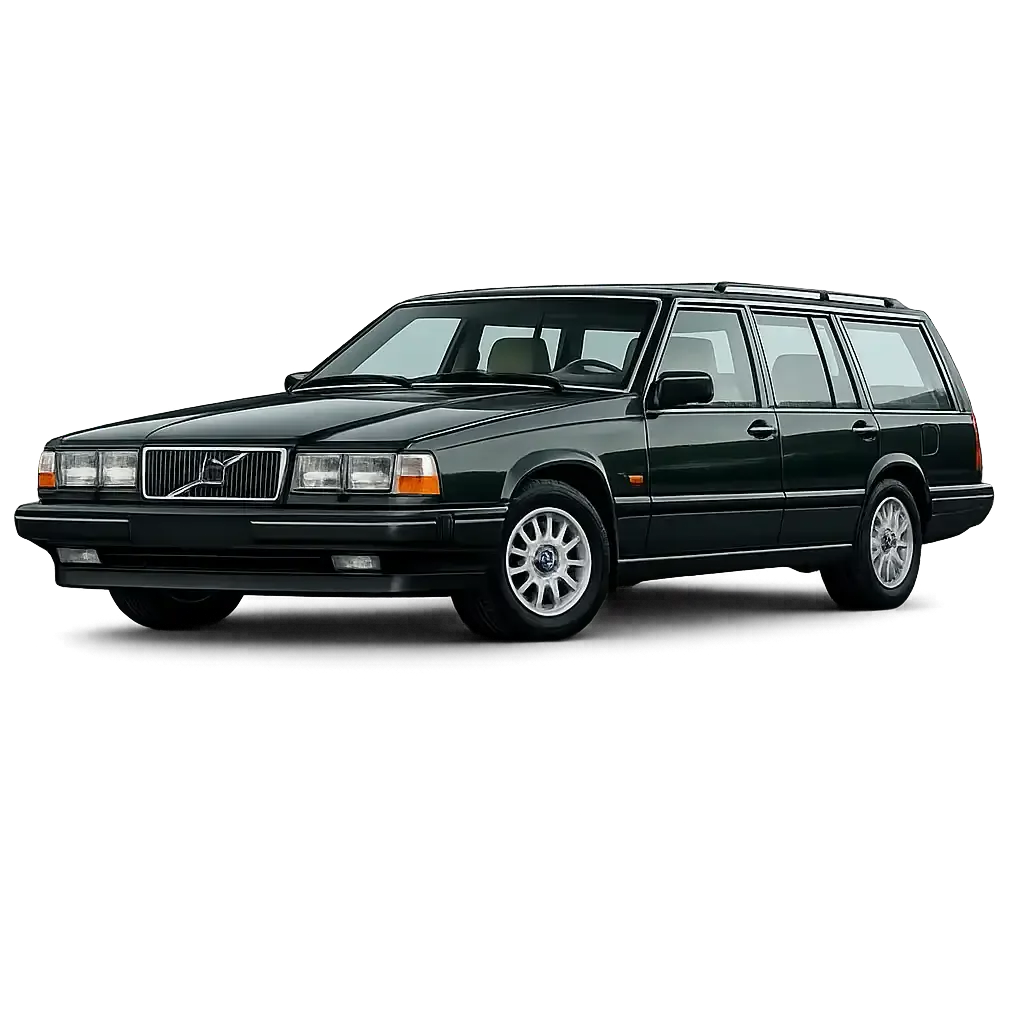
The 1985 Volvo 745 GLE is a 5-door rear-wheel-drive wagon (estate) that debuted in February 1985 at the Toronto and Chicago Auto Shows, marking the first year for the 740-series wagon in the US market. The "745" designation follows Volvo's naming convention: "7" for the 700 generation, "4" for the lower trim tier (below the 760), and "5" for the wagon body style. The GLE trim was the premium level within the 740 range, offering higher equipment than the GL. The 1985 745 GLE is powered exclusively by the B230F 2.3L naturally aspirated Redblock inline-4 producing 114 hp with Bosch LH-Jetronic electronic fuel injection. This is a single-year, single-trim, single-body-style guide. The 1985 model year is the 740 wagon's debut year, and it represents the pre-facelift configuration with the original angular front-end styling, flat dashboard, solid live rear axle, and Constant Track rear suspension shared with the 760 of the same era.
Vehicle Overview
Key Specifications
• Model: 745 GLE (740 wagon, GLE trim)
• Model year: 1985
• Body style: 5-door wagon (estate)
• Platform: Volvo 700 series
• Architecture: Rear-wheel drive, longitudinal engine, front-mounted
• Assembly: Kalmar, Sweden; Ghent, Belgium; or Halifax, Nova Scotia, Canada
• Engine: B230F 2.3L SOHC 8-valve naturally aspirated Redblock inline-4
• Power: 114 hp
• Torque: 136 lb-ft
• Fuel injection: Bosch LH-Jetronic 2.2 electronic fuel injection
• Transmission options: AW71 4-speed automatic or M46 4-speed manual with electric overdrive
• Rear suspension: Constant Track solid (live) rear axle with coil springs and anti-roll bar
• Front suspension: MacPherson struts with coil springs and anti-roll bar
• Brakes: Power-assisted disc brakes front (ventilated), solid disc rear
• ABS: Not standard; optional or not available on 740 GLE for 1985
• Wheelbase: 109.1 inches (277.0 cm)
• Overall length: 188.4 inches (478.5 cm)
• Width: 68.9 inches (175.0 cm)
• Wheel bolt pattern: 5x10⁸
• Tires: 185/70 HR-14 or 195/60 HR-15 depending on wheel option
• Fuel tank: Approximately 80 liters (21.1 US gallons)
• Rear axle fluid: API GL-5 (MIL-L-2105), SAE 90 or 80W/90
• Power steering fluid: ATF type
• Brake fluid: DOT 4
• Engine oil: SAE 15W/40 recommended for severe conditions; 10W/30 or 10W/40 for normal use
Engine Reference
B230F: 2.3L SOHC 8-Valve Inline-4 (Redblock)
The B230F is the sole engine available in the 1985 745 GLE. It is part of Volvo's legendary Redblock engine family, named for the characteristic red paint on the cast-iron block. The B230F was introduced for the 1985 model year as a significant revision of the earlier B23 engine, featuring longer connecting rods (13 mm), an improved crankshaft, reduced internal friction, and a catalytic converter with Lambda Sond (oxygen sensor) for emissions control. The B230F uses Bosch LH-Jetronic 2.2 electronic fuel injection (not the mechanical K-Jetronic used on some V-6 models of the era).
• Type: SOHC, 8-valve, inline-4, cast-iron block, aluminum head
• Displacement: 2,316 cc (2.3 liters)
• Bore x stroke: 96 mm x 80 mm
• Compression ratio: 9.8:1
• Fuel injection: Bosch LH-Jetronic 2.2 (electronic)
• Ignition: Electronic ignition with distributor
• Power: 114 hp
• Torque: 136 lb-ft
• Catalytic converter: Yes, with Lambda Sond oxygen sensor
• Timing belt: Yes. Interference engine. 50,000-mile replacement interval recommended.
• Engine oil capacity: Approximately 4.0 US quarts (3.8 liters) with filter
• Coolant capacity: Approximately 9.5 to 10 quarts (9 to 9.5 liters)
B230F vs. B230FT: The 1985 740 Turbo (also available as a wagon) uses the B230FT, which is the turbocharged version of the same Redblock block. The B230F (NA) and B230FT (turbo) share the same basic block and many external accessories, but the B230FT has lower compression pistons, a turbocharger, intercooler, wastegate, boost plumbing, different exhaust manifold, and a different ECU calibration. Do not interchange turbo-specific components (intake manifold, exhaust manifold, ECU) between the B230F and B230FT.
Transmission Reference
AW71 (Aisin-Warner) 4-Speed Automatic
The primary automatic transmission for the 1985 745 GLE. A heavy-duty 4-speed automatic with overdrive fourth gear.
• Type: 4-speed automatic with overdrive fourth, torque converter
• Fluid: Dexron II ATF
• Identification: No "3" position on shift gate (if "3" is present, it is a ZF 4HP22)
M46 4-Speed Manual with Electric Overdrive
Available on the 1985 745 GLE as an alternative to the automatic. A 4-speed manual gearbox with a Laycock de Normanville J-type electrically engaged overdrive on 4th gear, effectively creating a 5th gear for highway cruising.
• Type: 4-speed manual with electric overdrive engaged on 4th gear
• Overdrive engagement: Dashboard switch or automatic engagement at highway speed
• Fluid: ATF type
Transmission identification: If the car has a stick shift, it is the M46. If automatic with no "3" on the gate, it is the AW71. If automatic with "3" on the gate, it is a ZF 4HP22 (some 740/760 models received the ZF unit). These are completely different transmissions with no parts interchange between them.
Catalog Accuracy: The Fitment Splits That Matter
Even though this guide covers a single model year, single body style, and single trim, the 1985 745 GLE still has meaningful fitment splits that cause returns when catalogs get them wrong. The primary risks are confusing the 745 GLE with the 745 Turbo, the 744 sedan, the 760 (765 wagon), or later facelift models.
Split 1: 745 GLE (B230F NA) vs. 745 Turbo (B230FT)
The 1985 740 wagon was available as both the 745 GLE (naturally aspirated B230F, 114 hp) and the 745 Turbo (turbocharged B230FT, 160 hp). Parts catalogs that list "1985 745" without specifying GLE or Turbo will cause confusion on anything engine-specific. The B230F and B230FT share the same basic Redblock block but differ in: compression ratio (9.8:1 NA vs. 8.7:1 turbo), exhaust manifold (standard vs. turbo manifold with wastegate), intake plumbing (standard vs. intercooler and boost tubes), ECU calibration (NA vs. turbo mapping), and various sensors. External accessories like the alternator, power steering pump, and water pump are generally shared.
Split 2: 745 Wagon vs. 744 Sedan
The 745 wagon and 744 sedan share everything from the B-pillar forward: hood, fenders, front bumper, headlights, doors, engine, transmission, front suspension, rear axle assembly, brakes, steering, dashboard, and front seats. From the B-pillar back, they are completely different vehicles: different roof, rear quarter panels, C-pillar, tailgate (wagon) vs. trunk lid (sedan), taillights, rear bumper, rear glass, rear wiper (wagon only), rear seat configuration, cargo area, and rear body wiring harness.
Split 3: 740 (745) vs. 760 (765) Wagon
The 1985 765 (760 wagon) was also introduced the same year. The 745 and 765 wagons share the same basic platform, wheelbase, and wagon body from the B-pillar back. The distinction is primarily in trim level and available engines: the 765 could be equipped with the PRV V-6 or the turbodiesel in addition to the Redblock-4, while the 745 GLE was Redblock-4 only. Front sheetmetal is shared. Interior trim differs (760 has more wood, different gauge cluster inserts, higher equipment levels). The grille insert may differ between 740 and 760.
• Shared (745 and 765 wagon): Hood, fenders, doors, wagon body from B-pillar back (roof, tailgate, rear quarter panels, rear glass, taillights), rear axle assembly, front suspension, brakes, steering, wheels.
• Not shared: Engine (if V-6 760 vs. inline-4 740), grille insert, interior trim, gauge cluster inserts, seat materials.
Split 4: AW71 Automatic vs. M46 Manual
Two different transmissions with no parts interchange. The AW71 uses a torque converter and flex plate; the M46 uses a flywheel, clutch, and pressure plate. Shifter linkage, console, pedal assembly, and driveshaft specifications differ. Always verify which transmission the car has.
Split 5: 1985 (Pre-Facelift) vs. 1988+ (Facelift)
The 1985 745 GLE is a pre-facelift model with the original angular headlights, exposed windshield wipers, flat dashboard, and single-lever climate control. The 1988 facelift introduced over 2,000 changes including aerodynamic headlights, recessed wipers, driver-angled dashboard, and Electronic Climate Control. Pre-1988 and 1988+ front sheetmetal, dashboards, and climate controls do NOT interchange. The wagon body from the B-pillar back is largely consistent between pre-facelift and facelift models, but always verify by part number because minor revisions were common. Note that unlike the 760 sedan, the 740 wagon (745) retained the solid live rear axle through the end of production; there was never a multilink IRS on any 740 model.
Split 6: Wiring Harness Condition (Pre-1987 Concern)
The 1985 745 falls within the pre-1987 wiring harness deterioration window. Early 700-series cars (1983 to 1986) are known for wiring harness insulation that becomes brittle and crumbles with age, particularly in the engine compartment where heat accelerates degradation. This is a known issue documented by Volvo specialists. Brittle wiring causes intermittent electrical faults, sensor failures, and hard-to-diagnose driveability problems. When ordering replacement sensors or electrical components for a 1985 745, the underlying issue may be damaged wiring rather than a failed component. If the customer reports multiple electrical gremlins, recommend a wiring harness inspection before replacing individual sensors.
Split 7: 14-Inch vs. 15-Inch Wheels
The 1985 745 GLE could be equipped with either 14-inch or 15-inch wheels depending on options. Tire specifications differ: 185/70 HR-14 for the 14-inch wheels or 195/60 HR-15 for the 15-inch wheels. Brake rotors are the same regardless of wheel size, but wheel center caps, lug nut covers, and hubcaps are wheel-size-specific. Always verify wheel size before ordering tires or wheel accessories.
Split 8: Assembly Plant Variations
The 1985 745 GLE could have been assembled in Kalmar (Sweden), Ghent (Belgium), or Halifax (Nova Scotia, Canada). While the mechanical specifications are the same regardless of assembly plant, minor differences in trim, options packages, and optional equipment availability have been documented between plants. The assembly plant can be identified from the VIN. Some parts availability or NVH characteristics may vary slightly between plants due to different supplier sourcing for trim components.
Common Wear Items and Fitment Notes
• Timing belt: The B230F is an interference engine. Replace belt, tensioner, and idler pulleys together at 50,000-mile intervals. Failure causes catastrophic valve damage. The timing belt system is shared with the B230FT turbo engine.
• Wiring harness: Pre-1987 engine compartment wiring is known to deteriorate. Inspect before blaming individual sensors for electrical faults.
• Fuel injection (LH-Jetronic): The mass airflow sensor, fuel pressure regulator, and cold start injector are common failure items. Verify B230F (NA) specification; do not order B230FT (turbo) fuel injection components.
• Rear axle bushings: Solid rear axle subframe and trailing arm bushings wear over time, causing vague handling and clunking. Shared with all 700-series models using the live rear axle (all 740s, pre-1988 760 sedans, all 760 wagons).
• Front struts: MacPherson strut design shared with the 744 sedan and 760 of the same model year.
• Brake rotors and pads: 4-wheel disc brakes. Shared with the 744 sedan and generally shared with the 760 of the same year. Verify ABS vs. non-ABS if applicable.
• Heater core: Known failure item on 700-series cars. Replacement requires significant dashboard work. Shared between 744 sedan and 745 wagon.
• Power window regulators: Cable-type mechanisms that fail with age. Shared with 744 sedan of the same model year.
• Overdrive solenoid (M46): If the car has the M46 manual transmission, the electric overdrive solenoid is a common failure item. Symptoms: overdrive does not engage, or engages and disengages intermittently.
• Tailgate struts (wagon): Gas-charged struts that support the rear tailgate. These weaken over time and allow the tailgate to fall. 745-specific (not shared with 744 sedan for obvious reasons). May be shared with the 765 wagon.
• Rear cargo area trim: 745 wagon-specific. Not shared with the 744 sedan. May be shared with the 765 wagon depending on trim level.
• Distributor cap and rotor: Common maintenance item. The distributor is shared across all B230F and B230FT applications in the 700 series.
Ordering Quick-Reference Checklist
• Confirm: 1985 model year, 745 wagon body, GLE trim level
• Engine: B230F 2.3L NA (114 hp). NOT the B230FT turbo.
• Transmission: AW71 automatic or M46 manual with overdrive?
• Wheel size: 14-inch or 15-inch?
• Body part: sedan or wagon? Confirm the part is for the 745 wagon, not the 744 sedan. From the B-pillar back, they are different vehicles.
• Pre-facelift: The 1985 is pre-facelift. Do not order 1988+ facelift components (headlights, dashboard, grille, hood).
• GLE vs. Turbo: The GLE is naturally aspirated. Verify engine-specific parts are for the B230F, not the B230FT.
• ABS: Verify if equipped. Affects brake master cylinder and line routing.
• VIN: Always verify by VIN.
Three Questions to Always Ask
• "GLE or Turbo?" The 1985 740 wagon was available in both GLE (B230F NA, 114 hp) and Turbo (B230FT, 160 hp) trims. A parts listing for "1985 745" without specifying the engine will cause errors on anything engine-specific: exhaust manifold, intake plumbing, ECU, turbo-related components, and some sensors. The GLE is naturally aspirated; the Turbo has the turbocharger, intercooler, and all associated hardware.
• "Wagon or sedan?" The 745 is the wagon; the 744 is the sedan. From the B-pillar forward they are essentially identical. From the B-pillar back, completely different. Taillights, tailgate vs. trunk, rear glass, rear wiper, cargo trim, and rear body wiring all differ. Confirm the customer actually has a wagon before ordering any rear body component.
• "Automatic or manual?" The AW71 automatic and M46 manual are completely different transmissions. This affects the shifter, console, pedal assembly, flywheel vs. flex plate, and driveshaft. The quickest identification: stick shift = M46 manual; automatic gear selector = AW71 (or ZF if "3" appears on the shift gate).
Disclaimer: This guide is based on publicly available specifications, Volvo press materials, and independent research. Part interchangeability should always be confirmed via VIN and OEM part number lookup. Specifications may change without notice. This document does not constitute official The 1985 Volvo 745 GLE is a 5-door rear-wheel-drive wagon (estate) that debuted in February 1985 at the Toronto and Chicago Auto Shows, marking the first year for the 740-series wagon in the US market. The "745" designation follows Volvo's naming convention: "7" for the 700 generation, "4" for the lower trim tier (below the 760), and "5" for the wagon body style. The GLE trim was the premium level within the 740 range, offering higher equipment than the GL. The 1985 745 GLE is powered exclusively by the B230F 2.3L naturally aspirated Redblock inline-4 producing 114 hp with Bosch LH-Jetronic electronic fuel injection. This is a single-year, single-trim, single-body-style guide. The 1985 model year is the 740 wagon's debut year, and it represents the pre-facelift configuration with the original angular front-end styling, flat dashboard, solid live rear axle, and Constant Track rear suspension shared with the 760 of the same era.
Vehicle Overview
Key Specifications
• Model: 745 GLE (740 wagon, GLE trim)
• Model year: 1985
• Body style: 5-door wagon (estate)
• Platform: Volvo 700 series
• Architecture: Rear-wheel drive, longitudinal engine, front-mounted
• Assembly: Kalmar, Sweden; Ghent, Belgium; or Halifax, Nova Scotia, Canada
• Engine: B230F 2.3L SOHC 8-valve naturally aspirated Redblock inline-4
• Power: 114 hp
• Torque: 136 lb-ft
• Fuel injection: Bosch LH-Jetronic 2.2 electronic fuel injection
• Transmission options: AW71 4-speed automatic or M46 4-speed manual with electric overdrive
• Rear suspension: Constant Track solid (live) rear axle with coil springs and anti-roll bar
• Front suspension: MacPherson struts with coil springs and anti-roll bar
• Brakes: Power-assisted disc brakes front (ventilated), solid disc rear
• ABS: Not standard; optional or not available on 740 GLE for 1985
• Wheelbase: 109.1 inches (277.0 cm)
• Overall length: 188.4 inches (478.5 cm)
• Width: 68.9 inches (175.0 cm)
• Wheel bolt pattern: 5x10⁸
• Tires: 185/70 HR-14 or 195/60 HR-15 depending on wheel option
• Fuel tank: Approximately 80 liters (21.1 US gallons)
• Rear axle fluid: API GL-5 (MIL-L-2105), SAE 90 or 80W/90
• Power steering fluid: ATF type
• Brake fluid: DOT 4
• Engine oil: SAE 15W/40 recommended for severe conditions; 10W/30 or 10W/40 for normal use
Engine Reference
B230F: 2.3L SOHC 8-Valve Inline-4 (Redblock)
The B230F is the sole engine available in the 1985 745 GLE. It is part of Volvo's legendary Redblock engine family, named for the characteristic red paint on the cast-iron block. The B230F was introduced for the 1985 model year as a significant revision of the earlier B23 engine, featuring longer connecting rods (13 mm), an improved crankshaft, reduced internal friction, and a catalytic converter with Lambda Sond (oxygen sensor) for emissions control. The B230F uses Bosch LH-Jetronic 2.2 electronic fuel injection (not the mechanical K-Jetronic used on some V-6 models of the era).
• Type: SOHC, 8-valve, inline-4, cast-iron block, aluminum head
• Displacement: 2,316 cc (2.3 liters)
• Bore x stroke: 96 mm x 80 mm
• Compression ratio: 9.8:1
• Fuel injection: Bosch LH-Jetronic 2.2 (electronic)
• Ignition: Electronic ignition with distributor
• Power: 114 hp
• Torque: 136 lb-ft
• Catalytic converter: Yes, with Lambda Sond oxygen sensor
• Timing belt: Yes. Interference engine. 50,000-mile replacement interval recommended.
• Engine oil capacity: Approximately 4.0 US quarts (3.8 liters) with filter
• Coolant capacity: Approximately 9.5 to 10 quarts (9 to 9.5 liters)
B230F vs. B230FT: The 1985 740 Turbo (also available as a wagon) uses the B230FT, which is the turbocharged version of the same Redblock block. The B230F (NA) and B230FT (turbo) share the same basic block and many external accessories, but the B230FT has lower compression pistons, a turbocharger, intercooler, wastegate, boost plumbing, different exhaust manifold, and a different ECU calibration. Do not interchange turbo-specific components (intake manifold, exhaust manifold, ECU) between the B230F and B230FT.
Transmission Reference
AW71 (Aisin-Warner) 4-Speed Automatic
The primary automatic transmission for the 1985 745 GLE. A heavy-duty 4-speed automatic with overdrive fourth gear.
• Type: 4-speed automatic with overdrive fourth, torque converter
• Fluid: Dexron II ATF
• Identification: No "3" position on shift gate (if "3" is present, it is a ZF 4HP22)
M46 4-Speed Manual with Electric Overdrive
Available on the 1985 745 GLE as an alternative to the automatic. A 4-speed manual gearbox with a Laycock de Normanville J-type electrically engaged overdrive on 4th gear, effectively creating a 5th gear for highway cruising.
• Type: 4-speed manual with electric overdrive engaged on 4th gear
• Overdrive engagement: Dashboard switch or automatic engagement at highway speed
• Fluid: ATF type
Transmission identification: If the car has a stick shift, it is the M46. If automatic with no "3" on the gate, it is the AW71. If automatic with "3" on the gate, it is a ZF 4HP22 (some 740/760 models received the ZF unit). These are completely different transmissions with no parts interchange between them.
Catalog Accuracy: The Fitment Splits That Matter
Even though this guide covers a single model year, single body style, and single trim, the 1985 745 GLE still has meaningful fitment splits that cause returns when catalogs get them wrong. The primary risks are confusing the 745 GLE with the 745 Turbo, the 744 sedan, the 760 (765 wagon), or later facelift models.
Split 1: 745 GLE (B230F NA) vs. 745 Turbo (B230FT)
The 1985 740 wagon was available as both the 745 GLE (naturally aspirated B230F, 114 hp) and the 745 Turbo (turbocharged B230FT, 160 hp). Parts catalogs that list "1985 745" without specifying GLE or Turbo will cause confusion on anything engine-specific. The B230F and B230FT share the same basic Redblock block but differ in: compression ratio (9.8:1 NA vs. 8.7:1 turbo), exhaust manifold (standard vs. turbo manifold with wastegate), intake plumbing (standard vs. intercooler and boost tubes), ECU calibration (NA vs. turbo mapping), and various sensors. External accessories like the alternator, power steering pump, and water pump are generally shared.
Split 2: 745 Wagon vs. 744 Sedan
The 745 wagon and 744 sedan share everything from the B-pillar forward: hood, fenders, front bumper, headlights, doors, engine, transmission, front suspension, rear axle assembly, brakes, steering, dashboard, and front seats. From the B-pillar back, they are completely different vehicles: different roof, rear quarter panels, C-pillar, tailgate (wagon) vs. trunk lid (sedan), taillights, rear bumper, rear glass, rear wiper (wagon only), rear seat configuration, cargo area, and rear body wiring harness.
Split 3: 740 (745) vs. 760 (765) Wagon
The 1985 765 (760 wagon) was also introduced the same year. The 745 and 765 wagons share the same basic platform, wheelbase, and wagon body from the B-pillar back. The distinction is primarily in trim level and available engines: the 765 could be equipped with the PRV V-6 or the turbodiesel in addition to the Redblock-4, while the 745 GLE was Redblock-4 only. Front sheetmetal is shared. Interior trim differs (760 has more wood, different gauge cluster inserts, higher equipment levels). The grille insert may differ between 740 and 760.
• Shared (745 and 765 wagon): Hood, fenders, doors, wagon body from B-pillar back (roof, tailgate, rear quarter panels, rear glass, taillights), rear axle assembly, front suspension, brakes, steering, wheels.
• Not shared: Engine (if V-6 760 vs. inline-4 740), grille insert, interior trim, gauge cluster inserts, seat materials.
Split 4: AW71 Automatic vs. M46 Manual
Two different transmissions with no parts interchange. The AW71 uses a torque converter and flex plate; the M46 uses a flywheel, clutch, and pressure plate. Shifter linkage, console, pedal assembly, and driveshaft specifications differ. Always verify which transmission the car has.
Split 5: 1985 (Pre-Facelift) vs. 1988+ (Facelift)
The 1985 745 GLE is a pre-facelift model with the original angular headlights, exposed windshield wipers, flat dashboard, and single-lever climate control. The 1988 facelift introduced over 2,000 changes including aerodynamic headlights, recessed wipers, driver-angled dashboard, and Electronic Climate Control. Pre-1988 and 1988+ front sheetmetal, dashboards, and climate controls do NOT interchange. The wagon body from the B-pillar back is largely consistent between pre-facelift and facelift models, but always verify by part number because minor revisions were common. Note that unlike the 760 sedan, the 740 wagon (745) retained the solid live rear axle through the end of production; there was never a multilink IRS on any 740 model.
Split 6: Wiring Harness Condition (Pre-1987 Concern)
The 1985 745 falls within the pre-1987 wiring harness deterioration window. Early 700-series cars (1983 to 1986) are known for wiring harness insulation that becomes brittle and crumbles with age, particularly in the engine compartment where heat accelerates degradation. This is a known issue documented by Volvo specialists. Brittle wiring causes intermittent electrical faults, sensor failures, and hard-to-diagnose driveability problems. When ordering replacement sensors or electrical components for a 1985 745, the underlying issue may be damaged wiring rather than a failed component. If the customer reports multiple electrical gremlins, recommend a wiring harness inspection before replacing individual sensors.
Split 7: 14-Inch vs. 15-Inch Wheels
The 1985 745 GLE could be equipped with either 14-inch or 15-inch wheels depending on options. Tire specifications differ: 185/70 HR-14 for the 14-inch wheels or 195/60 HR-15 for the 15-inch wheels. Brake rotors are the same regardless of wheel size, but wheel center caps, lug nut covers, and hubcaps are wheel-size-specific. Always verify wheel size before ordering tires or wheel accessories.
Split 8: Assembly Plant Variations
The 1985 745 GLE could have been assembled in Kalmar (Sweden), Ghent (Belgium), or Halifax (Nova Scotia, Canada). While the mechanical specifications are the same regardless of assembly plant, minor differences in trim, options packages, and optional equipment availability have been documented between plants. The assembly plant can be identified from the VIN. Some parts availability or NVH characteristics may vary slightly between plants due to different supplier sourcing for trim components.
Common Wear Items and Fitment Notes
• Timing belt: The B230F is an interference engine. Replace belt, tensioner, and idler pulleys together at 50,000-mile intervals. Failure causes catastrophic valve damage. The timing belt system is shared with the B230FT turbo engine.
• Wiring harness: Pre-1987 engine compartment wiring is known to deteriorate. Inspect before blaming individual sensors for electrical faults.
• Fuel injection (LH-Jetronic): The mass airflow sensor, fuel pressure regulator, and cold start injector are common failure items. Verify B230F (NA) specification; do not order B230FT (turbo) fuel injection components.
• Rear axle bushings: Solid rear axle subframe and trailing arm bushings wear over time, causing vague handling and clunking. Shared with all 700-series models using the live rear axle (all 740s, pre-1988 760 sedans, all 760 wagons).
• Front struts: MacPherson strut design shared with the 744 sedan and 760 of the same model year.
• Brake rotors and pads: 4-wheel disc brakes. Shared with the 744 sedan and generally shared with the 760 of the same year. Verify ABS vs. non-ABS if applicable.
• Heater core: Known failure item on 700-series cars. Replacement requires significant dashboard work. Shared between 744 sedan and 745 wagon.
• Power window regulators: Cable-type mechanisms that fail with age. Shared with 744 sedan of the same model year.
• Overdrive solenoid (M46): If the car has the M46 manual transmission, the electric overdrive solenoid is a common failure item. Symptoms: overdrive does not engage, or engages and disengages intermittently.
• Tailgate struts (wagon): Gas-charged struts that support the rear tailgate. These weaken over time and allow the tailgate to fall. 745-specific (not shared with 744 sedan for obvious reasons). May be shared with the 765 wagon.
• Rear cargo area trim: 745 wagon-specific. Not shared with the 744 sedan. May be shared with the 765 wagon depending on trim level.
• Distributor cap and rotor: Common maintenance item. The distributor is shared across all B230F and B230FT applications in the 700 series.
Ordering Quick-Reference Checklist
• Confirm: 1985 model year, 745 wagon body, GLE trim level
• Engine: B230F 2.3L NA (114 hp). NOT the B230FT turbo.
• Transmission: AW71 automatic or M46 manual with overdrive?
• Wheel size: 14-inch or 15-inch?
• Body part: sedan or wagon? Confirm the part is for the 745 wagon, not the 744 sedan. From the B-pillar back, they are different vehicles.
• Pre-facelift: The 1985 is pre-facelift. Do not order 1988+ facelift components (headlights, dashboard, grille, hood).
• GLE vs. Turbo: The GLE is naturally aspirated. Verify engine-specific parts are for the B230F, not the B230FT.
• ABS: Verify if equipped. Affects brake master cylinder and line routing.
• VIN: Always verify by VIN.
Three Questions to Always Ask
• "GLE or Turbo?" The 1985 740 wagon was available in both GLE (B230F NA, 114 hp) and Turbo (B230FT, 160 hp) trims. A parts listing for "1985 745" without specifying the engine will cause errors on anything engine-specific: exhaust manifold, intake plumbing, ECU, turbo-related components, and some sensors. The GLE is naturally aspirated; the Turbo has the turbocharger, intercooler, and all associated hardware.
• "Wagon or sedan?" The 745 is the wagon; the 744 is the sedan. From the B-pillar forward they are essentially identical. From the B-pillar back, completely different. Taillights, tailgate vs. trunk, rear glass, rear wiper, cargo trim, and rear body wiring all differ. Confirm the customer actually has a wagon before ordering any rear body component.
• "Automatic or manual?" The AW71 automatic and M46 manual are completely different transmissions. This affects the shifter, console, pedal assembly, flywheel vs. flex plate, and driveshaft. The quickest identification: stick shift = M46 manual; automatic gear selector = AW71 (or ZF if "3" appears on the shift gate).
Disclaimer: This guide is based on publicly available specifications, Volvo press materials, and independent research. Part interchangeability should always be confirmed via VIN and OEM part number lookup. Specifications may change without notice. This document does not constitute official Volvo parts catalog data. Visuals and illustrations in this article were generated using AI for representative purposes and may not reflect exact technical schematics. parts catalog data. Visuals and illustrations in this article were generated using AI for representative purposes and may not reflect exact technical schematics.