
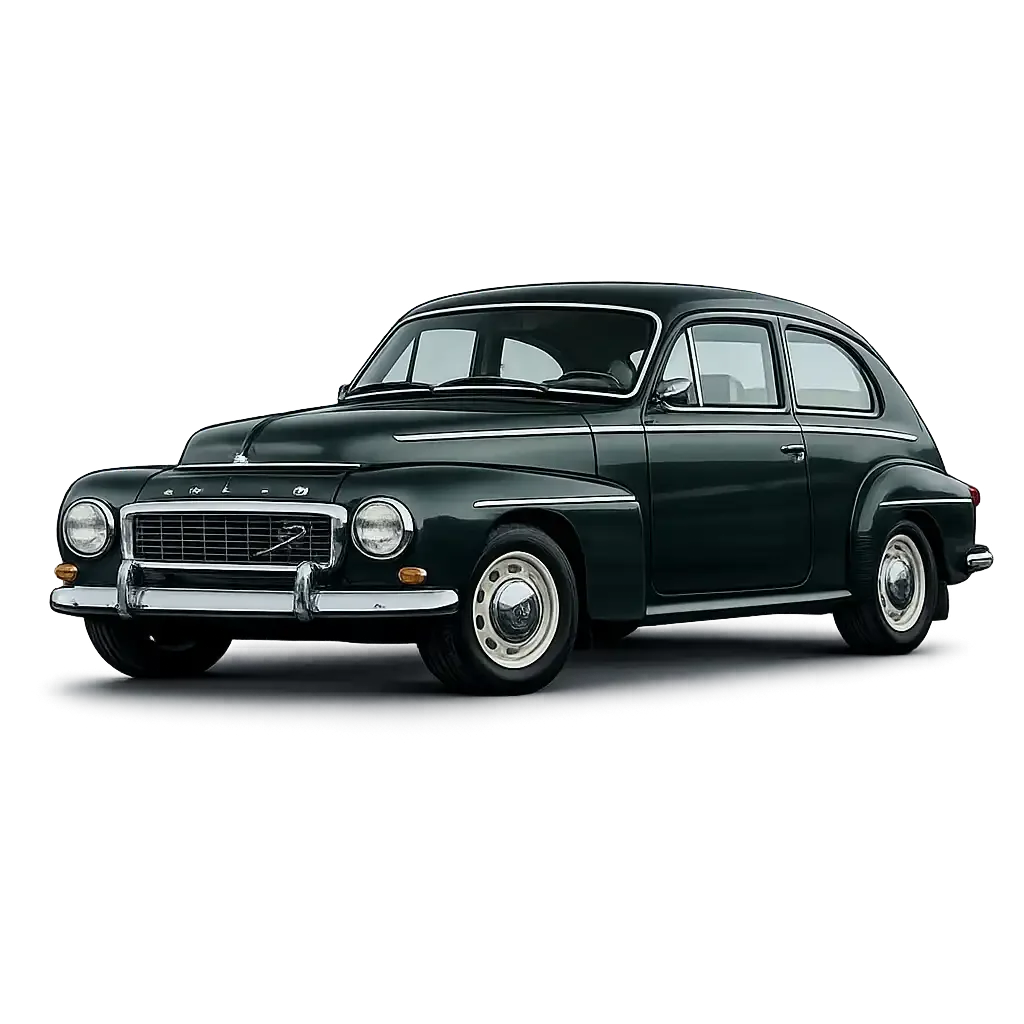
The Volvo PV544 is a 2-door, 5-passenger fastback sedan produced from August 1958 to 1965, succeeding the PV444 (1947 to 1958). The PV544 was introduced as a modernized version of the PV444, featuring a curved one-piece windshield replacing the earlier two-piece flat glass, larger taillights, a padded dashboard, a ribbon-type speedometer, wider rear seating, and an available 4-speed manual gearbox. Volvo designated the PV544 in sequential model variants: A, B, C, D, E, F, and G, each representing a production series with incremental changes. The most significant mechanical change occurred in 1962 (C-model) when the B16 engine family was replaced by the new B18 engine (originally developed for the P1800 sports car) and the electrical system was upgraded from 6-volt to 12-volt. Total production: 243,990 PV544 units (combined with the PV444, approximately 440,000 units over the 18-year PV run). The PV544 was also the basis for the Duett estate/wagon (P445, later P210). Assembly: Gothenburg, Sweden, and from 1963, Dartmouth/Halifax, Nova Scotia, Canada (Volvo's first plant outside Sweden). The PV544 was one of the most successful rally cars of its era, memorably winning the Safari Rally in 1965.
Generation Overview and Model Variants
Volvo designated PV544 production variants with letter suffixes A through G. Each variant represents a distinct production series with specific mechanical and trim changes. Parts catalogs for the PV544 are organized by these variant letters, making correct identification essential for accurate parts ordering.
PV544 Variant Timeline
PV544 A (August 1958 to 1960)
The launch variant. B16 engine family: B16A single downdraft SU carburetor (60 hp) for standard models; B16B twin side-draft SU carburetors (85 hp) for Sport models. 6-volt electrical system. 3-speed (M30) or 4-speed (M40) manual transmission. Hydraulic drum brakes on all four wheels. Curved one-piece windshield (new vs. PV444's two-piece flat glass). Padded dashboard upper half. Ribbon-type speedometer. Handbrake lever relocated from under-dash to between seats. US market designation: 54408 (B16B engine, 4-speed) and 54409 (B16B engine, 3-speed).
PV544 B (August 1960 to 1961)
New upholstery and revised rear seat sides. Near-fully-synchronized gearboxes: M30 (3-speed) and M40 (4-speed). B16A and B16B engines continue. 6-volt electrical system. Approximately 34,600 units produced.
PV544 C (1962)
The most significant change in PV544 production. The B16 engine family is retired and replaced by the B18 engine (1,778 cc), originally developed for the P1800 sports car. The B18 has 5 main bearings (vs. 3 on the B16). Single Zenith carburetor version: B18A (75 hp); twin SU carburetor version: B18D (90 hp). Electrical system upgraded from 6-volt to 12-volt. Headlights made asymmetrical with front turn signals relocated further out on the fenders. Available in three Swedish trim levels: Favorit, Special, and Sport.
PV544 D (1963)
Production begins at Volvo's new Dartmouth/Halifax, Nova Scotia plant (first Volvo assembly outside Sweden). Minor interior revisions. B18A and B18D engines continue. 12-volt electrical system.
PV544 E (1964)
Non-reusable air filter introduced. New valve cap with oil cap relocated from center to front position. New interior plastics and inner roof lining. Larger control lights with green instrument illumination. Tire dimension changed from 5.90-15 to 6.00-15. Approximately 24,200 units produced.
PV544 F (1964 to 1965)
New silver-colored wheels with oval cooling holes. "B18" engine emblems removed; new emblems placed on grille, sides, and rear. New hubcaps with black center field featuring a "V." Radiator cooling curtain ("blind") deleted. Approximately 17,300 units produced.
PV544 G (1965, Final Year)
The final PV544 variant. Sport engine upgraded to 95 hp (up from 90 hp). Sport model receives radial tires (165-15)replacing the earlier bias-ply tires. Minor trim changes. Disc brakes offered for competition purposes. Ventilated wheels for better brake cooling. Production ends 1965. The PV544 was presented as a 1966 model in August 1965 before final discontinuation.
Platform and Engineering
Key Platform Facts
• Body: 2-door fastback sedan, unitary (monocoque) construction
• Architecture: Rear-wheel drive, longitudinal engine, front-mounted
• Front suspension: Independent, coil springs, telescopic shock absorbers
• Rear suspension: Live (solid) rear axle (Spicer), coil springs
• Steering: Cam and roller (Gemmer type)
• Brakes: Hydraulic drums on all four wheels (disc brakes offered for competition on late models)
• Wheelbase: 102.4 inches (260 cm)
• Tire size (early): 5.90-15 (A through D models)
• Tire size (E/F): 6.00-15
• Tire size (G Sport): 165-15 radial
• Propeller shaft: One-piece
• Total production: 243,990 units (PV544 only)
Engine Reference (Detailed)
B16A: 1.6L Inline-4, Single Carburetor (1958 to 1961)
The standard-output engine for non-Sport PV544 models during the B16 era.
• Displacement: 1,583 cc (1.6 liters)
• Bore x stroke: 79.37 mm x 80 mm
• Carburetion: Single downdraft SU carburetor
• Power: 60 hp at 4,500 rpm
• Main bearings: 3
• Electrical system: 6-volt
B16B: 1.6L Inline-4, Twin Carburetors (1958 to 1961)
The Sport/performance engine with twin SU carburetors. Standard on US-market PV544s.
• Displacement: 1,583 cc (1.6 liters)
• Bore x stroke: 79.37 mm x 80 mm
• Carburetion: Twin side-draft SU carburetors
• Power: 85 hp at 5,500 rpm
• Main bearings: 3
• Electrical system: 6-volt
B18A: 1.8L Inline-4, Single Carburetor (1962 to 1965)
The standard-output B18 engine. A major upgrade over the B16, with 5 main bearings for improved durability and smoothness.
• Displacement: 1,778 cc (1.8 liters)
• Bore x stroke: 84.14 mm x 80 mm
• Compression ratio: 8.5:1
• Carburetion: Single Zenith carburetor
• Power: 75 hp at 4,500 rpm
• Main bearings: 5
• Electrical system: 12-volt
B18D: 1.8L Inline-4, Twin Carburetors (1962 to 1965)
The Sport/performance B18 engine with twin SU carburetors. Used in PV544 Sport models and standard on most US-market cars.
• Displacement: 1,778 cc (1.8 liters)
• Bore x stroke: 84.14 mm x 80 mm
• Compression ratio: 9.5:1 (Sport)
• Carburetion: Twin side-draft SU carburetors
• Power: 90 hp at 5,000 rpm (C through F models); 95 hp (G-model Sport)
• Torque: 105 lb-ft at 3,500 rpm
• Main bearings: 5
• Electrical system: 12-volt
B18 shared with P1800 and Amazon: The B18 engine family is shared across the PV544, Volvo P1800 sports car, and the Amazon (120 series). Many B18 engine components interchange between these models, including pistons, rods, crankshaft, bearings, and most external accessories. However, carburetion setup, exhaust manifold, and ECU/ignition calibration may differ between applications. Always verify the specific engine variant (B18A vs. B18D) and the target vehicle.
Transmission Reference
M30: 3-Speed Manual
The base transmission, carried over from the PV444 era. Available on early PV544 models.
M40: 4-Speed Manual
The new 4-speed gearbox introduced with the PV544. Became the standard transmission. Fully synchronized from the B-model onward (near-full synchronization).
3-Speed Automatic (Borg-Warner)
A 3-speed automatic transmission was available on some export models, particularly for the US market.
Catalog Accuracy: The Fitment Splits That Matter
The PV544's seven-year production run spans two completely different engine families, two electrical systems, three tire sizes, and numerous trim changes. The variant letter (A through G) is the primary key for parts identification, but the B16 vs. B18 engine split and the 6-volt vs. 12-volt electrical split are the two most critical fitment boundaries.
Split 1: B16 Engine (A/B Models, 1958 to 1961) vs. B18 Engine (C through G, 1962 to 1965)
This is the single most important fitment split on the PV544. The B16 and B18 are different engine families with different displacements, different bore sizes (79.37 mm vs. 84.14 mm), different numbers of main bearings (3 vs. 5), different crankshafts, different pistons, different connecting rods, and different engine blocks. While the engines share the same basic architecture (inline-4, OHV, pushrod), internal components do NOT interchange between B16 and B18. External accessories (generator/alternator, starter, water pump) may also differ due to the electrical system change that coincided with the engine change. Carburetor specifications differ between all four variants (B16A, B16B, B18A, B18D).
Split 2: 6-Volt (A/B Models) vs. 12-Volt (C through G Models)
The second most critical split. The electrical system was upgraded from 6-volt to 12-volt simultaneously with the B18 engine introduction in 1962 (C-model). This change affects every electrical component on the car: generator (6V) vs. alternator (12V, later models), starter motor, ignition coil, voltage regulator, lights (headlights, taillights, instrument lights), horn, wiper motor, and all wiring. 6-volt and 12-volt electrical components do NOT interchange. This split aligns perfectly with the engine split: B16 cars are 6-volt, B18 cars are 12-volt.
Split 3: Single Carburetor (B16A / B18A) vs. Twin Carburetors (B16B / B18D)
Within each engine family, the single-carburetor and twin-carburetor versions differ in intake manifold, carburetor(s), air filter housing, fuel line routing, and exhaust manifold. US-market PV544s predominantly used the twin-carburetor Sport engines (B16B, then B18D). When ordering carburetor-related components, specify not just the engine family (B16 or B18) but the specific variant (A, B, or D).
Split 4: 3-Speed (M30) vs. 4-Speed (M40) vs. Automatic
Three transmission options across the PV544 production run. The M30 3-speed was the base option (primarily early models). The M40 4-speed became the standard and most common transmission. An automatic (Borg-Warner 3-speed) was available on some export models. Shifter linkage, crossmember, and driveshaft specifications differ between transmissions.
Split 5: PV544 vs. PV444
The PV544 succeeded the PV444 in 1958. While the two models share the same basic body structure and platform, they differ in: windshield (PV444 has two-piece flat glass; PV544 has one-piece curved), taillights (PV544 larger), dashboard (PV544 padded), rear seat (PV544 wider), and handbrake location (PV444 under-dash; PV544 between seats). Many mechanical components interchange between late PV444 and early PV544 models (same B16 engines, same transmissions, same rear axle, same front suspension), but body glass, dashboard, taillights, and interior components do NOT interchange.
Split 6: PV544 vs. P210 Duett (Wagon)
The P210 Duett is the estate/wagon version based on the PV platform. The Duett shares many mechanical components (engine, transmission, front suspension) but has a completely different body from the B-pillar back, different rear springs (rated for cargo), different rear glass, different tailgate, and different interior trim. The Duett was produced until 1969, outliving the PV544 sedan by four years. Late Duetts received the B18 engine in 1962, matching the PV544 C-model transition.
Split 7: Tire Size and Wheel Changes
Three different tire specifications across PV544 production. A through D models used 5.90-15. E and F models switched to 6.00-15. The G-model Sport received 165-15 radial tires. Wheels also changed: the F-model introduced silver-colored wheels with oval cooling holes. The G-model offered ventilated wheels for competition. Hubcap designs changed with most variants.
Split 8: Assembly Plant (Sweden vs. Canada)
From 1963 (D-model onward), PV544s were assembled at both the Gothenburg, Sweden plant and the new Dartmouth/Halifax, Nova Scotia plant. While specifications are the same regardless of assembly location, some minor trim and options differences have been documented. The assembly plant can be identified from production records.
Common Wear Items and Fitment Notes
• Carburetor rebuild kits: Specify B16A (single downdraft SU), B16B (twin side-draft SU), B18A (single Zenith), or B18D (twin side-draft SU). Four different carburetor setups require four different rebuild kits.
• Ignition components: 6-volt (A/B models) or 12-volt (C through G). Points, condenser, coil, distributor cap, and rotor may differ between voltage systems. 6-volt parts are increasingly difficult to source.
• Generator (6V) vs. alternator (12V): Early PV544s use a 6-volt generator. Later models use a 12-volt system (generator or alternator depending on exact year). Not interchangeable.
• Starter motor: Different between 6-volt and 12-volt systems.
• Headlight bulbs: 6-volt (A/B) vs. 12-volt (C through G). Different bulbs, different brightness.
• Brake drums and shoes: Hydraulic drum brakes on all four wheels throughout production. Generally consistent across all PV544 variants but verify by model year as minor revisions occurred.
• Disc brakes (competition, G-model): Disc brakes were offered for competition purposes on late models. These are not standard equipment and require specific brackets, calipers, and rotors not used on drum-brake cars.
• Water pump: Different between B16 and B18 engine families.
• Exhaust manifold: Different between single-carburetor and twin-carburetor engines within each family.
• Engine bearings (B16 vs. B18): B16: 3 main bearings. B18: 5 main bearings. Completely different crankshafts and bearing sets.
• Clutch: May differ between B16 and B18 applications due to different flywheel specifications.
• Windshield: PV544 uses a curved one-piece windshield. Not interchangeable with PV444's two-piece flat windshield.
• Seat belts: Standard or optional from 1959 onward (the PV544 was among the first cars to offer factory seat belts). Mounting points are integral to the body structure.
Ordering Quick-Reference Checklist
• Variant letter: A, B, C, D, E, F, or G? This is the primary identification key.
• Engine: B16A (60 hp single carb), B16B (85 hp twin carb), B18A (75 hp single carb), or B18D (90/95 hp twin carb)?
• Electrical system: 6-volt (A/B models, 1958 to 1961) or 12-volt (C through G, 1962 to 1965)?
• Transmission: M30 3-speed, M40 4-speed, or automatic?
• Trim level: Standard (Favorit/Special) or Sport?
• Tire size: 5.90-15 (A through D), 6.00-15 (E/F), or 165-15 radial (G Sport)?
• PV544 vs. PV444: Confirm the car is a 544, not a 444. Body glass, dashboard, and taillights differ.
• Assembly plant: Sweden or Canada (1963+ only)?
Three Questions to Always Ask
• "B16 or B18 engine?" This is the single most important question. It determines the engine family, displacement, bore size, number of main bearings, and simultaneously identifies the electrical system (6-volt for B16, 12-volt for B18). Getting this wrong means every engine internal component, every electrical component, and every ignition part will be incorrect. The quickest identification: pre-1962 = B16 (6-volt); 1962 onward = B18 (12-volt).
• "Single or twin carburetors?" Within each engine family, the single-carburetor and twin-carburetor versions have different intake manifolds, carburetors, air filters, and potentially different exhaust manifolds. US-market cars were predominantly twin-carburetor Sport models, but do not assume. Verify visually: one carburetor or two.
• "Which variant letter (A through G)?" The variant letter identifies the exact production series and determines trim, tire size, wheel design, hubcap style, and minor mechanical details. Parts catalogs for the PV544 are organized by variant letter. If the customer does not know their variant letter, determine it by asking about the engine (B16 = A/B; B18 = C through G), the electrical system (6V = A/B; 12V = C+), and the approximate model year.
Disclaimer: This guide is based on publicly available specifications, Volvo press materials, and independent research. Part interchangeability should always be confirmed via VIN and OEM part number lookup. Specifications may change without notice. This document does not constitute official Volvo parts catalog data. Visuals and illustrations in this article were generated using AI for representative purposes and may not reflect exact technical schematics.