
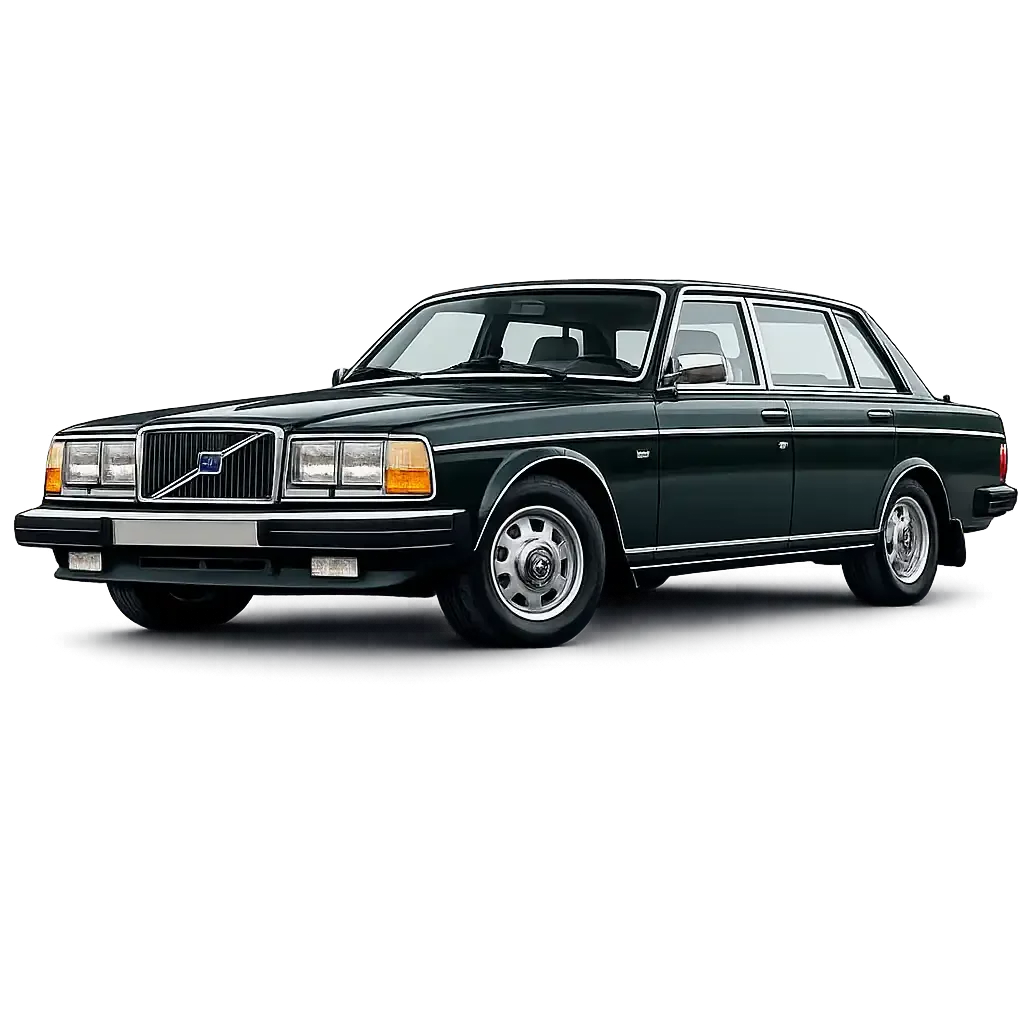
The Volvo 264 is the 4-door sedan variant of the Volvo 260 series, powered by the PRV V-6 engine (Peugeot-Renault-Volvo). In Volvo's naming convention, "264" means 200-series, 6-cylinder, 4-door. Introduced to the US market as a 1976 model year (production began autumn 1975), the 264 replaced the Volvo 164 as Volvo's executive sedan. It shares the 200-series platform with the 240-series four-cylinder models but has different front sheetmetal (fenders, bumpers, grille, headlights) from the firewall forward to accommodate the V-6 engine. The 260 series accounted for only approximately 10% of all 200-series sales, and 1976 was the peak year with 25,267 264s sold in the US. Two primary trim levels were available: DL (cloth upholstery, manual windows, basic trim) and GL (leather seats, power windows, sunroof, upgraded exterior trim). The GLE appeared for 1979, adding further luxury equipment. The critical engine transition was from B27F (2.7L, 1976 to 1979) to B28F (2.8L, 1980 to 1982), which brought a bore increase, a change from 4 to 7 main bearings, and persistent top-end oiling problems. Production continued through the 1982 model year, overlapping with the introduction of the Volvo 760 in 1982.
Generation Overview (1976 to 1982 US Market)
Year-by-Year Changes
1976 Model Year (US Debut)
264 debuts alongside the 262 two-door sedan and 265 wagon. Engine: B27F 2.7L PRV V-6 with Bosch K-Jetronic (CIS) fuel injection, producing 125 hp and 150 lb-ft (US specification). All-aluminum alloy block with wet cylinder liners. 4 main bearings. 90-degree V-6, SOHC per bank. Transmission: 4-speed manual with electric overdrive standard; 3-speed automatic (Borg-Warner) optional. 5-speed manual also available on GL. Trim levels: 264 DL(starting at $6,595) and 264 GL (starting at $9,895). California models equipped with catalytic converter since 1975 model year.
1977 Model Year
Lambda Sond oxygen sensor introduced on all US models. 49-state models receive catalytic converters (California models already had them). B27F continues. Volvo's 50th anniversary year.
1978 Model Year
Grille altered with chrome surround. Rear-view mirrors changed to black. Front seats redesigned. New emblems. Interval wipers introduced. Power mirrors added. New paint formula introduced to combat severe rust problems on earlier model years. B27F continues. 264 GLE trim introduced on some markets. The trunk lid design is modified on the sedan, with a deeper trunk lid and new taillights that are visible from the side.
1979 Model Year (Major Facelift)
Full front and rear facelift. GL and GLE models receive rectangular headlamps and a new grille, replacing the earlier round-headlamp design. Modified front suspension: stiffer shock absorbers, heavier anti-roll bars, altered caster angle on power-steering models. 264 GLE becomes a distinct luxury trim in the US, competing with BMW 530i and Mercedes 280SE. Light body trim updates. B27F continues at 125 hp. The GLE featured leather or plush upholstery, power accessories, and alloy wheels.
1980 Model Year (Engine Displacement Increase and Facelift)
Major engine change: B27F (2.7L) replaced by B28F (2.8L). Displacement increased from 2,664 cc to 2,849 cc via bore increase from 88 mm to 91 mm. Main bearings increased from 4 to 7. Compression ratio increased from 8.2:1 to 8.8:1. US power: 130 hp and 153 lb-ft of torque. The B28 engines suffer from the same top-end oiling troubles and premature camshaft wear as the B27. Additional facelift: new dashboard layout, redesigned headlights and indicators, narrower bumpers with black plastic coating, redesigned front spoiler. The 264 GLE is dropped from most markets for 1980. Some 1980 to 1981 264 GL sedans were sold with four-cylinder B21/B23 engines rather than the V-6, blurring the 240/260 distinction.
1981 Model Year
B28F continues. Further minor updates. The manual transmission option may have been discontinued for US-market 264s by this point (most sold with automatic). The 260 range is gradually being consolidated as the 700 series approaches.
1982 Model Year (Final Year)
Final year of the Volvo 264. B28F continues. The Volvo 760 is introduced in 1982 as the 264's eventual replacement in the executive segment. The 264 and 760 overlap in showrooms. The PRV V-6 will continue in the 760 as the B28E/B280F. 264 production ends.
US Trim Levels
264 DL (De Luxe)
The base 264. Cloth upholstery (vinyl/cloth in early US models), manual windows, basic interior trim. Available throughout the production run.
264 GL (Grand Luxe)
The premium trim level. Leather seats, power windows, sunroof option, upgraded exterior paint and trim. More extensive standard equipment than DL. Available from 1976.
264 GLE (Grand Luxe Executive)
The top-tier luxury specification, appearing for the 1979 model year. Featured alloy wheels, full power accessories, leather upholstery, and premium sound system. Rectangular headlamps standard. Positioned as a luxury car competing with BMW and Mercedes. Dropped from most markets for 1980 as Volvo reorganized its trim structure.
Trim level fitment warning: DL, GL, and GLE models share the same mechanical platform but differ in interior trim, electrical accessories (power windows, central locking, heated seats), exterior trim (alloy wheels vs. steel, chrome trim levels, grille variations), and sometimes headlamp configuration (round on DL vs. rectangular on GL/GLE for 1979). Always specify the trim level when ordering interior or electrical components.
Platform and Engineering
Key Platform Facts
• Platform: Volvo 200 series (shared with 240 and other 260 variants)
• Body style: 4-door sedan
• Architecture: Rear-wheel drive, longitudinal engine, front-mounted
• Assembly: Torslanda, Gothenburg, Sweden
• Front suspension: MacPherson struts (new for 200 series vs. predecessor 140 series)
• Rear suspension: Live (solid) rear axle, coil springs, trailing arms, Panhard rod
• Steering: Rack-and-pinion (new for 200 series)
• Brakes: Power-assisted disc brakes front (ventilated), solid disc rear
• Wheelbase: 104.3 inches (2,650 mm)
• Wheel bolt pattern: 5x10⁸
Engine Reference (Detailed)
B27F: 2.7L SOHC V-6 PRV (1976 to 1979 US)
The original PRV V-6 for the US-market 264. All-aluminum alloy block with wet cylinder liners. 90-degree V-6 configuration. Known for weak oiling systems with cams especially vulnerable to low oil levels and blockages.
• Displacement: 2,664 cc (2.7 liters, 163 cubic inches)
• Bore x stroke: 88 mm x 73 mm
• Compression ratio: 8.2:1
• Main bearings: 4
• Fuel injection: Bosch K-Jetronic (CIS, continuous injection system)
• Power (US): 125 hp, 150 lb-ft torque
• Block material: Aluminum alloy with wet cylinder liners
• Valvetrain: SOHC per bank, 2 valves per cylinder (12 valves total)
B28F: 2.8L SOHC V-6 PRV (1980 to 1982 US)
The enlarged PRV V-6 with bored-out cylinders and additional main bearings. Suffers from the same top-end oiling problems as the B27, with premature camshaft wear remaining a persistent issue.
• Displacement: 2,849 cc (2.8 liters)
• Bore x stroke: 91 mm x 73 mm
• Compression ratio: 8.8:1
• Main bearings: 7 (up from 4 on B27)
• Fuel injection: Bosch K-Jetronic (CIS)
• Power (US): 130 hp, 153 lb-ft torque
• Block material: Aluminum alloy with wet cylinder liners
• Known issues: Top-end oiling troubles, premature camshaft wear. Owners accustomed to bulletproof Redblock engines often neglected maintenance on the PRV, accelerating wear. Regular oil changes critical.
B27 vs. B28: Critical fitment boundary. Different bore (88 mm vs. 91 mm), different main bearing count (4 vs. 7), different crankshaft, different pistons, different cylinder liners, different head gaskets. The blocks appear similar externally but are dimensionally different internally. External accessories (alternator, power steering pump, water pump) are generally shared between B27 and B28, but always verify part numbers. The B28 continued into the Volvo 760 as the B28E, but 760-series engine management, motor mounts, and wiring differ from 200-series applications.
Transmission Reference
4-Speed Manual with Electric Overdrive (M46)
The standard transmission on the 1976 264. Floor-mounted shift lever. Overdrive engaged electrically on 4th gear, providing an effective 5th gear for highway cruising. Increasingly rare on US-market 264s as most buyers opted for the automatic.
5-Speed Manual
Available on GL models. Less common than either the M46 or the automatic.
Borg-Warner 3-Speed Automatic (BW35, then BW55)
The most common transmission on US-market 264s. The BW35 was the earlier unit; the BW55 replaced it during the production run with improved internals. These are different gearboxes with different internal components. By the early 1980s, the vast majority of US 264s left the factory with the automatic.
Transmission note: Three distinct gearbox types were offered. The manual with overdrive, the 5-speed manual, and the Borg-Warner automatic are all completely different units with different bellhousings, shift linkage, crossmembers, driveshafts, pedal assemblies, and flywheel/flex plate configurations. Within the automatic range, the BW35 and BW55 have different internal components. Always identify the exact transmission before ordering.
Catalog Accuracy: The Fitment Splits That Matter
Split 1: B27 (2.7L, 1976 to 1979) vs. B28 (2.8L, 1980 to 1982)
The most critical fitment split. Different bore (88 vs. 91 mm), different main bearing count (4 vs. 7), different crankshaft, pistons, liners, and head gaskets. Both engines suffer from oiling issues, but the B28's camshaft wear pattern can differ from the B27's. All engine-internal components are non-interchangeable between the two displacements. External accessories are generally shared but must be verified.
Split 2: Three Facelift Eras
The 264 went through three distinct visual phases, each with different body and lighting components:
• Phase 1 (1976 to 1978): Round headlamps (most models), original grille, earlier taillights, chrome bumpers. 1978 added chrome grille surround, black mirrors, interval wipers, and the new anti-rust paint formula.
• Phase 2 (1979): Rectangular headlamps on GL/GLE, new grille, wrap-around taillights visible from the side, modified front suspension, modified/deeper trunk lid.
• Phase 3 (1980 to 1982): Revised dashboard layout, changed headlights and indicators, narrower bumpers with black plastic coating, redesigned front spoiler.
All exterior lighting, grille, bumpers, dashboard, and many trim pieces are phase-specific. A 1977 grille will not fit a 1980 car. A 1979 rectangular headlamp will not fit a 1976 with round headlamp openings. Always specify the exact model year when ordering any exterior or interior trim component.
Split 3: 264 Sedan vs. 265 Wagon vs. 262 Two-Door/Coupe
The 264, 265, and 262 share the same platform, engine, and transmission. From the B-pillar forward, the 264 sedan and 265 wagon are essentially identical. From the B-pillar back: completely different body structures. The 264 has a sedan trunk, sedan taillights, sedan rear glass, and sedan rear suspension spring rates. The 265 has a wagon tailgate, raised roofline, cargo area, and potentially different rear spring rates for cargo loads. The 262C coupe (Bertone-built, 1978 to 1981) has a chopped roof approximately 100 mm (4 inches) lower than the sedan, a more raked windshield, custom doors, and unique body panels from Bertone. When ordering any component from the B-pillar back, always specify the body style.
Split 4: 264 (PRV V-6) vs. 244 (Redblock Inline-4)
The 264 and 244 share the same sedan body from the firewall back. From the firewall forward, they are different vehicles: different engine, different fenders, different hood, different bumpers, different grille, different headlights, different radiator, different motor mounts, different exhaust system. The 260 series has a wider and deeper engine bay to accommodate the V-6. A listing for "Volvo 244" will be correct for trunk lid, taillights, rear glass, rear suspension, and interior from the B-pillar back, but wrong for everything forward of the firewall. Important: Some 1980 to 1981 264 GL sedans were sold with four-cylinder B21 or B23 engines. These are mechanically 240s with 260-series badging and trim. Verify the actual engine before ordering engine-specific parts.
Split 5: California Emissions vs. 49-State
California models received catalytic converters from 1975 (model year). All US models got Lambda Sond in 1977, but 49-state models did not receive catalytic converters until later. This creates differences in exhaust systems, catalytic converter specifications, and oxygen sensor wiring between California and 49-state cars, particularly for 1976 to 1979models. Always determine emissions specification when ordering exhaust or engine management components.
Split 6: Rust Eras (Pre-1978 vs. 1978+)
1978 models received a new paint formula to combat severe rust problems on 1975 to 1977 model year cars. Early 264s (1976 to 1977) are significantly more prone to structural rust in fenders, rocker panels, and wheel arches. Body panels interchange dimensionally, but expect significant hidden corrosion on pre-1978 cars requiring additional repair.
Split 7: DL vs. GL vs. GLE Trim
Interior components (seats, door cards, headliner material, carpeting), electrical accessories (power window motors, central locking, heated seat elements), and some exterior items (alloy wheels vs. steel, chrome trim strips, grille badge variants) differ between trim levels. On 1979 models, the headlamp configuration may also differ: round on DL, rectangular on GL/GLE. Always specify trim level for interior and electrical orders.
Split 8: Automatic (BW35/BW55) vs. Manual (M46/5-Speed)
The vast majority of US-market 264s have the 3-speed automatic. Manual-equipped cars are uncommon. Different transmission, shifter, crossmember, driveshaft, pedal assembly, and flywheel vs. flex plate. Within the automatics, the BW35 and BW55 have different internal components.
Special and Rare Variants
264 TE (Top Executive) Limousine
A 7-seat stretched limousine on a 3,430 mm (135-inch) wheelbase, lengthened by approximately 70 cm (27.5 inches). Built by Bertone in Grugliasco, Italy, from raw 264 bodies sent from Sweden. 4 doors, 3 rows of seats. Featured plush velvet upholstery, hi-fi sound system with electric antenna, and electric window lifts. Only 335 units total built from 1975 to 1981 (with some additional units by Nilsson coachbuilders through 1984). Used by Swedish royalty (Carl XVI Gustaf) and East German political leadership. Not sold in the US. All body panels, doors, floor sections, driveshaft, fuel lines, wiring harness, and interior are unique to the 264 TE and do NOT interchange with standard 264 sedans.
Four-Cylinder 264 GL (1980 to 1981)
A small number of 1980 to 1981 264 GL sedans were sold with the four-cylinder B21 or B23 Redblock engineinstead of the PRV V-6. These cars carried 260-series trim and badging but were mechanically 240s from the firewall forward. This creates a significant identification trap: the badge says 264, but the engine bay contains a Redblock inline-4. Always verify the actual engine before ordering engine-specific parts.
Common Wear Items and Fitment Notes
• Camshaft and cam followers: The PRV V-6 (both B27 and B28) is prone to premature camshaft wear due to oiling design. This is the most common major repair. B27 and B28 camshafts may differ; always specify displacement.
• Wet cylinder liners: The PRV uses wet liners that can leak coolant into the crankcase if seals fail. B27 liners (88 mm) and B28 liners (91 mm) are NOT interchangeable.
• Fuel injection (Bosch K-Jetronic): Fuel distributor, warm-up regulator, cold-start valve, auxiliary air valve. All PRV-specific; do not order Redblock inline-4 K-Jetronic components.
• Exhaust manifolds: V-6-specific, two manifolds (one per bank). Not shared with inline-4 240 models.
• Water pump: PRV V-6-specific. Different from inline-4 water pump.
• Timing chain/gear: The PRV uses a timing chain. Chain stretch is a known wear item at high mileage.
• Front fenders/hood/grille: 260-series-specific. Different from 240-series front sheetmetal.
• Headlights: Three phases: round (1976 to 1978 base), rectangular (1979 GL/GLE), revised (1980+). Year and trim-specific.
• Taillights: Changed with the 1978/1979 facelift. Pre-1979 and 1979+ sedan taillights are different.
• Dashboard: Revised for 1980. Pre-1980 and 1980+ dashboards are different assemblies.
• Bumpers: Chrome (1976 to 1979) vs. narrow black plastic-coated (1980+). Different mounting brackets.
• Brake rotors/pads: Generally shared with 240 of the same model year. Verify year.
Ordering Quick-Reference Checklist
• Model year: 1976, 1977, 1978, 1979, 1980, 1981, or 1982?
• Engine: B27F 2.7L (1976 to 1979) or B28F 2.8L (1980 to 1982)? Or four-cylinder B21/B23 (rare 1980 to 1981 GL)?
• Trim level: DL, GL, or GLE?
• Facelift phase: Phase 1 (1976 to 1978), Phase 2 (1979), or Phase 3 (1980 to 1982)?
• Emissions: California or 49-state? (Critical for 1976 to 1979 exhaust/sensors.)
• Transmission: 4-speed manual with overdrive, 5-speed manual, or 3-speed automatic (BW35 or BW55)?
• Body style: 264 sedan vs. 265 wagon vs. 262 two-door/coupe? All different from B-pillar back.
• 264 (V-6) vs. 244 (inline-4): Everything forward of the firewall differs.
• VIN: Always verify by VIN, especially for 1980 to 1981 models that may have four-cylinder engines despite 264 badging.
Three Questions to Always Ask
• "B27 (2.7L) or B28 (2.8L), or is it actually a four-cylinder?" The engine displacement is the most critical fitment variable. B27 (1976 to 1979) and B28 (1980 to 1982) are dimensionally different with zero internal interchange. Additionally, a small number of 1980 to 1981 264 GL sedans were sold with four-cylinder Redblock engines. The badge says 264, but the engine could be an inline-4. Always confirm the actual engine installed.
• "What facelift phase?" Three visual phases (1976 to 1978, 1979, 1980 to 1982) with different headlights, grilles, bumpers, taillights, and dashboard. Every exterior trim component is phase-specific. A 1977 grille will not fit a 1980 car. A 1979 rectangular headlamp will not fit a 1976 with round headlamp openings.
• "264 sedan, 265 wagon, or 262 coupe?" From the B-pillar forward, the 264 and 265 are identical. From the B-pillar back, they are completely different vehicles. The 262C coupe (Bertone) is unique in roof, windshield, doors, and upper body panels. Any parts order for components behind the B-pillar requires the correct body style designation.
Disclaimer: This guide is based on publicly available specifications, Volvo press materials, and independent research. Part interchangeability should always be confirmed via VIN and OEM part number lookup. Specifications may change without notice. This document does not constitute official Volvo parts catalog data. Visuals and illustrations in this article were generated using AI for representative purposes and may not reflect exact technical schematics.