
Volvo 245 Wagon Second Facelift (1986 to 1989) US Market Fitment Guide
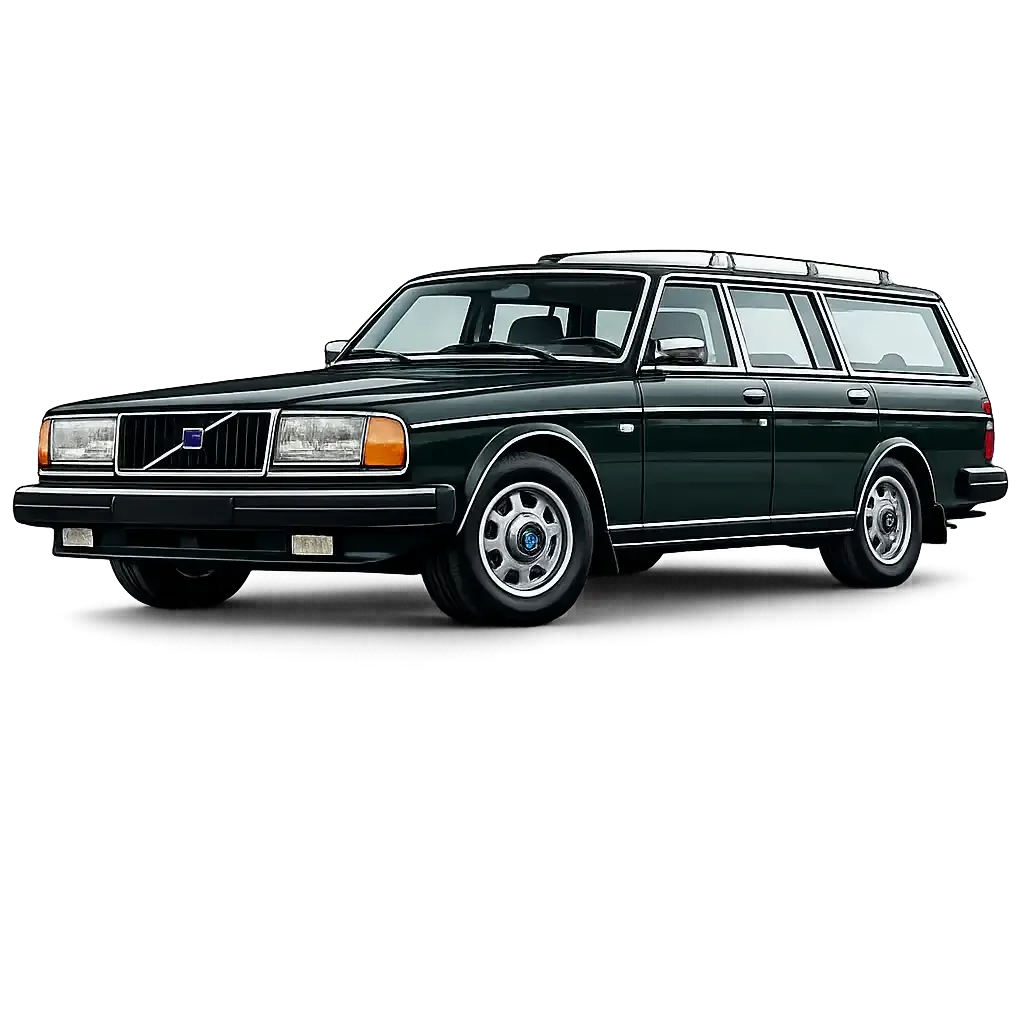
The 1986 model year brought the final and most significant exterior restyling of the Volvo 240 wagon, including larger one-per-side rectangular headlights, a new grille, revised fenders, smaller turn signals, and molded plastic rear mud flaps integrated into the wheel wells. The interior was also reconfigured. By this point, the 240 wagon was marketed simply as the "240 DL" or "240 GL" wagon (the old "245" designation was dropped from marketing in 1983, though it persists on engine bay and trunk labels). The engine was now standardized around the B230F (2.3L "low friction" Redblock) for all non-turbo models, with LH-Jetronic fuel injection throughout. This guide covers 1986 to 1989, after which the 240 continued with minimal changes through its final year of 1993. In 1986, total 200-series production passed two million units. The 240 wagon of this era is the iconic "brick" that cemented Volvo's reputation.
Year-by-Year Changes (1986 to 1989)
1986 Model Year (Major Exterior Facelift)
Last major restyling. Larger one-per-side rectangular headlights replace the previous multi-unit arrangement. New grille design. Revised fenders. Turn signals shrink. Interior reconfigured. Molded plastic mud flaps integrated into rear wheel wells. Engine: B230F (114 hp, 136 lb-ft) with LH-Jetronic 2.2. Turbo option discontinued on 240 for 1986 (turbo shifts to 740/760 only). 260 series discontinued; 240 is now the sole entry-level Volvo. Two million 200-series milestone.
1987 Model Year
5-speed manual transmission (M47) becomes available. B230F continues at 114 hp. Minor trim updates. Last model year with the degradation-prone wiring harness (1988+ harnesses improved). This is the last year buyers need to specifically check wiring harness condition.
1988 Model Year
Improved wiring harness replaces the degradation-prone earlier design. B230F continues. Plastic-lens replaceable-bulb headlamps may appear on some late-production cars (widespread by 1989). Minor updates.
1989 Model Year
B230F receives LH-Jetronic 2.4 fuel injection system, replacing LH-Jetronic 2.2. LH 2.4 uses a different mass airflow sensor, different ECU, and adds OBD-1 onboard diagnostics accessible from the engine compartment with no special equipment. Ignition system updated from Volvo/Chrysler ignition (Bosch coil and distributor) to Bosch EZK-116K system. Power remains 114 hp. Plastic-lens headlamps standard.
Engine Reference
B230F: 2.3L OHC Redblock "Low Friction" (1986 to 1989)
The sole gasoline engine for the 240 wagon in this period. Standardized across all non-turbo 240 models from 1986 onward.
• Displacement: 2,316 cc (2.3 liters)
• Valvetrain: SOHC, belt-driven overhead camshaft
• Main bearings: 5
• Compression: 9.8:1
• Power: 114 hp, 136 lb-ft torque (consistent throughout)
• Fuel injection (1986 to 1988): Bosch LH-Jetronic 2.2
• Fuel injection (1989): Bosch LH-Jetronic 2.4 (different MAF sensor, ECU, adds OBD-1)
• Ignition (1986 to 1988): Volvo/Chrysler system with Bosch coil and distributor
• Ignition (1989): Bosch EZK-116K system
• Internal design: Lighter rods, shorter-skirt pistons vs. earlier B23
LH-Jetronic 2.2 vs. 2.4: Key split within this guide. The 1986 to 1988 cars use LH 2.2 with one mass airflow sensor and ECU type. The 1989 cars use LH 2.4 with a different mass airflow sensor, different ECU, and OBD-1 diagnostics. The ignition system also changed in 1989 (Volvo/Chrysler to Bosch EZK-116K). Fuel injection sensors, ECU, and ignition components from 1986 to 1988 do NOT interchange with 1989.
Transmission Reference
• M46: 4-speed manual with electric overdrive (carryover)
• M47: 5-speed manual (available from 1987)
• AW70: 3-speed automatic with overdrive
• AW71: 4-speed automatic with overdrive
Catalog Accuracy: The Fitment Splits That Matter
Split 1: LH-Jetronic 2.2 (1986 to 1988) vs. LH-Jetronic 2.4 (1989)
The most critical split within this guide. Different mass airflow sensor, different ECU, and the addition of OBD-1 diagnostics on the 1989 system. The ignition system also changed in 1989 (EZK-116K replacing the earlier Volvo/Chrysler system). A 1987 MAF sensor will not work on a 1989 car and vice versa.
Split 2: 1986+ Second Facelift vs. 1981 to 1985 First Facelift
The 1986 exterior restyling changed headlights, grille, fenders, turn signals, and integrated rear mud flaps. Interior was reconfigured. All of these external components are different from 1981 to 1985 first-facelift cars. A 1984 grille will not fit a 1987 car.
Split 3: Pre-1987 Wiring Harness vs. 1988+ Improved Harness
1986 and 1987 models still have the degradation-prone wiring harness that affects all pre-1988 240s. The insulation breaks down from engine heat. 1988+ models received an improved harness. When troubleshooting electrical issues on 1986 to 1987 cars, the wiring harness itself may be the root cause, not the component being ordered.
Split 4: Glass-Lens Headlamps (Early) vs. Plastic-Lens Headlamps (1988/1989)
The 1986 second-facelift headlamps transitioned from glass to plastic lens construction during this period. Plastic-lens replaceable-bulb headlamps became widespread by 1989. The two types may not be directly interchangeable in terms of bulb type and mounting.
Split 5: M46 Overdrive (to 1986) vs. M47 5-Speed (1987+)
The 5-speed manual was introduced for 1987. Different gearbox case, gear ratios, shift linkage, and potentially driveshaft. Verify which transmission is installed.
Split 6: 240 Wagon vs. 240 Sedan
Same split as all eras: identical from B-pillar forward, completely different behind. Wagon tailgate, roofline, rear springs, taillights, rear wiper, and cargo components are wagon-specific.
Split 7: 240 (1986 to 1989) vs. 740 (1985 to 1989)
The 740 shares the B230F engine but has a completely different body, suspension, interior, and electrical system. The 740 has a different dashboard, different front and rear styling, and (from 1988 sedan) multilink IRS on some models. Engine internals are largely shared, but exhaust manifolds, motor mounts, wiring harness, and accessories may differ. Do not assume cross-compatibility between 240 and 740 without verifying part numbers.
Split 8: Turbo Availability
The turbo option was discontinued on the 240 after 1985. From 1986 onward, the 240 wagon was naturally aspirated only (B230F). If a customer asks for turbo parts for a 1986+ 240 wagon, they likely have an aftermarket or swap installation, not a factory turbo.
Common Wear Items
• Timing belt: B230F is an interference engine. Belt failure destroys valves. Replace at Volvo-specified intervals. Includes tensioner and idler pulley.
• Flame trap (PCV system): Volvo's positive crankcase ventilation system (called "flame trap") requires periodic attention. Clogged flame trap causes oil leaks and increased crankcase pressure.
• Mass airflow sensor: LH 2.2 (1986 to 1988) and LH 2.4 (1989) use different MAF sensors. Specify year.
• Distributor cap and rotor: 1989 (Bosch EZK-116K) uses different ignition components from 1986 to 1988 (Volvo/Chrysler).
• Wiring harness (1986 to 1987 only): Check for degradation. Brittle insulation causes electrical gremlins.
• Tailgate struts: Wagon-specific. Weaken with age.
• Rear springs: Wagon springs sag with age and cargo loading. Different from sedan.
• Headlamp assemblies: 1986+ second-facelift specific. Different from 1981 to 1985 and pre-1978 headlamps.
Ordering Quick-Reference Checklist
• Model year: 1986, 1987, 1988, or 1989?
• Fuel injection: LH-Jetronic 2.2 (1986 to 1988) or LH-Jetronic 2.4 (1989)?
• Ignition: Volvo/Chrysler (1986 to 1988) or Bosch EZK-116K (1989)?
• Transmission: M46 overdrive, M47 5-speed (1987+), AW70, or AW71?
• Headlamps: Glass-lens or plastic-lens replaceable-bulb?
• Body style: Wagon or sedan?
Three Questions to Always Ask
• "1986 to 1988 or 1989?" The 1989 model year brought a different fuel injection system (LH 2.4 vs. 2.2), different ignition system (EZK-116K vs. Volvo/Chrysler), and OBD-1 diagnostics. Sensors, ECU, and ignition components do not interchange between 1986 to 1988 and 1989.
• "Which facelift era?" The 1986+ second facelift has different headlights, grille, fenders, and turn signals from both the original (1975 to 1980) and first facelift (1981 to 1985) 245. All three eras have mutually exclusive front-end components. Confirm the customer has a 1986+ car before ordering 1986+ parts.
• "Wagon or sedan?" Same as always: identical from B-pillar forward, different behind. The 240 wagon in this era is the iconic 'brick' - but its tailgate, roofline, rear springs, taillights, and cargo area are all wagon-specific.
Disclaimer: This guide is based on publicly available specifications, Volvo press materials, and independent research. Part interchangeability should always be confirmed via VIN and OEM part number lookup. Specifications may change without notice. This document does not constitute official Volvo parts catalog data. Visuals and illustrations in this article were generated using AI for representative purposes and may not reflect exact technical schematics.