
Written by Arthur Simitian | PartsAdvisory
The Volvo 244 launched in 1975 as the successor to the legendary 140 series, and within a few years it became the car most people picture when they hear the word "Volvo." Boxy. Solid. Indestructible. The kind of car that outlives two owners, three transmissions, and every rust prevention product ever sprayed on it.
For aftermarket parts sellers, though, that durability creates a paradox. These cars are still on the road, still being maintained, still generating parts orders. And the 244 ran from 1975 to 1993 with three distinct styling and engineering periods that changed the external sheetmetal, lighting, interior components, and mechanical systems significantly. Parts that fit a 1976 do not necessarily fit a 1986, even though both cars wear the same "244" badge and share the same basic silhouette.
This post covers the original style 244, model years 1975 through 1980. This is the car as Volvo first designed it: round headlights, chrome bumpers, narrow body trim, and the B20/B21 engine family. Understanding what makes this era distinct is essential for anyone listing 244 parts in ACES or PIES, because the fitment splits that matter most are not always where sellers expect them to be.
How the 244 Arrived
The 200 series was designed by Jan Wilsgaard, the same designer responsible for the 140 series. The 244 designation followed Volvo's numbering convention: 2 for the series, 4 for the number of cylinders, and the final 4 for four doors. The two-door variant was the 242, and the wagon was the 245. All three shared the same platform, firewall, and basic structure, but the 244 sedan was the volume seller.
The 1975 to 1980 cars represent the 244 in its purest form. The styling was clean, upright, and deliberately restrained. Volvo was not trying to make a fashion statement. They were trying to make a car that would protect its occupants, start in Swedish winters, and run for 200,000 miles without structural failure. They succeeded.
From a parts catalog perspective, this original era is defined by a set of features that changed when the first major facelift arrived in 1981. Every one of these features creates a fitment boundary.
Exterior: What Defines the 1975 to 1980 244 Visually
Headlights: Round, sealed beam
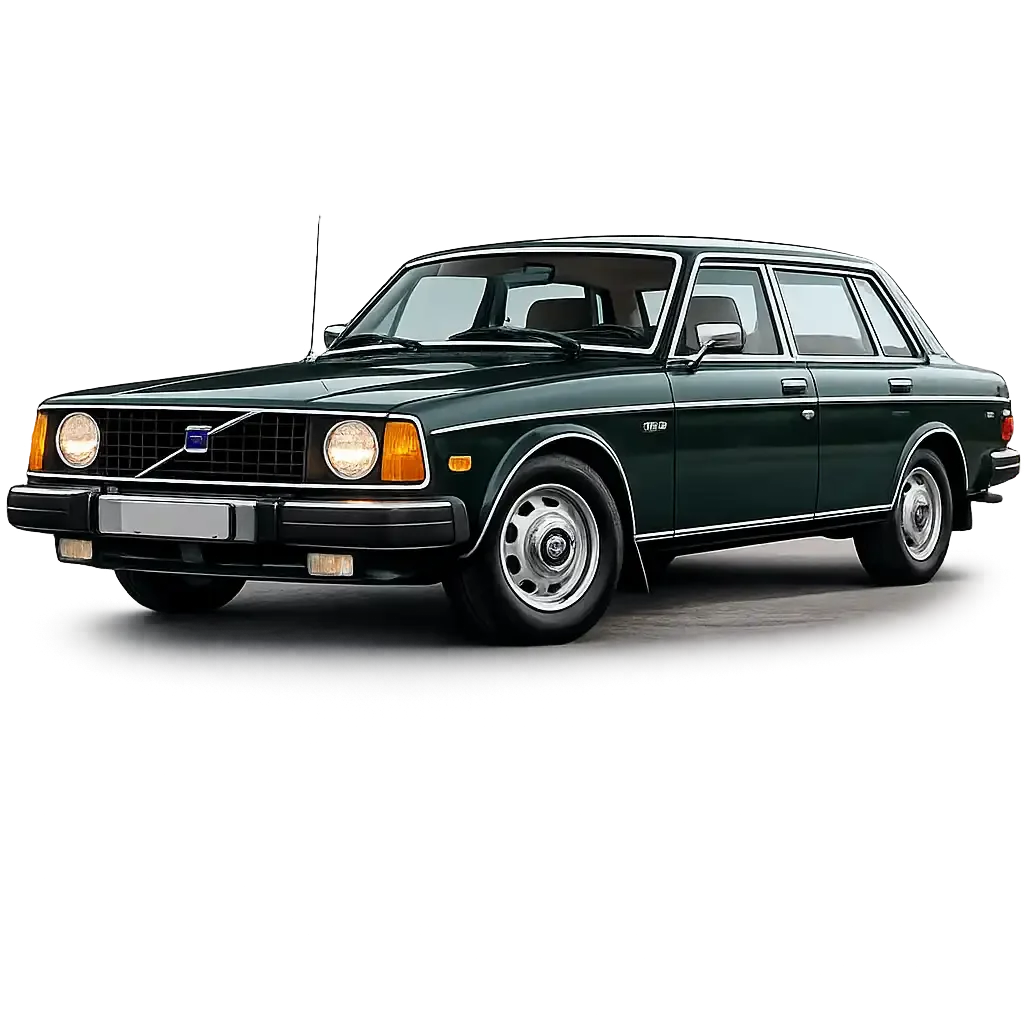
The original 244 used round sealed beam headlights, two on each side (quad round setup). This is the single most visible identifier separating pre-facelift from post-facelift 244s. The 1981 and later cars switched to rectangular headlights, and everything around them changed: the grille, the header panel, the headlight buckets, the bezels, and the wiring.
For sellers listing headlights, bezels, headlight rings, grille assemblies, or header panels, this is the primary split. A "Volvo 244 headlight" listing without a year range or headlight shape qualifier will generate returns from buyers on both sides of the 1980/1981 divide.
Grille
The original grille was designed around the round headlight openings. It featured a diagonal bar pattern with the Volvo emblem centered. The grille mounting points, width, and vertical height are specific to the round headlight front end. No 1981 or later rectangular headlight grille will fit, and no pre-1981 grille will retrofit to the later cars without significant modification.
Bumpers: Chrome, narrow profile
The 1975 to 1980 244 wore chrome-plated steel bumpers with rubber inserts. These bumpers were narrower and lighter than the energy-absorbing units that appeared in later years. The front bumper integrated with the front valance, and the rear bumper sat against the trunk panel in a straightforward fashion.
U.S. market 244s had bumper systems that met the 5 mph federal impact standard, which meant the bumpers were mounted on hydraulic or mechanical shock absorbers that allowed the bumper to absorb a low-speed impact and return to position. The bumper shocks, mounting brackets, and reinforcement bars are specific to this generation.
European market cars had simpler, lighter bumper assemblies without the same energy absorption requirements. This matters for sellers listing bumper parts, because a bumper bracket for a U.S. spec 1978 244 is not the same as the bracket for a European spec 1978 244. Market designation is a fitment variable.
Side trim and body moldings
The original 244 used narrow body side moldings, typically a thin chrome or bright strip along the beltline and a rubber rub strip at door height. The wheel arches were unadorned. Later facelifts added wider body cladding, wheel arch extensions, and more substantial side protection moldings. Any body trim, molding, or clip kit listing needs to specify the body style era.
Taillights
The 1975 to 1980 taillights are a specific design that was updated with the 1981 facelift. The taillight housings, lenses, and gaskets from this era do not interchange with the 1981 to 1985 units. The mounting hole positions, lens shape, and connector types differ. For sellers, taillights are one of the highest-volume exterior parts for any vehicle this age, and cross-referencing across the facelift boundary without noting the difference is a guaranteed return generator.
Mirrors
Original 244s came with smaller, chrome-backed side mirrors. The mirror mounting location on the door, the base plate shape, and the attachment hardware are different from the larger, body-colored mirrors used on later cars. Mirror listings must specify the era.
Under the Hood: Engine and Mechanical Differences
The B20 and B21 engine family
The 1975 to 1980 244 came with two primary engine families, and this is where catalog accuracy matters enormously.
B20 (1975 only in most markets): The 2.0L pushrod engine carried over from the 140 series. This was the outgoing engine, and it appeared in early production 244s. It is an overhead valve, pushrod design with a completely different cylinder head, valve train, intake manifold, and accessory drive layout compared to the B21 that replaced it.
B21 (1975 to 1980): The 2.1L overhead cam engine was the primary powertrain for this era. It was a significant departure from the B20, featuring a single overhead camshaft, a crossflow cylinder head, and Bosch fuel injection (K-Jetronic/CIS on most models, though some markets received carbureted versions).
Within the B21 family, variants existed. The B21A was a lower-compression version for certain markets. The B21E and B21F had electronic or mechanical fuel injection, respectively. The B21ET was the turbocharged variant (available in the 242 Turbo initially, but the turbo plumbing and engine management parts matter for sellers listing turbo-specific components).
For parts sellers, the B20 to B21 split is critical. These engines share almost nothing in terms of cylinder head gaskets, valve cover gaskets, timing components, fuel injection parts, exhaust manifolds, or engine mounts. A seller who lists a "Volvo 244 cylinder head gasket, 1975 to 1980" without specifying B20 vs. B21 will ship the wrong gasket roughly half the time to 1975 buyers.
Fuel injection: Bosch K-Jetronic (CIS)
The dominant fuel injection system on the B21 was the Bosch K-Jetronic continuous injection system, also known as CIS. This mechanical fuel injection system used a fuel distributor, warm-up regulator, auxiliary air valve, and cold start injector. The components are specific to the K-Jetronic system and do not interchange with the later LH-Jetronic electronic injection that arrived with the B23 engine in the early 1980s.
Fuel injection parts are a high-return category on these cars because of the K-Jetronic to LH-Jetronic transition. A fuel distributor, warm-up regulator, or control pressure regulator listed without the injection system type will catch buyers on both sides of the changeover.
Transmission
The original 244 was available with either a 4-speed manual (M40 or M41 with electric overdrive), or a 3-speed automatic (BW35 or BW55 Borg-Warner units). The M40/M41 manual transmissions and BW35/BW55 automatics have different bellhousing patterns, shift linkage, crossmembers, and driveshaft lengths depending on the specific unit.
The M41 with overdrive is a particular fitment concern because the overdrive unit adds length to the transmission, changing the driveshaft length and potentially the exhaust routing. Parts sellers listing driveshafts, transmission mounts, shift linkage components, or crossmembers need the specific transmission code, not just "manual" or "automatic."
Rear axle
The 244 used a live rear axle (solid axle with coil springs on trailing arms). The axle ratio varied by market and transmission choice. More importantly, the rear axle assembly itself came in different housing widths depending on the model year and whether the car had disc or drum rear brakes. The original 244s in this era predominantly used rear drum brakes, but disc brake rear axles existed on certain models and markets.
Brake components (shoes, drums, hardware kits, wheel cylinders) must be listed with the correct rear brake type. A "Volvo 244 rear brake shoe" listing that does not verify whether the specific application has rear drums is a problem, because some 244s of this era had rear discs, and the parts are completely different.
Suspension
The front suspension was a MacPherson strut design. The rear used a live axle located by trailing arms and a Panhard rod, with coil springs and separate shock absorbers. Suspension component fitment in this era is relatively stable across model years, but the strut specifications, spring rates, and shock absorber lengths can vary by market (heavy-duty suspension packages were common on certain export models).
Strut listings should specify whether the strut assembly includes the spring seat, bearing plate, and bump stop, or whether it is a cartridge-only replacement. Both products exist in the aftermarket, and shipping a cartridge to a buyer who expected a complete assembly is a common return.
Interior: Fitment Notes
Dashboard and instrument cluster
The 1975 to 1980 dashboard is a distinct design that was replaced with the 1981 facelift. The instrument cluster shape, gauge layout, switch locations, and HVAC control panel are specific to this era. Dashboards, dash pads, instrument cluster lenses, and HVAC control units from this period do not interchange with 1981 and later cars.
Seats
Seat mounting patterns on the original 244 differ from later years. Seat tracks, mounting brackets, and the seat frame itself were updated with the facelifts. Listing seats or seat components requires era specification.
Door panels and window regulators
Door panel trim, armrest shapes, and window regulator mechanisms may differ between the original style and later facelifts. The door shell itself remained similar across years, but the interior trim components that bolt to it changed.
The Fitment Boundaries That Matter Most
For sellers listing parts for the 1975 to 1980 Volvo 244, here are the critical boundaries to enforce in your catalog data:
Model year 1975 specifically requires extra attention because it straddles the B20/B21 engine transition. Any engine-related part listing that includes 1975 must specify the engine code.
Headlight and front end components are the hardest line. Round headlight parts (1975 to 1980) and rectangular headlight parts (1981 and later) share zero interchangeability in the grille, header panel, headlight, and bezel categories.
Fuel injection system type (K-Jetronic CIS vs. later LH-Jetronic) must be a required attribute for any fuel system component.
Bumper assemblies and brackets must specify U.S. vs. European market, as the energy-absorbing bumper hardware is market-specific.
Transmission type must go beyond "manual/automatic" to specify the exact unit (M40, M41, BW35, BW55), because driveshaft length, crossmember, and mount fitment depend on it.
Taillights are era-specific and must not be cross-referenced across the 1980/1981 boundary.
Common ACES/PIES Mistakes for This Era
Listing a part as "1975 to 1985 Volvo 244" without accounting for the 1981 facelift. This creates a single application record that spans two fundamentally different front-end and interior designs.
Listing engine parts for "Volvo 244, 4-cylinder" without the engine code. The B20, B21A, B21E, B21F, and B21ET all have different component requirements.
Using a single taillight or headlight listing across the entire 244 production run. These parts changed with every facelift.
Omitting the transmission code for drivetrain and driveline parts. "Manual" and "automatic" are not sufficient qualifiers.
Ignoring market-specific differences. U.S., Canadian, and European 244s had different bumper systems, lighting configurations (sealed beam vs. H4), and emission equipment.
Why This Era Still Matters for Aftermarket Sellers
The 1975 to 1980 Volvo 244 is between 46 and 51 years old. These cars are increasingly rare as daily drivers, but they have a dedicated hobbyist and restoration community that is actively buying parts. Restoration buyers are among the most detail-oriented customers in the aftermarket. They know exactly what their car is supposed to have, and they will return anything that does not match.
A restoration buyer ordering a chrome grille for a 1978 244 is not going to accept a grille that fits the 1982 rectangular headlight car. They are not going to accept B21 valve cover gaskets for their early B20 engine. They know the difference, and they expect the seller to know it too.
These buyers are also willing to pay a premium for correct, well-documented parts. Accurate fitment data is not just return prevention in this segment. It is a competitive advantage.
Catalog Checklist for 1975 to 1980 Volvo 244
Enforce the 1980/1981 boundary as a hard split for all exterior lighting, grille, bumper, and interior dash components
Require engine code (B20, B21A, B21E, B21F, B21ET) for all engine, fuel injection, and exhaust parts
Require transmission code (M40, M41, BW35, BW55) for all drivetrain parts
Specify fuel injection system type (K-Jetronic/CIS) for all fuel system components
Specify market (U.S./Canada/Europe) for bumper assemblies and lighting
Require rear brake type (drum/disc) for all rear brake components
Flag 1975 model year as a potential B20/B21 split year
Cross-Reference Logic
Volvo 242 (same front end, same engines, different rear body)
Volvo 245 (same front end, same engines, wagon rear body)
Volvo 264/265 (same body, V6 engine, different engine bay components)
Frame as "may also fit" with appropriate year and engine code qualifiers.
Final Take
The 1975 to 1980 Volvo 244 is the car in its original form, before the rectangular headlights, before the wider body cladding, before the B23 engine and LH-Jetronic injection. For parts sellers, this era has clear, well-defined fitment boundaries, but those boundaries are only useful if they appear in the listing.
State the engine code. State the headlight shape. State the fuel injection system type. State the transmission code. State the market. These five attributes eliminate the majority of returns on 244 parts from this era, and they signal to the restoration buyer that you know what you are selling.
Disclaimer: This guide is based on publicly available specifications, Volvo press materials, and independent research. Part interchangeability should always be confirmed via VIN and OEM part number lookup. Specifications may change without notice. This document does not constitute official Volvo parts catalog data. Visuals and illustrations in this article were generated using AI for representative purposes and may not reflect exact technical schematics.