
Volvo 245 Wagon First Facelift (1981 to 1985) US Market Fitment Guide
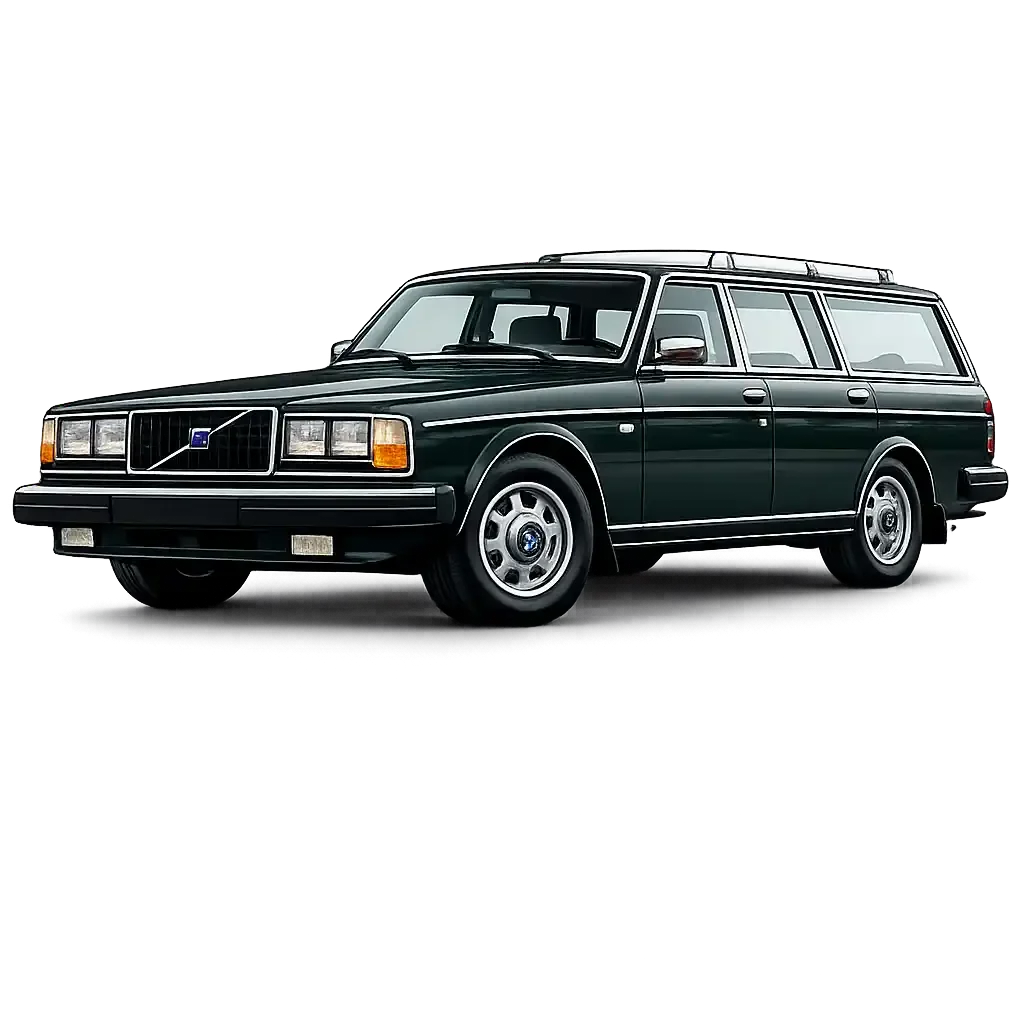
The 1981 model year brought the first major facelift to the Volvo 245 wagon, introducing a completely redesigned dashboard with a larger instrument binnacle bringing the radio and clock within the driver's line of sight (the first dashboard change since the 1973 model year 100 series), wrap-around taillights on wagons (sedans had received them in 1979), and the arrival of the turbocharged B21FT engine making Volvo one of the pioneers of turbocharged road cars. This period also saw the transition from B21 (2.1L) to B23 (2.3L) displacement, the introduction of the VW-sourced D24 diesel option, and the shift from Bosch K-Jetronic to LH-Jetronic electronic fuel injection. By 1983, the 240-series naming convention changed: "245" was replaced by "240" followed by trim level letters (GL, DL, Turbo), though the body style digit (5 for wagon) still appeared on engine bay and trunk labels. In 1982, Volvo sold 66,194 245 wagons. The 245 continued to offer the reverse-facing third-row seat option.
Year-by-Year Changes (1981 to 1985)
1981 Model Year (Major Facelift)
Completely redesigned dashboard with larger instrument binnacle. Wagon wrap-around taillights (new for wagon; sedans had them since 1979). New grille. Turbo model arrives: B21FT producing approximately 127 hp with Garrett turbocharger. B21F naturally aspirated continues. D24 diesel (VW-sourced 2.4L inline-6, 82 hp) was announced but federalization delayed US deliveries. 50,352 wagons sold.
1982 Model Year
Turbo wagon now available (GLT Turbo). Automatic transmission shifts to Aisin-Warner 70 (AW70) with overdrive for non-turbo models. Some late 1982 B21F models receive Bosch LH-Jetronic 2.0 electronic fuel injection replacing K-Jetronic (small number of early production). D24 diesel enters US market (245 DL Diesel). 66,194 wagons sold.
1983 Model Year
Naming convention changes: "245" becomes "240" followed by trim level letters. The car is now marketed as "240 DL wagon" or "240 GLT Turbo wagon" rather than "245 DL." B23F 2.3L engine introduced, replacing B21F in naturally aspirated applications. B23F has 9.5:1 to 10.3:1 compression (varies by transmission pairing), Bosch LH-Jetronic 2.2electronic fuel injection, producing approximately 114 hp. Turbo intercooler introduced on B21FT (now B21FT intercooled). AW70 automatic with overdrive continues.
1984 Model Year
B23E engine with modified cylinder head produces 129 hp on certain trim levels. AW71 automatic gearbox (from the 760) becomes available for the 240. D24 diesel continues. 5-speed manual gearbox development in progress.
1985 Model Year
B230F "low friction" engine introduced, replacing B23F in non-turbo applications. The B230F has lighter connecting rods and pistons with shorter skirts, improved crankshaft, and 9.8:1 compression. Output: 114 hp, 136 lb-ft. Fuel injection: LH-Jetronic 2.2. The B230F would carry the 240 for the rest of its life. 260 series discontinued; 240 variants now adopt 260-series front grille and bonnet. Turbo evolves to B230FT.
Engine Reference
B21F: 2.1L OHC Redblock NA (1981 to 1982)
• Displacement: 2,127 cc
• Fuel injection: K-Jetronic (most); some late 1982 with LH-Jetronic 2.0
• Power: 107 hp
B21FT: 2.1L OHC Redblock Turbo (1981 to 1983)
• Displacement: 2,127 cc
• Turbocharger: Garrett T3
• Power: 127 to 131 hp (intercooled from 1983)
• Fuel injection: K-Jetronic initially; LH-Jetronic later
B23F: 2.3L OHC Redblock NA (1983 to 1985)
• Displacement: 2,316 cc
• Fuel injection: Bosch LH-Jetronic 2.2
• Power: 114 hp (auto) to 129 hp (B23E high-compression)
• Compression: 9.5:1 to 10.3:1 (varies by year and transmission)
B230F: 2.3L OHC Redblock "Low Friction" NA (1985)
• Displacement: 2,316 cc
• Fuel injection: Bosch LH-Jetronic 2.2
• Power: 114 hp, 136 lb-ft
• Compression: 9.8:1
• Changes from B23F: Lighter rods, shorter-skirt pistons, improved crankshaft, lower internal friction
D24: 2.4L Diesel Inline-6 (1981/1982 to 1985)
• Displacement: 2,383 cc
• Configuration: Inline-6, naturally aspirated diesel (VW/Volvo sourced)
• Power: 78 to 82 hp
Critical engine boundaries: B21 (2.1L) and B23/B230 (2.3L) are different displacements with different bore sizes. Pistons, rings, liners, and head gaskets do not interchange. The B23F and B230F share the same 2.3L displacement but the B230F has redesigned internals (lighter rods, different pistons). Turbo engines (B21FT, B230FT) have different pistons, head gaskets, exhaust manifolds, turbo plumbing, and engine management from their naturally aspirated counterparts. The D24 diesel is a completely different engine family sharing zero components with any Redblock gasoline engine.
Transmission Reference
• M45: 4-speed manual
• M46: 4-speed manual with electric overdrive
• M47: 5-speed manual (introduced late in this period)
• BW55/AW55: 3-speed automatic (carryover)
• AW70: 3-speed automatic with overdrive (1982+)
• AW71: 4-speed automatic with overdrive (1984+, from 760)
Catalog Accuracy: The Fitment Splits That Matter
Split 1: B21 (2.1L, 1981 to 1982) vs. B23 (2.3L, 1983 to 1985) vs. B230 (2.3L Low Friction, 1985)
Three engine generations in five years. B21 and B23/B230 differ in displacement (2.1L vs. 2.3L). B23 and B230 share displacement but differ in internal components (rod weight, piston design, crankshaft). Always specify exact engine designation.
Split 2: K-Jetronic (1981 to early 1982) vs. LH-Jetronic (late 1982 to 1985)
Completely different fuel injection systems. K-Jetronic is mechanical/continuous injection; LH-Jetronic is electronic with a mass airflow sensor. Different fuel distributors, sensors, wiring, and ECU. Zero interchange between the two systems. A small number of 1982 cars are transitional.
Split 3: NA vs. Turbo
Naturally aspirated and turbocharged engines differ in pistons, head gaskets, exhaust manifolds, intake plumbing, turbocharger, wastegate, oil lines, and engine management. The turbo also requires an intercooler (from 1983). Turbo-specific parts do not interchange with NA.
Split 4: Pre-1981 Dashboard vs. 1981+ Dashboard
The 1981 dashboard is a completely different assembly from the 1975 to 1980 dashboard. Instrument cluster, center console, radio housing, and switch locations all differ. This is the boundary between the "original" and "first facelift" 245.
Split 5: Wagon Taillights (Pre-1981 Flat vs. 1981+ Wrap-Around)
The 245 wagon received wrap-around taillights for 1981 (sedans got them in 1979). Pre-1981 and 1981+ wagon taillights are different assemblies with different housings, lenses, and wiring.
Split 6: Three Automatic Transmissions
BW55/AW55 (3-speed, to 1981), AW70 (3-speed with overdrive, 1982+), and AW71 (4-speed with overdrive, 1984+). Different internal components, different shift patterns, different fluid requirements. Verify the exact unit.
Split 7: Gasoline (Redblock) vs. Diesel (D24)
The D24 diesel is a VW-sourced inline-6 sharing zero components with the Redblock inline-4. Different motor mounts, exhaust system, fuel system, wiring, instrument cluster (tachometer vs. no tachometer), and transmission bellhousing.
Split 8: Wiring Harness Degradation (All Pre-1987)
All 240s through at least 1987 have a known wiring harness degradation issue. The harness insulation breaks down from engine heat, becoming brittle and "crunchy." This causes electrical gremlins with fuel injection, ignition, charging, starting, and lights. Worse on turbo models due to higher underhood temperatures. When selling electrical components, inform customers that wiring harness condition should be checked first.
Ordering Quick-Reference Checklist
• Engine: B21F, B21FT turbo, B23F, B23E, B230F, B230FT, or D24 diesel?
• Fuel injection: K-Jetronic (1981 to early 1982) or LH-Jetronic (late 1982+)?
• Transmission: M45, M46, M47, BW55, AW70, or AW71?
• Turbo or NA: Turbo models have unique exhaust, intake, and cooling components.
• Dashboard era: 1981+ (this guide) vs. pre-1981 (original style)?
• Body style: Wagon (245/240 wagon), sedan (244/240 sedan), or 242 two-door?
Three Questions to Always Ask
• "Which engine: B21, B23, B230, or D24 diesel?" Three gasoline engine generations plus diesel in this period. B21 (2.1L) and B23/B230 (2.3L) differ in displacement. B23 and B230 differ in internals. The D24 diesel is a completely different engine family. Turbo variants (B21FT, B230FT) add another layer of complexity.
• "K-Jetronic or LH-Jetronic fuel injection?" Two completely different fuel injection systems overlapped in 1982. K-Jetronic is mechanical; LH-Jetronic is electronic. Zero interchange. Most 1981 to early 1982 cars have K-Jetronic; most late 1982+ have LH-Jetronic. Always verify.
• "Which automatic transmission?" Three different automatic transmissions in this period: BW55 (3-speed), AW70 (3-speed + overdrive), AW71 (4-speed + overdrive). Different internal components, shift behavior, and fluid. The customer may not know which they have.
Disclaimer: This guide is based on publicly available specifications, Volvo press materials, and independent research. Part interchangeability should always be confirmed via VIN and OEM part number lookup. Specifications may change without notice. This document does not constitute official Volvo parts catalog data. Visuals and illustrations in this article were generated using AI for representative purposes and may not reflect exact technical schematics.