
Volvo 245 Wagon Original Style (1975 to 1980) US Market Fitment Guide
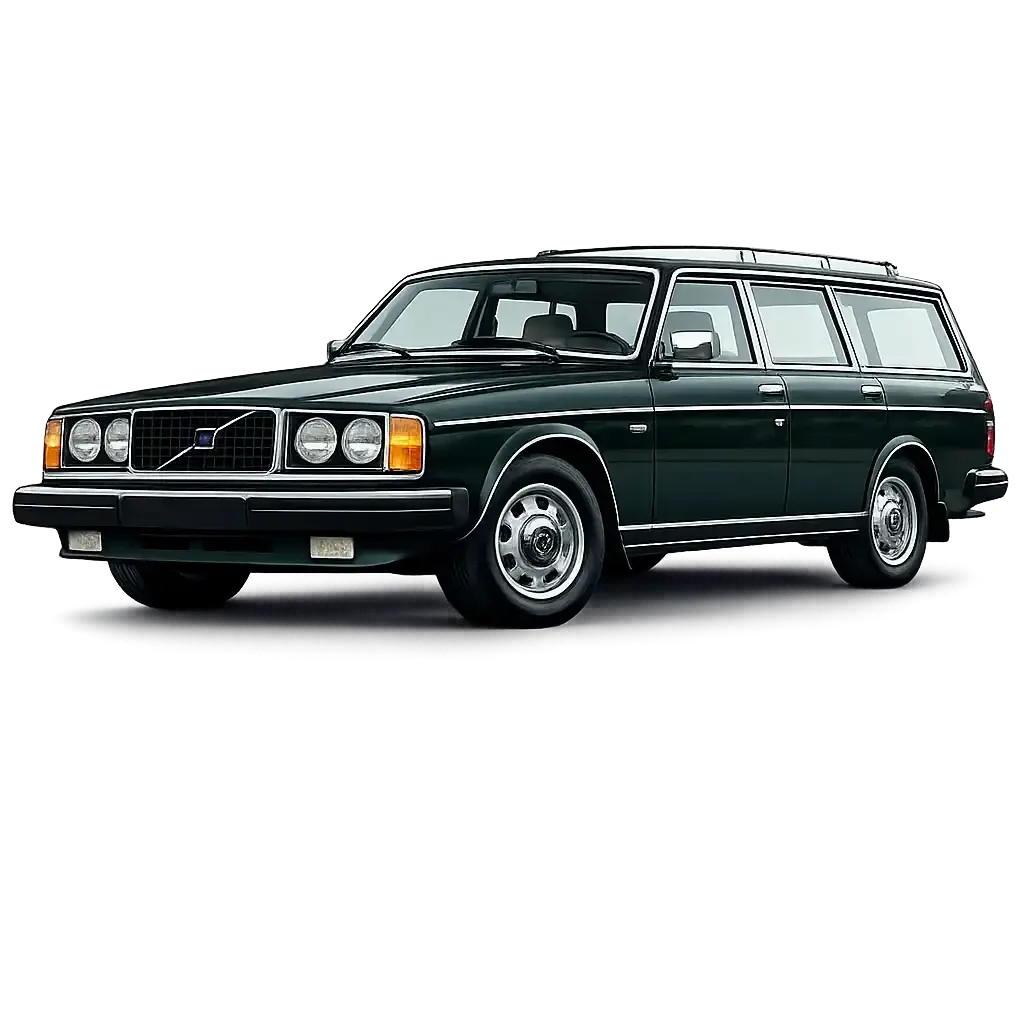
The Volvo 245 is the 5-door wagon (estate) variant of the Volvo 240 series, powered by the Redblock inline-4 engine. In Volvo's naming convention, "245" means 200-series, 4-cylinder, 5-door. The 245 debuted alongside the 242 two-door sedan and 244 four-door sedan as part of the 1975 US model year (production began autumn 1974). The 200 series was developed from the Volvo 140 series and incorporated innovations from Volvo's VESC experimental safety vehicle program, including MacPherson strut front suspension and rack-and-pinion steering. This guide covers the original-style 245 from 1975 to 1980, before the 1981 facelift that introduced a new dashboard, wrap-around wagon taillights, and turbo option. During this period the 245 transitioned from the carryover pushrod B20F (1975 only) to the new overhead-cam B21F Redblock (1976 onward). In 1976, Volvo sold 60,640 245 wagons in the US. The 245 was available in DL and GL trim levels, with the optional reverse-facing folding third-row seat making it a de facto 7-passenger vehicle.
Year-by-Year Changes (1975 to 1980)
1975 Model Year (US Debut)
245 DL and GL debut. Engine: carryover pushrod B20F (2.0L, 98 hp) from the 140 series with Bosch K-Jetronic fuel injection and catalytic converter. 4-speed manual standard (M40/M41 with optional Laycock overdrive); 3-speed Borg-Warner automatic optional. DL: vinyl upholstery (wagons), manual steering standard. GL: metallic paint, steel sunroof, power steering, overdrive, tachometer, sportier steering wheel. Reverse-facing third-row seat option debuts in 1976.
1976 Model Year (New Engine)
Major change: B20F pushrod replaced by new OHC B21F Redblock. The B21F is a 2,127 cc inline-4 with cast-iron block, 5 main bearings, belt-driven overhead camshaft, aluminum crossflow head, and Bosch K-Jetronic fuel injection. US output: 104 hp at 5,500 rpm, 114 lb-ft torque. Transmission upgraded to Kopping M45 4-speed and M46 4-speed with overdrive. Reverse-facing third-row seat option. Overdrive now available on all manual models except base 245L. 60,640 wagons sold.
1977 Model Year
Lambda Sond oxygen sensor and three-way catalytic converter on California vehicles only. New steering wheel and gearknob. B21F continues at 104 hp. Volvo's 50th anniversary. 265 GL wagon (V-6) joins the lineup alongside the 245.
1978 Model Year
Grille altered with chrome surround. 240 models adopt 260-series front-end styling with quad headlamps, domed hood, and square grille. Seats redesigned. Black rear-view mirrors. New emblems. Interval wipers. New paint formulato address severe rust problems on 1975 to 1977 models. B21F continues. 47,490 wagons sold.
1979 Model Year (Rear Facelift)
Rear facelift: Addition of wrap-around taillamp clusters on sedans (wagons retain original taillights through 1980). "Coffin hood" with distinct contour lines replaces flat hood on non-242 models. Front suspension modified: stiffer shocks, heavier anti-roll bars, altered caster angle on power-steering models. B21F revised with higher compression flat-top pistons, output increased to 107 hp. 53,430 wagons sold.
1980 Model Year
Lambda Sond oxygen sensor now standard on 49-state vehicles (California had it since 1977). Automatic transmission switches from Borg-Warner BW35 to Borg-Warner/Aisin-Warner 55 (BW55/AW55). B21F continues at 107 hp. Aspheric side-view mirrors introduced. Minimal other changes. The 245 wagon retains the original-style flat wagon taillights through 1980.
Platform and Engineering
• Platform: Volvo 200 series
• Body: 5-door wagon (estate)
• Architecture: Rear-wheel drive, longitudinal engine, front-mounted
• Assembly: Torslanda, Gothenburg, Sweden; also Halifax, Nova Scotia (Canadian market)
• Front suspension: MacPherson struts (new vs. 140 series)
• Rear suspension: Live (solid) rear axle, coil springs, trailing arms, Panhard rod
• Steering: Rack-and-pinion
• Brakes: Power-assisted disc front (ventilated), solid disc rear
• Wheelbase: 104.3 inches (2,650 mm)
• Cargo space: Approximately 41 cubic feet, expandable with folded rear seat
• Wheel bolt pattern: 5x10⁸
Engine Reference
B20F: 2.0L OHV Pushrod Inline-4 (1975 Only)
• Displacement: 1,986 cc (2.0 liters)
• Valvetrain: Overhead valve (pushrod), carryover from 140 series
• Fuel injection: Bosch K-Jetronic
• Compression: 8.7:1
• Power (US): 98 hp at 6,000 rpm, 110 lb-ft torque
• Note: 1975 US only. Replaced by OHC B21F for 1976.
B21F: 2.1L OHC Redblock Inline-4 (1976 to 1980)
• Displacement: 2,127 cc (2.1 liters)
• Valvetrain: SOHC, belt-driven, aluminum crossflow head
• Main bearings: 5
• Fuel injection: Bosch K-Jetronic (CIS)
• Power (1976 to 1978): 104 hp at 5,500 rpm, 114 lb-ft torque
• Power (1979 to 1980): 107 hp (higher compression flat-top pistons)
• Timing: Toothed belt drives camshaft; intermediate shaft drives distributor and oil pump
B20F vs. B21F: Critical engine boundary. The 1975 B20F is a pushrod OHV engine from the 140 series. The 1976+ B21F is a completely new overhead-cam design. Different block, head, camshaft system, timing mechanism (chain vs. belt), and most internal components. Zero interchange between B20F and B21F. External accessories (alternator, starter, water pump) also differ. If the customer says "1975," it is a B20F. If 1976 or later, it is a B21F.
Transmission Reference
Manual Transmissions
• 1975: M40 4-speed or M41 4-speed with Laycock de Normanville overdrive (D-type on B20)
• 1976 onward: Kopping M45 4-speed or M46 4-speed with overdrive (J-type on B21)
Note: The 1975 M40/M41 and 1976+ M45/M46 are different gearboxes. The overdrive unit type also changed (D-type to J-type). Do not interchange between B20F and B21F applications.
Automatic Transmission
• 1975 to 1979: Borg-Warner BW35 3-speed automatic
• 1980: Borg-Warner/Aisin-Warner 55 (BW55/AW55) 3-speed automatic
Different internal components between BW35 and BW55/AW55. Verify the exact transmission.
Catalog Accuracy: The Fitment Splits That Matter
Split 1: B20F Pushrod (1975) vs. B21F OHC Redblock (1976 to 1980)
The most critical split. Completely different engine architectures. Different block, head, timing system, transmission bellhousing, exhaust manifold, intake manifold, motor mounts, and most accessories. A 1975 245 is mechanically closer to a 1974 145 than to a 1976 245.
Split 2: Pre-1978 vs. 1978+ Front End
In 1978, the 240 adopted the 260-series front-end styling: domed hood, quad headlamps, square grille with chrome surround. Pre-1978 cars had a flat hood, dual headlamps, and black grille. Hood, fenders, grille, headlights, and bumpers differ.
Split 3: Pre-1979 vs. 1979+ Rear (Sedans Only; Wagons Unchanged)
The 1979 facelift added wrap-around taillamps on sedans only. The 245 wagon retained its original flat taillights through 1980. This is a common source of confusion: the 244 sedan got new taillights in 1979, but the 245 wagon did not until 1981.
Split 4: California vs. 49-State Emissions
California cars got Lambda Sond and three-way cat in 1977. 49-state cars got Lambda Sond in 1980. Different exhaust systems, catalytic converters, and oxygen sensor wiring between California and 49-state for 1977 to 1979.
Split 5: Pre-1978 Rust-Prone Paint vs. 1978+ New Formula
1978 introduced a new paint formula to combat severe rust on 1975 to 1977 cars. Early 245s are significantly more prone to structural rust in fenders, rocker panels, and wheel arches.
Split 6: 245 Wagon vs. 244 Sedan vs. 242 Two-Door
From the B-pillar forward, all three share the same components. From the B-pillar back: completely different. The 245 has a wagon tailgate, raised roofline, cargo area, wagon-specific rear suspension springs (heavier for cargo loads), wagon taillights, rear wiper, and different rear glass. A listing for "244" will work for front-end parts but fail for anything behind the B-pillar.
Split 7: 245 (Inline-4) vs. 265 (PRV V-6)
The 245 and 265 share the wagon body from the firewall back. From the firewall forward: different engine, fenders, hood, grille, headlights, radiator, motor mounts, and exhaust. A listing for "265" will fail for everything forward of the firewall.
Split 8: BW35 Automatic (1975 to 1979) vs. BW55/AW55 (1980)
Different automatic transmissions with different internal components, torque converters, and potentially different driveshafts.
Common Wear Items
• Timing belt (B21F, 1976+): Belt-driven OHC. Interference engine. Belt failure destroys valves. Replace at Volvo-specified intervals.
• Fuel injection (Bosch K-Jetronic): Fuel distributor, warm-up regulator, cold-start valve, auxiliary air valve. Year and engine-specific.
• Wiring harness: Pre-1987 wiring harnesses are known to degrade. Insulation becomes brittle and crunchy, causing electrical gremlins. Check before purchase.
• Tailgate struts: Gas struts weaken with age. 245-wagon-specific.
• Headlights: Pre-1978 (dual round) vs. 1978+ (quad rectangular). Different assemblies.
• Rear springs: Wagon springs rated for cargo loads. Different from sedan springs. Sag with age.
Ordering Quick-Reference Checklist
• Model year: 1975 (B20F pushrod) or 1976 to 1980 (B21F Redblock)?
• Front end era: Pre-1978 (flat hood, dual headlamps) or 1978+ (domed hood, quad headlamps)?
• Emissions: California or 49-state? (1977 to 1979 critical.)
• Transmission: Manual (M40/M41 for 1975; M45/M46 for 1976+) or automatic (BW35 through 1979; BW55/AW55 from 1980)?
• Body style: 245 wagon, 244 sedan, or 242 two-door?
• Trim: DL or GL?
Three Questions to Always Ask
• "1975 or 1976 onward?" The 1975 B20F pushrod and the 1976+ B21F OHC Redblock are completely different engines with zero interchange. This is the single most important question for any engine-related parts order.
• "Pre-1978 or 1978+ front end?" The 1978 restyling changed the hood, fenders, grille, and headlights to match the 260 series. Pre-1978 and 1978+ front-end components do not interchange.
• "245 wagon or 244 sedan?" Identical from the B-pillar forward, completely different behind. Wagons have unique taillights, tailgate, roofline, rear suspension springs, cargo area, and rear wiper. Wagon taillights did NOT change in 1979 (sedans did).
Disclaimer: This guide is based on publicly available specifications, Volvo press materials, and independent research. Part interchangeability should always be confirmed via VIN and OEM part number lookup. Specifications may change without notice. This document does not constitute official Volvo parts catalog data. Visuals and illustrations in this article were generated using AI for representative purposes and may not reflect exact technical schematics.