
Written by Arthur Simitian | PartsAdvisory
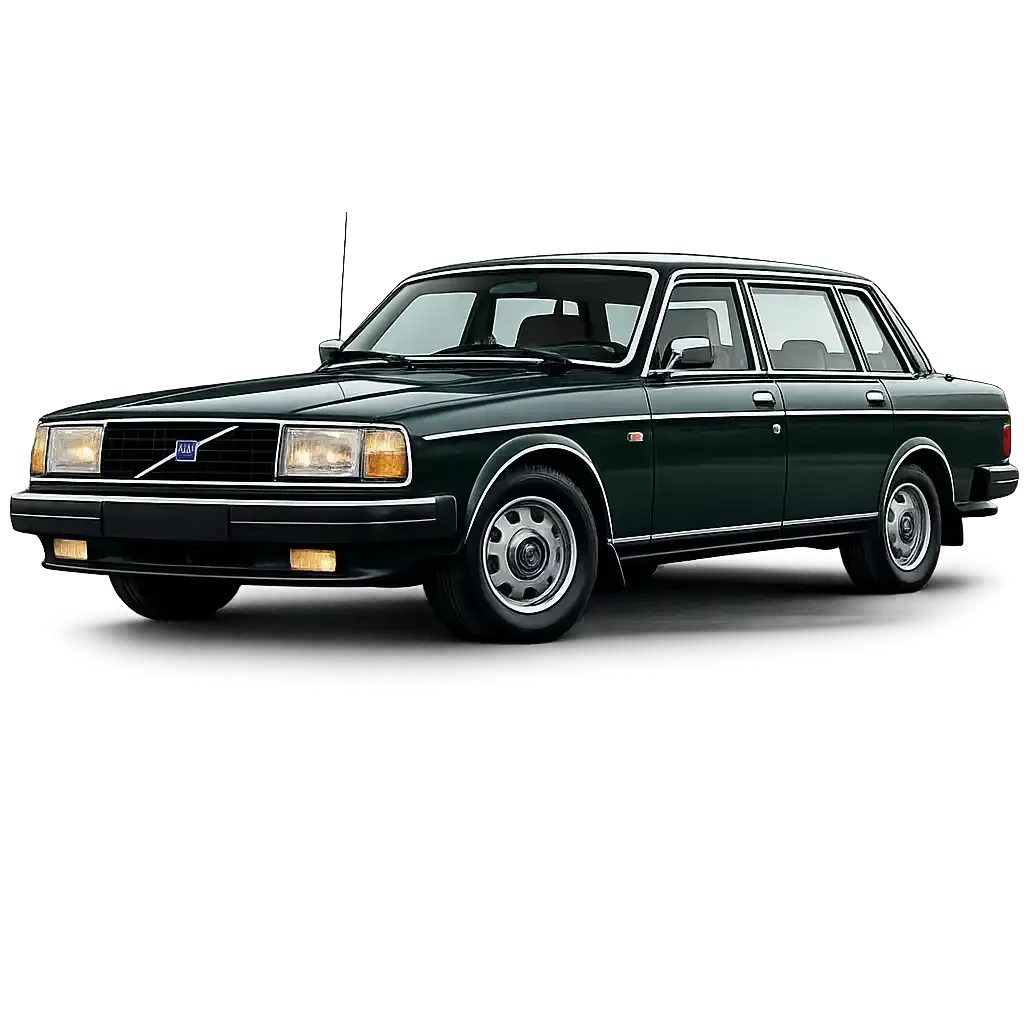
By 1986, the Volvo 244 had been in production for over a decade. The car that arrived in showrooms for the 1986 model year looked familiar, but Volvo had quietly changed nearly everything a parts seller needs to care about. The taillights were new. The body cladding was wider. The engine evolved again. The fuel injection system completed its transition to full electronic control. And for the first time, ABS brakes appeared as an option on the 244.
This second major facelift carried the 244 through to its final production year. In most markets, the 244 nameplate ended in 1993, though in the U.S. market it was effectively replaced by the 240 designation starting in 1986 (Volvo dropped the engine-code suffix, and all 200 series sedans became "240" regardless of engine). For clarity in this post, we will continue using the 244 designation, since that is what appears in many aftermarket catalogs and the parts remain the same regardless of badge.
This post covers the 1986 to 1989 era. These are the final-evolution 244s before the car entered its last years of production with minimal further changes. For parts sellers, this era introduces new fitment splits on top of the ones established in 1981, and if your catalog does not account for them, you are shipping wrong parts to a buyer base that increasingly consists of knowledgeable enthusiasts who will catch every error.
What the 1986 Facelift Changed
Taillights: Third and final design
The 1986 facelift introduced the third distinct taillight design in the 244's production history. The taillight housings, lenses, gaskets, and bulb configurations are different from both the 1975 to 1980 originals and the 1981 to 1985 first-facelift units.
The 1986 and later taillights are often described as "wider" or "more modern" than the earlier designs, and they integrated differently with the rear body panel. The mounting points, gasket profile, and wiring connector are all unique to this era.
For sellers, the Volvo 244 now has three non-interchangeable taillight designs across its production run. A single "Volvo 244 taillight" listing that does not specify the era will cross-match three different parts. This is one of the most predictable return generators in the entire 200 series catalog.
Body cladding: Wider, more protective
The 1986 facelift added wider body side cladding and larger wheel arch extensions. The narrow chrome strips and thin rub rails of the earlier cars were replaced with wider, more substantial plastic body moldings that wrapped around the wheel arches and ran along the lower body sides.
This change affects body molding kits, wheel arch trim, rocker panel trim, fender trim, and door edge protectors. All of these parts are era-specific. A "Volvo 244 body side molding" listing must specify whether it fits the narrow-trim (1975 to 1980), medium-trim (1981 to 1985), or wide-trim (1986 and later) body style.
The wider cladding also means that fender liner clips, push fasteners, and trim attachment hardware may differ from earlier cars. Sellers listing body hardware kits should verify which cladding generation the kit is designed for.
Front end: Evolutionary updates
The rectangular headlight design from 1981 continued into the 1986 and later cars, but with refinements. The grille received subtle updates (bar pattern, badge mounting), and the front turn signal/parking light assemblies were revised. Some of these changes were minor (lens color tint, gasket shape), but they can still prevent a clean fit if the wrong year's part is shipped.
The headlight bezels and surrounds may also have been updated with slightly different finishes or contours. Sellers listing front lighting components should not assume that "1981 to 1993, rectangular headlight" is a single fitment window. There are sub-splits within the rectangular headlight era.
Bumpers: Further refinement
The bumper assemblies received another update, with changes to the end caps, impact strips, and mounting hardware. U.S. market bumpers continued to include energy-absorbing systems, but the specific bracketry, shock absorbers, and reinforcement bars were revised from the 1981 to 1985 units.
European market bumpers also evolved, with some markets receiving body-colored bumper covers in place of the earlier black rubber-faced units. This adds another variable: bumper color/material (body-colored vs. black) on top of market designation (U.S. vs. European).
Under the Hood: The B230 Engine
B230 replaces B23
The engine designation changed from B23 to B230 starting in 1986 (the exact changeover year varies by market, with some 1985 models already receiving the B230). The B230 was essentially a further development of the B23, sharing the same basic red block architecture, but with meaningful changes to the cylinder head, fuel injection, and emission controls.
What changed from B23 to B230:
The cylinder head was updated. The combustion chamber design evolved, with some B230 variants receiving a higher-swirl intake port design for improved emissions and efficiency. Head gasket specifications may differ between late B23 and early B230 heads.
The fuel injection system completed its transition to LH-Jetronic 2.2 and later LH 2.4 electronic injection. By 1986, K-Jetronic (CIS) was gone from the 244 in virtually all markets. This simplifies fuel system parts listings for 1986 and later cars (everything is LH-Jetronic), but it creates a hard boundary with any pre-1986 car that still used K-Jetronic.
The ignition system transitioned from conventional breaker-point or basic electronic ignition to the Bosch EZK (Elektronische Zundung mit Klopfregelung) computerized ignition with knock sensing on many models. This affected the distributor, ignition module, knock sensor, and associated wiring.
B230 variants
The B230 family included several variants during the 1986 to 1989 period:
B230F: The standard naturally aspirated variant with LH-Jetronic 2.2 fuel injection and EZK ignition. This was the most common engine in U.S. market 244s of this era.
B230FT: The turbocharged variant, used in the 244 Turbo. It added a Mitsubishi or Garrett turbocharger, an air-to-air intercooler, a different exhaust manifold, higher-flow fuel injectors, a modified ECU with boost enrichment, and an upgraded cooling system. The turbo-specific components do not interchange with the naturally aspirated B230F.
B230K: A lower-output variant used in certain European markets, with different compression ratio and emission equipment.
B230E: A designation used in some markets for the base fuel-injected version.
For sellers, the B230 era is easier to catalog than the B23 era because the fuel injection system is standardized on LH-Jetronic. However, the naturally aspirated vs. turbocharged split remains critical, and the specific LH-Jetronic version (2.2 vs. 2.4) can matter for ECU, airflow sensor, and injector compatibility.
Emission system complexity
The 1986 and later 244s had increasingly sophisticated emission control systems to meet tightening regulations. This included a catalytic converter (standard on U.S. cars, optional or absent in some other markets), EGR valve (exhaust gas recirculation), air injection system (pulsed air or belt-driven air pump), and an evaporative emission canister.
Emission components are heavily market-dependent. A U.S. spec 1988 244 has a different catalytic converter, different O2 sensor configuration, and different EGR setup than a European spec 1988 244. These differences extend to the exhaust manifold (some U.S. turbo cars had a two-piece manifold with integrated wastegate, while European cars differed).
Sellers listing exhaust system components, catalytic converters, O2 sensors, EGR valves, and air injection parts must specify the market and emission standard. California emission vehicles are a further sub-split within the U.S. market, with different catalytic converter configurations and sometimes different ECU calibrations than 49-state cars.
Transmission and Drivetrain
Manual transmissions
The M46 (with overdrive) and M47 transmissions were available in this era. The M47 was a five-speed manual that replaced the M46 in some markets and model years. The M47 had a different case, different gear ratios, and a different shift linkage than the M46. Driveshaft length, crossmember, and transmission mount fitment depend on the specific manual transmission installed.
Automatic transmissions
The AW70 and AW71 automatics continued, with the AW71 being the more common unit in later production. Some markets also received the AW72 (a lock-up torque converter version). The internal components (filter, gasket set, bands, clutch packs) differ between AW70, AW71, and AW72. External parts like cooler lines, shift cables, and transmission mounts may also differ.
As with every era of the 244, "automatic" is not a sufficient transmission qualifier. The specific unit code is required.
Brakes: The ABS Variable
ABS arrives on the 244
The most significant brake system change in the 1986 to 1989 era was the introduction of ABS (anti-lock braking system) as an option on the 244. Volvo used a Bosch ABS system on these cars, and its presence or absence creates fitment splits across multiple brake component categories.
What ABS changes for parts fitment:
The brake hydraulic lines (PartTerminologyID 1820) are routed differently on ABS-equipped cars. The lines run to the ABS hydraulic modulator before continuing to the wheel calipers and wheel cylinders. Non-ABS cars route lines directly from the master cylinder and proportioning valve to the wheels. The line lengths, routing paths, and end fittings differ.
The master cylinder bore size and design may differ between ABS and non-ABS cars. The proportioning valve may be integrated into the ABS modulator rather than being a separate inline unit.
The brake hoses (PartTerminologyID 1792) at each wheel may have different end fittings on ABS-equipped cars to accommodate the ABS wheel speed sensor wiring and the different hard line routing.
The wheel bearing and hub assemblies may include an ABS tone ring (reluctor ring) on ABS-equipped cars. If the tone ring is integral to the hub or bearing, the hub/bearing assembly is a different part number for ABS vs. non-ABS applications.
For sellers, the introduction of ABS on the 244 means that every brake component listing for 1986 and later cars must include an ABS/non-ABS qualifier. This applies to master cylinders, brake lines, brake hoses, proportioning valves, wheel bearings/hubs, and the ABS-specific components (modulator, wheel speed sensors, wiring harnesses, ABS pressure and return hoses per PartTerminologyID 1796 and 1800).
Rear brakes
The rear disc vs. rear drum split continued in this era. The specific rear brake configuration depends on the model, market, and option packages. Rear brake component listings must specify the brake type.
Electrical System and Accessories
Engine management wiring
The transition to fully electronic engine management (LH-Jetronic 2.2/2.4 fuel injection plus EZK electronic ignition) meant a more complex engine wiring harness than the earlier K-Jetronic cars. The harness connectors, sensor plugs, and ECU pinouts are specific to the LH-Jetronic/EZK combination. An engine harness from a 1979 K-Jetronic car will not work on a 1987 LH-Jetronic car.
Power accessories
By the mid-1980s, power windows, power mirrors, and central locking were increasingly common on the 244. These accessories used electric motors, switches, and wiring that were not present on base models or earlier cars. Parts listings for window regulators, mirror motors, and lock actuators should note whether the part is for the power or manual version.
Climate control
Some 1986 and later 244s in higher trim levels received automatic climate control (ACC) in place of the manual HVAC controls used on earlier and base-model cars. The ACC system uses different control head, servo motors, sensors, and wiring than the manual system. HVAC component listings must specify manual vs. automatic climate control.
The 240 vs. 244 Naming Confusion
Starting in 1986, Volvo simplified its naming convention for the U.S. market. The 242, 244, and 245 designations were dropped in favor of "240" for all body styles (sedan and wagon; the two-door 242 was discontinued). The 244 sedan and 245 wagon both became "240."
This creates a catalog headache. In ACES data, a "240" listing for 1986 and later may need to specify body style (sedan vs. wagon) for any parts that differ between the two (taillights, rear bumper, liftgate/trunk components, rear wiring, cargo area trim). In some databases, the older "244" and "245" designations persist alongside the newer "240" designation, potentially creating duplicate application records.
Sellers should verify how their catalog system handles this name change and ensure that application records are not duplicated or contradicted across the old and new naming conventions.
Common ACES/PIES Mistakes for 1986 to 1989
Treating "1981 to 1993, rectangular headlights" as a single fitment window for front lighting, grille, and bumper parts. There are sub-splits within this range.
Listing brake components without the ABS/non-ABS qualifier. ABS was new on the 244 in this era, and its presence changes line routing, master cylinder specification, and hub/bearing assemblies.
Omitting the California vs. 49-state emission split for exhaust, catalytic converter, and O2 sensor listings.
Confusing 240 and 244 designations in application records, creating duplicate or conflicting fitment data.
Listing B230 engine parts without the turbo/non-turbo split. The B230F and B230FT share the block but differ on intake, exhaust, fuel injection calibration, and cooling components.
Failing to specify the LH-Jetronic version (2.2 vs. 2.4) for ECU, airflow sensor, and injector listings where the version matters.
Listing automatic transmission parts without the specific unit code (AW70, AW71, AW72).
The Enthusiast Market
The 1986 to 1989 244 occupies an interesting position in the collector market. These are the most refined versions of the original 244 design. They have the best engines (the B230 is widely regarded as the most reliable and most tunable version of the red block), the most complete equipment levels, and the most modern safety features (including ABS on some models).
The enthusiast community around these cars is active and technically sophisticated. They build turbocharged 244s for performance, restore stock examples for shows, and maintain high-mileage daily drivers with meticulous attention to correct parts. This community does not tolerate vague or inaccurate listings. They know the difference between a B230F and a B230FT. They know whether their car has ABS. They know the LH-Jetronic version. And they will return a part that does not match.
For sellers who invest in accurate fitment data, this community represents repeat business. Volvo 200 series owners tend to own multiple Volvos, maintain them for long periods, and share parts source recommendations within their community. A seller who gets the fitment right earns word-of-mouth referrals that no advertising can buy.
Catalog Checklist for 1986 to 1989 Volvo 244
Enforce the 1985/1986 boundary for taillights, body cladding, and bumper trim
Require ABS/non-ABS qualifier for all brake system components
Require engine code (B230F, B230FT, B230K, B230E) for all engine parts
Require LH-Jetronic version (2.2 or 2.4) for ECU, airflow sensor, and injector listings where applicable
Require transmission code (M46, M47, AW70, AW71, AW72) for all drivetrain parts
Specify emission standard (California, 49-state, European) for exhaust, catalytic converter, O2 sensor, and EGR parts
Resolve 240 vs. 244 naming in application records to prevent duplication
Specify body style (sedan/wagon) for rear body parts when using the "240" designation
Specify climate control type (manual/automatic) for HVAC components
Specify power vs. manual for window regulators, mirrors, and locks
Cross-Reference Logic
Volvo 245/240 Wagon (same front end, same engines, wagon body)
Volvo 740 (shares B230 engine family, many engine and fuel system parts interchange, different body and platform)
Volvo 940 (shares some late B230 engine components and LH-Jetronic parts)
Frame as "may also fit" with engine code, injection version, and body style qualifiers. The 740 cross-reference is particularly important because the 740 used the same B230 engine family, and many engine, fuel injection, and ignition parts are interchangeable between the 244/240 and 740 when the engine code and injection system match.
Final Take
The 1986 to 1989 Volvo 244 is the most complex era to catalog correctly, because it layers new variables (ABS, wider body cladding, B230 engine variants, emission splits, naming convention changes) on top of all the splits established in the two earlier eras.
The temptation is to simplify. To list a part as "Volvo 240/244, 1986 to 1993" and call it done. But simplification in this category means returns. It means a non-ABS master cylinder shipped to an ABS-equipped car. It means a 49-state catalytic converter shipped to a California emission vehicle. It means a B230F exhaust manifold shipped to a turbocharged car.
The fix is the same as it has been across every era of this car: require the attributes that define the fitment. Engine code. Injection version. ABS or not. Emission standard. Transmission code. Body style. These are the fields that separate a catalog that works from a catalog that generates returns.
Disclaimer: This guide is based on publicly available specifications, Volvo press materials, and independent research. Part interchangeability should always be confirmed via VIN and OEM part number lookup. Specifications may change without notice. This document does not constitute official Volvo parts catalog data. Visuals and illustrations in this article were generated using AI for representative purposes and may not reflect exact technical schematics.