
Written by Arthur Simitian | PartsAdvisory
The Volvo 242 launched alongside the 244 and 245 in 1975 as part of the new 200 series. Same platform, same firewall, same basic structure. Where the 244 was the four-door family sedan and the 245 was the wagon, the 242 was Volvo's two-door offering - a slightly sportier proposition aimed at buyers who wanted the 200 series solidity with a cleaner roofline.
For aftermarket parts sellers, the 242 presents a particular challenge: it shares so much with the 244 and 245 that sellers frequently over-extend their fitment windows, applying 244 listings to the 242 without checking where the two cars actually diverge. And they do diverge - significantly - in the rear body, the rear lighting, the rear doors, the trunk, and several interior components. The shared front end and engine bay create a false sense of universal compatibility that generates consistent returns in rear-body part categories.
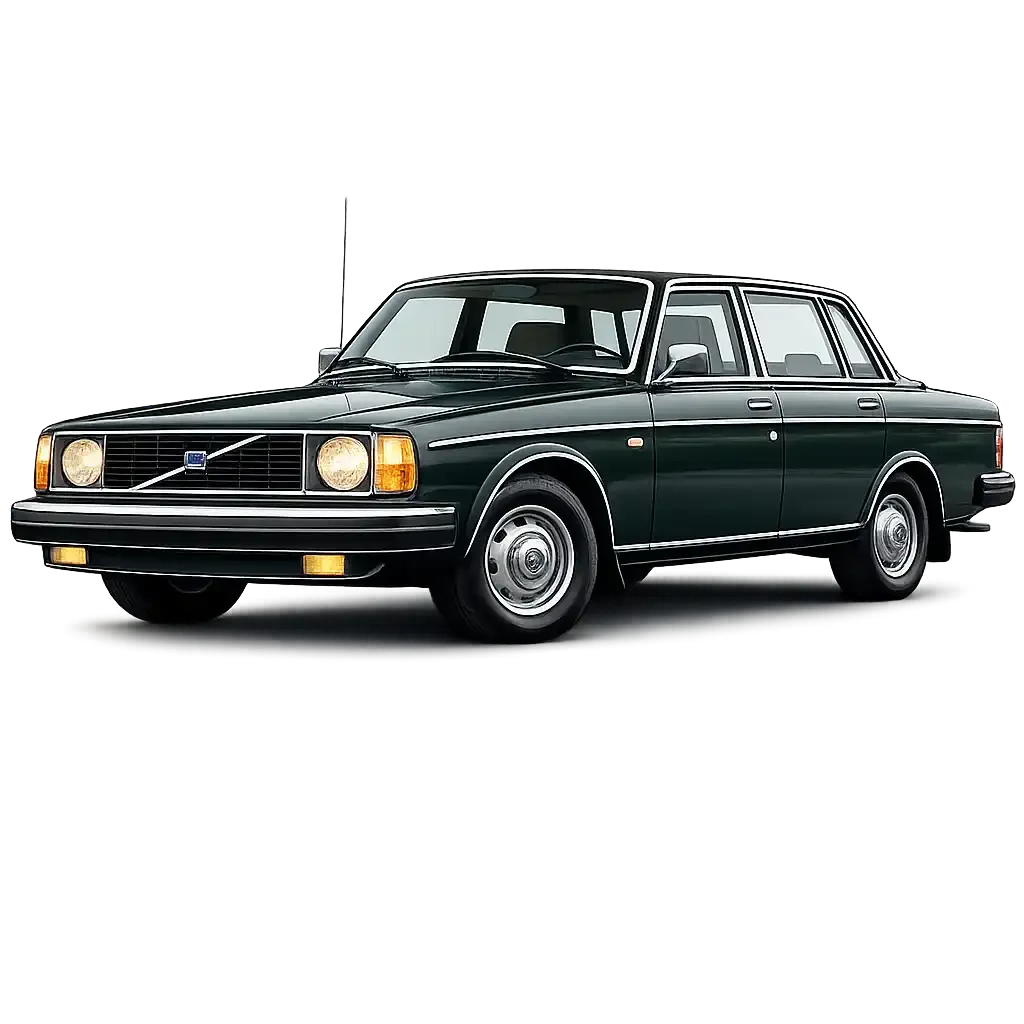
This post covers the 1975 to 1980 Volvo 242 - the original style with round headlights, chrome bumpers, and the B20 or B21 engine. The 1981 facelift that introduced rectangular headlights will be covered separately. If your catalog treats 1975 to 1985 as a single fitment window on the 242, the front end components are only the beginning of your return exposure. The rear is where the 242-specific mismatches accumulate.
What makes the 242 different from the 244 and 245
The two-door body
The 242 designation followed Volvo's naming convention: 2 for the series, 4 for four cylinders, 2 for two doors. The two-door body shared the 244's A-pillar, firewall, floor pan, and front subframe. From the B-pillar back, the cars diverge.
The 242 has longer door skins than the 244. The rear quarter panels are unique to the two-door body, with a fixed rear side window integrated into the quarter panel rather than a separate rear door opening. The C-pillar angle and profile differ. The trunk lid, trunk opening dimensions, and trunk weatherstrip are specific to the 242. The rear bumper-to-body interface is the same basic design as the 244 sedan, but the body panels surrounding it are different.
For sellers, this means: any part that touches or interacts with the rear body of the car must be verified as 242-specific before being listed as a cross-fit from the 244 or 245. The front end, engine bay, and underbody are largely shared. Everything from the B-pillar back requires independent verification.
Rear doors: none
The 242 has no rear doors. This sounds obvious, but it has catalog implications. Door weatherstrips, door glass, door regulators, door handles, door locks, and door panel listings that include both 242 and 244 applications are only valid for the front doors. Rear door components from the 244 have no application on the 242 at all. A listing that reads "Volvo 242/244 door weatherstrip" without specifying front or rear will send rear door weatherstrips to 242 owners who cannot use them.
Rear quarter windows
The 242 has fixed rear quarter windows integrated into the rear quarter panel. These are not the same as the rear door glass on a 244. The glass shape, the rubber seal or gasket, the trim surround, and the mounting method are all unique to the 242's two-door body. There is no 244 equivalent for this component.
Exterior: what defines the 1975 to 1980 242
Headlights: quad round, sealed beam
The original 242 used the same quad round sealed beam headlights as the 244 - two units per side. This is the definitive visual identifier for the pre-facelift car. The 1981 facelift switched the entire 200 series to rectangular headlights, and the header panel, grille, bezels, buckets, and front wiring all changed with it.
For sellers, the headlight split at 1980/1981 is a hard boundary. Round headlight components and rectangular headlight components are completely incompatible. The header panel stamping, grille mounting interface, and headlight bucket dimensions are different. There is no fitment overlap.
Grille
The original 242 used the same grille as the 1975 to 1980 244 - designed around the round headlight openings, with the Volvo emblem centered. The mounting points, width, and vertical height are specific to the round headlight front end. No 1981-and-later grille will fit the original body without modification.
The grille is one of the highest-volume cross-fit opportunities between the 242 and 244 in this era. Verify the year range, but a correctly era-specified 244 grille will fit the 242.
Front bumper
The front bumper on the 242 was the same unit as the 244 in this era. The bumper face bar, end caps, and mounting hardware are shared. U.S. market cars had energy-absorbing bumper systems to meet federal 5 mph standards; European cars had lighter, simpler assemblies. The market split (U.S./Canada vs. Europe) is a fitment variable for bumper components regardless of body style.
Rear bumper
The rear bumper face bar and end caps are shared with the 244 sedan, as the rear body geometry at the bumper line is similar between the two-door and four-door bodies. However, the body panels immediately above and around the bumper differ between the 242 and 244, and trim pieces that bridge the bumper to the body may not transfer. Verify individually rather than assuming full rear bumper assembly interchangeability.
Taillights
The 242 taillights are specific to the two-door body. The taillight housing shape, lens design, mounting hole pattern, and gasket profile differ from the 244 sedan units. The 242's rear quarter panel has a different geometry at the tail end than the 244's rear body, which changes the taillight pocket dimensions and mounting interface.
This is one of the most common return sources on the 242: a seller lists a "Volvo 242/244 taillight" based on assumed commonality, when the two cars have different taillight assemblies from the outset. The 242 taillight is a 242-only part. Within the 242's own production run, the taillight design was updated with the 1981 facelift, creating a further split at the 1980/1981 boundary.
Trunk lid
The trunk lid is unique to the 242. The 244 trunk lid will not fit a 242, and vice versa. The hinge mounting points, the striker location, the lid profile at the rear window junction, and the weatherstrip channel are all specific to the two-door body. Trunk lid listings must specify the body style.
Rear quarter panels and body panels
As noted above, everything from the B-pillar back is 242-specific sheet metal. Rear quarter panels, the sail panel, the C-pillar trim, and the rear body panel between the taillights are not shared with the 244 or 245. Body panel listings must specify the 242 body style.
Side trim and body moldings
The 242 used the same narrow body side molding philosophy as the original 244 - thin chrome or bright beltline strip, rubber rub strip at door height, unadorned wheel arches. The molding pieces themselves may differ in length or shape where they pass over the longer 242 door vs. the shorter 244 front door and absent rear door. Molding kits should be verified for body style before listing as a shared fit.
Mirrors
The 242 used the same small chrome-backed side mirrors as the 244 in this era, mounted at the same door location. This is a genuine shared-fit opportunity that can be listed as such with appropriate year qualifiers.
Under the hood: B20 and B21
The 242 used the same engine family as the 244 and 245. Engine and fuel system parts are the primary cross-fit category between the 200 series body styles. The caveat is that engine code accuracy remains essential regardless of which body style you are listing for.
B20 (1975 in most markets)
The 2.0L B20 overhead valve pushrod engine appeared in early 1975 production 242s, carried over from the 140 series. It has a completely different cylinder head, valve train, intake manifold, and accessory drive layout compared to the B21 that replaced it. The two engines share almost nothing that matters for parts fitment.
Any engine component listing that includes 1975 must specify B20 vs. B21. A gasket set, valve cover, timing gear, or intake manifold listed for "Volvo 242, 1975 to 1980" without the engine code will ship the wrong part to B20-equipped early cars.
B21 (1975 to 1980)
The 2.1L B21 single overhead cam engine was the primary powertrain for this era. Several variants existed within the B21 family:
B21A: Lower-compression version for certain markets, often carbureted
B21E: Fuel-injected with K-Jetronic/CIS
B21F: Market-specific fuel-injected variant
B21ET: Turbocharged variant - the engine behind the 242 Turbo, which was a more significant variant on the 242 than on the 244
The engine code is not cosmetic. A cylinder head gasket, valve cover gasket, timing belt, intake manifold, or exhaust manifold must be matched to the specific B21 variant, not just the year range.
Fuel injection: Bosch K-Jetronic (CIS)
The dominant fuel system on B21-equipped 242s was Bosch K-Jetronic continuous injection (CIS): a mechanical system using a fuel distributor, warm-up regulator, auxiliary air valve, and cold start injector. None of these components interchange with the LH-Jetronic electronic injection system that arrived with the B23 engine in the early 1980s.
Fuel injection type is a mandatory attribute for all fuel system component listings. The year range alone does not determine the system, particularly at the 1975 boundary where B20 carbureted, B21 carbureted (B21A), and B21 K-Jetronic cars all coexisted depending on market.
Carbureted variants
Some markets received carbureted B21A versions of the 242. These cars have entirely different fuel delivery components: carburetor, mechanical fuel pump, choke cable, and carburetor-specific air cleaner housing. A fuel delivery listing that does not specify the delivery type will cross-match components from two incompatible systems.
Transmissions
The 242 used the same transmission options as the 244:
M40: 4-speed manual without overdrive
M41: 4-speed manual with electric overdrive (adds length to the transmission, changing driveshaft requirements)
BW35: 3-speed Borg-Warner automatic
BW55: 3-speed Borg-Warner automatic (more common in later years of this era)
The driveshaft length, transmission mount, crossmember, and shift linkage depend on the specific unit installed. "Manual" or "automatic" is not a sufficient qualifier for any drivetrain component. The specific transmission code is required.
The M41 overdrive is a particularly common return source on driveshaft listings. The overdrive unit adds to the transmission's overall length, which changes the driveshaft length relative to an M40-equipped car. A driveshaft listed for "242, manual" without the M40 vs. M41 distinction will be wrong half the time.
Suspension and brakes
Suspension
The 242 used the same front MacPherson strut and rear live axle arrangement as the 244. Spring rates, shock absorber specifications, and some bushing dimensions varied by market and suspension package. Heavy-duty or sport suspension packages existed on certain export models and trim levels, with different component specifications than the standard suspension.
Strut cartridge and complete strut assembly listings must specify whether the part fits standard or sport/heavy-duty suspension. Spring listings should include free height and spring rate. The 242's suspension geometry is shared with the 244, and genuine cross-fit opportunities exist here - but the suspension package qualifier still applies.
Brakes
The 1975 to 1980 242 used front disc brakes throughout. The rear brake configuration varied: most cars in this era used rear drum brakes, but rear disc brake axles were available on certain models and markets.
The rear brake type (disc or drum) is a mandatory qualifier for all rear brake component listings. The rear disc and drum assemblies are completely different parts. This split is not always apparent from the year or market designation alone, and the disc/drum configuration should be treated as an independent variable requiring verification.
Front brake components - rotors, calipers, pads, and hoses - are shared with the 244 in this era and can be listed as such with appropriate year and front-brake qualifiers.
Electrical system
The 242 shared its basic electrical architecture with the 244, including the alternator, starter, ignition system, and dashboard wiring. The front lighting harness is the same round-headlight design as the 244. The engine harness for K-Jetronic cars is the same unit.
Where the 242 diverges electrically is at the rear. The rear lighting harness runs to the 242-specific taillight housings and has different routing through the rear quarter panels than the 244 sedan harness. The trunk/interior lighting wiring differs. Any rear wiring harness listing must specify body style.
The 242 Turbo: a separate fitment profile
The 242 Turbo warrants its own section because it is frequently treated as a minor variant when it is actually a distinct model with a meaningfully different parts profile.
Volvo offered the 242 Turbo in several markets starting in 1977 in some regions, using the B21ET engine. The model used the same two-door body, but the engine bay was configured for the turbo installation. Turbo-specific components include:
Turbocharger (Garrett or Mitsubishi unit depending on year and market)
Modified exhaust manifold integrating the turbo mount
Intercooler (on some models and later production)
Boost control hardware (wastegate, boost pressure regulator)
Higher-flow fuel injectors
Modified ECU or fuel distributor calibration for boost enrichment
Upgraded cooling system components
None of these components interchange with the naturally aspirated 242. A seller who lumps "Volvo 242, 1975 to 1980, B21" into a single fitment window is cross-matching turbo and non-turbo cars across every one of these categories.
The 242 Turbo buyer is also among the most technically sophisticated in the 200 series market. They know exactly which turbo their car has, what the boost spec is, and which year's intercooler arrangement they are running. A vague listing will not satisfy them, and a wrong part will come back.
Common ACES/PIES mistakes for 1975 to 1980 Volvo 242
Using 244 taillight listings on the 242 without verification. The two cars have different taillight assemblies throughout the entire production run. This is the most predictable return category specific to the 242.
Listing door components (weatherstrips, glass, regulators, handles, panels) as "242/244" without specifying front-only. The 242 has no rear doors. Rear door parts from the 244 have no application on the 242.
Spanning the 1980/1981 boundary with a single application record for front lighting, grille, bumper, dashboard, or instrument cluster parts.
Listing 1975 engine components without the B20 vs. B21 split. Both engines were in production during the 1975 model year.
Listing fuel system parts without the injection system type. K-Jetronic CIS, LH-Jetronic, and carbureted variants existed across this era and market range. The parts are not interchangeable.
Listing B21 parts without the turbo/non-turbo qualifier. The 242 Turbo with B21ET has a distinct parts profile. Exhaust manifold, intake, injectors, and fuel system calibration all differ from the naturally aspirated cars.
Listing transmission or driveshaft parts without the specific transmission code. M40 vs. M41 changes driveshaft length. BW35 vs. BW55 changes internal component specifications.
Omitting the rear brake type (disc or drum) qualifier for rear brake components.
Treating trunk lid and rear quarter panel components as shared fits with the 244. These are 242-specific panels.
Catalog checklist for 1975 to 1980 Volvo 242
Enforce the 1980/1981 boundary as a hard split for all front lighting, grille, bumper, dashboard, and instrument cluster components
Require engine code (B20, B21A, B21E, B21F, B21ET) for all engine, fuel, and exhaust parts
Require fuel delivery type (carbureted, K-Jetronic/CIS) for all fuel system components
Require transmission code (M40, M41, BW35, BW55) for all drivetrain and driveshaft parts
Require rear brake type (drum or disc) for all rear brake components
Require market designation (U.S./Canada vs. Europe) for bumpers and lighting
Flag 1975 as a B20/B21 split year for all engine-related listings
Specify body style (242 two-door) for taillights, trunk lid, rear quarter panels, rear harness, and all rear body components
Specify "front only" for any door component listed across 242 and 244
Treat B21ET (242 Turbo) as a separate model profile requiring its own application records for engine, exhaust, fuel, and cooling components
Cross-reference logic
Volvo 244 (same year): Front end, engine, transmission, front suspension, and front brake components are shared. Rear body, rear lighting, trunk, rear wiring, and door count-dependent components are not.
Volvo 245 (same year): Same engine and front end sharing logic as the 244. No rear body components interchange.
Volvo 264/265 (same year): Same body structure and front end, but V6 (PRV) engine. Engine, fuel system, and exhaust components do not interchange. Suspension and some body components may overlap.
Volvo 262C (1977 to 1981): A coachbuilt variant of the 242 with a vinyl-covered roof and revised roofline by Bertone. The 262C shares mechanical components with the 242 but has unique body panels above the beltline. Do not cross-reference body or glass components between 262C and 242 without verification.
Frame all cross-references as "may also fit" with engine code, injection type, and body style qualifiers. The 244 cross-reference is the most useful one for this vehicle, but it requires the front/rear distinction to be explicit in every application record.
Final take
The 1975 to 1980 Volvo 242 is not a 244 with two fewer doors. It is a distinct body style that shares a platform with the 244 and 245 while diverging in every rear body component, both door assemblies, the trunk, and the rear lighting. Sellers who understand this distinction will get the front end and engine bay right by leveraging their 244 catalog work, and will avoid the 242-specific return categories by treating the rear body as a separate fitment exercise.
The five attributes that eliminate the majority of returns on 1975 to 1980 Volvo 242 parts: engine code, fuel delivery type, transmission code, rear brake type, and body-style qualification on rear components. Add those to every applicable listing, and the return rate drops. Leave them out, and the 242's technically engaged owner base will catch every error.
Disclaimer: This guide is based on publicly available specifications, Volvo press materials, and independent research. Part interchangeability should always be confirmed via VIN and OEM part number lookup. Specifications may change without notice. This document does not constitute official Volvo parts catalog data.