
Written by Arthur Simitian | PartsAdvisory
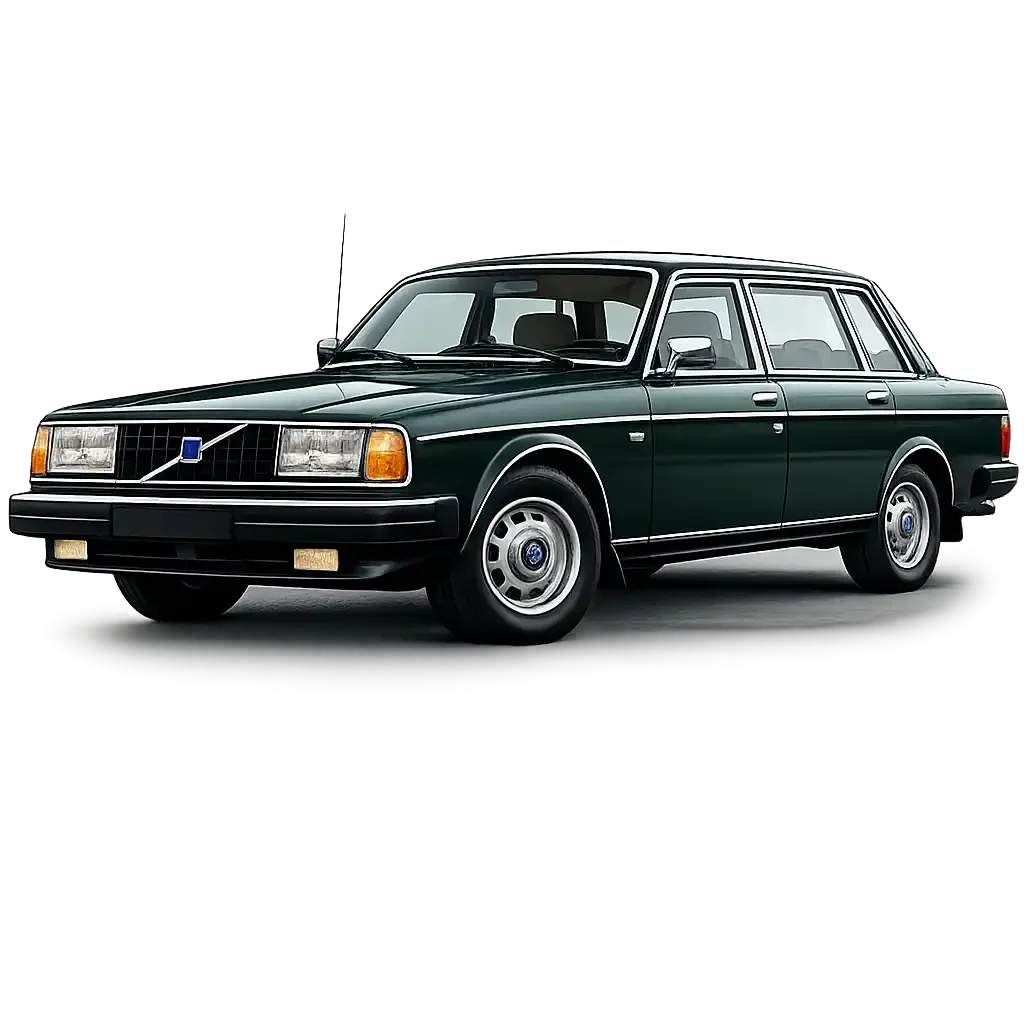
In 1981, Volvo gave the 244 its first significant visual update. The round headlights disappeared. Rectangular sealed beam units took their place. The grille was redesigned. The bumpers grew. The dashboard was replaced. Under the hood, the B21 gave way to the B23, and the fuel injection system began its transition from mechanical to electronic.
For anyone who was not paying attention, the car still looked like a Volvo 244. Same boxy shape. Same greenhouse. Same basic proportions. But for aftermarket parts sellers, 1981 was a hard line that divided nearly every exterior panel, most interior components, and a significant number of engine and fuel system parts into "before" and "after" categories.
This post covers the 1981 to 1985 Volvo 244, the first major facelift period. If you sell parts for the 200 series and your catalog treats 1975 to 1985 as a single fitment window, this is where the returns are coming from.
What the 1981 Facelift Actually Changed
The 1981 update was not a new car. The platform, the basic body structure, the doors, the roof, and the floor pan carried over. The changes were concentrated in four areas: the front end, the rear lighting, the interior, and the engine bay. Each area introduced new parts that do not interchange with the 1975 to 1980 originals.
Front end: Rectangular headlights and new grille
The most visible change was the switch from quad round headlights to rectangular sealed beam headlights. This was not a lens swap. The entire front end was redesigned.
Header panel: New stamping to accommodate the rectangular headlight openings. Different mounting points, different shape, different part number. The round headlight header panel will not accept rectangular lights, and the rectangular panel will not accept round lights.
Grille: Redesigned to integrate with the rectangular headlight openings. The 1981 to 1985 grille has a different width dimension at the headlight interface, different mounting tab locations, and a different bar pattern than the pre-1981 grille. The Volvo emblem placement remained centered, but the grille shell is a unique part.
Headlight bezels and buckets: Completely new parts. The round headlight rings, adjusting mechanisms, and bucket housings from the earlier cars are obsolete on the 1981 and later front end.
Front turn signal and parking light assemblies: Relocated and reshaped to match the new front end geometry. The lens shape, housing, and bulb configuration changed.
For sellers, this front end changeover means that every part forward of the windshield on the 244, from the grille to the headlights to the turn signals to the header panel, must carry a hard year split at 1980/1981. There is zero cross-compatibility in this zone.
Bumpers: Larger, more integrated
The 1981 facelift brought larger, more substantial bumper assemblies. The U.S. market cars continued to use energy-absorbing bumper systems to meet federal 5 mph standards, but the bumper face bars, end caps, mounting brackets, and reinforcement beams were all updated. The bumper-to-body interface changed, meaning the valance panels and fender-to-bumper transition areas also received new parts.
European market bumpers remained slimmer than U.S. units but were also updated from the pre-1981 design. The market split (U.S./Canada vs. Europe) continued to be a fitment variable within this era.
Bumper trim, end caps, and rubber strips from the 1981 to 1985 cars do not match the 1975 to 1980 bumper assemblies. Sellers listing bumper components need both the era and the market designation.
Taillights: Updated design
The taillight assemblies were redesigned for 1981. The lens shape, housing dimensions, gasket profiles, and bulb configurations changed from the 1975 to 1980 units. The mounting hole pattern on the body also shifted, meaning you cannot physically bolt a pre-1981 taillight onto a 1981 to 1985 body without modification.
Taillight lenses, housings, and gaskets are among the most commonly ordered parts for any sedan this age. A single listing that spans the facelift boundary without noting the taillight design change will generate consistent returns.
Interior: New dashboard and controls
The 1981 interior received a redesigned dashboard, updated instrument cluster, and new HVAC control panel. The basic architecture of the interior (door panel shape, seat mounting, center console) remained similar, but the dashboard assembly, gauge cluster, and many of the electrical switches changed.
Specific fitment concerns for interior parts in this era include dashboard pads, instrument cluster lenses and bezels, heater control valves and cables, and the radio/stereo mounting pocket dimensions. If a seller lists a "Volvo 244 dashboard pad" without era specification, the buyer will receive the wrong part roughly half the time.
Under the Hood: The B23 Engine
B23 replaces B21
The most significant mechanical change in the 1981 to 1985 era was the introduction of the B23 engine. The B23 was a 2.3L version of the Volvo red block four-cylinder, replacing the 2.1L B21. While the B23 shared the same basic block architecture as the B21 (they are both "red block" engines), the displacement increase and associated changes affected a meaningful number of parts.
What carried over from B21 to B23: The basic block casting dimensions, the bellhousing bolt pattern, and many of the external accessories. This is what makes the B21/B23 split tricky for sellers. The engines look almost identical externally, and many parts do interchange. But not all of them.
What changed: The crankshaft, pistons, and connecting rods changed to accommodate the 2.3L displacement. The cylinder head received updates on some variants. The intake manifold and fuel injection components changed as the injection system evolved.
B23 variants
Within the 1981 to 1985 window, several B23 variants existed:
B23E: Fuel-injected, Bosch LH-Jetronic (on later cars) or continued K-Jetronic (on transitional models). This is the critical detail. The switch from K-Jetronic mechanical injection to LH-Jetronic electronic injection did not happen on a single model year across all markets. Some 1981 and 1982 cars still used K-Jetronic. Some 1983 and later cars had LH-Jetronic. The changeover was market-dependent and sometimes mid-year.
B23F: A variant designation used in certain markets, typically with slightly different emission equipment or compression ratios.
B23ET: The turbocharged version, used in the 244 Turbo (and 242 Turbo). This variant added a turbocharger, intercooler (on some models), different exhaust manifold, boost control hardware, and higher-flow fuel injection components. Turbo-specific parts do not interchange with naturally aspirated B23 parts, even though the base engine is the same block.
For sellers, the B23 era requires the following mandatory splits in catalog data:
Engine code (B23E, B23F, B23ET)
Fuel injection system type (K-Jetronic CIS or LH-Jetronic)
Turbo vs. naturally aspirated
A listing for "Volvo 244, 1981 to 1985, 4-cylinder" that does not specify these attributes will cross-match parts that are physically incompatible. A K-Jetronic fuel distributor will not work on an LH-Jetronic car. A naturally aspirated exhaust manifold will not fit a turbo car. These are not edge cases. They are the primary fitment splits in this engine family.
The K-Jetronic to LH-Jetronic transition
This transition deserves its own section because it is the single largest source of fuel system part returns on the Volvo 200 series.
K-Jetronic (CIS) is a mechanical fuel injection system. It uses a fuel distributor (a complex precision metering device), a control pressure regulator/warm-up regulator, an air flow sensor plate that moves mechanically, and continuous fuel injection (fuel is always flowing to the injectors when the engine is running). The injectors are simple mechanical nozzles.
LH-Jetronic is an electronic fuel injection system. It uses an electronic control unit (ECU), a hot-wire or hot-film mass airflow sensor, pulsed fuel injectors (that open and close electronically), and a fuel pressure regulator. The fuel rail, injectors, airflow sensor, ECU, and wiring harness are completely different from K-Jetronic.
These two systems share almost nothing. The fuel injectors are different. The fuel rail is different. The airflow measurement device is different. The wiring is different. The only common components are the fuel pump, fuel filter, and fuel tank, which are shared across both systems (with some exceptions).
Any fuel injection component listing that does not specify K-Jetronic or LH-Jetronic is a liability. The year range alone is not sufficient because the changeover happened at different times in different markets.
Transmission and Drivetrain
The 1981 to 1985 244 continued with manual and automatic transmission options, but the specific units evolved.
Manual transmissions: The M46 (with overdrive) became more common, replacing the M41 on many models. The M46 used a laycock overdrive unit and had a different case length and shifter mechanism than the M41. The M45 (without overdrive) was also available. Driveshaft length, shift linkage, and crossmember fitment depend on the specific manual transmission installed.
Automatic transmissions: The AW55 and AW70/AW71 (Aisin Warner) automatics began appearing, replacing the earlier Borg-Warner BW55 on some models. The AW70/AW71 had a different case length, different torque converter, and different cooler line routing than the BW55. Parts sellers listing automatic transmission components (filters, gaskets, seals, cooler lines, mounts) must specify the transmission type.
The transmission code is essential for drivetrain parts in this era. "1981 to 1985, automatic" is not a sufficient qualifier when two or three different automatic transmissions may have been installed depending on model year and market.
Suspension and Brakes
Suspension
The front MacPherson strut and rear live axle layout carried over from the earlier cars, but spring rates, shock absorber specifications, and some bushing dimensions changed across model years and suspension packages. The 244 was available with standard and heavy-duty (sport) suspension packages, and the component specifications differ between them.
Strut cartridge and complete strut assembly listings must specify whether the part fits the standard or sport suspension. Spring listings should include free height and spring rate.
Brakes
The 1981 to 1985 244 continued with front disc brakes and either rear disc or rear drum brakes depending on the model and market. The front brake rotor diameter may have changed on some models within this era, and the caliper type (single-piston sliding caliper) may have been updated.
The key fitment variables for brake parts remain the same as the earlier era: front rotor diameter, rear brake type (disc/drum), and whether the vehicle has a load-sensing proportioning valve (which affects hard line routing).
ABS was not yet standard on the 244 in this era, so the ABS/non-ABS split is not typically a concern for 1981 to 1985 models. However, some late-production 1985 models in certain markets may have had early ABS systems. Sellers should verify rather than assume.
Electrical System
The 1981 facelift brought changes to the wiring harness, particularly in the front end (to accommodate the new headlight configuration) and the dashboard area (for the new instrument cluster and HVAC controls). The alternator, starter, and basic charging system components remained similar to the earlier cars, but the harness connectors and routing changed.
For sellers listing wiring harnesses, connector pigtails, or engine harness sub-assemblies, the facelift boundary is a hard split. A pre-1981 front lighting harness will not mate to the 1981 and later headlight and grille area.
Common ACES/PIES Mistakes for 1981 to 1985
Spanning the 1980/1981 boundary with a single application record for exterior lighting, grille, bumper, or dashboard parts. This is the most frequent error.
Listing fuel system parts without the injection system type. K-Jetronic and LH-Jetronic parts are not interchangeable, and the changeover year varies by market.
Listing engine parts as "B23" without the specific variant code. The naturally aspirated and turbocharged B23 share many parts but diverge on intake, exhaust, fuel, and boost control components.
Listing automatic transmission parts as "1981 to 1985, automatic" without specifying BW55 vs. AW70/AW71. Filter kits, gasket sets, and cooler lines differ.
Failing to note that the 1981 to 1985 taillights are different from both the earlier (1975 to 1980) and later (1986 to 1993) designs. The 244 had three different taillight designs across its production run.
The Aftermarket Opportunity
The 1981 to 1985 244 is the most common era for this model in the U.S. market. These cars sold well, survived well, and are now at an age where they are transitioning from "cheap used car" to "interesting classic." The buyer base is shifting from people who just need a water pump to keep their daily driver running, to enthusiasts who want correct, well-documented parts for a car they plan to maintain for years.
This transition rewards sellers who invest in accurate fitment data. The enthusiast buyer searches for the specific part, reads the listing carefully, and knows when the fitment description is incomplete. They will pay more for a listing that says "B23E, LH-Jetronic, 1983 to 1985, non-turbo" than a generic "Volvo 244, 4-cylinder" listing at a lower price. The specific listing builds trust. The generic listing generates returns.
Catalog Checklist for 1981 to 1985 Volvo 244
Enforce the 1980/1981 boundary for all exterior lighting, grille, bumper, dashboard, and instrument cluster parts
Enforce the 1985/1986 boundary for taillights and rear trim (the second facelift changed these again)
Require engine code (B23E, B23F, B23ET) for all engine, fuel, and exhaust parts
Require fuel injection system type (K-Jetronic/CIS or LH-Jetronic) for all fuel system components
Require transmission code (M45, M46, BW55, AW70, AW71) for all drivetrain parts
Specify suspension type (standard or sport) for struts, springs, and shock absorbers
Specify rear brake type (disc or drum) for all rear brake components
Note market (U.S./Canada/Europe) for bumpers, lighting, and emission-related parts
Cross-Reference Logic
Volvo 242 (same front end, same engines, two-door body)
Volvo 245 (same front end, same engines, wagon body)
Volvo 264/265 (same body, V6 engine, different engine bay components)
Volvo 740 (shares some B23 engine components, but different body and platform)
Frame as "may also fit" with engine code, injection type, and body style qualifiers.
Final Take
The 1981 to 1985 Volvo 244 is the era where the catalog complexity spikes. The front end is new. The engine displacement changed. The fuel injection system is in transition between two fundamentally different technologies. The transmission options expanded. A single listing that spans this era without the right attributes will cross-match parts that physically do not fit.
For sellers, the investment is in five attributes: engine code, injection type, transmission code, headlight era, and market designation. Add those five fields to every 244 listing in the 1981 to 1985 range, and the return rate drops. Leave them out, and the returns will keep coming from buyers who know exactly what they need and know that the listing did not tell them.
Disclaimer: This guide is based on publicly available specifications, Volvo press materials, and independent research. Part interchangeability should always be confirmed via VIN and OEM part number lookup. Specifications may change without notice. This document does not constitute official Volvo parts catalog data. Visuals and illustrations in this article were generated using AI for representative purposes and may not reflect exact technical schematics.