
Written by Arthur Simitian | PartsAdvisory
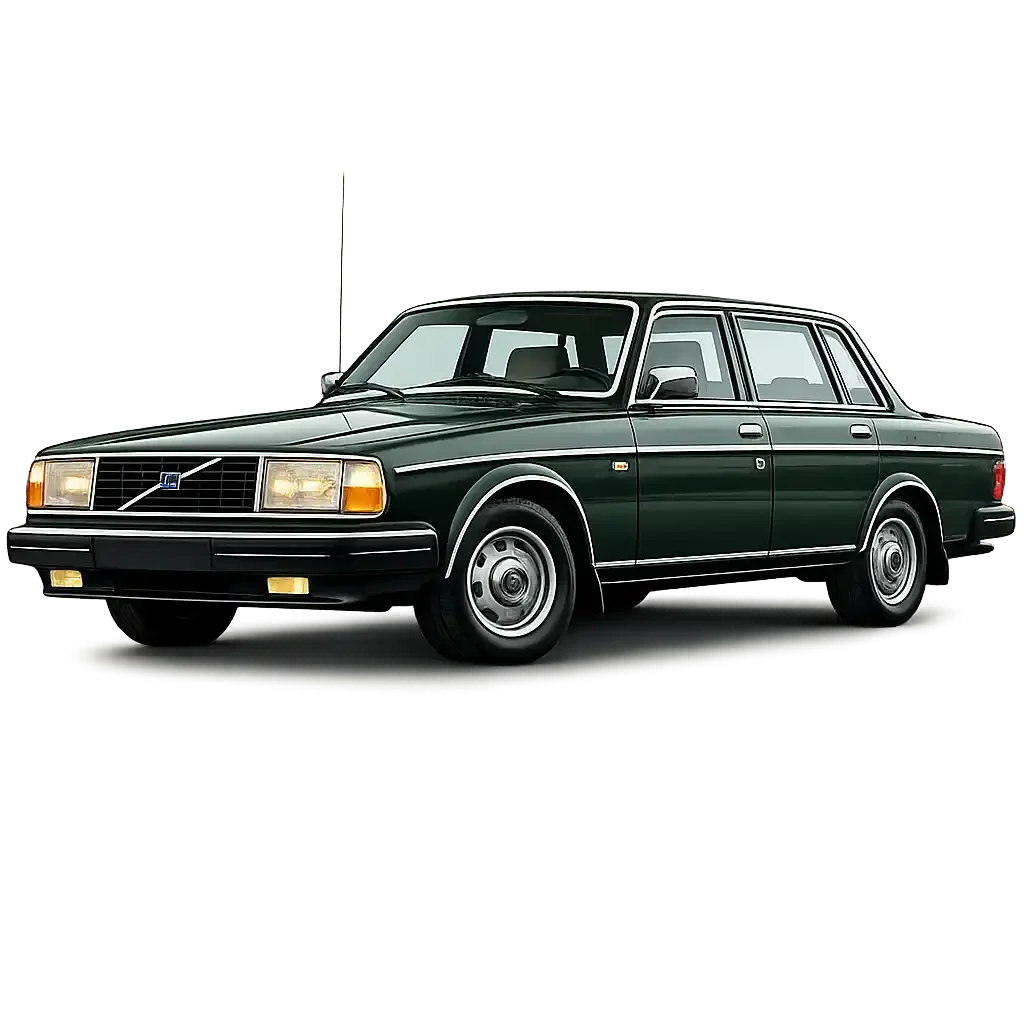
In 1981, the Volvo 242 received its first significant update. The round headlights were gone. Rectangular sealed beam units replaced them. The grille was redesigned. The bumpers grew. The dashboard was replaced. Under the hood, the B21 gave way to the B23, and the fuel injection system began its transition from mechanical K-Jetronic to fully electronic LH-Jetronic.
To a casual observer, the car still looked like a 242. The two-door body remained. The roofline was unchanged. The basic proportions carried over. But for aftermarket parts sellers, 1981 was a hard line that divided nearly every front-end component, most interior parts, and a significant number of engine and fuel system listings into before and after categories.
This post covers the 1981 to 1984 Volvo 242 - the first major facelift period. It picks up where the 1975 to 1980 original-style guide left off. If you sell parts for the 200 series and your catalog treats 1975 to 1984 as a single fitment window for exterior or interior components, this is where the returns are coming from.
What the 1981 Facelift Changed on the 242
The 1981 update was not a new car. The platform, the two-door body structure, the doors, the roof, and the floor pan carried over from the original 242. The changes were concentrated in four areas: the front end, the rear lighting, the interior, and the engine bay. Each area introduced new parts that do not interchange with the 1975 to 1980 originals.
Front end: rectangular headlights and new grille
The most visible change was the switch from quad round headlights to rectangular sealed beam headlights. This was not a lens swap. The entire front end was redesigned.
The header panel received a new stamping to accommodate the rectangular headlight openings. The mounting points, shape, and part number are all different from the round-headlight header panel. The grille was redesigned around the rectangular headlight interface, with different mounting tab locations, different bar pattern, and a different width dimension at the headlight opening. The headlight bezels, buckets, and adjusting mechanisms are completely new parts.
The front turn signal and parking light assemblies were relocated and reshaped to match the new front end geometry. The lens shape, housing, and bulb configuration changed.
For sellers, this front end changeover means that every component forward of the windshield - grille, headlights, bezels, turn signals, header panel - must carry a hard year split at 1980/1981. There is zero cross-compatibility in this zone between the original and facelift cars.
The 242 and 244 continue to share this front end. A correctly era-specified 1981 to 1984 244 grille or headlight fits the 1981 to 1984 242. The shared front end cross-fit opportunity that existed in the original era carries forward into the facelift era.
Bumpers: larger, more integrated
The 1981 bumpers were substantially larger than the chrome units of the original 242. U.S. market cars continued to use energy-absorbing systems to meet federal 5 mph standards, but the face bars, end caps, mounting brackets, reinforcement beams, and bumper-to-body interface all changed.
European market bumpers also evolved. The market split (U.S./Canada vs. Europe) remained a fitment variable. Sellers must specify both the facelift era and the market for any bumper-related listing. A bumper end cap from a 1979 242 will not fit a 1982 242, and a U.S. spec 1982 bumper bracket will not match a European spec 1982 car.
Taillights: new design, still 242-specific
The taillight assemblies were redesigned for 1981. The lens shape, housing dimensions, gasket profiles, and bulb configurations all changed from the 1975 to 1980 units. The body mounting hole pattern shifted, meaning a pre-1981 taillight cannot be bolted onto a 1981 to 1984 242 body without modification.
Critically, the 1981 to 1984 242 taillights remain specific to the two-door body. They do not interchange with the 1981 to 1984 244 sedan taillights. This is the same situation as in the original era: the shared platform assumption breaks down at the rear, and the 242 taillight is a 242-only part.
The 242 taillight has now created three distinct fitment windows across the car's production run: the 1975 to 1980 original, the 1981 to 1984 facelift, and the 1985 to 1993 second facelift era. A single "Volvo 242 taillight" listing without era specification is wrong for two of the three generations at any given time.
Interior: new dashboard and controls
The 1981 interior received a redesigned dashboard, updated instrument cluster, and a new HVAC control panel. The basic architecture of the interior carried over - door panel shape, seat mounting, and center console footprint remained similar - but the dashboard assembly, gauge cluster, and most electrical switches changed.
Dashboard pads, instrument cluster lenses and bezels, heater control valves and cables, and the radio mounting pocket dimensions are all era-specific. A dashboard pad listed as "Volvo 242, 1975 to 1984" will be wrong for roughly half of those buyers. The 1980/1981 interior boundary is a hard split.
The 1981 to 1984 242 and 244 continued to share their dashboard and interior components. A dashboard pad, instrument cluster, or HVAC control unit from the 1981 to 1984 244 will fit the same-year 242.
Body cladding: updated but not wide
The 1981 facelift updated the body side moldings on the 242. The result was more substantial than the narrow chrome strips of the original cars, but narrower than the wide plastic body cladding introduced with the second facelift in 1986. Sellers should treat this as a distinct middle generation: the 1981 to 1984 molding kits are not interchangeable with either the 1975 to 1980 originals or the 1986-and-later wide-cladding cars.
The 242's molding pieces will differ in length from the 244's equivalent generation, given the longer door skins and absence of rear doors. Verify body style before listing molding kits as a cross-fit between 242 and 244 even within the same facelift era.
Under the Hood: The B23 Engine
B23 replaces B21
The 2.3L B23 replaced the 2.1L B21 starting with the 1981 model year, though the transition was gradual and market-dependent in some regions. The B23 shares the same fundamental red block architecture as the B21 and the same bellhousing bolt pattern. Many external accessories carry over. But the displacement increase affected the crankshaft, pistons, connecting rods, and cylinder head, and the intake and fuel injection components evolved alongside it.
The apparent similarity between B21 and B23 is a catalog trap. Engines that look nearly identical externally have different part numbers for cylinder head gaskets, head bolts, valve cover gaskets on some variants, and fuel injection hardware. The engine code must appear in every listing.
B23 variants
Within the 1981 to 1984 window, the following B23 variants existed in the 242:
B23E: Fuel-injected, transitional between K-Jetronic and LH-Jetronic depending on market and year
B23F: Variant designation used in certain markets with different emission equipment or compression ratios
B23ET: Turbocharged variant, used in the 242 Turbo - with turbocharger, intercooler on some models, different exhaust manifold, boost control hardware, and higher-flow fuel injection components
The 242 Turbo continued as a distinct performance model in this era. The B23ET parts profile does not overlap with naturally aspirated B23 applications. Exhaust manifold, intake, injectors, intercooler (where fitted), boost control, and fuel system calibration are all turbo-specific. Sellers must treat B23ET as a separate application from B23E and B23F.
The K-Jetronic to LH-Jetronic transition
This transition is the single largest source of fuel system part returns on the 200 series in this era, and it runs directly through the 1981 to 1984 window.
K-Jetronic (CIS) is a mechanical fuel injection system. It uses a fuel distributor, control pressure regulator, warm-up regulator, and an airflow sensor plate that moves mechanically. Fuel flows continuously to the injectors while the engine runs.
LH-Jetronic is an electronic fuel injection system. It uses an ECU, a hot-wire mass airflow sensor, pulsed injectors that open and close electronically, and a separate fuel pressure regulator. The fuel rail, injectors, airflow sensor, ECU, and wiring harness share nothing with K-Jetronic.
The switchover from K-Jetronic to LH-Jetronic did not happen on a single model year across all markets. Some 1981 and 1982 cars retained K-Jetronic. Some 1983 and 1984 cars had LH-Jetronic. The changeover was market-dependent and occasionally mid-year. The injection system type is not derivable from the year range alone.
Any fuel injection component listing that does not identify K-Jetronic or LH-Jetronic explicitly is incomplete. This applies to injectors, fuel rail, airflow sensor, fuel distributor, warm-up regulator, ECU, and the associated wiring harness.
The 242 Rear Body: Still Distinct from the 244
Everything that was true of the 242 rear body in the original era remains true in the 1981 to 1984 era. The second-generation 242 retained the same two-door body structure from the B-pillar back. The rear quarter panels, trunk lid, C-pillar profile, and rear body panel between the taillights are all 242-specific sheet metal that does not interchange with the 244 sedan.
The rear wiring harness routes to 242-specific taillight housings through the rear quarter panels, diverging from the 244 sedan harness. Any rear body panel, rear lighting, trunk lid, or rear wiring listing must specify the 242 body style.
The absence of rear doors on the 242 remains a catalog issue. Door weatherstrips, glass, regulators, handles, locks, and panel listings for the 1981 to 1984 242 are only valid for the front doors. A listing that spans 242 and 244 without a front/rear door qualifier will send rear door components to 242 owners who cannot use them - exactly the same problem as in the original era, now one generation later.
The fixed rear quarter windows unique to the 242 body also carry over. Glass shape, rubber seal, trim surround, and mounting method are all 242-specific. There is no 244 equivalent.
Transmissions
The 1981 to 1984 242 saw the M41 (with electric overdrive) give way to the M46 on many models. The M46 used a mechanical overdrive rather than an electric one, with a different case configuration and shift linkage than the M41. The automatic transmission market in this era also saw the Borg-Warner BW55 give way to the Aisin Warner AW70 and AW71 on some models and markets.
The AW70 and AW71 have a different case length, different torque converter, and different cooler line routing than the BW55. Filter kits, gasket sets, cooler lines, and transmission mounts differ between units. The transmission code is required for all drivetrain parts. Acceptable qualifiers for the 1981 to 1984 242 are M45, M46 (manual) and BW55, AW70, or AW71 (automatic). "Manual" and "automatic" alone are not sufficient.
Suspension and Brakes
Suspension
The 242 retained the front MacPherson strut and rear live axle layout from the original era. Spring rates, shock absorber lengths, and bushing specifications varied by market and suspension package. Sport or heavy-duty suspension packages remain a separate fitment profile from the standard setup.
Strut assembly listings should specify whether the part is a complete assembly or a cartridge-only replacement, and whether it fits standard or sport suspension. The 242 suspension geometry is shared with the 244 in this era and genuine cross-fit opportunities exist, but the suspension package qualifier still applies to both body styles.
Brakes
Front disc brakes continued throughout. The rear brake configuration remained a variable: most cars used rear drum brakes, but rear disc axles were available on certain models and markets. The rear brake type (disc or drum) is a mandatory qualifier for all rear brake component listings.
ABS was not standard on the 242 in this era. Some very late production 1984 models in certain markets may have had early ABS systems, but this is uncommon. Sellers should verify rather than assume ABS absence on all 1981 to 1984 cars.
Front brake components - rotors, calipers, pads, and hoses - are shared with the 244 in this era and can be listed as such with appropriate year and front-brake qualifiers.
Emission Systems
U.S. market 242s in this era were subject to federal emission standards, with California-specification cars requiring different catalytic converter configurations and sometimes different ECU calibrations than 49-state cars. The California vs. 49-state split is a required attribute for exhaust, catalytic converter, O2 sensor, EGR valve, and air injection system listings targeting the U.S. market.
European market cars had different emission equipment altogether. A single exhaust or emissions system listing without market and emission standard qualification is not reliably accurate for any 242 in this era.
Common ACES/PIES Mistakes for 1981 to 1984 Volvo 242
Spanning the 1980/1981 boundary with a single application record for front lighting, grille, bumper, dashboard, or instrument cluster parts. The facelift changed all of these, and the original and facelift components do not interchange.
Using 244 sedan taillight listings on the 242 without verification. The 1981 to 1984 242 taillight is a 242-specific part, just as it was in the original era. The shared platform does not extend to the rear lighting.
Listing fuel system parts without the injection system type. K-Jetronic and LH-Jetronic coexisted through much of this era depending on market. The year range does not determine the system.
Listing B23 parts without the turbo/non-turbo qualifier. The 242 Turbo with B23ET has a distinct parts profile. Exhaust manifold, intake, injectors, and boost control components all differ from naturally aspirated B23 applications.
Listing door components as "242/244" without specifying front-only. The 242 still has no rear doors. Rear door parts from the 244 have no application on the 242.
Listing transmission parts as "manual" or "automatic" without the unit code. M45, M46, BW55, AW70, and AW71 all have different internal and external specifications.
Failing to note that the 1981 to 1984 taillights are different from both the 1975 to 1980 originals and the 1985-and-later second facelift units. The 242 had three distinct taillight designs across its production run.
Omitting the California vs. 49-state emission split for exhaust and catalytic converter listings on U.S. market cars.
Treating trunk lid, rear quarter panels, and rear body panel components as shared fits with the 244. These remain 242-specific panels through the entire production run.
Catalog Checklist for 1981 to 1984 Volvo 242
Enforce the 1980/1981 boundary as a hard split for all front lighting, grille, bumper, dashboard, and instrument cluster components
Enforce the 1984/1985 boundary for taillights and body cladding (the second facelift changes these again)
Require engine code (B23E, B23F, B23ET) for all engine, fuel, and exhaust parts
Require fuel injection system type (K-Jetronic/CIS or LH-Jetronic) for all fuel system components
Require transmission code (M45, M46, BW55, AW70, AW71) for all drivetrain and driveshaft parts
Require rear brake type (drum or disc) for all rear brake components
Require market designation (U.S./Canada vs. Europe) for bumpers, lighting, and emission parts
Require California vs. 49-state qualifier for U.S. exhaust, catalytic converter, and O2 sensor listings
Specify body style (242 two-door) for taillights, trunk lid, rear quarter panels, rear harness, and all rear body components
Specify "front only" for any door component listed across 242 and 244
Treat B23ET (242 Turbo) as a separate model profile requiring its own application records for engine, exhaust, fuel, intercooler, and cooling components
Cross-Reference Logic
Volvo 244 (1981 to 1984): Front end, engine, transmission, dashboard, instrument cluster, front suspension, and front brake components are shared. Rear body, rear lighting, trunk, rear wiring, and door count-dependent components are not.
Volvo 245 (1981 to 1984): Same engine and front end sharing logic as the 244. No rear body components interchange.
Volvo 264/265 (same year): Same body structure and front end, but PRV V6 engine. Engine, fuel system, and exhaust components do not interchange. Suspension and some body components may overlap.
Volvo 262C (discontinued 1981): The 262C coachbuilt variant ended production in 1981. Late 262C mechanical components may cross-reference with early 1981 to 1984 242 mechanical parts, but body panels and glass should not be cross-referenced without verification.
Volvo 740 (1985 and later): Shares the B23 engine family. Engine internal components, some fuel injection hardware, and certain accessories may cross-reference with B23-equipped 1981 to 1984 242s when the engine code and injection system match. Platform, body, and suspension components do not interchange.
Frame all cross-references as "may also fit" with engine code, injection type, and body style qualifiers.
Final Take
The 1981 to 1984 Volvo 242 is the facelift generation that sellers most often get wrong, because it looks like a clean continuation of the original car while actually sitting on the wrong side of multiple hard fitment boundaries. The front end is new. The interior is new. The engine grew. The fuel injection system is in transition. The taillights changed again.
The temptation is to span 1975 to 1984 as a single window and let buyers sort it out. But that approach generates returns from a buyer base that is increasingly composed of knowledgeable enthusiasts who know exactly which version of the 242 they own and exactly which part they need.
The fix is the same attributes that work across every era of this car: engine code, injection type, transmission code, rear brake type, body style qualification on rear components, and a hard split at the 1980/1981 facelift boundary. Apply those consistently, and the 1981 to 1984 242 becomes a well-documented catalog entry rather than a chronic return source.
Disclaimer: This guide is based on publicly available specifications, Volvo press materials, and independent research. Part interchangeability should always be confirmed via VIN and OEM part number lookup. Specifications may change without notice. This document does not constitute official Volvo parts catalog data.c