
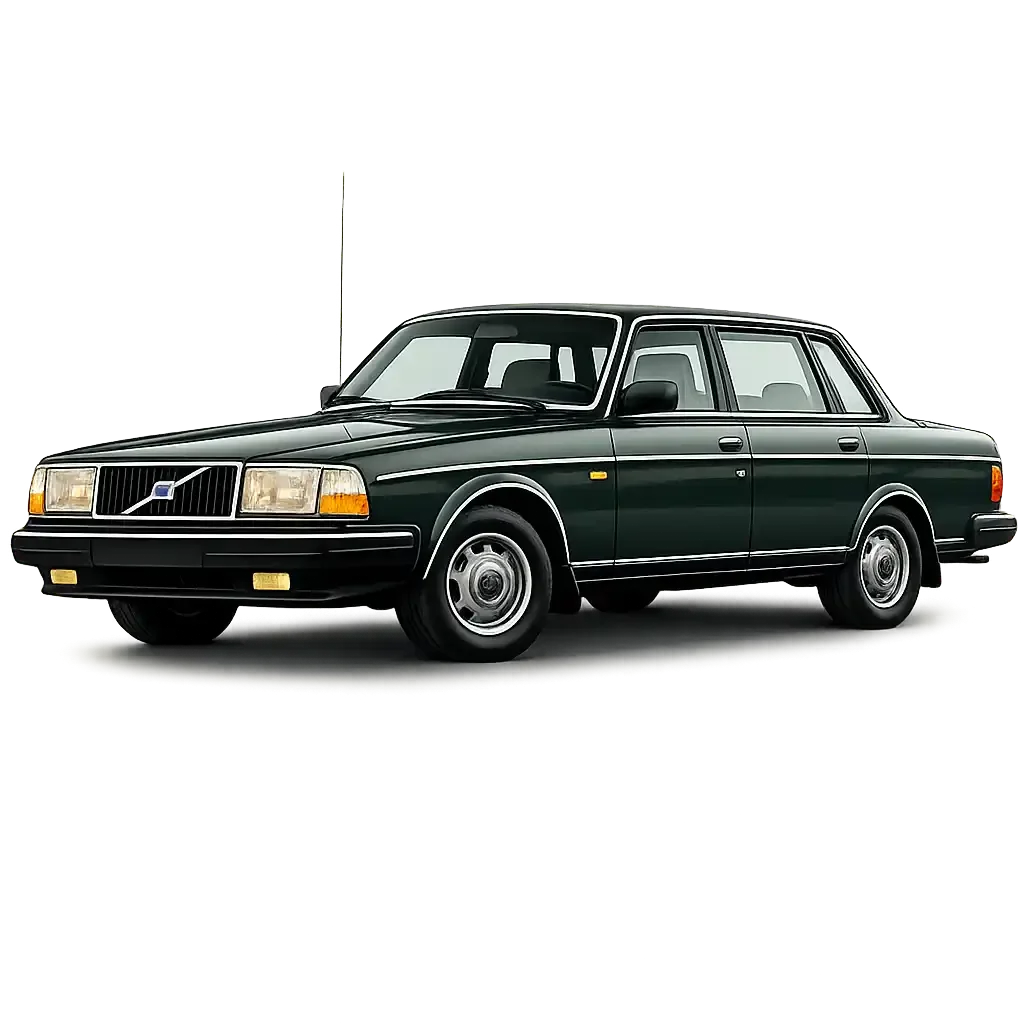
Written by Arthur Simitian | PartsAdvisory
By 1990, the Volvo 240 had been in production for fifteen years. The car that began life as the 244 in 1975 had outlasted two major facelifts, three engine families, and multiple generations of competitors. Volvo had already launched the 700 series and the 900 series as its mainstream products. The 240 was now the legacy model - kept in production because buyers kept asking for it, not because it represented the company's future.
For aftermarket parts sellers, the 1990 to 1993 final production window is a distinct era that layers new variables on top of everything established in the earlier generations. The B230 engine family was fully settled into LH-Jetronic 2.4 by this point. Regina fuel injection appeared on some models. The sedan (240) and the wagon (245) share a front end and engine bay but diverge at the rear in ways that have been true since 1975 and remain true through the final model year. And the parts pool has been thinning for decades, which means catalog accuracy matters more, not less, for this generation.
This post covers both the 240 sedan and the 245 wagon together, because the two cars are frequently lumped into a single "240" listing without the body style qualification that many rear components require. Understanding what is genuinely shared and what is body-style-specific is the foundation for accurate fitment data on the final 200 series cars.
A note on naming: Volvo dropped the engine-suffix naming convention for the U.S. market in 1986, at which point the 244 sedan and 245 wagon both became "240." In this post, 240 refers to the sedan and 245 refers to the wagon, following the convention used in most aftermarket catalogs and enthusiast communities regardless of what appeared on the badge.
What Defines the 1990 to 1993 Era
The second facelift carried forward
The 1990 to 1993 cars are a continuation of the second major facelift that arrived in 1986. The wide body cladding, the third-generation taillight design, the rectangular headlight front end, the B230 engine, and LH-Jetronic electronic fuel injection were all established in 1986 and carried through to the end of production with minimal further change.
This means the 1990 to 1993 cars share most of their parts with the 1986 to 1989 cars. For sellers who already have 1986 to 1989 listings built correctly, the 1990 to 1993 era is largely an extension of the same fitment window - with several important exceptions covered below.
The hard boundary that matters most for this era is not at 1989/1990. It is at 1985/1986, where the second facelift changed the taillights, bumpers, body cladding, and front end details. Parts from the 1981 to 1985 first facelift era do not cross into the 1986-and-later window on most exterior categories.
Final production trim consolidation
As the 240 approached the end of its run, Volvo simplified the trim and equipment lineup. Fewer option packages meant fewer variant combinations on the final cars compared to the peak production years of the early 1980s. Some components that were optional earlier in the production run became standard on later cars, while other options were discontinued entirely.
For sellers, this consolidation means that some components previously requiring option-level qualification (power windows, central locking, certain HVAC configurations) may have a more predictable fitment window on the 1990 to 1993 cars than on earlier production. However, it does not eliminate the need for the fundamental qualifiers - engine code, transmission code, body style, and market designation - that apply across the entire production run.
Exterior: Sedan vs. Wagon
Front end: shared
The 1990 to 1993 240 sedan and 245 wagon share the same front end. The headlights, grille, header panel, front bumper, front fenders, hood, and front turn signal assemblies are the same parts on both body styles. This is the most useful cross-fit opportunity between the two cars, and it is consistent with the shared front end that has existed across the entire 200 series production run since 1975.
The rectangular headlight design from the 1986 facelift continued unchanged into the final production years. There are no new front end splits introduced after 1986 on these cars.
Body cladding: shared design, different lengths
The wide plastic body cladding introduced in 1986 continued on both the sedan and wagon. The wheel arch extensions, rocker panel cladding, and lower body side moldings are the same profile on both cars. However, the specific pieces differ in length between the sedan and wagon body styles. A rocker panel molding cut for the sedan's wheelbase will not be the correct length for the wagon.
Sellers listing body cladding, rocker panel trim, or lower side molding kits must specify body style. The part profile and design are shared; the dimensions are not.
Rear end: where the cars diverge
From the C-pillar back, the 240 sedan and 245 wagon are different vehicles.
The sedan has a traditional trunk opening with a separate trunk lid, a rear window integrated into the C-pillar and rear body structure, and sedan-specific rear quarter panels and rear body panel. The taillights sit in a sedan-specific rear body surround.
The wagon has a liftgate in place of a trunk lid, a rear cargo area with a different floor and side panel structure, a rear window integrated into the liftgate, and wagon-specific rear quarter panels and D-pillar area. The taillights are mounted differently and are specific to the wagon body.
The following components must be specified by body style for the 1990 to 1993 cars:
Taillights and taillight assemblies
Rear bumper and bumper cover
Liftgate (wagon) or trunk lid (sedan)
Rear glass - liftgate glass vs. sedan rear window
Rear quarter panels
Rear body panel
Cargo area trim and floor mats (wagon-specific)
Rear wiring harness
Rear weatherstripping - liftgate seal vs. trunk lid seal
Taillights: era and body style both required
The 1990 to 1993 taillights are the third and final generation of the 200 series taillight design, introduced with the 1986 facelift. They do not interchange with the 1981 to 1985 or 1975 to 1980 units.
Within the 1986-and-later taillight generation, the sedan and wagon taillights are different parts. The wagon's rear body structure is different enough from the sedan's that the taillight housings, mounting interfaces, and wiring connectors differ between body styles.
A "Volvo 240 taillight, 1986 to 1993" listing that does not specify body style will cross-match sedan and wagon parts. Both the era and the body style are mandatory qualifiers for taillight listings.
Rear bumper
The rear bumper on the 1990 to 1993 cars is body-style-specific. The sedan and wagon have different rear body geometries, which changes the bumper mounting interface, the bumper profile, and the end cap fitment. U.S. market cars had energy-absorbing bumper systems throughout the final production run; European market cars had different assemblies. Both market and body style are required qualifiers for rear bumper components.
Mirrors
Power mirrors were increasingly standard on the 1990 to 1993 cars compared to earlier production. The mirror motor, glass, and housing for power mirrors are different parts from the manual mirror assembly. Sellers listing mirrors should specify power vs. manual, in addition to the standard year and body style qualifiers.
Under the Hood: B230 in Its Final Form
B230 family
The B230 engine family was the sole powertrain option for the 1990 to 1993 240 and 245 in virtually all markets. The displacement, basic architecture, and red block heritage carried over from the earlier B21 and B23 families, but the B230 was the most refined version of the engine and the most fully developed for electronic engine management.
The key engine variants in this era:
B230F: The standard naturally aspirated variant with LH-Jetronic 2.4 fuel injection and Bosch EZK ignition with knock sensing. This was the most common engine in final-production 240s and 245s in the U.S. market.
B230FT: The turbocharged variant, used in markets where the 240 Turbo continued. It added a turbocharger, intercooler, different exhaust manifold, higher-flow injectors, and a modified ECU with boost enrichment. Turbo-specific components do not interchange with naturally aspirated B230F parts.
B230K and B230E: Lower-output variants used in certain European markets, with different compression ratios and emission equipment.
For sellers, the B230 era is more straightforward than the B21/B23 transitional years because LH-Jetronic 2.4 was essentially universal by 1990. The fuel injection system type no longer needs to be verified against a K-Jetronic possibility in this window. However, the naturally aspirated vs. turbocharged split remains critical, and the specific B230 variant code must appear in all engine-related listings.
LH-Jetronic 2.4
By the 1990 to 1993 era, the LH-Jetronic 2.4 system was standard across virtually all B230F-equipped cars in all markets. This simplifies fuel system parts listings compared to the earlier transitional years when K-Jetronic and LH-Jetronic 2.2 were both in the market.
The LH 2.4 system uses a hot-wire mass airflow sensor, pulsed fuel injectors, an ECU specific to the 2.4 calibration, and a fuel pressure regulator. These components are different from the LH 2.2 used on some earlier B230 cars (roughly 1985 to 1987 depending on market). Sellers listing ECU, airflow sensor, or injector sets should verify whether the LH 2.2 vs. 2.4 distinction is relevant to their specific fitment window.
Regina fuel injection
Some 1990 to 1993 245 wagons in certain markets received the Regina fuel injection system rather than LH-Jetronic. The Regina system is an integrated engine management unit that combines fuel injection and ignition control in a single ECU. Its components - the ECU, injectors, throttle position sensor, and wiring harness - are not interchangeable with LH-Jetronic components.
Regina-equipped cars are not common in the U.S. market but appear in European market cars from this era. Sellers with European market 245 applications should verify whether the car has LH-Jetronic or Regina before listing fuel system or ignition components.
Emission systems: final evolution
U.S. market 240s and 245s in the final production years had fully developed catalytic converter systems with oxygen sensors, EGR valves, and evaporative emission canisters. California-specification cars retained different catalytic converter configurations and ECU calibrations from 49-state cars.
The California vs. 49-state split is a required attribute for catalytic converter, O2 sensor, and EGR listings on U.S. market cars through the end of production. It does not disappear because the car is late-production.
European market emission equipment differed. Some European markets did not require catalytic converters on all 240/245 variants through the end of production, creating a meaningful divergence in exhaust system specifications between U.S. and European cars even within the final model year window.
Transmissions
The 1990 to 1993 240 and 245 were available with the following transmissions:
M46: 4-speed manual with mechanical overdrive, the primary manual option through the end of production on most markets
M47: 5-speed manual that replaced the M46 on some models and markets in later production years. The M47 has a different case, different gear ratios, and different shift linkage than the M46. Driveshaft length, crossmember, and transmission mount fitment differ.
AW70/AW71: The primary automatic options through the final production years. The AW71 was more common in later production. Internal components (filter, gasket set, bands, clutch packs) and external parts (cooler lines, shift cables, mounts) differ between AW70 and AW71.
As with every era of this car, "manual" or "automatic" is not a sufficient qualifier. The specific transmission code is required for all drivetrain parts. The M46 vs. M47 distinction changes driveshaft length and shift linkage components.
Brakes
ABS: a required qualifier through the final years
ABS was introduced as an option on the 240 series in 1986 and continued through the end of production. On the 1990 to 1993 cars, ABS presence or absence is a fitment variable that must be specified for multiple brake component categories.
ABS changes the routing and specification of brake hydraulic lines, which run through an ABS hydraulic modulator rather than directly from the master cylinder to the wheels. The master cylinder bore and design may differ between ABS and non-ABS cars. Wheel bearing and hub assemblies on ABS-equipped cars include a tone ring (reluctor ring) that may be integral to the hub - making the hub itself a different part number for ABS vs. non-ABS applications.
The following brake components require an ABS/non-ABS qualifier for the 1990 to 1993 cars:
Master cylinder
Brake hydraulic lines
Brake hoses
Proportioning valve
Wheel bearing and hub assemblies
ABS-specific components (modulator, wheel speed sensors, ABS wiring harness)
ABS/non-ABS is not an optional qualifier on the final production 240 and 245. It is mandatory for all of the above categories.
Rear brakes
The rear disc vs. rear drum split that existed in earlier production years continued on the 1990 to 1993 cars, though rear disc brakes were increasingly standard on higher-specification models. The rear brake type (disc or drum) remains a mandatory qualifier for rear brake component listings.
Electrical System and Late-Production Specifics
Engine management wiring
The fully electronic LH-Jetronic 2.4 and EZK ignition combination meant a more complex engine wiring harness on the 1990 to 1993 cars than on any earlier 200 series production. The harness connectors, sensor plugs, and ECU pinouts are specific to the LH 2.4/EZK combination. An engine harness from a K-Jetronic car or an LH 2.2 car will not work on a 1990 to 1993 240 or 245.
Power accessories
Power windows, power mirrors, and central locking were increasingly standard on final-production 240s and 245s. The electric motors, switches, and wiring for these systems are different parts from the manual equivalents used on earlier or base-model cars. Window regulator, mirror motor, and lock actuator listings should specify power vs. manual.
Climate control
Some late-production 240s and 245s in higher trim levels received automatic climate control (ACC) in place of manual HVAC controls. The ACC system uses a different control head, servo motors, sensors, and wiring than the manual system. HVAC component listings must specify manual vs. automatic climate control.
Immobilizer and security systems
Some 1992 and 1993 cars in certain markets received factory immobilizer systems not present on earlier production. Ignition switch, ECU, and wiring harness listings for the final two model years should flag the potential presence of an immobilizer system if the component is affected.
The 240 vs. 245 in ACES Data
The naming consolidation that began in 1986 (when 244 and 245 became "240" for the U.S. market) creates a persistent catalog challenge. In ACES data, a "240" listing for 1990 to 1993 may refer to the sedan, the wagon, or both. Any component that differs between sedan and wagon - taillights, rear bumper, liftgate/trunk lid, rear glass, rear wiring, cargo trim - requires a body style qualifier to be correct.
Some databases retain both "240" and "244/245" designations for the same model years, potentially creating duplicate or conflicting application records. Sellers should verify how their catalog system handles the naming and ensure that sedan and wagon applications are not collapsed into a single undifferentiated "240" record for rear-body components.
Common ACES/PIES Mistakes for 1990 to 1993 Volvo 240 and 245
Listing taillights, rear bumpers, liftgates, trunk lids, and rear glass as "Volvo 240, 1990 to 1993" without body style specification. The sedan and wagon are different vehicles from the C-pillar back.
Listing brake components without the ABS/non-ABS qualifier. ABS was an option through the final production years. Its presence changes master cylinder specification, brake line routing, hub assemblies, and hose fittings.
Treating "1986 to 1993" as a single unbroken fitment window for all components. While many parts do span this range, sub-splits exist for LH-Jetronic version (2.2 vs. 2.4), late-production electrical systems, and transmission codes.
Listing B230 engine parts without the turbo/non-turbo qualifier. The B230FT and B230F share the block but differ on intake, exhaust, fuel calibration, and cooling components.
Listing transmission parts as "manual" or "automatic" without the specific unit code. M46 vs. M47 changes driveshaft length and shift linkage. AW70 vs. AW71 changes internal specifications and some external fittings.
Omitting the California vs. 49-state emission qualifier for catalytic converter, O2 sensor, and EGR listings on U.S. market cars.
Failing to flag Regina fuel injection on European market 245 wagons. Regina and LH-Jetronic components are not interchangeable.
Collapsing 240 sedan and 245 wagon into a single "240" ACES application record for rear-body components, creating fitment data that is wrong for at least one of the two body styles.
Listing body cladding and rocker panel molding kits without body style specification. The profile is shared but the dimensions differ between sedan and wagon.
Omitting power vs. manual qualifiers for window regulators, mirrors, and lock actuators on late-production cars where power accessories were increasingly standard.
Catalog Checklist for 1990 to 1993 Volvo 240 and 245
Require body style (sedan/240 or wagon/245) for all rear body components: taillights, rear bumper, liftgate/trunk lid, rear glass, rear quarter panels, rear wiring harness, rear weatherstripping, cargo trim
Require ABS/non-ABS qualifier for master cylinder, brake lines, brake hoses, proportioning valve, and wheel bearing/hub assemblies
Require engine code (B230F, B230FT, B230K, B230E) for all engine, fuel, and exhaust parts
Require transmission code (M46, M47, AW70, AW71) for all drivetrain parts
Require LH-Jetronic version (2.2 or 2.4) for ECU, airflow sensor, and injector listings where the version matters
Flag Regina fuel injection as an alternative to LH-Jetronic on European market 245 wagons
Require California vs. 49-state emission qualifier for catalytic converter, O2 sensor, and EGR listings
Require market designation (U.S./Canada vs. Europe) for bumpers, lighting, and emission parts
Require rear brake type (disc or drum) for all rear brake components
Specify power vs. manual for window regulators, mirrors, and lock actuators
Specify manual vs. automatic climate control for HVAC components
Resolve 240 vs. 244/245 naming in application records to prevent duplicate or conflicting fitment data
Cross-Reference Logic
Volvo 240/244 sedan and 245 wagon (1986 to 1989): Front end, engine, transmission, and most mechanical components are shared. Same B230 engine family, same LH-Jetronic system, same body cladding generation. The 1986 to 1989 cars are the most direct cross-fit source for the 1990 to 1993 cars.
Volvo 740/760 (B230-equipped): Shares the B230 engine family. Many engine internal components, fuel injection hardware, and ignition parts cross-reference when engine code and injection version match. Body, platform, and suspension components do not interchange.
Volvo 940 (B230-equipped): Same cross-reference logic as the 740. B230 engine and LH-Jetronic components may overlap; platform and body components do not.
Frame all cross-references as "may also fit" with engine code, injection version, and body style qualifiers. The 740/940 engine cross-reference is commercially significant because those cars are more numerous in the current market and share a meaningful parts overlap with the final-production 240 and 245.
The Enthusiast and Collector Market
The 1990 to 1993 240 and 245 occupy a specific position in the collector market that is different from the earlier production years. These are the last of the original 200 series - the final cars to carry a design lineage that dates to 1975. Low-production final years mean fewer cars survived, and the survivor pool is shrinking.
The buyer base for these cars includes long-term owners maintaining vehicles they have run for decades, restoration buyers seeking the cleanest final examples, and enthusiasts who value the B230F's reliability and tunability. All of these buyers are technically sophisticated. They know whether their car has ABS. They know the transmission code. They know the difference between a sedan taillight and a wagon taillight.
The wagon (245) carries a particular premium in this final-year window. The 1990 to 1993 245 is the last of the original boxy Volvo wagon - a vehicle with a strong following among enthusiasts and practical buyers alike. Wagon-specific parts listings that are accurate and clearly attributed to the 245 body style will consistently outperform generic "240" listings that leave body style ambiguous.
Final Take
The 1990 to 1993 Volvo 240 and 245 are the easiest era to catalog correctly in one sense: the engine is settled, the fuel injection system is standardized, and the exterior design has been stable since 1986. But they are also the era where accumulated catalog errors from earlier years are most likely to be inherited without correction - where a "1986 to 1993" listing that was never right for body style, ABS, or transmission code just keeps generating returns until someone fixes it.
The fix is the same set of attributes that works across the entire production run: engine code, transmission code, ABS or not, body style for rear components, emission standard, and rear brake type. Apply those to every applicable listing for the 1990 to 1993 cars, and the final 200 series generation becomes a well-documented catalog entry that serves a loyal and knowledgeable buyer base accurately.
Disclaimer: This guide is based on publicly available specifications, Volvo press materials, and independent research. Part interchangeability should always be confirmed via VIN and OEM part number lookup. Specifications may change without notice. This document does not constitute official Volvo parts catalog data.