
Written by Arthur Simitian | PartsAdvisory
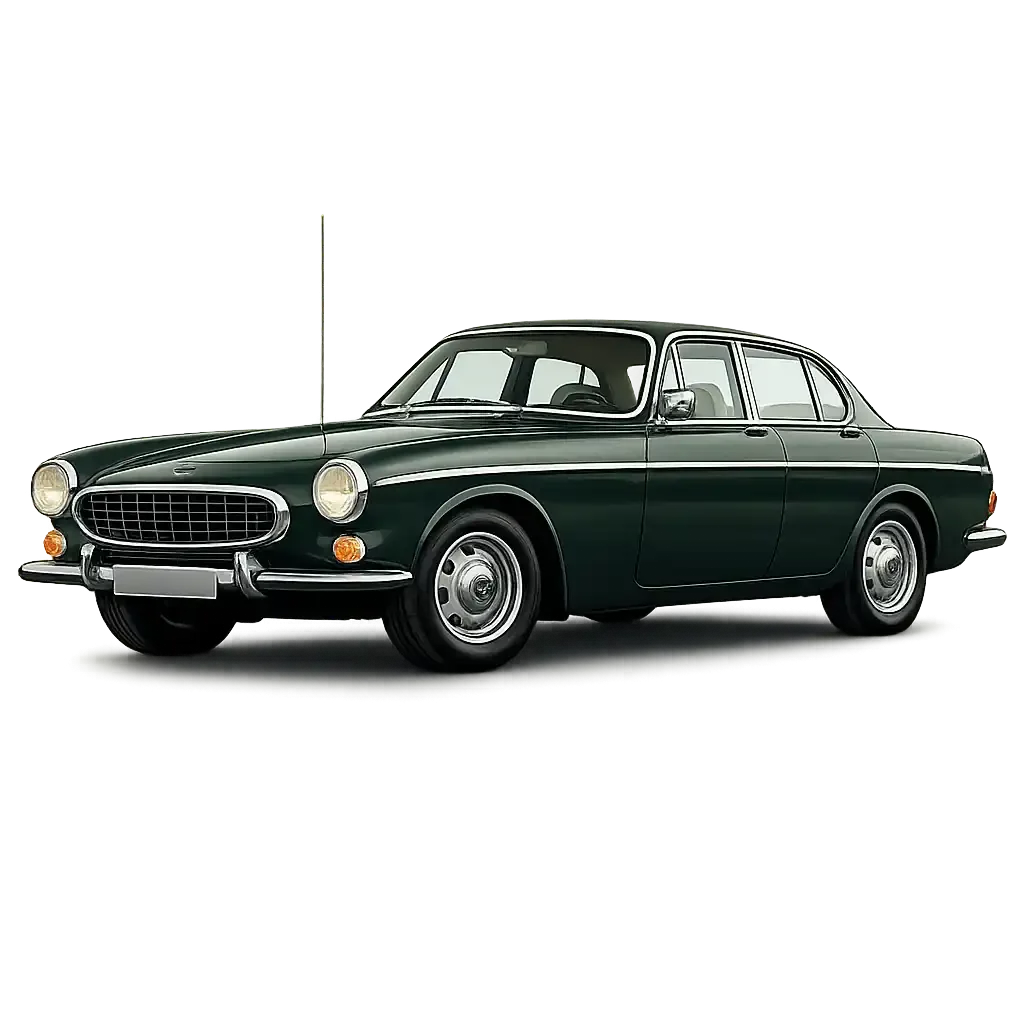
The Volvo 1800 is unlike any other car in the 200 series seller's catalog. Where the 140 and 200 series were volume vehicles built for durability and sold in large numbers, the 1800 was a sports grand tourer built in relatively small numbers over a twelve-year run. It is best known outside the enthusiast community as the car driven by Roger Moore in the television series The Saint. Inside the enthusiast community, it is known for its rarity, its mechanical evolution across four distinct variants, and the unforgiving specificity of its parts requirements.
For aftermarket parts sellers, the 1800 series is a high-risk, high-reward catalog entry. The cars are rare enough that search volume is low compared to the 240 or 740. But the buyers who search are among the most technically demanding in the entire Volvo aftermarket. They know exactly which variant they own. They know the production year and the assembly location. They know the engine code and the fuel delivery system. They will not accept a vague listing, and they will return a wrong part without hesitation.
This post covers all four variants of the 1800 series in a single guide - the P1800, the 1800S, the 1800E, and the 1800ES - because the four cars are related closely enough that many sellers attempt to catalog them together, while being different enough in their mechanical specifications that doing so incorrectly generates consistent errors. The goal is to make clear what each variant shares with the others, where the hard splits are, and what attributes must appear in every listing.
Overview: Four Variants, One Platform, Many Splits
The 1800 series was built on a dedicated sports car platform that shares no major structural components with the 140 or 200 series sedans. The wheelbase, floor pan, front subframe, and basic body structure were unique to the 1800 throughout its production run. This means that cross-referencing 1800 parts against the 120 series (Amazon), the 140 series, or the 200 series is almost never valid, and sellers should not attempt it without very specific component-level verification.
Within the 1800 series itself, the four variants share the basic platform and body structure while diverging on assembly origin, engine specification, fuel delivery, braking system, interior design, and rear body configuration. The divergences are substantial enough that the four variants cannot be treated as a single fitment window for most component categories.
The production breakdown:
P1800 (1961 to 1963): Approximately 6,000 units assembled by Jensen Motors in West Bromwich, England, under contract to Volvo. Bodies were supplied by Pressed Steel in Scotland. Swedish final assembly began partway through 1963.
1800S (1963 to 1969): Production moved fully to Sweden (the S designation references Sverige, Swedish for Sweden). The B18 engine continued and was later replaced by the B20. Several mechanical refinements were introduced.
1800E (1970 to 1972): Fuel injection (the E references Einspritzung, German for injection) was introduced alongside four-wheel disc brakes and a revised interior. The B20E engine with Bosch D-Jetronic injection replaced the carbureted B20.
1800ES (1972 to 1973): The final variant, a shooting-brake body style with a distinctive all-glass tailgate replacing the traditional fastback coupe rear. The ES designation references Einspritzung Sport. Approximately 8,000 units were built.
P1800 (1961 to 1963): Jensen Assembly and Early Specification
Assembly origin and its catalog implications
The Jensen-assembled P1800s are the most collectible and most expensive units in the 1800 series, and their assembly origin creates fitment variables that do not exist on later Swedish-built cars.
Jensen assembled the cars using some UK-sourced components alongside Volvo-supplied Swedish parts. The quality control issues that ultimately led Volvo to move production to Sweden are well documented, but from a parts fitment perspective the more relevant issue is that some components on early Jensen-built cars may differ from equivalent Swedish-built units in ways that are not always captured in aftermarket catalog data.
Sellers listing parts for the P1800 specifically should note the Jensen assembly window (approximately chassis numbers 1 to 6,000) and flag any known component differences between Jensen-built and Swedish-built early cars. In practice, most mechanical components are the same, but body trim, interior fittings, and some electrical components may have UK-sourced variants on early cars.
Body and exterior
The P1800 coupe body is a two-door fastback design styled by Pietro Frua (with the production design credited to Helmer Pettersson and refined by Jan Wilsgaard). The body is unique to the 1800 series and shares no exterior panels with any other Volvo production model.
The front end used round headlights in a distinctive twin-headlight nacelle arrangement integrated into the front fenders. The grille, front bumper, and front fender stampings are specific to the 1800 body. There is no cross-fit with the 120 series, 140 series, or 200 series for any exterior panel.
The P1800 used chrome bumpers front and rear with a distinctive profile specific to the model. The bumper overriders, end caps, and mounting hardware are 1800-specific parts with no equivalent on other Volvo models.
Taillights on the P1800 used a design specific to this early production window. The lens shape, housing, and bulb configuration are different from the later 1800S units, and different again from the 1800E and 1800ES. Within the 1800 series, there are at least two distinct taillight generations on the coupe body, and the 1800ES shooting-brake introduced a completely different rear body and lighting arrangement.
Engine: B18
The P1800 used the B18 engine - a 1.8L overhead cam four-cylinder that was also used in the 120 series (Amazon) and early 140 series. The basic B18 architecture is the same across applications, but the specific variant in the P1800 differed from the Amazon application in tune, carburetor setup, and some accessory configurations.
B18 variants in the P1800:
B18B: The high-performance twin-carburetor version used in the P1800, producing approximately 100 horsepower. It used twin SU or Zenith-Stromberg carburetors depending on the market and year, a higher-compression cylinder head, and a different camshaft profile than the lower-output B18A used in the Amazon.
The B18B is not the same engine as the B18A. Cylinder head gaskets, camshaft, carburetor mounting and jets, intake manifold, and valve specifications differ. A listing for "Volvo B18 parts" without the specific variant code will cross-match components from two different engine tunes.
Transmission
The P1800 used the M40 4-speed manual gearbox as standard, with an overdrive unit (electric or mechanical depending on year) available. The gearbox tunnel and shift linkage geometry are specific to the 1800 body - the same M40 unit used in the 120 or early 140 series requires different mounting and linkage hardware to fit the 1800. Transmission internal components may cross-reference, but driveshaft, crossmember, and shift linkage parts should be treated as 1800-specific.
Fuel system: twin carburetors
The P1800 was carbureted throughout its production run. The twin-carburetor setup on the B18B used SU HS6 carburetors on most markets, with Zenith-Stromberg units on some North American spec cars for emission reasons. The carburetor type, needle specification, jet size, and float height are specific to the application. A fuel system listing must identify the carburetor type and market specification.
1800S (1963 to 1969): Swedish Production and the B18 to B20 Transition
Production move to Sweden
From 1963 onward, all 1800s were assembled at Volvo's Lundby plant in Gothenburg. The S designation is often misread as "Sport" but refers to Sverige (Sweden). The move to Swedish production brought tighter quality control and gradual mechanical refinements, but the basic body structure and platform remained unchanged from the P1800.
Exterior evolution
The 1800S received minor exterior updates over its production run, primarily in trim details, badging, and some lighting refinements. The fundamental body shape, panel stampings, and major exterior components carried over from the P1800.
However, sellers should not assume that every P1800 exterior component fits the 1800S without verification. Minor changes to trim mounting points, badge locations, grille details, and taillight design occurred at various points during the 1800S production run. Taillight lenses and housings in particular saw updates during this period, and the specific unit may not be interchangeable across all production years within the 1800S window.
The 1800S continued with the round headlight arrangement from the P1800. There was no switch to rectangular headlights on the 1800 series at any point in its production - the round headlights were retained through the final 1800ES.
Engine: B18B continuing, then B20
The 1800S began production with the B18B engine carried over from the P1800 and transitioned to the B20 engine starting with the 1968 model year (the exact changeover varies by market).
B18B (1963 to 1967 approximately): Same twin-carburetor high-performance specification as in the P1800. Fuel system, cylinder head, and valve train as described above.
B20B (1968 to 1969): The 2.0L B20 used in the later 1800S was the high-performance twin-carburetor variant of the B20 family - the same basic architecture as the B18 but with larger displacement. The B20B used twin SU or Stromberg carburetors. Cylinder head gaskets, pistons, crankshaft, and displacement-specific components differ from the B18.
The B18 to B20 transition is a hard parts boundary. Virtually every engine internal component, most gaskets, the intake manifold, and the carburetor jetting differ between B18 and B20. A listing for "Volvo 1800S engine parts" without specifying B18 or B20 will be wrong for a significant portion of 1800S buyers.
Transmission
The 1800S continued with the M40 4-speed manual as standard, with overdrive available. Later 1800S production introduced the M41 with electric overdrive as an option. The M40 and M41 have different shift mechanisms and the M41's overdrive unit changes the overall transmission length and driveshaft specification. Transmission code is required for drivetrain parts.
1800E (1970 to 1972): Fuel Injection and Four-Wheel Discs
The most significant mechanical update
The 1800E represented the largest single mechanical leap in the 1800 series production run. Two changes define this variant above all others: the introduction of Bosch D-Jetronic fuel injection and the adoption of four-wheel disc brakes. Both changes create hard parts boundaries with every preceding 1800 variant.
Bosch D-Jetronic fuel injection
The E in 1800E stands for Einspritzung - German for injection - and refers to the Bosch D-Jetronic electronic fuel injection system introduced on the B20E engine. D-Jetronic is an early electronic injection system that uses manifold pressure (speed-density) rather than airflow measurement to calculate fuel delivery. It predates the K-Jetronic and LH-Jetronic systems used in the 200 series and operates on different principles.
D-Jetronic components include:
Electronic control unit (ECU) specific to D-Jetronic - not compatible with K-Jetronic or LH-Jetronic
Manifold pressure sensor (vacuum-referenced)
Temperature sensors (coolant and intake air)
Trigger points on the distributor for injection timing
Fuel injectors specific to D-Jetronic (different connector, different flow rate than LH-Jetronic injectors)
Fuel pressure regulator and fuel rail specific to D-Jetronic
Throttle body and intake manifold specific to the injected engine
None of these components interchange with the carbureted B18B or B20B fuel systems from the P1800 and 1800S. None interchange with the K-Jetronic or LH-Jetronic systems from the 200 series. The D-Jetronic system on the 1800E is a self-contained fuel management system with its own parts universe.
For sellers, the fuel injection system type is the single most important qualifier for any 1800E fuel system listing. "Volvo 1800 fuel injector" or "Volvo B20 fuel system" without specifying D-Jetronic will generate returns from carbureted 1800S owners and from 200 series LH-Jetronic owners in equal measure.
B20E engine
The B20E used the same basic 2.0L B20 block as the carbureted B20B, but the cylinder head, intake manifold, fuel system, and ignition timing were all revised for the injection application. The B20E head has different port geometry than the B20B head. The intake manifold is a completely different casting. The distributor has D-Jetronic trigger points not present on the carbureted distributor.
B20E engine-specific parts include: cylinder head and head gasket (different from B20B), intake manifold, all D-Jetronic fuel system components, revised distributor, and associated wiring harness. The B20B and B20E share the block, crankshaft, pistons, connecting rods, and most rotating assembly components - but diverge significantly on top-end and fuel system parts.
Four-wheel disc brakes
The 1800E introduced four-wheel disc brakes, replacing the front disc/rear drum setup of the earlier cars. This change affected:
Rear brake caliper - new part specific to the 1800E rear disc setup
Rear brake rotor - new part, rear drums from earlier cars do not apply
Rear brake hoses and hard lines - revised routing for disc caliper
Master cylinder - bore and specification changed for the four-wheel disc system
Proportioning valve - revised for the changed front/rear brake balance
Handbrake mechanism - revised for rear disc application
Sellers listing any brake component for the 1800 series must specify the variant. A "Volvo 1800 rear brake" listing without variant specification will cross-match rear drum components from the P1800 and 1800S with the rear disc setup from the 1800E and 1800ES. These are physically incompatible parts.
Interior revisions
The 1800E received a significantly revised interior compared to the 1800S, including a new dashboard design, revised instrumentation, and updated upholstery patterns. Interior components from the 1800S do not necessarily fit the 1800E. Dashboard pads, instrument clusters, center console trim, and door panel designs are variant-specific.
1800ES (1972 to 1973): The Shooting-Brake and Its Unique Rear Body
A fundamentally different rear end
The 1800ES is the most visually distinctive variant of the 1800 series and the one with the most unique parts profile. Where the P1800, 1800S, and 1800E were all fastback coupes with a conventional trunk, the 1800ES was a shooting-brake - a body style that adds a rear cargo area accessed through a tailgate in place of the traditional coupe trunk.
The 1800ES retained the coupe body from the windshield forward. From the B-pillar back, the body was redesigned entirely. The C-pillar profile changed to accommodate the taller roofline required for the cargo area. The rear quarter panels were new stampings. The rear body panel was different. And the defining feature of the 1800ES - the all-glass tailgate designed by Jan Wilsgaard - replaced the entire conventional trunk lid and rear window arrangement.
For sellers, the practical implication is that virtually every exterior component from the B-pillar back on the 1800ES is unique to that variant. The following parts from the coupe variants (P1800, 1800S, 1800E) will not fit the 1800ES:
Trunk lid (the 1800ES has no conventional trunk lid)
Rear window glass (the 1800ES has an all-glass tailgate, not a fixed rear window)
Tailgate glass and frame (unique to 1800ES)
Tailgate hinges, struts, and latch mechanism
Rear quarter panels
C-pillar trim and glass
Rear body panel
Taillights - the 1800ES used a different taillight arrangement integrated into the revised rear body
Rear weatherstrip and seals
Rear wiring harness routing (different path through revised rear body)
Cargo area floor and trim panels
The glass tailgate is the highest-profile 1800ES-specific part, and it is also among the most expensive and difficult to source. The full-width glass panel with its black rubber seal and chrome trim surround is a unique assembly with no equivalent on any other Volvo model.
Mechanical specification
The 1800ES used the same B20F engine as the final 1800E production, with D-Jetronic fuel injection and four-wheel disc brakes carrying over from the 1800E without major change. This means the mechanical parts profile of the 1800ES is the same as the 1800E for engine, fuel system, and braking components.
The engine code, fuel injection type (D-Jetronic), and brake configuration (four-wheel disc) qualifiers that apply to the 1800E apply equally to the 1800ES. The variant distinction between 1800E and 1800ES is primarily a body structure issue, not a mechanical one.
Production numbers and parts scarcity
Approximately 8,000 1800ES units were built over two model years. This is a small production run by any standard, and the survival rate is lower than for the more numerous coupes. Parts for the 1800ES - particularly the rear-body-specific components, the tailgate glass, and the rear weatherstripping - are among the most difficult to source in the entire Volvo catalog.
Sellers who can correctly identify and stock 1800ES-specific parts are serving a highly motivated buyer with few alternative sources. Accurate listing is not just good catalog hygiene in this segment - it is a genuine competitive differentiator.
Parts That Cross All Variants (With Qualifications)
Some components do cross multiple 1800 variants with appropriate qualifications:
Suspension components: The basic front MacPherson strut (introduced on later variants) and rear trailing arm geometry were consistent across the production run, though spring rates and shock specifications varied. Strut and spring listings should verify variant and specification.
B20 rotating assembly: The B20 block, crankshaft, pistons, and connecting rods are shared between the B20B (carbureted 1800S), the B20E (injected 1800E), and the B20F (1800ES). These rotating assembly components can be listed as "B20" without variant qualification, but all top-end and fuel system components still require the B20B vs. B20E/B20F distinction.
Cooling system: Radiator, water pump, thermostat, and cooling hoses are largely consistent across B20-equipped variants, though the 1800E and 1800ES may have slightly different hose routing due to the fuel injection intake manifold configuration.
Ignition components (non-injection related): Spark plugs, ignition leads, and coil may cross B18 and B20 variants with appropriate heat range and terminal type verification.
Door components: Front door glass, window regulators, door handles, and lock mechanisms are shared across all coupe variants (P1800, 1800S, 1800E). The 1800ES also shares the front door assembly with the coupes. These are among the most reliable cross-variant fit opportunities in the 1800 catalog.
Common ACES/PIES Mistakes for the Volvo 1800 Series
Listing 1800 parts without variant specification. P1800, 1800S, 1800E, and 1800ES are four distinct applications for most component categories. A single "Volvo 1800, 1961 to 1973" application record is wrong for almost every part except the most basic shared components.
Listing fuel system parts without specifying carbureted vs. D-Jetronic. The carbureted and injected 1800s have completely different fuel systems. D-Jetronic components do not interchange with K-Jetronic or LH-Jetronic components from the 200 series.
Listing brake parts without specifying the front disc/rear drum (P1800, 1800S) vs. four-wheel disc (1800E, 1800ES) configuration. These are physically incompatible rear brake setups.
Listing B18 and B20 engine parts in a single "1800 series, 4-cylinder" application record. B18 and B20 share architecture but differ on all displacement-specific components.
Listing rear body components - taillights, trunk lid, rear glass, rear weatherstrip - without specifying coupe (P1800, 1800S, 1800E) vs. shooting-brake (1800ES). These rear body components are not interchangeable between body styles.
Cross-referencing 1800 parts with the 120 series (Amazon) or 140 series without component-level verification. The B18 engine is shared with those platforms but the mounting, accessories, and some specifications differ for the 1800 application.
Listing carburetor components without specifying SU vs. Zenith-Stromberg. North American spec cars often received Stromberg carburetors rather than SU units for emission reasons. Jets, needles, and rebuild kits are carburetor-specific.
Listing transmission parts without the specific code (M40 vs. M41 with overdrive). Driveshaft length and shift linkage differ.
Treating early Jensen-built P1800 and later Swedish-built 1800S as identical for all trim and electrical components. Some UK-sourced components on Jensen-built cars may differ.
Catalog Checklist for Volvo 1800 Series (1961 to 1973)
Require variant designation (P1800, 1800S, 1800E, 1800ES) for all listings
Require engine code (B18B, B20B, B20E, B20F) for all engine, fuel, and exhaust parts
Require fuel delivery type (twin SU carburetors, twin Stromberg carburetors, D-Jetronic) for all fuel system components
Require brake configuration (front disc/rear drum vs. four-wheel disc) for all brake components
Require body style (coupe vs. shooting-brake/ES) for all rear body components: taillights, trunk lid/tailgate, rear glass, rear quarter panels, rear weatherstrip, rear wiring harness
Require transmission code (M40, M41) for all drivetrain parts
Require market designation (U.S./North America vs. Europe/Sweden) for carburetor type and emission equipment
Flag Jensen-built P1800 (approximately first 6,000 chassis numbers) for potential trim and electrical component differences
Do not cross-reference with 120 series, 140 series, or 200 series for body, suspension, or platform components
Verify B18 vs. B20 engine code for all 1800S listings - the transition occurred mid-production run
Cross-Reference Logic
Volvo 120 series (Amazon/P120): B18 engine components may cross-reference for rotating assembly and some accessories. Verify tune and application before listing. Body, platform, and suspension components do not interchange.
Volvo 140 series (144/145): B18 and early B20 engine rotating assembly may cross-reference. Same verification requirement. Body and platform components do not interchange.
Volvo 200 series (240/244/245): B20 engine rotating assembly may cross-reference for lower-end components. Fuel system components do not interchange - the D-Jetronic on the 1800E/ES is completely different from the K-Jetronic and LH-Jetronic on the 200 series. Body and platform components do not interchange.
Frame all cross-references as "may also fit" with engine code, application, and fuel system qualifiers. The engine cross-references are the only commercially significant ones for the 1800 series. All body, brake, and platform cross-references to other Volvo models should be avoided.
The Collector Market
The 1800 series occupies a unique position in the Volvo aftermarket. These are not high-volume parts vehicles. They are collectibles that have been appreciating steadily, with the 1800ES commanding the highest prices of any 200-series-adjacent Volvo in the current market.
The buyer for 1800 series parts is almost always an enthusiast or restorer with detailed knowledge of the car. They know which variant they own. They know the assembly origin of a P1800. They know whether their 1800E has SU or Stromberg carburetors - wait, they know it has D-Jetronic. They will verify your listing against their workshop manual before ordering, and they will return anything that does not match.
The 1800ES buyer in particular is working with a parts supply that gets thinner every year. When they find a seller who has the tailgate seal, the correct rear quarter weatherstrip, or the D-Jetronic ECU correctly listed to the ES variant, they become a loyal customer. The catalog investment in getting the 1800 series right pays back in ways that a high-volume commodity listing does not.
Final Take
The Volvo 1800 series is four cars that share a nameplate, a platform, and a basic body shape while diverging in almost every way that matters for parts fitment. The P1800 is a Jensen-built B18 coupe with twin carburetors and front disc/rear drum brakes. The 1800S is a Swedish-built evolution that transitioned from B18 to B20 mid-run while retaining the carbureted fuel system. The 1800E introduced D-Jetronic injection and four-wheel discs - two hard boundaries that split it from every preceding car. The 1800ES retained the 1800E mechanical specification while replacing the entire rear body with a shooting-brake structure that shares nothing from the C-pillar back with the coupe variants.
For catalog purposes, the variant designation is the first attribute. Engine code is the second. Fuel delivery type is the third. Brake configuration is the fourth. Body style - coupe or shooting-brake - is the fifth, and it applies to every rear body component on the car.
Get those five attributes into every 1800 listing, and the most demanding buyer in the Volvo aftermarket gets the right part. Leave them out, and the returns will come from buyers who know the car better than the listing does.
Disclaimer: This guide is based on publicly available specifications, Volvo press materials, and independent research. Part interchangeability should always be confirmed via VIN and OEM part number lookup. Specifications may change without notice. This document does not constitute official Volvo parts catalog data.