
Volvo 240 (200 Series) 1984 GLE US Market Fitment Guide
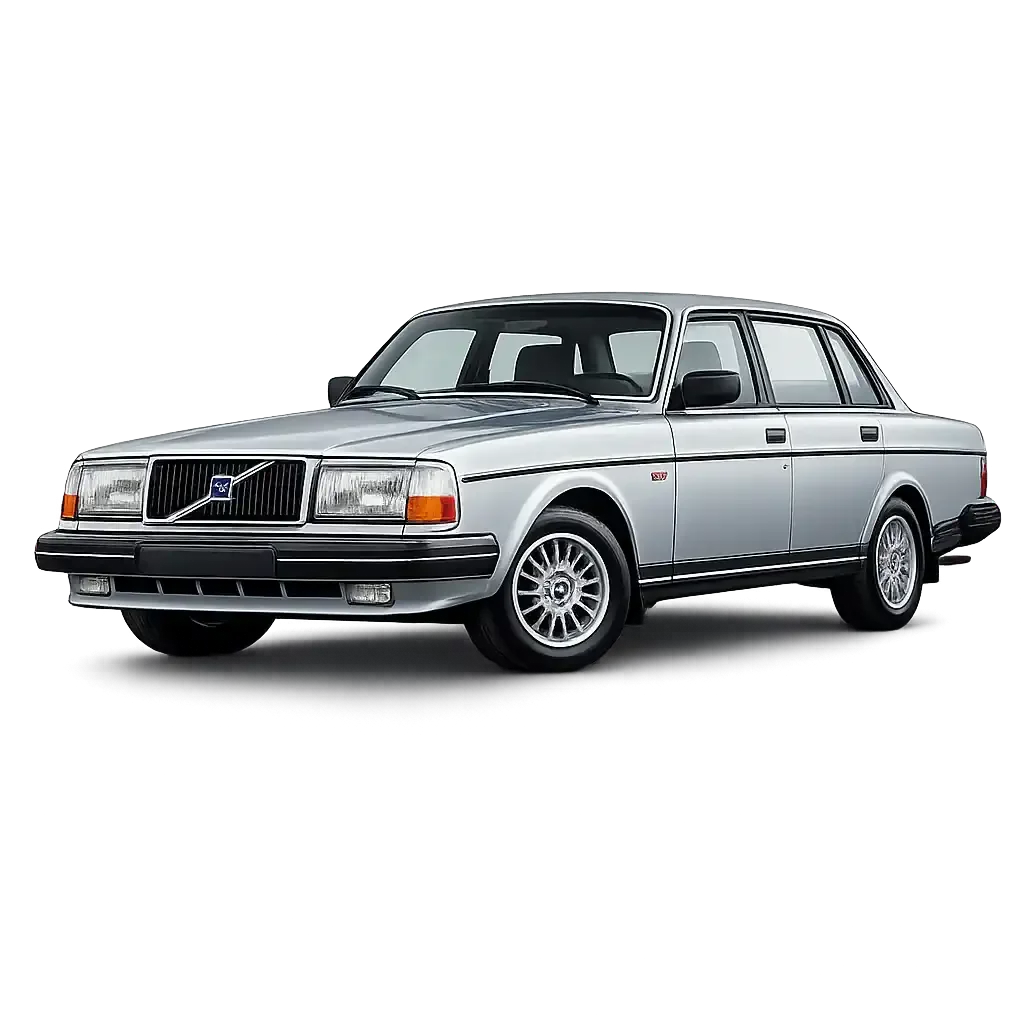
The Complete Fitment Guide
Returns destroy margins. The 1984 Volvo 240 is one of the best-selling model years in the entire 200 Series production run, with over 133,000 sedans and 85,000 wagons sold in the US alone. Volvo offered the 240 in three body styles (two-door sedan, four-door sedan, and wagon) with four distinct powertrains (naturally aspirated gasoline, turbocharged gasoline, and diesel) spread across three trim levels (DL, GL, and GLT Turbo). The 1984 model year is particularly important for catalog managers because it was the final year for the two-door 242 body, the last year Volvo offered the B21FT turbo engine before the B230 family took over, and a transitional year where new transmissions replaced older units. An additional catalog hazard specific to 1984: the "GLE" badge was used on 240s in Canada and Australia but NOT in the US market, where the equivalent luxury trim was badged "GL." Any catalog listing a "1984 240 GLE" for the US market is referencing a trim that did not exist domestically and will confuse buyers. This guide maps every fitment split required to prevent returns on one of Volvo's most iconic platforms.
Generation Overview (1984 US Market)
The Volvo 240 is part of the 200 Series, which was manufactured from 1974 to 1993. Designed by Jan Wilsgaard and developed from the Volvo 140 Series, the 200 Series incorporated safety innovations from Volvo's VESC experimental safety vehicle program. Over 2.8 million units were manufactured during the 19-year production run. The 200 Series was produced in sedan, wagon, and limited two-door sedan body styles. The 240 used Volvo's Redblock inline four-cylinder engines, while its sibling the 260 used the PRV V6. The 260 was discontinued after 1982 in the US (replaced by the 760 GLE), but the 240 continued all the way to 1993.
The 1984 model year was a peak sales year for the 240 in the United States. The new 740 had just debuted, but rather than cannibalizing 240 sales, Volvo sold more 240s in 1984 than at any point in its history. The lineup included the base DL (sedan and wagon), the luxury GL (four-door sedan and wagon only), and the performance GLT Turbo (sedan and wagon). A diesel option was available in DL and GL trims. The two-door 242 body style was in its final year, available only as the 242 DL.
For 1983, Volvo had briefly dropped all trim level badges and sold the cars simply as "240." Buyers protested, and the DL, GL, and GLT designations returned for 1984. A new four-speed automatic (AW70) had replaced the old three-speed Borg Warner unit on non-turbo automatics starting in 1982. The 1984 GLT Turbo received the AW71 (a strengthened variant). Manual-equipped cars used the M46 four-speed with electric overdrive.
Key Platform Facts
• Platform: Volvo 200 Series (shared with 260 Series)
• US model year: 1984 (240 Series produced 1975 to 1993)
• Assembly: Torslanda, Sweden (also Halifax, Nova Scotia for Canadian market)
• Engine family: Volvo Redblock inline-4 (B23F naturally aspirated, B21FT turbocharged) and VW/Volvo D24 inline-6 diesel
• Transmissions: 4-speed AW70 automatic (NA gas), 4-speed AW71 automatic (Turbo), M46 4-speed manual with electric overdrive
• Drive: RWD only (all models)
• Body styles: 242 (two-door sedan, DL only, final year), 244 (four-door sedan), 245 (wagon)
• US trim levels: DL (base), GL (luxury), GLT Turbo (performance). Note: GLE was NOT a US market trim for the 240. GLE was used in Canada and Australia.
Why the 1984 240 Causes Catalog Errors
• Three completely different engines under one nameplate: The B23F (naturally aspirated 2.3L, 114 hp), the B21FT (turbocharged 2.1L, 131 hp), and the D24 (naturally aspirated 2.4L diesel, 78 hp) are different displacements, different aspiration types, different fuel systems, and different engine families entirely. The D24 is a six-cylinder diesel sourced from Volkswagen. The B23F and B21FT are Volvo Redblock four-cylinders but share very few parts between them due to the turbo hardware.
• Three body styles with different rear sheet metal: The 242 (two-door), 244 (four-door), and 245 (wagon) share the platform, front end, and drivetrain, but everything behind the B-pillar is different. Doors, rear quarter panels, trunk/tailgate, rear bumper, and rear glass do not interchange between body styles.
• Multiple transmission types: The AW70 four-speed automatic was used on naturally aspirated gasoline models. The AW71 (strengthened) was used on the Turbo. The M46 four-speed manual with electric overdrive was available on both. These are different units with different internals, different fluid requirements, and different service parts. Earlier 240s (pre-1982) used the Borg Warner 55 three-speed automatic, which is a completely different transmission.
• GLE trim confusion across markets: The "GLE" badge was used on Canadian-market 240s (roughly equivalent to the US GL) and on Australian-market 240s (which had the turbo engine with blacked-out trim). In the US, the luxury trim was simply "GL." Any catalog listing a US-market "240 GLE" is incorrect and will cause buyer confusion.
• Long production run with mid-cycle changes: The 240 was produced from 1975 to 1993. A 1984 240 shares the basic platform with a 1993 240, but engines changed (B21 to B23 to B230), transmissions changed (BW55 to AW70 to AW71 to AW72, M45 to M46 to M47), bumper designs changed (1975 to 1980 chrome, 1981 to 1985 5-mph, 1986+ slimmer), headlight designs changed, and interior layouts changed. Year-specific fitment is critical.
• B23F compression ratio split: The 1984 B23F came in two compression ratios depending on transmission. The automatic-transmission B23F had 9.8:1 compression and 114 hp. The M46 manual-transmission B23F had 9.5:1 compression and 111 hp but more torque (136 lb-ft vs. 133 lb-ft). These are the same engine code but with different pistons and different calibration.
• 240 vs. 260 platform overlap: The 260 Series (V6 engine) shared the same body and platform as the 240 but used the PRV V6 engine and different transmission. The 260 was discontinued in the US after 1982, but 260 parts are still in circulation and will be incorrectly cross-referenced to the 240 by engine-agnostic catalog entries.
• Wiring harness as a known failure item: The engine wiring harness on 1980 to 1987 240s is a well-known failure point. The insulation crumbles from engine heat, exposing bare wire. Replacement harnesses are a high-volume parts order, and they are year-specific and engine-specific.
Complete Powertrain Reference (1984 US Market)
DL and GL: Naturally Aspirated 2.3L Inline-4 (B23F)
• Engine code: B23F
• Displacement: 2.3L (2,316cc) inline-4
• Block material: Cast iron block, aluminum crossflow head
• Valvetrain: SOHC, 8-valve (2 valves per cylinder)
• Aspiration: Naturally aspirated (no turbo)
• Fuel system: Bosch LH-Jetronic electronic fuel injection
• Output (automatic): 114 hp at 5,400 rpm, 133 lb-ft at 3,500 rpm (9.8:1 compression)
• Output (manual M46): 111 hp at 5,400 rpm, 136 lb-ft at 2,750 rpm (9.5:1 compression)
• Timing: Timing BELT (interference engine), drives intermediate shaft which runs distributor and oil pump
• Transmission options: 4-speed AW70 automatic OR M46 4-speed manual with electric overdrive
• Drive: RWD
• Notes: The B23F replaced the earlier B21F (2.1L) starting in 1983. Can be distinguished from the B21F by water plugs on both sides of the block (B21F has them on one side only). The B23F is the standard engine across both DL and GL trims. No turbocharger, no intercooler, no boost-related components.
GLT Turbo: Turbocharged 2.1L Inline-4 (B21FT)
• Engine code: B21FT
• Displacement: 2.1L (2,127cc) inline-4
• Aspiration: Turbocharged with intercooler (IBS intercooler became standard mid-1984)
• Fuel system: Bosch K-Jetronic mechanical fuel injection with Lambda-Sond
• Output: 131 hp at 5,400 rpm, 150 lb-ft of torque
• Timing: Timing BELT (interference engine)
• Transmission options: 4-speed AW71 automatic (strengthened) OR M46 4-speed manual with electric overdrive
• Notes: Despite the 240 moving to the B23F for naturally aspirated models, the turbo engine was never enlarged to 2.3L. The B21FT uses the older K-Jetronic mechanical fuel injection, NOT the LH-Jetronic electronic system used on the B23F. The turbo engine uses a different fuel injection system, different engine management, different exhaust manifold, and adds turbocharger, wastegate, intercooler (mid-1984+), and boost piping. The AW71 automatic is a strengthened version of the AW70 and is NOT the same unit. 1984 was the final year for the B21FT in the 240; it was replaced by the B230FT for 1986.
Diesel: 2.4L Inline-6 (D24)
• Engine code: D24
• Displacement: 2.4L inline-6 (NOT a Volvo engine; sourced from Volkswagen)
• Aspiration: Naturally aspirated diesel (no turbo on the 240 diesel)
• Output: 78 hp at 4,800 rpm
• Transmission: 4-speed AW70 automatic or M46 manual
• Notes: Available in DL and GL trims. The D24 is a completely different engine family from the Redblock gasoline engines. It is a six-cylinder unit (not four) and shares no components with the B23F or B21FT. 1985 was the final year for the diesel in the US 240.
Body Styles (1984 US Market)
242 (Two-Door Sedan) - Final Year
Available only as the 242 DL in 1984. This was the final year for the two-door body. The 242 has unique door panels (longer than the 244 front doors), unique rear quarter panels, unique rear window, and a unique C-pillar. The 242 shares its trunk lid, front fenders, hood, and front bumper with the 244 sedan. After 1984, the two-door 240 was gone permanently.
244 (Four-Door Sedan)
The most common body style. Available in DL, GL, GLT Turbo, and Diesel trims. The 244 shares its platform, front end, hood, and front fenders with the 242 and 245. Rear doors, trunk lid, and C-pillar are shared only with other 244 sedans. The GL trim in the US included a manual sunroof as standard for 1984, along with alloy wheels, leather upholstery, power windows, and upgraded interior trim.
245 (Station Wagon)
Available in DL, GL, GLT Turbo, and Diesel trims. The 245 shares its front end, hood, front fenders, and front doors with the 244 sedan. Everything behind the B-pillar is wagon-specific: the roof line, rear quarter panels, tailgate, rear bumper, rear glass, cargo floor, and optional rear-facing third-row seat. The 245 also had unique rear suspension spring rates calibrated for cargo loads.
US Trim Levels (1984)
DL (De Luxe): Base trim. Available in 242 (two-door), 244 (four-door), and 245 (wagon). B23F engine standard. Diesel optional on 244 and 245. Steel wheels with hubcaps. Cloth interior. Manual transmission or automatic.
GL (Grand Luxe): Luxury trim. Available only as 244 sedan and 245 wagon (no two-door). B23F engine standard. Diesel optional. Corona alloy wheels. Leather upholstery. Manual sunroof standard for 1984. Power windows. This is the US equivalent of the Canadian-market GLE. Automatic or M46 manual.
GLT Turbo: Performance trim. Available as 244 sedan and 245 wagon. B21FT turbocharged engine. Taller grille design. Sport-tuned suspension. Virgo alloy wheels. Black exterior trim accents. Available with AW71 automatic or M46 manual. The GLT Turbo had a visually distinct grille from the DL and GL.
Important: There was no "240 GLE" sold in the United States for 1984. The GLE designation was used on Canadian-market 244 models (equivalent to the US GL) and on Australian-market 240s (which had the turbo engine in a GLE package due to RHD turbo fitment issues). If your catalog lists a US-market 240 GLE, it is incorrect.
Catalog Accuracy: The Fitment Splits That Matter
Split 1: B23F (NA Gas) vs. B21FT (Turbo) vs. D24 (Diesel)
Three completely different engine families. The B23F is a 2.3L naturally aspirated Redblock four-cylinder with LH-Jetronic electronic fuel injection. The B21FT is a 2.1L turbocharged Redblock four-cylinder with K-Jetronic mechanical fuel injection. The D24 is a 2.4L naturally aspirated six-cylinder diesel sourced from Volkswagen. They share virtually no engine-specific components. All turbocharger hardware (turbo, wastegate, intercooler, boost piping, oil feed/return lines) is exclusive to the B21FT. The diesel has a completely different engine block, head, injection pump, and glow plug system. Fuel system components (injectors, fuel pump, fuel lines) are entirely different across all three engines.
Split 2: B23F Automatic vs. B23F Manual (Compression Ratio)
The 1984 B23F came in two compression ratio variants. The automatic-transmission version had 9.8:1 compression and 114 hp. The M46 manual version had 9.5:1 compression and 111 hp but slightly more torque. Pistons and possibly head gaskets differ between the two. For most maintenance parts (timing belt, water pump, filters, ignition) this split does not matter, but for internal engine components it does.
Split 3: AW70 vs. AW71 vs. M46 Transmission
Three different transmissions were offered. The AW70 four-speed automatic was used on naturally aspirated gasoline and diesel models. The AW71 (strengthened internals) was used on the GLT Turbo. The M46 four-speed manual with electric overdrive was available across all engine options. Clutch kits, flywheel, shift linkage, and transmission-specific service parts differ between all three. The AW70 and AW71 look similar externally but have different internal components and different torque ratings. Earlier 240s (pre-1982) used the Borg Warner 55 three-speed automatic, which is a completely different unit and must not be cross-referenced with the AW70 or AW71.
Split 4: 242 vs. 244 vs. 245 Body
All three body styles share the platform, front end (hood, fenders, grille, headlights, front bumper), and drivetrain. Everything behind the B-pillar differs. The 242 two-door has unique long doors, unique rear quarter panels, and a unique rear window. The 244 four-door has unique rear doors and unique C-pillars. The 245 wagon has a unique roofline, unique tailgate, unique rear bumper, unique rear quarter panels, and wagon-specific cargo area components. Rear suspension spring rates also differ between the sedan and wagon due to load capacity differences.
Split 5: GLT Turbo Grille vs. DL/GL Grille
The 1984 GLT Turbo received a taller grille design distinct from the DL and GL. The Turbo also had unique bumper-mounted fog lights, a front spoiler, and blacked-out exterior trim. These exterior pieces do not interchange with the standard DL/GL front end.
Split 6: 1984 vs. Other 240 Model Years
The 240 was produced for 19 years (1975 to 1993). While the basic platform remained the same, critical components changed throughout the run. The engine went from B21F (1976 to 1982) to B23F (1983 to 1984) to B230F (1985 to 1993). Transmissions changed from Borg Warner 55 three-speed (pre-1982) to AW70 four-speed (1982 to 1986) to AW72 (late models). The M45 manual was replaced by the M46 (1981) which was later replaced by the M47 five-speed (1987). Bumpers changed in 1981 (chrome to rubber-faced 5-mph) and again in 1986 (slimmer body-color). Headlights changed between round sealed beams, rectangular sealed beams, and European-style composite units depending on year. A "240 timing belt kit" listed without a year range is almost certainly wrong.
Split 7: 240 (Four-Cylinder) vs. 260 (V6)
The 260 Series used the same body shell and platform as the 240 but was powered by the PRV V6 engine (B28E/B28F) instead of the Redblock four-cylinder. The 260 was discontinued in the US after 1982. Body panels, suspension components, and brakes may cross-reference between the 240 and 260. Engine, transmission, exhaust, motor mounts, and engine-specific wiring do NOT cross-reference. Catalogs that list "240/260" without specifying engine are generating returns.
Biggest Return Traps and How to Prevent Them
Trap 1: Turbo Components Shipped to B23F Owner
What happens: Turbocharger, intercooler, boost piping, or wastegate listed for "240" ships to a DL or GL owner. The DL and GL use the naturally aspirated B23F. No turbo components exist on this engine.
Prevention: Always specify engine: B23F (naturally aspirated) or B21FT (turbocharged). Or specify trim: DL/GL (NA) vs. GLT Turbo.
Trap 2: Gasoline Parts Shipped to Diesel Owner
What happens: Spark plugs, ignition wires, ignition coil, or gasoline fuel injectors ship to a D24 diesel owner. The diesel has no ignition system (compression ignition), no spark plugs, and uses a completely different fuel injection setup with an injection pump and glow plugs.
Prevention: Always specify fuel type: gasoline (B23F or B21FT) vs. diesel (D24).
Trap 3: Wrong Transmission Service Parts
What happens: AW70 automatic filter or fluid specification ships to a GLT Turbo owner who has the AW71, or vice versa. Or a Borg Warner 55 three-speed filter ships to a 1984 owner who has the AW70 four-speed because the catalog only says "240 automatic transmission."
Prevention: Always specify transmission: AW70 (NA gas/diesel), AW71 (Turbo), or M46 (manual). Never list "240 automatic" without specifying which unit.
Trap 4: Wagon Parts Shipped to Sedan Owner (or Vice Versa)
What happens: A 245 wagon tailgate, rear bumper, or rear quarter panel ships to a 244 sedan owner. Or 244 sedan taillights ship to a 245 wagon owner. Everything behind the B-pillar differs between body styles.
Prevention: Always specify body style: 242 (two-door), 244 (four-door sedan), or 245 (wagon) for all body, glass, and rear suspension components.
Trap 5: Wrong Model Year Fitment
What happens: A timing belt kit for a 1986+ 240 (B230F engine) ships to a 1984 owner (B23F engine). Or a Borg Warner 55 transmission filter for a pre-1982 240 ships to a 1984 owner with the AW70. The 240 was made for 19 years with significant mechanical changes throughout.
Prevention: Always specify exact model year or year range AND engine code for all engine and transmission parts. "240" alone is never sufficient.
Trap 6: GLE Trim Listed for US Market
What happens: A catalog lists parts for a "1984 Volvo 240 GLE" in the US market. This trim did not exist in the US. A buyer searching for their GL may not find the listing, or a buyer who imported a Canadian GLE gets parts that do not match the slightly different Canadian-spec equipment.
Prevention: Use correct US trim designations: DL, GL, GLT Turbo. If listing for Canadian market, specify "Canadian market GLE" separately.
Trap 7: Engine Wiring Harness Year Mismatch
What happens: A replacement engine wiring harness for a 1986+ 240 (B230F with LH 2.2 fuel injection) ships to a 1984 owner (B23F with LH-Jetronic). The connector pinouts and sensor wiring differ between engine codes.
Prevention: Always specify engine code and model year for wiring harnesses. The B23F (1983 to 1984), B230F (1985 to 1993), and B21FT (turbo) all have different harnesses.
Aftermarket Parts Cross-Reference Notes
200 Series platform cross-references: The 240 shares its body shell and suspension architecture with the 260 Series (V6). Body panels, doors, glass, suspension arms, wheel bearings, brakes, and steering components generally cross-reference between 240 and 260 of the same body style and year range. Engine, transmission, exhaust, motor mounts, and engine-specific electrical do NOT cross-reference.
Engine cross-references: The B23F was used exclusively in the 1983 to 1984 North American 240. It was not used in the 740 or 760. The B21FT turbo was shared with the 1981 to 1985 240 Turbo. The D24 diesel was shared with the Volkswagen Quantum and some VW Vanagon models, though Volvo-specific accessories (motor mounts, exhaust manifold) differ.
Transmission cross-references: The AW70 was also used in the 1982 to 1986 740 with naturally aspirated engines. The AW71 was shared with the 760 Turbo and later 740 Turbo. The M46 manual was shared across the 240 and 740 for the same engine type. The M46 overdrive unit is a Laycock de Normanville J-type, also used in some British cars.
Known high-volume maintenance items: Timing belt and tensioner, engine wiring harness (1980 to 1987, insulation failure), water pump, fuel injectors (LH-Jetronic), overdrive solenoid (M46), automatic transmission filter and fluid, front struts and strut mounts, rear trailing arm bushings, brake rotors and pads, heater core, and PCV system components.
Specialist sources: FCP Euro carries extensive 240 inventory with lifetime replacement warranty. IPD stocks performance and maintenance parts with detailed engine-specific identification guides. Dave Barton at Prancing Moose sells replacement engine wiring harnesses and maintains one of the most detailed 240 technical resources online. Turbobricks.com forums maintain detailed 200 Series parts interchange databases.
Data Quality Checklist for Catalog Managers
Required attributes for every 1984 Volvo 240 parts listing:
• Model year: 1984 (do not list as generic "240" without year)
• Engine: B23F (2.3L NA gas), B21FT (2.1L turbo gas), or D24 (2.4L diesel)
• Transmission: AW70 automatic, AW71 automatic (Turbo), or M46 manual
• Body style: 242 (two-door), 244 (four-door sedan), or 245 (wagon)
• Trim: DL, GL, or GLT Turbo (NOT GLE for US market)
• Market: US, Canadian, or other (trim designations and engine specs differ by market)
Buyer Confirmation Prompts
Before shipping any part for a 1984 240, confirm:
• "Is your engine the 2.3L naturally aspirated (B23F), the 2.1L turbo (B21FT), or the diesel (D24)?"
• "Is your 240 a two-door (242), four-door sedan (244), or wagon (245)?"
• "Do you have an automatic or manual transmission?"
• "What is the exact model year?" (critical because the 240 was produced 1975 to 1993 with significant changes)
• "Was your vehicle sold new in the US or Canada?" (GLE trim existed only in Canada/Australia)
The Business Case: Why Fitment Data Pays for Itself
The 240 is now over 40 years old and sits squarely in the enthusiast/classic maintenance window. Timing belt kits, engine wiring harnesses, water pumps, overdrive solenoids, and suspension bushings are the highest-volume parts orders. The three-engine split (B23F vs. B21FT vs. D24) is the most important fitment attribute: a timing belt kit for the wrong engine family is an automatic return. The body style split (242 vs. 244 vs. 245) matters for all body, glass, and rear suspension components. The transmission split (AW70 vs. AW71 vs. M46) matters for all drivetrain service parts.
The 240 carries an additional catalog hazard: its 19-year production run with multiple engine families (B21, B23, B230), multiple transmission generations (BW55, AW70, AW71, AW72, M45, M46, M47), and multiple bumper/headlight/grille designs means that "1984 240" and "1990 240" share a nameplate and very little else mechanically. Any catalog that lists "Volvo 240" without specifying exact year range and engine code is generating returns across the entire model line.
The 1984 240's three engines (B23F, B21FT, D24), three body styles (242, 244, 245), three transmissions (AW70, AW71, M46), and the GLE/GL trim-level market discrepancy are the minimum fitment attributes required. If your catalog does not capture engine code, body style, transmission type, model year, and market, you are shipping wrong parts to a knowledgeable Volvo ownership community that will return them.
Disclaimer: This guide is based on publicly available specifications, Volvo press materials, and independent research. Part interchangeability should always be confirmed via VINand OEM part number lookup. Specifications may change without notice. This document does not constitute official Volvo parts catalog data. Visuals and illustrations in this article were generated using AI for representative purposes and may not reflect exact technical schematics.