
The Volvo PV 444 (1944-1949)- Where It All Began
The Peacetime Car
There is a moment in the history of every automaker when a single car changes the trajectory of the company forever. For Volvo, that car was the PV 444. Announced in September 1944, while Europe was still at war, the PV 444 was Volvo's promise that better times were coming. It was a car designed in wartime, built for peacetime, and it transformed a small Swedish truck and luxury car manufacturer into an international automaker. Before the PV 444, Volvo was a regional brand building large, expensive, six-cylinder sedans for the Swedish market. After the PV 444, Volvo was a global name.
The story begins in 1943. Volvo's co-founders, Assar Gabrielsson and Gustaf Larson, had been watching the European market shift toward smaller, more affordable cars for years. The company's pre-war models -- the PV51 through PV56 series -- were big, heavy, American-influenced sedans powered by inline-six engines. They sold modestly in Sweden but had virtually no presence outside Scandinavia. Gabrielsson and Larson knew that the postwar world would demand something different: a car that was small enough to be affordable, tough enough to survive Swedish roads, and modern enough to compete internationally.
They tapped engineer Helmer Pettersson to lead the project, with Erik Jern and a team of about 40 designers and engineers. The body design was influenced by Edward Lindbergh, a former Studebaker man. The team studied a 1939 Hanomag 1.3-liter that Volvo had purchased specifically to understand its construction methods. What they came up with was unlike anything Volvo had ever built.
A Car Full of Firsts
The PV 444 was a car of firsts for Volvo, and several of those firsts were genuinely ahead of the industry.
It was Volvo's first unibody car. Every Volvo before it had used a separate body-on-frame construction, which was the standard approach for most automakers at the time. The PV 444's all-steel unitized body was lighter, stiffer, and more modern than anything Volvo had attempted. The unibody construction came directly from studying the Hanomag, and it gave the little Volvo a strength-to-weight ratio that would become legendary. This was the car that earned Volvo its reputation for being built like a tank -- and it did it while being one of the company's smallest and lightest vehicles.
It was Volvo's first overhead valve engine. The B4B -- a 1,414cc inline-four with three main bearings, overhead valves, and a single downdraft Carter carburetor -- was the smallest engine Volvo had ever developed. Previous Volvos had used side-valve straight sixes, a much more conservative design. The B4B produced just 40 horsepower at 3,800 rpm, but it was smooth, reliable, and remarkably willing to rev for its era. The overhead valve design was forward-thinking. While many European manufacturers were still building flathead engines in the late 1940s, Volvo went straight to pushrod OHV, a layout that offered better breathing, more efficient combustion, and a clear path for future development. That development path would eventually lead to the B16, B18, and B20 engines that powered Volvos through the 1970s -- a direct lineage from this little B4B.
It was the first Volvo with a laminated windscreen. This is the one that matters most in the context of Volvo's later identity. While the PV 444 was designed as an affordable small car, not a safety flagship, Volvo equipped it with a laminated windshield from the very beginning. Laminated glass -- two layers of glass bonded to an inner plastic layer -- does not shatter into sharp fragments on impact the way tempered glass does. In 1944, this was a genuine world-first safety innovation for a production car in this class. It is the earliest tangible evidence of what would become Volvo's defining corporate identity: the idea that safety is not a luxury feature but a standard one. Decades before the three-point seatbelt, decades before side-impact protection and crumple zones, the PV 444 shipped from the factory with a windshield designed to protect its occupants. That instinct was already there.
It was Volvo's first four-cylinder car in nearly 20 years. Volvo had built four-cylinder cars very early in its history, but by the late 1920s had moved exclusively to inline-six engines. The return to four cylinders for the PV 444 was a deliberate choice: smaller, lighter, cheaper, and better suited to the austerity that Gabrielsson expected in the postwar economy. The four-cylinder layout also kept the car compact, with a short hood and a roomy interior relative to its exterior dimensions.
The Stockholm Exhibition
On September 1, 1944, Volvo unveiled the PV 444 at a large company exhibition at the Royal Tennis Hall in Stockholm. The war in Europe was not yet over, but Sweden -- neutral throughout the conflict -- was already looking ahead. The timing was deliberate. The PV 444 was positioned as a symbol of optimism, a car for the world that would come after the fighting stopped.
The day before the exhibition opened, Volvo announced the price: 4,800 Swedish kronor. This was the same price as the OV4, Volvo's very first car, had cost in 1927 -- seventeen years earlier. Adjusted for the inflation of the intervening decades, it was an extraordinarily attractive price. The public responded with a frenzy that Volvo had not anticipated.
Over the ten days of the exhibition, 150,000 visitors came through. Contracts were signed for 2,300 cars before the show closed. People offered to pay double the asking price for contracts with early delivery dates. The interest was so intense that Volvo eventually had to stop taking orders -- they had sold over 10,000 cars before they had built a single production unit. Gabrielsson's original production estimate had been 8,000 cars total. He was off by a factor of about 25.
There was one detail that the enthusiastic buyers did not know: the show car on display in Stockholm did not actually have an engine under its hood.
The Long Wait
The gap between announcement and delivery is one of the more remarkable chapters in automotive history. The PV 444 was shown in September 1944. Series production did not begin until February 1947 -- nearly two and a half years later.
The delay was not due to lack of interest. It was the reality of postwar industrial recovery. When the war ended in 1945, a long strike hit the Swedish engineering industry, shelving Volvo's production plans. Throughout 1946, the company focused on getting the PV 444's tooling and production processes ready while building the larger PV60 sedan on a modest scale. In early 1947, a test series of ten PV 444s was built to verify the production line. Changes were made from the original show car prototypes: the taillights were redesigned (they had been round but were now wraparound), turn indicators were moved to the center pillars, and small "444" emblems were added to the sides of the hood.
The first 2,300 cars -- the ones that had been contracted at the 1944 exhibition price -- were sold at a loss. Volvo honored the 4,800 kronor price even though the actual production cost had risen to 8,000 kronor. It was an expensive promise to keep, but it built a reservoir of customer goodwill that the company would draw on for decades.
By 1948, production was ramping up. Nearly 3,000 cars were built that year, almost all of them PV 444s. The little sedan was becoming a common sight on Swedish roads, and it was only the beginning.
What It Was Like
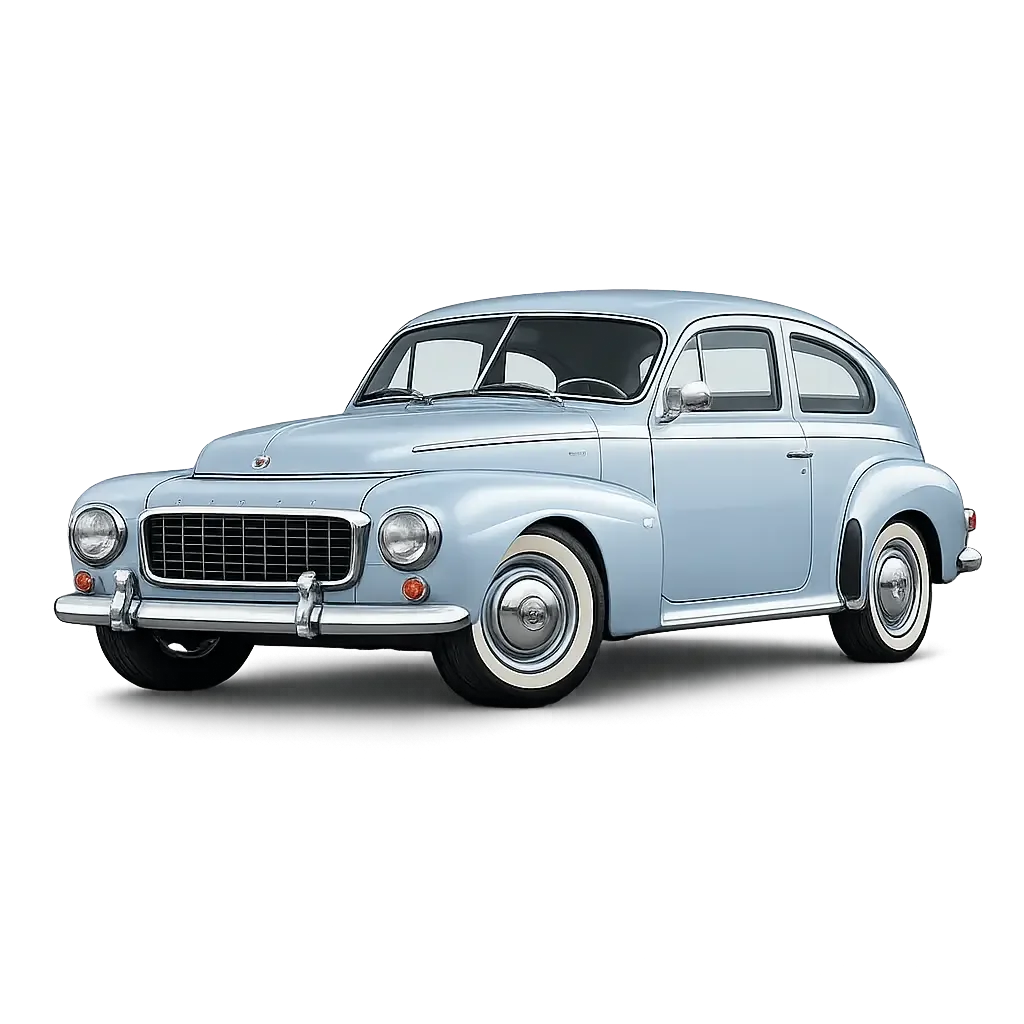
The PV 444 of 1947-1949 was a compact two-door sedan with seating for four. Its styling owed an obvious debt to American design -- particularly the rounded, fastback profile of late-1930s and early-1940s Fords and Studebakers -- but scaled down to European dimensions. The wheelbase was 256 cm (about 100.8 inches), making it substantially smaller than the American sedans it resembled. The combination of American design language and European proportions was, as Volvo had predicted, a highly successful formula.
The body was an all-steel unibody, strong and heavy for its size. The split windshield -- two flat panes of laminated glass -- gave the car a distinctive face. The four-bar radiator grille sat low and wide. The rear window was initially small, limiting rearward visibility (this would be progressively enlarged in later years). The doors were front-hinged but used exterior handles that resembled household door handles -- functional but not elegant, and they would become a known weak point over the years as they wore and became difficult to operate.
Under the hood, the B4B engine sat longitudinally, driving the rear wheels through a three-speed manual gearbox with synchromesh on the top two gears. First gear was unsynchronized, which was standard practice for the era. The electrical system was 6-volt. Suspension was independent at the front with coil springs, and a live rear axle also on coil springs -- an advanced setup for a car in this price class. Brakes were Wagner hydraulic drums on all four wheels.
The driving experience was defined by the contrast between modest power and genuine chassis competence. Forty horsepower does not sound like much, and it was not -- but the PV 444 was light enough and handled well enough that the little B4B never felt inadequate on the winding, poorly surfaced roads of 1940s Sweden. The car's reputation for toughness was established almost immediately. Owners discovered that they could drive PV 444s hard over rough roads without breaking them, a quality that would later make the model a surprise contender in international rally competition.
The 1949 Special
In 1949, Volvo introduced the PV 444 S -- the first "Special" variant. Finished in dove grey with a red leather interior and fitted with special bumpers with bumper horns, the 444 S was aimed at buyers who wanted something a bit more luxurious than the standard car. It was still the same 40 hp B4B under the hood, still the same three-speed gearbox, but the interior appointments and trim level marked it as something slightly elevated. The S designation would follow the 444 through its production life, with each new series getting its own Special variant (444 AS, 444 BS, 444 CS, and so on).
Also in 1949, Volvo introduced the PV 445 -- a derivative of the 444 built on a separate conventional chassis rather than the unibody. The PV 445 was designed for coachbuilders and commercial applications. Its rear suspension used leaf springs instead of coil springs, better suited for carrying heavy loads. Swedish coachbuilders like Grip, Valbo, and Nordberg used the PV 445 chassis to build ambulances, hearses, panel vans, and -- most importantly -- estate cars. The PV 445 would eventually evolve into the Volvo Duett, the ancestor of every Volvo wagon that followed.
Why It Matters
The PV 444 matters because it is the car that made Volvo. Before it, Volvo was a minor Scandinavian manufacturer producing a few thousand large sedans and trucks per year. The PV 444 was supposed to be built in a run of 8,000 units. When production finally ended in 1958 (replaced by the PV 544), 196,005 PV 444s had been built. Combined with the PV 544 that succeeded it, the PV series would eventually reach over 530,000 units -- half a million cars from a design that began as a wartime sketch.
The PV 444 established every theme that would define Volvo for the next 80 years. Safety as a standard feature, not an option. Tough, durable construction that outlasts the competition. Scandinavian design that borrows confidently from global trends but remains distinctly its own. Engines designed for reliability and progressive development rather than outright power. And a stubborn refusal to let a good design die before its time -- the basic PV body shape remained in production for over 20 years, receiving continuous mechanical improvements under a shell that barely changed.
When Volvo finally began exporting the PV 444 to the United States in the mid-1950s, fitted with twin SU carburetors and the uprated B14A engine producing 70 hp, American buyers discovered a car that could outrun an Alfa Romeo Giulietta on a twisting road despite having pushrod valve actuation and three forward gears. The PV's success in American SCCA racing -- and later, the PV 544's legendary victory at the 1965 East African Safari Rally -- cemented Volvo's reputation as a builder of cars that are far more capable than they look.
All of that started here, in 1944, with a show car that did not have an engine, a price that the company honored at a loss, and a laminated windshield that kept its occupants a little bit safer than the competition.
That instinct -- to protect the people inside the car, quietly, without fanfare, as a matter of course -- was already there from the very first production Volvo sedan. Everything that came after, from the three-point seatbelt to the side-impact protection system to the modern City Safety automatic braking, is a continuation of the decision that Helmer Pettersson and his team made in 1943: put laminated glass in the windshield. Not because the customer asked for it. Because it was the right thing to do.
Disclaimer: This guide is based on publicly available specifications, Volvo press materials, and independent research. Part interchangeability should always be confirmed via VINand OEM part number lookup. Specifications may change without notice. This document does not constitute official Volvo parts catalog data. Visuals and illustrations in this article were generated using AI for representative purposes and may not reflect exact technical schematics.