
Written by Arthur Simitian | PartsAdvisory
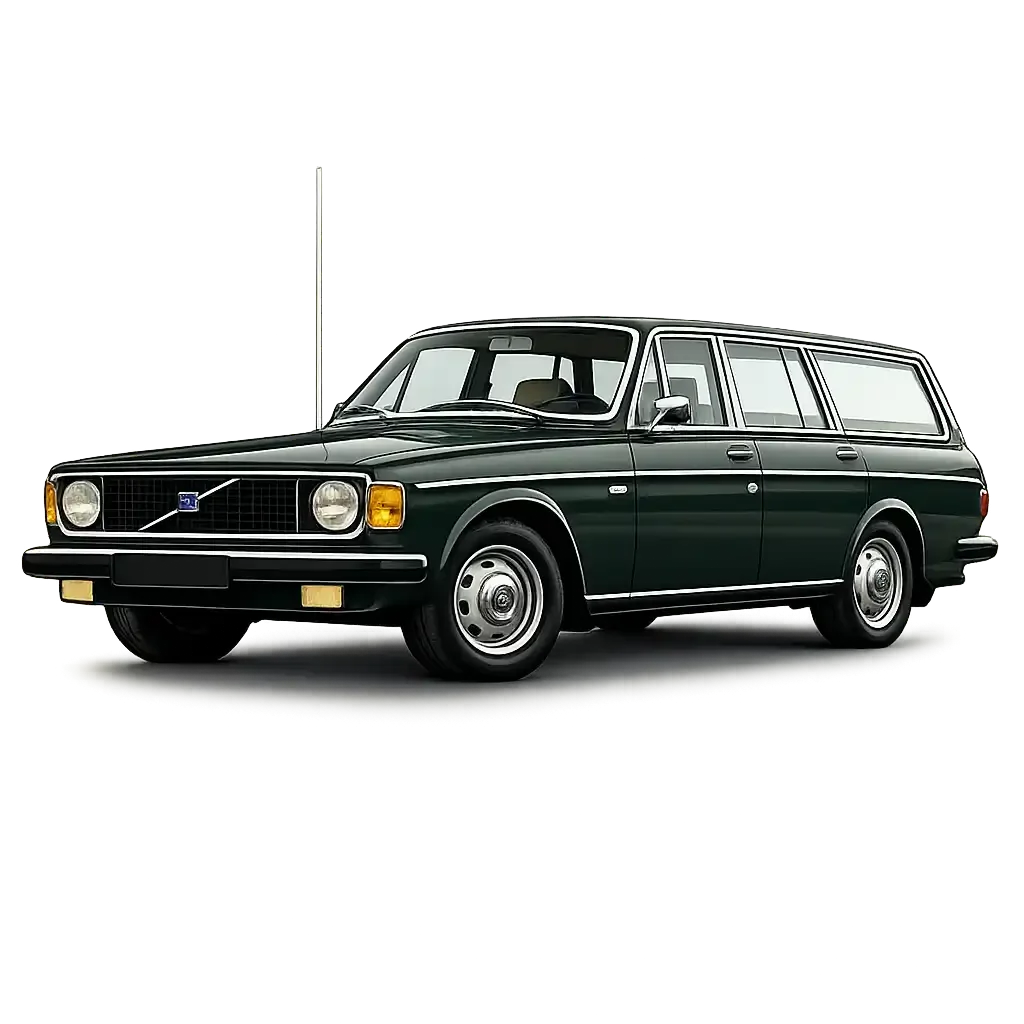
The Volvo 145 is the wagon version of the 140 series - the car that established Volvo's reputation for practical, durable family transportation in the late 1960s and early 1970s. It was introduced in 1968, two years after the 144 sedan, and ran through 1974 when it was replaced by the 245. It shared its platform, front end, and engine bay entirely with the 144 sedan. From the B-pillar back, it was a different vehicle.
For aftermarket parts sellers, the 145 presents the same structural challenge as every Volvo wagon that followed it: the shared front end creates a strong cross-fit opportunity with the sedan, while the wagon-specific rear body creates a category of parts that only fit the 145 and will never fit a 144. Sellers who understand this distinction catalog the 145 accurately. Sellers who do not generate consistent returns on rear body components by treating the two cars as fully interchangeable.
This post covers the full 1968 to 1974 production run of the Volvo 145, the mechanical evolution across that window, and the fitment variables that determine whether a part fits or not.
The 145 in the 140 Series Context
Platform relationship with the 144
The 140 series was introduced in 1966 with the 144 four-door sedan. The 142 two-door sedan followed, and the 145 wagon arrived in 1968. All three shared the same platform: same wheelbase, same floor pan, same firewall, same front subframe, same engine bay dimensions. The front end - hood, front fenders, grille, headlights, front bumper, and header panel - is shared across all three body styles within the same production year and facelift generation.
The 145 designation followed Volvo's naming convention: 1 for the 100 series, 4 for four cylinders, 5 for five doors (four passenger doors plus the tailgate). The five-door description reflects the wagon body's liftgate as the fifth door, distinguishing it from the four-door 144 sedan.
From the B-pillar forward, the 145 and 144 are the same car. From the B-pillar back, they are not. The rear quarter panels, the roofline extension, the liftgate, the liftgate glass, the rear cargo area structure, the taillights, the rear bumper geometry, and the rear wiring harness are all wagon-specific. None of these interchange with the 144 sedan.
Production window and facelift
The 145 ran from 1968 to 1974, a window that includes one significant facelift. The 140 series received its major update for the 1970 model year, which changed the grille, front bumper design, and some front-end trim details. This facelift creates a split at the 1969/1970 boundary for front-end components that applies equally to the 144 and 145.
Within the 145's own rear body, there were minor trim and detail changes across the production run, but no major structural update to the wagon body itself between 1968 and 1974. The fundamental rear body architecture - liftgate opening, taillight pocket geometry, cargo floor structure - remained consistent across the full wagon production window.
Exterior: What the 145 Shares and What It Does Not
Front end: shared with the 144 (with facelift split)
The 145 and 144 share the following front-end components within the same facelift generation:
Hood
Front fenders
Grille
Header panel
Headlights, headlight bezels, and headlight buckets
Front bumper, bumper brackets, and end caps
Front turn signal and parking light assemblies
Front valance panel
The facelift at the 1969/1970 boundary is a hard split for all of these components. A pre-facelift (1968 to 1969) grille will not fit a post-facelift (1970 to 1974) 145 or 144, and vice versa. Front-end component listings must specify the facelift generation.
The pre-facelift front end used a horizontal bar grille with a more upright appearance. The post-facelift front end introduced a revised grille with a different bar pattern and a slightly different front bumper profile. The headlight design remained round sealed beam throughout the 145 production run - the rectangular headlight transition did not happen until the 200 series in 1981.
Rear end: wagon-specific from the B-pillar back
The following components are specific to the 145 wagon body and do not interchange with the 144 sedan:
Liftgate: The 145 liftgate is a unique assembly with its own hinge mounting points, latch mechanism, glass channel, and weatherstrip profile. No sedan trunk lid will fit a 145 liftgate opening, and the 145 liftgate will not fit any sedan.
Liftgate glass: The rear window is integrated into the liftgate as a fixed or opening pane depending on the specification. The glass dimensions, seal profile, and mounting method are specific to the 145 liftgate. This is not the same glass as the 144 rear window, which sits in a fixed body structure.
Rear quarter panels: The 145 rear quarter panels extend the roofline rearward to form the wagon body. The panel shape, the D-pillar geometry, and the mounting interface are all specific to the wagon body. No rear quarter panel from a 144 will fit a 145.
Taillights: The 145 taillights are mounted in a wagon-specific rear body surround. The taillight housing shape, mounting hole pattern, and lens dimensions differ from the 144 sedan taillights. This is consistently one of the highest-volume return categories on the 145 when sellers list sedan taillights as fitting the wagon.
Rear bumper: The rear bumper mounting geometry differs between the 144 and 145 due to the different rear body structure. The bumper face bar profile may be similar, but the mounting brackets, end caps, and body interface hardware are wagon-specific. U.S. market cars had energy-absorbing bumper systems on later production; the specific hardware is body-style-dependent.
Rear wiring harness: The rear lighting harness routes through the wagon body to the liftgate and taillights by a different path than the 144 sedan harness. The harness length, connector locations, and routing clips are wagon-specific.
Cargo area components: The 145 cargo floor, side trim panels, cargo cover supports, and load floor are specific to the wagon body. None of these have equivalents on the 144.
Rear weatherstripping: The liftgate seal, rear quarter window seals (if applicable), and cargo area weatherstripping are all wagon-specific profiles.
Roof rack provisions
The 145 wagon was frequently equipped with or prepared for roof racks, with specific mounting provisions in the roof structure. Roof rack feet, mounting brackets, and associated hardware are wagon-specific.
Engine and Fuel System
The 145 used the same engine options as the 144 sedan throughout its production run. Engine parts cross-reference freely between the 144 and 145 with appropriate year and specification qualifiers.
B18 (1968 to 1969)
The early 145 used the B18 engine in both the B18A (lower output, single carburetor) and B18D (higher output, twin carburetors on some markets) variants. The B18 is a 1.8L overhead cam four-cylinder shared with the 120 series Amazon and the early 1800 series.
Fuel delivery on B18-equipped 145s was carbureted throughout. Market specification determined the carburetor type: SU carburetors on most European-specification cars, with Zenith-Stromberg units increasingly used on North American specification cars for emission compliance. Carburetor type is a required attribute for all B18 fuel system listings.
B20 (1969 to 1974)
The B20 replaced the B18 during the 1969 model year. The transition was gradual and market-dependent - some 1969 cars retained the B18 while others received the B20. The B18 to B20 transition is a hard parts boundary: the two engines share the same basic architecture but differ on all displacement-specific components including head gaskets, pistons, crankshaft, and intake manifold.
B20 variants in the 145:
B20A: Lower-output single-carburetor variant used in some markets
B20B: Higher-output twin-carburetor variant
B20E: Fuel-injected variant with Bosch D-Jetronic, introduced in some markets from 1970 onward
B20F: Further development of the injected variant on later production
The carbureted B20 variants (B20A and B20B) used SU or Zenith-Stromberg carburetors depending on market, following the same market-dependent carburetor split as the B18-equipped cars.
The injected B20E and B20F used Bosch D-Jetronic electronic fuel injection - the same system introduced on the 1800E and 164E in the same period. D-Jetronic components do not interchange with carbureted fuel system components, and do not interchange with the K-Jetronic or LH-Jetronic systems used on the later 200 series.
Fuel delivery type is a mandatory attribute for all 145 fuel system listings. Carbureted and injected B20 components are physically incompatible, and the carburetor type (SU vs. Stromberg) matters for carbureted listings.
Emission systems
U.S. market 145s faced tightening emission requirements through the early 1970s. Air injection systems, EGR valves on some later models, and revised carburetor or injection calibrations for U.S. spec cars create market-dependent parts splits for emission-related components. Market designation (U.S./North America vs. Europe) is a required attribute for exhaust, emission control, and carburetor listings on later production 145s.
Transmissions
The 145 used the same transmission options as the 144:
M40: 4-speed manual without overdrive. The M40 in the 145 shares internal components with the 144 application but the driveshaft length and shift linkage routing may differ slightly due to body dimensions. Internal components cross-reference; external drivetrain components should be verified.
M41: 4-speed manual with electric overdrive. The overdrive unit adds length to the transmission, changing the driveshaft specification. The M41 vs. M40 distinction is critical for driveshaft listings.
BW35: 3-speed Borg-Warner automatic. Internal components cross-reference with 144 application; selector linkage and mounting hardware should be verified for wagon body fitment.
BW55: 3-speed Borg-Warner automatic introduced on later production, replacing the BW35. Different internal component specifications from the BW35.
Transmission code is required for all drivetrain parts. The M40 vs. M41 distinction changes driveshaft length. The BW35 vs. BW55 distinction changes internal filter, gasket, and seal specifications.
Suspension and Brakes
Suspension
The 145 shared its front MacPherson strut and rear live axle suspension geometry with the 144. Spring rates and shock absorber specifications differed between the sedan and wagon due to the wagon's higher gross vehicle weight and cargo carrying capacity. A rear spring listed for the 144 sedan will have a different free height and spring rate than the correct spring for the 145 wagon.
Front suspension components - strut cartridges, front springs, front sway bar - are more likely to cross-reference between 144 and 145, but the heavy-duty suspension packages available on the 145 for towing or cargo use introduce a further split. Standard vs. heavy-duty suspension is a required qualifier for spring and shock listings on the 145.
Brakes
The 145 used front disc brakes and rear drum brakes throughout its production run. The front brake components - caliper, rotor, pads, and front hose - cross-reference with the 144. The rear brake components - drums, shoes, wheel cylinders, and hardware kits - also cross-reference with the 144 on rear drum specifications.
The master cylinder and brake booster on the 145 are shared with the 144 within the same year range. This is one of the cleaner cross-fit categories between the two body styles.
Some late-production 145s may have received rear disc brakes on certain market specifications or option packages. Rear brake type (disc or drum) should be treated as a variable requiring verification on later production cars.
Interior
The 145 interior shared its dashboard, instrument cluster, front door panels, and HVAC system with the 144. These are among the most reliable cross-fit categories between the two body styles.
The 140 series facelift at 1969/1970 brought dashboard and interior updates that apply equally to the 144 and 145. Pre-facelift (1968 to 1969) and post-facelift (1970 to 1974) interior components are not interchangeable at the dashboard and cluster level. The 1969/1970 split is a required qualifier for interior component listings.
Wagon-specific interior components include:
Cargo area floor mat and carpet
Cargo area side trim panels
Load floor board and supports
Rear seat back panel (wagon-specific profile)
Rear side window trim (if wagon has fixed rear quarter windows)
Liftgate interior trim panel
The 145 and the 245: Understanding the Transition
The 145 was replaced by the 245 for the 1975 model year. The 245 was built on the new 200 series platform with the rectangular headlight front end (introduced 1981) and the B21 and later B23 engines. Despite sharing a wagon body style and the Volvo brand, the 145 and 245 share no body panels, no platform components, and - across most of their overlapping production windows - no engine components.
Sellers who maintain both 140 series and 200 series wagon listings should treat the 145 and 245 as completely separate catalog entries with no cross-reference between them. The body style similarity is cosmetic. The platform, front end, and mechanical specifications are entirely different.
Common ACES/PIES Mistakes for 1968 to 1974 Volvo 145
Listing 144 sedan taillights as fitting the 145 wagon. The 145 taillight housing, mounting pattern, and lens shape are wagon-specific. This is the most common return category on the 145.
Listing 144 trunk lids as fitting the 145, or 145 liftgates as fitting the 144. These are completely different assemblies for completely different rear body openings.
Spanning the 1969/1970 facelift boundary with a single application record for grille, front bumper, or front lighting components. The facelift changed these parts, and they are not interchangeable across the boundary.
Listing rear springs with 144 specifications on 145 applications. The wagon's higher load rating requires different spring rates.
Listing fuel system parts without specifying carbureted vs. D-Jetronic. The B20A, B20B, B20E, and B20F all require different fuel system components.
Listing carbureted fuel system parts without specifying SU vs. Zenith-Stromberg carburetor type. Market specification determines the carburetor family.
Listing B18 and B20 engine parts in a single "140 series, 4-cylinder" application record without the engine code. B18 and B20 share architecture but differ on all displacement-specific components.
Listing transmission parts as "manual" or "automatic" without the unit code. M40 vs. M41 changes driveshaft length. BW35 vs. BW55 changes internal specifications.
Cross-referencing rear body components between the 145 and the 245. These are different platforms with no rear body interchangeability.
Catalog Checklist for 1968 to 1974 Volvo 145
Enforce the 1969/1970 facelift boundary as a hard split for all front-end components: grille, front bumper, front fenders, header panel, front turn signals
Require body style specification (wagon/145) for all rear body components: taillights, liftgate, liftgate glass, rear quarter panels, rear bumper hardware, rear wiring harness, cargo area trim
Require engine code (B18A, B18D, B20A, B20B, B20E, B20F) for all engine, fuel, and exhaust parts
Require fuel delivery type (single carburetor, twin carburetors, D-Jetronic) for all fuel system components
Require carburetor type (SU or Zenith-Stromberg) for all carbureted fuel system listings
Require transmission code (M40, M41, BW35, BW55) for all drivetrain parts
Require suspension specification (standard or heavy-duty) for rear spring and shock listings
Require market designation (U.S./North America vs. Europe) for carburetor type and emission equipment
Require rear brake type (disc or drum) on late-production cars where rear disc may apply
Do not cross-reference rear body components between 145 and 245 - different platforms entirely
Verify front interior components against the 1969/1970 facelift split before listing as 1968 to 1974 combined
Cross-Reference Logic
Volvo 144 (same year): Front end, engine, transmission, front suspension, front brakes, dashboard, and front door components cross-reference with appropriate year and specification qualifiers. Rear body, rear lighting, liftgate, rear wiring harness, cargo area, and rear suspension spring rates do not cross-reference.
Volvo 142 (same year): Same cross-reference logic as the 144. Two-door body shares the same front end and mechanical components. Rear body components are specific to the 142 two-door body and do not fit the 145 wagon.
Volvo 164 (same year): Rear body and some interior components may cross-reference given the shared 140 series floor pan. Engine, front end, and drivetrain do not cross-reference due to the B30 six-cylinder and extended wheelbase.
Volvo 245 (1975 and later): No cross-reference. Different platform, different engine family, different body.
Volvo 120 series (Amazon): B18 rotating assembly may cross-reference for early 145 engine components. Body and platform components do not interchange.
The Collector and Enthusiast Market
The 145 has developed a strong following among Volvo enthusiasts who value its combination of 140 series simplicity and wagon practicality. The cars are increasingly collected as early Volvo estates, particularly the pre-facelift 1968 to 1969 cars with the B18 engine and the injected B20E cars from the early 1970s. Values have been rising steadily as clean examples become scarcer.
The 145 buyer searching for parts knows the car. They know whether they have the pre- or post-facelift front end. They know the engine code. A wagon owner ordering taillights knows they are not the same as sedan taillights - and if your listing implies they are, they will order elsewhere or return the part.
Sellers who invest in 145-specific rear body listings - correctly attributed to the wagon body style, correctly split by facelift generation - serve a buyer who has few other well-documented sources and will return for repeat business.
Final Take
The Volvo 145 is a 144 from the B-pillar forward and its own vehicle from the B-pillar back. The shared front end and engine bay make it a natural catalog companion to the 144, but the wagon-specific rear body - liftgate, rear quarters, taillights, cargo area - requires its own application records that cannot be derived from sedan listings.
Within the 145's production window, the 1969/1970 facelift is the hard boundary for front-end components, the engine code split (B18 vs. B20, and carbureted vs. injected within B20) is the boundary for all engine and fuel system parts, and the body style designation is required for everything from the B-pillar back.
Seven attributes cover the majority of correct 145 fitment: body style (wagon), facelift generation (pre or post 1970), engine code, fuel delivery type, carburetor type where applicable, transmission code, and market. Apply those consistently and the 145 becomes a well-cataloged vehicle for a growing collector buyer base that rewards accuracy.
Disclaimer: This guide is based on publicly available specifications, Volvo press materials, and independent research. Part interchangeability should always be confirmed via VIN and OEM part number lookup. Specifications may change without notice. This document does not constitute official Volvo parts catalog data.