
Written by Arthur Simitian | PartsAdvisory
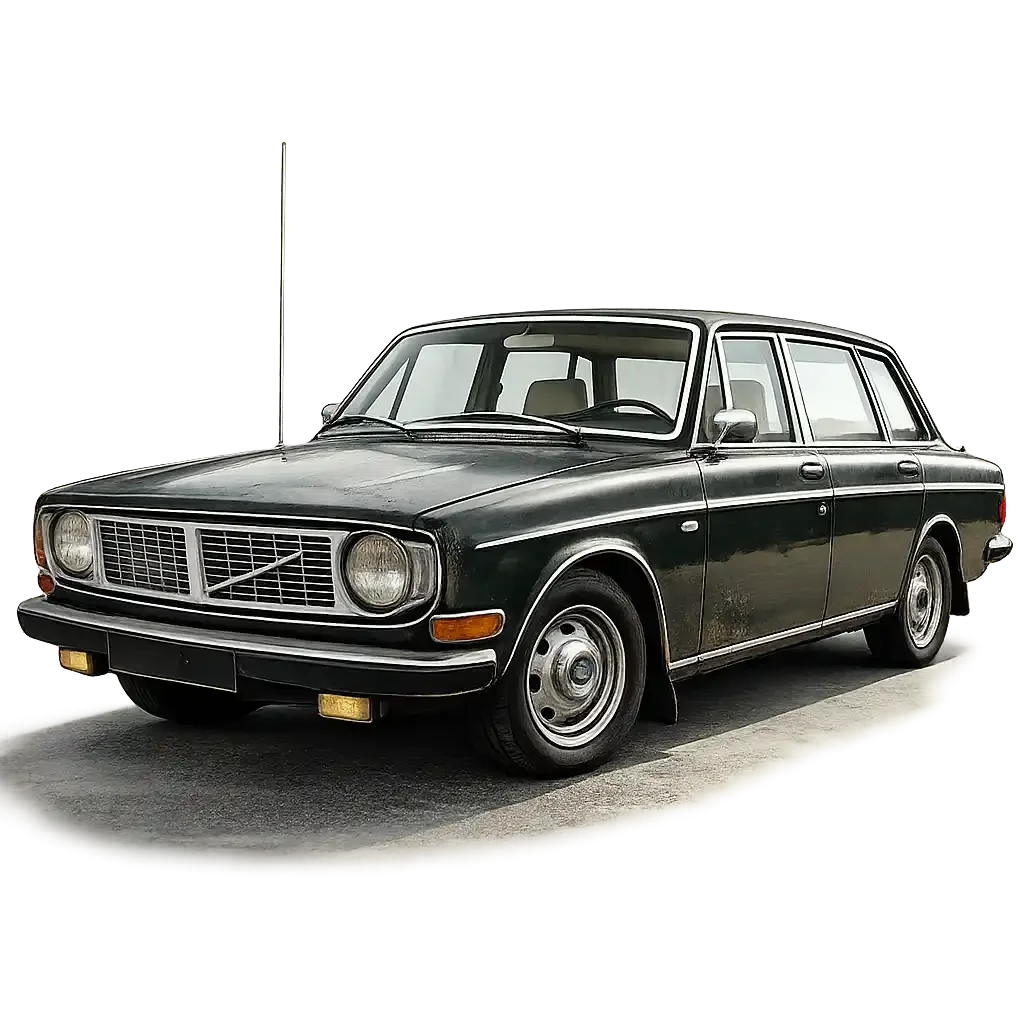
The Volvo 144 is the car that defined Volvo's modern identity. Introduced in 1966 as a 1967 model year vehicle, it replaced the 120 series Amazon and established the safety-first engineering philosophy that would carry Volvo through the 200 series, the 700 series, and beyond. It was a four-door sedan built for durability, repairability, and occupant protection - not performance, not fashion. It sold in large numbers across Europe, North America, and export markets, and it ran for eight model years with one meaningful facelift before giving way to the 244 in 1975.
For aftermarket parts sellers, the 144 is the reference vehicle for the entire 140 series. The 142 two-door and 145 wagon are built on the same platform and share the same front end and mechanical components. The 164 shares the floor pan and rear body. Understanding the 144's fitment structure is the foundation for cataloging the entire 140 series family correctly.
This post covers the 1967 to 1974 Volvo 144 - the full production run of the four-door sedan - including the mechanical evolution across that window, the facelift that divided it, and the fitment variables that determine whether a part fits or generates a return.
Production Overview: Two Distinct Periods
The 144 production run divides cleanly into two periods at the 1969/1970 model year boundary. The 1970 model year brought a facelift that updated the grille, front bumper design, front lighting trim, and interior. These changes were not cosmetic refinements - they created hard parts boundaries that affect a wide range of exterior and interior component listings.
1967 to 1969: Original specification
The original 144 used the B18 engine in its first two production years, transitioning to the B20 during 1969. The front end used a horizontal bar grille with a distinctive upright appearance, round sealed beam headlights in a simple bezel arrangement, and a relatively narrow chrome front bumper. The interior used a dashboard design specific to the pre-facelift era.
The 1967 model year cars are the earliest production and carry some first-year specification details that may differ from 1968 and 1969 cars in trim and electrical components. Sellers covering 1967 production should verify component specifications against 1967-specific part numbers rather than assuming full interchangeability with all pre-facelift cars.
1970 to 1974: Post-facelift
The 1970 update gave the 144 a revised grille with a different bar pattern and a more modern appearance, a revised front bumper with updated end caps and mounting hardware, updated front turn signal assemblies, and a new dashboard design with revised instrumentation and HVAC controls. These changes are carried through to the end of 144 production in 1974.
The post-facelift front end is not interchangeable with the pre-facelift front end on any of the components listed above. The facelift boundary at 1969/1970 is the most important single fitment split in the 144 catalog.
Exterior
Front end: the facelift split in detail
The 1969/1970 facelift boundary is a hard split for the following front-end components:
Grille: The pre-facelift grille and the post-facelift grille have different bar patterns, different mounting tab locations, and different width dimensions at the headlight interface. They are not interchangeable.
Front bumper: The bumper face bar profile, end cap shape, and mounting hardware changed at the facelift. U.S. market cars additionally had energy-absorbing bumper systems on post-facelift production to meet evolving federal 5 mph impact standards. The bumper shocks, mounting brackets, and reinforcement hardware on U.S. spec post-facelift cars are different from the European spec bumper assembly and from the pre-facelift bumper on either market.
Front turn signal and parking light assemblies: The lens shape, housing profile, and mounting location were revised at the facelift. Pre- and post-facelift front signal assemblies are not interchangeable.
Header panel: The header panel stamping was updated to match the revised grille opening dimensions. Pre- and post-facelift header panels are different part numbers.
Headlights and bezels: The round sealed beam headlight design continued across the facelift, and the headlight units themselves may cross-reference between pre- and post-facelift cars. However, the headlight bezels and surrounding trim were revised and may differ between generations. Verify individual component fitment before listing as a full-range cross-fit.
Hood: The hood profile is generally consistent across the 144 production run, but minor changes to the leading edge geometry and hood latch mechanism may affect fitment of hood-related hardware between early and late production cars. Verify before spanning the full range.
Rear end
The 144 rear body remained largely consistent across the full 1967 to 1974 production run, with no major structural changes to the trunk opening, rear quarter panels, or rear body panel geometry. This consistency makes the rear body a relatively reliable fitment window when correctly identified as 144 sedan-specific.
Taillights: The 144 taillights are specific to the sedan body. They do not interchange with the 145 wagon taillights, the 142 two-door taillights, or any 200 series component. Within the 144 sedan production run, the taillight design may have received minor updates in lens detail or gasket profile across the years. Sellers should verify specific production year ranges rather than spanning 1967 to 1974 as a single taillight application without confirmation.
Trunk lid: The trunk lid is specific to the 144 sedan. The hinge mounting points, latch mechanism, and weatherstrip channel are sedan-specific. No wagon liftgate or two-door trunk lid will fit.
Rear bumper: The rear bumper is specific to the 144 body. The face bar profile, end caps, and mounting hardware are sedan-specific. U.S. market cars had energy-absorbing rear bumper systems on later production.
Body panels
The 144 body panels - front fenders, rear quarter panels, doors, and trunk lid - are specific to the four-door sedan body. The front fenders are shared with the 142 two-door and the 145 wagon within the same facelift generation. The rear quarter panels are sedan-specific and do not interchange with the wagon or two-door. The door skins are shared with the 142 for the front doors only; the 144 rear doors have no equivalent on the two-door 142.
Engine: B18 to B20 Transition
B18 (1967 to 1969)
The 144 launched with the B18 engine - a 1.8L overhead cam four-cylinder carried over from the 120 series Amazon. The B18 in the 144 was available in several variants:
B18A: Lower-output single-carburetor version for most markets
B18B: Higher-output twin-carburetor version, used in sportier specifications and some markets
B18D: A further variant designation used in some markets
The B18A and B18B differ on cylinder head specification, carburetor setup, camshaft profile, and valve train components. Listing an engine component as "B18" without the specific variant code will cross-match parts from two different engine tunes. Cylinder head gaskets, valve cover gaskets, carburetor-related components, and exhaust manifold specifications may all differ between B18 variants.
B20 (1969 to 1974)
The B20 replaced the B18 during the 1969 model year. As with the 145, the transition was market-dependent and some 1969 cars retained the B18. The B18 to B20 boundary is a hard parts split for all displacement-specific components: head gaskets, pistons, crankshaft, connecting rods, and intake manifold are all different between the two engine families despite sharing the same basic architecture.
B20 variants in the 144:
B20A: Lower-output single-carburetor variant for base specifications and some markets
B20B: Higher-output twin-carburetor variant
B20E: Fuel-injected variant with Bosch D-Jetronic, introduced from 1970 onward in most markets
B20F: Further development of the injected variant on later production
The B20A and B20B differ on carburetor setup, compression ratio, and camshaft specification. The B20E and B20F introduced D-Jetronic fuel injection, creating a fundamental parts boundary between carbureted and injected B20 applications.
The engine code - B18A, B18B, B20A, B20B, B20E, or B20F - is the first required attribute for every engine and fuel system listing on the 144. "Volvo 144, 4-cylinder" is not a sufficient qualifier for any engine component.
Fuel System
Carbureted B18 and B20 (B18A, B18B, B20A, B20B)
The carbureted 144 variants used single or twin carburetors depending on the engine variant and market specification. The carburetor family was market-dependent:
SU carburetors: Used on most European-specification cars. HS6 units on higher-output variants.
Zenith-Stromberg carburetors: Used on North American specification cars from the early 1970s onward to meet tightening emission requirements, and on some lower-output European variants.
The SU and Zenith-Stromberg carburetor families are not interchangeable. Rebuild kits, jets, needles, float valves, and throttle shaft seals are specific to each carburetor family. A fuel system listing must specify both the engine variant (B18A, B18B, B20A, B20B) and the carburetor type (SU or Stromberg). Market designation alone is not sufficient because the carburetor type changed at different points for different engine variants in different markets.
D-Jetronic fuel injection (B20E, B20F)
The B20E and B20F used Bosch D-Jetronic electronic fuel injection - the same system used on the contemporary 1800E and 164E. As covered in those guides, D-Jetronic is a manifold pressure-sensing system that predates and is completely incompatible with the K-Jetronic and LH-Jetronic systems used on the 200 series.
D-Jetronic components on the 144 B20E/B20F:
ECU calibrated for the B20E/B20F application
Manifold pressure sensor
Coolant temperature and intake air temperature sensors
Trigger distributor with D-Jetronic timing points
Four fuel injectors with D-Jetronic connectors and flow specification
Fuel rail specific to four-cylinder D-Jetronic application
Intake manifold specific to the injected B20
The four-injector D-Jetronic application on the 144 B20E is compatible with the equivalent 1800E application at the component level (both use four-cylinder B20E with D-Jetronic), making the 1800E a legitimate cross-reference source for 144 D-Jetronic fuel system parts. This is one of the more useful cross-reference opportunities in the 140 series catalog. Verify individual part numbers before listing, but the platform overlap is real and commercially useful.
The six-cylinder 164E D-Jetronic application is not compatible for fuel rail, ECU calibration, or injector count.
Emission systems
U.S. market 144s faced progressively tighter emission requirements through the early 1970s. Air injection systems, revised carburetor calibrations, and on some later models EGR valves were added to meet federal and California standards. California-specification cars may have different emission equipment from 49-state U.S. cars on later production.
Market designation (U.S./North America vs. Europe) and emission standard (California vs. 49-state) are required attributes for emission-related component listings on post-1970 144s.
Transmissions
The 144 was available with the following transmissions throughout its production run:
M40: 4-speed manual without overdrive. The standard manual gearbox for most markets. Internal components are widely cross-referenced across 140 series applications.
M41: 4-speed manual with electric Laycock overdrive. The overdrive unit adds length to the transmission, requiring a different driveshaft than the M40. The M40 vs. M41 distinction is the most important transmission split for driveshaft listings.
BW35: 3-speed Borg-Warner automatic, the early automatic option. Different internal filter, gasket, and clutch pack specifications from the BW55.
BW55: 3-speed Borg-Warner automatic that superseded the BW35 in later production. More common on post-facelift cars.
Transmission code is required for all drivetrain parts. The M40 vs. M41 distinction changes driveshaft length. BW35 vs. BW55 changes internal component specifications including filter kits and gasket sets. "Manual" or "automatic" alone is not a sufficient qualifier for any drivetrain listing.
Suspension and Brakes
Suspension
The 144 used a front MacPherson strut design and a rear live axle with trailing arms and a Panhard rod, coil springs, and separate shock absorbers. This layout carried over from the 120 series Amazon in its basic architecture but with updated geometry and specifications for the heavier 140 series body.
Front strut specifications varied by market. Heavier-duty suspension packages were available on some export models and later production years, with different spring rates and shock absorber valving than the standard setup. Strut cartridge and spring listings should specify standard vs. sport/heavy-duty suspension where applicable.
Rear spring specifications differed between the 144 sedan and 145 wagon due to the wagon's higher load rating. This is relevant only for cross-referencing - within the 144 sedan application, rear spring specifications are relatively consistent across the production run with minor variations by market and year.
Brakes
The 144 is significant in Volvo's history as one of the first production cars to offer front disc brakes as standard equipment from the outset. Front disc brakes, with a sliding caliper design, were standard on the 144 throughout its production run.
The rear brakes used drum brakes throughout the 1967 to 1974 production window on the vast majority of 144s. Some later production cars, particularly post-facelift models in certain markets, may have received optional rear disc brakes. Rear brake type (disc or drum) should be treated as a variable requiring verification on late-production cars, not assumed to be drums on all 144s.
The master cylinder and brake booster are shared between the 144 sedan and 145 wagon within the same year range, making these reliable cross-fit parts between the two body styles.
Interior
Dashboard: facelift split
The 144 interior received a revised dashboard at the 1970 facelift. The pre-facelift dashboard (1967 to 1969) and the post-facelift dashboard (1970 to 1974) are different assemblies with different instrument cluster layouts, different HVAC control panels, and different switch positions. Dashboard pads, instrument cluster lenses, and HVAC control components must be specified by facelift generation.
Shared interior components
The following interior components cross-reference between the 144 and 145 wagon within the same year range:
Dashboard assembly and sub-components (same front body structure)
Instrument cluster
Front door panels and hardware
HVAC system components
Headliner (front section)
Front seat mounting hardware
The following interior components are sedan-specific and do not cross-reference with the 145:
Rear seat cushion and back (sedan profile vs. wagon rear seat)
Trunk area carpet and trim
Rear package shelf
Interior rear pillar trim (sedan C-pillar vs. wagon D-pillar)
The 144 as the Cross-Reference Hub for the 140 Series
The 144 is the reference vehicle for all 140 series fitment decisions. When a component is listed for the 142 two-door or the 145 wagon, the starting question is always whether it fits the 144. If it does, the follow-up question is whether the body style introduces a difference. For front-end and mechanical components, the answer is usually no - the cross-fit with the 144 holds. For rear body components, the answer is usually yes - the specific body style determines fitment.
The cross-reference logic for the full 140 series family from the 144 perspective:
142 two-door: Front end, engine, transmission, and front interior components shared with the 144. Front doors shared. Rear doors, rear quarter panels, trunk lid, and taillights are 142-specific. The 142 rear body is a two-door configuration with no rear door equivalent on the 144.
145 wagon: Front end, engine, transmission, and front interior components shared with the 144. Rear body, rear lighting, liftgate, cargo area, and rear quarter panels are 145-specific.
164: Rear body and floor pan shared with the 144 in concept. Front end, engine (B30 six-cylinder), and front suspension are 164-specific due to the extended wheelbase and six-cylinder engine bay.
Common ACES/PIES Mistakes for 1967 to 1974 Volvo 144
Spanning the 1969/1970 facelift boundary with a single application record for grille, front bumper, front turn signals, header panel, or dashboard components. These parts changed at the facelift and the pre- and post-facelift units are not interchangeable.
Listing fuel system parts as "Volvo 144, B20" without specifying carbureted vs. D-Jetronic. The B20A, B20B, B20E, and B20F all require different fuel system components with zero interchangeability between carbureted and injected variants.
Listing carbureted fuel system components without specifying SU vs. Zenith-Stromberg. Market and model year determine the carburetor family, and rebuild kits, jets, and float valves are carburetor-specific.
Listing B18 and B20 parts in a single "140 series, 4-cylinder" application record. The B18 and B20 share architecture but differ on all displacement-specific components.
Listing B18 parts without the specific variant code (B18A vs. B18B). The two variants differ on head specification, carburetor setup, and camshaft.
Listing transmission parts as "manual" or "automatic" without the unit code. M40 vs. M41 changes driveshaft length. BW35 vs. BW55 changes internal specifications.
Listing taillights as cross-fits between the 144, 142, and 145 without body style verification. All three body styles have different rear body geometry and different taillight assemblies.
Treating the 144 and 164 as fully interchangeable because they share a floor pan. The 164 has a different front end, different front suspension, different engine, and a longer wheelbase. The driveshaft, front suspension components, and all front-end sheetmetal are not shared.
Listing rear quarter panels from the 144 as fitting the 145 wagon. These are completely different stampings for different body structures.
Catalog Checklist for 1967 to 1974 Volvo 144
Enforce the 1969/1970 facelift boundary as a hard split for grille, front bumper, header panel, front turn signals, and dashboard components
Require engine code (B18A, B18B, B20A, B20B, B20E, B20F) for all engine, fuel, and exhaust parts
Require fuel delivery type (single carburetor, twin carburetors, D-Jetronic) for all fuel system components
Require carburetor type (SU or Zenith-Stromberg) for all carbureted fuel system listings
Require transmission code (M40, M41, BW35, BW55) for all drivetrain parts
Require market designation (U.S./North America vs. Europe) for bumper hardware and emission equipment
Require facelift generation (pre-1970 or post-1970) for all front-end and dashboard component listings
Specify body style (144 sedan) for taillights, trunk lid, rear quarter panels, and all rear body components
Require rear brake type (disc or drum) on late-production cars where rear disc may apply
Verify D-Jetronic cross-reference with 1800E B20E application at part number level before listing as shared fit
Cross-Reference Logic
Volvo 142 (same year): Front end, engine, transmission, front suspension, front brakes, dashboard, and front door components cross-reference with appropriate year and specification qualifiers. Rear doors (the 144 has them, the 142 does not), rear quarter panels, trunk lid, and taillights are body-style-specific and do not cross-reference.
Volvo 145 (same year): Same cross-reference logic as the 142 for front-end and mechanical components. Rear body, rear lighting, liftgate, cargo area, and rear quarter panels are wagon-specific.
Volvo 164 (same year): Rear floor pan and some rear interior components may cross-reference. Front end, engine (B30), front suspension, and driveshaft do not cross-reference due to the extended wheelbase and six-cylinder engine bay.
Volvo 1800E/1800ES (same year, B20E application): D-Jetronic fuel system components on the 144 B20E may cross-reference with the 1800E B20E application at the part number level. Both use four-cylinder B20E with D-Jetronic. Verify individual part numbers. Body and platform components do not interchange.
Volvo 120 series (Amazon): B18 rotating assembly may cross-reference for early 144 engine components. Body and platform components do not interchange.
Volvo 244 (1975 and later): The 244 replaced the 144 on the new 200 series platform. No body or platform interchangeability. Some B20 engine components from the late 144 may cross-reference with early B20-equipped 244s - verify by part number.
Frame all cross-references as "may also fit" with year, engine code, body style, and specification qualifiers.
Final Take
The Volvo 144 is the anchor of the 140 series catalog. Get the 144 right and the 142 and 145 follow naturally, because both of those body styles are defined by what they share with the 144 and where they diverge from it. Get the 144 wrong - by spanning the facelift boundary, by conflating B18 and B20 variants, by treating carbureted and injected B20s as a single application, by listing sedan taillights as fitting the wagon - and the errors propagate across the entire 140 series family.
The five boundaries that define correct 144 catalog data: the 1969/1970 facelift for front-end and dashboard components, the B18/B20 engine transition for all engine parts, the carbureted/D-Jetronic split for all fuel system parts, the transmission code for all drivetrain parts, and the sedan body style designation for all rear body components. Those five attributes, applied consistently, produce 144 listings that serve a growing collector buyer base accurately and without returns.
Disclaimer: This guide is based on publicly available specifications, Volvo press materials, and independent research. Part interchangeability should always be confirmed via VIN and OEM part number lookup. Specifications may change without notice. This document does not constitute official Volvo parts catalog data.