
Volvo 142 (1967 to 1974): The Two-Door 140 Series and the Fitment Splits Sellers Miss
Written by Arthur Simitian | PartsAdvisory
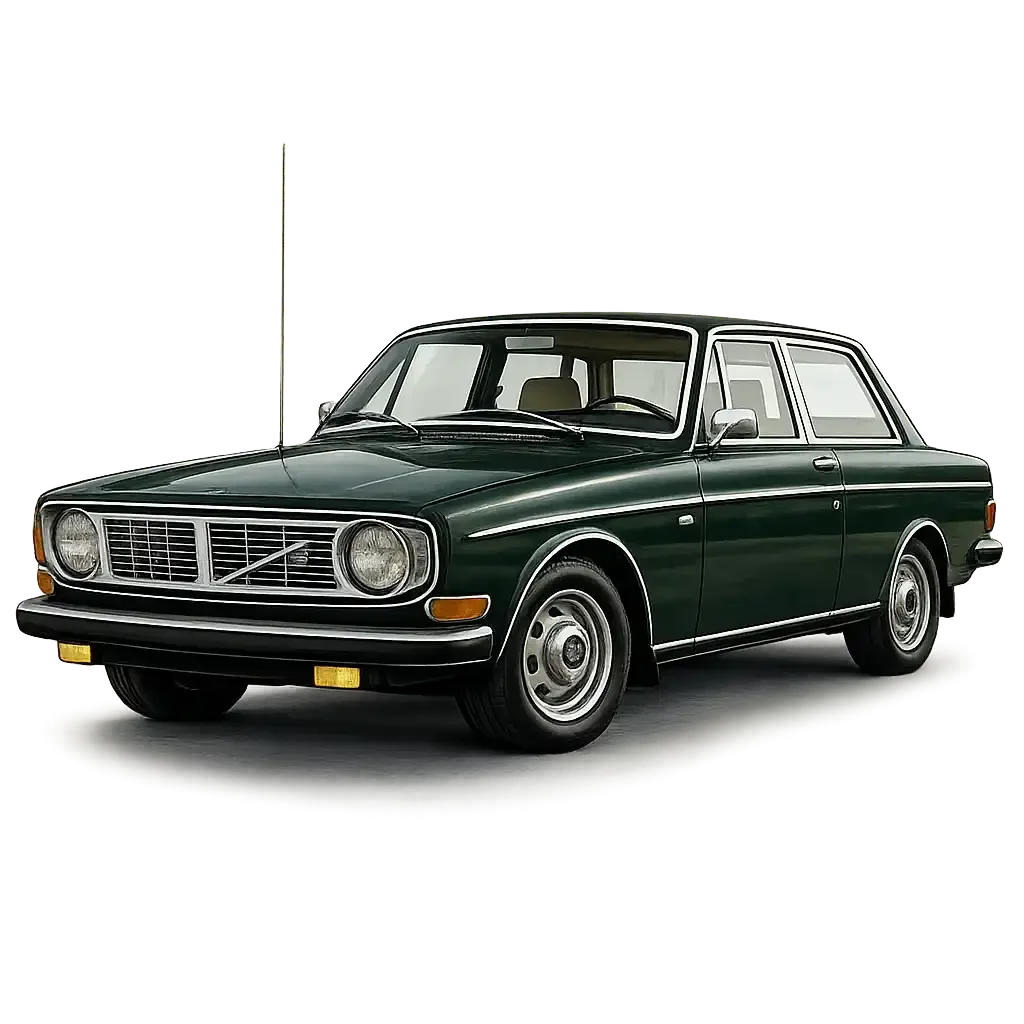
The Volvo 142 is the least discussed car in the 140 series family. The 144 sedan was the volume seller. The 145 wagon became the definitive practical Volvo. The 164 was the flagship. The 142 was the two-door - a sportier body style on the same platform that appealed to buyers who wanted 140 series engineering with a cleaner roofline and fewer doors. It launched alongside the 144 in 1966 as a 1967 model year vehicle and ran through 1974, when the 242 took its place in the 200 series lineup.
For aftermarket parts sellers, the 142 is the 140 series car most likely to be cataloged incorrectly, because its relationship to the 144 creates a strong temptation to treat the two as fully interchangeable. They share a platform, a front end, an engine bay, and a front door shell. A seller who knows the 144 catalog well will get the front half of the 142 right almost automatically. The rear half is where the errors accumulate - and the rear half of the 142 is a different vehicle from the 144 in every meaningful way.
This post covers the 1967 to 1974 Volvo 142, what it shares with the rest of the 140 series family, where it diverges, and the fitment variables that determine accuracy for every component category.
The 142 in the 140 Series Context
Naming and body style
The 142 designation followed Volvo's naming convention: 1 for the 100 series, 4 for four cylinders, 2 for two doors. The two-door body style gave the 142 a longer door skin than the 144 - a single large door covering the full front-to-rear passenger compartment opening, with no rear door. The roofline was lower at the C-pillar, giving the car a fastback-adjacent profile that distinguished it visually from the more upright 144.
The 142 was positioned as the sportier option in the 140 lineup, and in certain markets and specifications it was offered in higher-trim and higher-output configurations that are relevant for parts fitment - particularly for engine variant and carburetor specification.
Platform relationship with the 144 and 145
The 142 shares its wheelbase, floor pan, firewall, front subframe, and engine bay dimensions with the 144 and 145. The front end - hood, front fenders, grille, headlights, front bumper, and header panel - is shared across all three body styles within the same facelift generation.
From the B-pillar back, the 142 is its own vehicle. The longer door skin, the fixed rear quarter window integrated into the rear quarter panel, the two-door rear body structure, the trunk lid, the rear quarter panels, the taillights, and the rear body panel between the taillights are all 142-specific. None of these interchange with the 144 sedan or the 145 wagon.
The practical catalog rule: everything from the firewall forward is a potential cross-fit with the 144 and 145, subject to facelift generation and specification qualifiers. Everything from the B-pillar back is a 142-only part.
Production Overview: Two Periods at the 1970 Facelift
The 142 production run divides at the same 1969/1970 model year boundary as the 144 and 145. The 1970 facelift updated the grille, front bumper, front turn signal assemblies, header panel, and interior dashboard across the entire 140 series lineup. The changes apply identically to the 142 as to the 144 - the shared front end means the facelift boundary is the same hard split for front-end component listings on both body styles.
1967 to 1969: Original specification
The original 142 used the B18 engine in its first production years, transitioning to the B20 during 1969. The front end used the pre-facelift horizontal bar grille, round sealed beam headlights, and narrow chrome bumper that characterized the early 140 series. The dashboard was the pre-facelift design shared with the 144.
As with the 144, 1967 first-year production cars may carry specification details in trim and electrical components that differ from 1968 and 1969 cars. Sellers covering 1967 production should verify against 1967-specific part numbers rather than assuming full interchangeability across the pre-facelift window.
1970 to 1974: Post-facelift
The 1970 update brought the revised grille, updated front bumper, new front turn signal assemblies, and revised dashboard to the 142 in lockstep with the 144 and 145. Post-facelift front-end and interior components on the 142 cross-reference with the equivalent 144 and 145 parts from the same production year.
Exterior: Shared Front, Unique Rear
Front end: shared with 144 and 145 (with facelift split)
The following front-end components are shared between the 142, 144, and 145 within the same facelift generation:
Hood
Front fenders
Grille
Header panel
Headlights, headlight bezels, and headlight buckets
Front bumper, bumper brackets, and end caps
Front turn signal and parking light assemblies
Front valance panel
The 1969/1970 facelift is a hard split for all of these components. Pre-facelift (1967 to 1969) and post-facelift (1970 to 1974) front-end parts are not interchangeable. Within each facelift generation, the cross-fit between 142, 144, and 145 on front-end components is genuine and commercially useful.
U.S. market cars received energy-absorbing front bumper systems on post-facelift production to meet federal 5 mph impact standards. The bumper shocks, mounting brackets, and reinforcement hardware on U.S. spec post-facelift cars differ from European spec cars and from the pre-facelift bumper on either market. Market designation is a required qualifier for bumper hardware listings.
Doors: front doors shared, rear doors absent
The 142 front doors share their door skin, glass, window regulator, door handle, lock mechanism, and door panel mounting structure with the 144 front doors within the same production year. This is one of the most reliable cross-fit opportunities between the two body styles.
The 142 has no rear doors. This is obvious but has direct catalog implications. Any door component listing that spans 142 and 144 applications is only valid for front doors. A listing that reads "Volvo 142/144 door weatherstrip" or "Volvo 142/144 window regulator" without specifying front applies rear door parts to a car that has no rear doors, or ships front-door-only parts to a 144 buyer who may need a rear door component.
Rear door glass, rear door regulators, rear door handles, rear door locks, and rear door panels from the 144 have no application on the 142.
Fixed rear quarter windows
In place of rear doors, the 142 has fixed rear quarter windows integrated into the rear quarter panels. These windows are unique to the 142 body. The glass shape, the rubber gasket or seal, the chrome trim surround, and the mounting method are all 142-specific. There is no 144 or 145 equivalent for this component.
Fixed rear quarter window glass and seals are among the most difficult-to-source body components on the 142, and sellers who can correctly list them as 142-specific parts serve a buyer with few alternatives.
Rear body: 142-specific from the B-pillar back
The following rear body components are specific to the 142 two-door body and do not interchange with the 144 or 145:
Trunk lid: The 142 trunk lid has a different profile, different hinge mounting geometry, and different weatherstrip channel than the 144 trunk lid. The two-door body's C-pillar slope affects the trunk lid's rear window junction, making the 142 trunk lid a distinct part from the 144 unit.
Rear quarter panels: The 142 rear quarter panels incorporate the fixed rear quarter window opening and reflect the two-door roofline geometry. They are completely different stampings from the 144 rear quarter panels.
Taillights: The 142 taillights are mounted in a rear body surround specific to the two-door body. The housing shape, mounting hole pattern, lens dimensions, and gasket profile differ from the 144 sedan taillights. Listing 144 taillights as fitting the 142 is one of the most consistent return generators in the 140 series catalog.
Rear bumper: The rear bumper face bar and mounting hardware are specific to the 142 body geometry. The rear body panel dimensions and bumper mounting points differ between the 142 and 144.
Rear body panel: The panel between the taillights is specific to the 142 rear body width and profile.
Rear wiring harness: The rear lighting harness routes through the 142 body by a path specific to the two-door structure, with different routing clips, different harness lengths, and different connector locations than the 144 sedan harness.
C-pillar trim and rear window: The 142's rear window is integrated into the two-door roofline at a different angle than the 144's rear window, and the C-pillar trim surrounds and rear window seal are specific to the 142 body.
Engine: B18 to B20 Transition
The 142 used the same engine family as the 144 and 145 throughout its production run. Engine parts cross-reference across the 140 series body styles with appropriate engine code and specification qualifiers.
B18 (1967 to 1969)
The early 142 used the B18 in two primary variants:
B18A: Lower-output single-carburetor version for base specifications and most markets
B18B: Higher-output twin-carburetor version, used on sportier specifications
The 142 was frequently specified with the B18B in markets where it was available, reflecting its positioning as the sportier 140 series option. The B18A and B18B differ on cylinder head specification, carburetor setup, camshaft profile, and valve train components. Engine code is required for all B18-era listings - "B18" alone is not sufficient.
B20 (1969 to 1974)
The B20 replaced the B18 during the 1969 model year, with the same market-dependent transition timing as on the 144 and 145. B20 variants available in the 142:
B20A: Lower-output single-carburetor variant
B20B: Higher-output twin-carburetor variant - the more common specification on the 142 given its sporting orientation in many markets
B20E: Fuel-injected variant with Bosch D-Jetronic, introduced from 1970 onward
B20F: Further development of the injected variant on later production
The B20B was the predominant engine in the 142 in most markets where both B20A and B20B were offered, though this varies by market and year. Sellers should not assume the 142 automatically received the higher-output variant in all applications - engine code verification remains essential.
The B18 to B20 transition is a hard parts boundary for all displacement-specific components. B18 and B20 engine parts do not cross-reference at the gasket, piston, or manifold level despite the shared architecture.
Fuel System
Carbureted B18 and B20 (B18A, B18B, B20A, B20B)
The carbureted 142 variants used single or twin carburetors depending on the engine variant. The carburetor family was market-dependent:
SU carburetors: Standard on most European-specification cars
Zenith-Stromberg carburetors: Used on North American specification cars from the early 1970s onward for emission compliance, and on some lower-output variants in certain markets
SU and Zenith-Stromberg rebuild kits, jets, needles, and float valves are not interchangeable. Fuel system listings must specify both the engine variant code and the carburetor type. Market designation alone is not sufficient because carburetor type changes at different points for different engine variants.
D-Jetronic fuel injection (B20E, B20F)
The B20E and B20F used Bosch D-Jetronic electronic fuel injection, identical in system architecture to the D-Jetronic used on the contemporary 144, 1800E, and 164E. The four-cylinder B20E application on the 142 cross-references with the equivalent 144 B20E and 1800E B20E applications at the fuel system component level - ECU calibration, injector count, fuel rail, and intake manifold are shared across these four-cylinder D-Jetronic applications.
This cross-reference is commercially valuable. A seller with D-Jetronic components listed for the 144 B20E can extend that listing to the 142 B20E with confidence, subject to part number verification. The 164E six-cylinder D-Jetronic application does not cross-reference for fuel rail, ECU, or injector count.
Fuel delivery type is a mandatory attribute for all 142 fuel system listings. Carbureted and injected B20 components are physically incompatible.
Emission systems
U.S. market 142s faced the same tightening emission requirements as the 144, with air injection systems and revised carburetor or injection calibrations on later production cars. Market designation and emission standard (California vs. 49-state) are required attributes for emission-related component listings on post-1970 U.S. market cars.
Transmissions
The 142 used the same transmission options as the 144:
M40: 4-speed manual without overdrive
M41: 4-speed manual with electric Laycock overdrive - the overdrive unit changes driveshaft length relative to M40
BW35: 3-speed Borg-Warner automatic, early production
BW55: 3-speed Borg-Warner automatic, later production
The M40 vs. M41 distinction is critical for driveshaft listings - the overdrive unit adds length and requires a shorter driveshaft. The BW35 vs. BW55 distinction changes internal filter, gasket, and clutch pack specifications. Transmission code is required for all drivetrain parts.
The driveshaft on the 142 is shared with the 144 when the same transmission is installed - the wheelbase is identical between the two body styles, and the driveshaft length is determined by the transmission type rather than the body style.
Suspension and Brakes
Suspension
The 142 used the same front MacPherson strut and rear live axle configuration as the 144. Spring rates and shock absorber specifications were typically the same as the 144 sedan for equivalent specification levels. Heavy-duty or sport suspension packages available on some export markets differed from the standard setup in spring rate and shock valving.
Front strut and spring listings cross-reference with the 144 within the same year and specification level. Rear spring and shock listings also cross-reference with the 144 sedan - the 142 and 144 have similar unladen weights, unlike the 145 wagon which required heavier rear springs for load capacity.
Brakes
The 142 used front disc brakes and rear drum brakes throughout its production run, matching the 144 specification. Front brake components - caliper, rotor, pads, and front hose - cross-reference with the 144. Rear brake components - drums, shoes, wheel cylinders, and hardware kits - also cross-reference with the 144 sedan.
The master cylinder and brake booster are shared with the 144 within the same year range. These are among the most reliable cross-fit categories in the 140 series.
Some late-production 142s in certain markets may have received optional rear disc brakes. Rear brake type (disc or drum) should be verified rather than assumed on late-production cars.
Interior
Dashboard and front interior: shared with 144
The 142 interior shared its dashboard, instrument cluster, HVAC system, and front door panels with the 144. The 1969/1970 facelift dashboard split applies equally to the 142. Pre-facelift (1967 to 1969) dashboard components are not interchangeable with post-facelift (1970 to 1974) units on either body style.
Front door panels on the 142 match the 144 front door panels within the same year and trim specification. This is a consistent and reliable cross-fit.
Rear interior: 142-specific
The following interior components are specific to the 142 two-door body:
Rear seat cushion and back: The 142 rear seat profile fits the two-door body dimensions. The 144 rear seat is shaped for the four-door opening and does not fit the 142.
Door panel (rear): The 142 has no rear doors, so rear door panels from the 144 have no application. The 142's rear interior surface - the rear quarter trim panel covering the area where a 144 would have a rear door - is a 142-specific trim piece.
Rear quarter trim panels: These panels cover the interior face of the rear quarter panel and the fixed rear quarter window surround. They are 142-specific.
Headliner: The 142's lower roofline and two-door greenhouse geometry requires a different headliner profile from the 144.
C-pillar trim: The 142 C-pillar interior trim is specific to the two-door body.
Common ACES/PIES Mistakes for 1967 to 1974 Volvo 142
Listing 144 taillights as fitting the 142. The 142 taillight housing, mounting pattern, and lens shape are specific to the two-door rear body. This is the most common return category on the 142.
Listing door components (weatherstrips, glass, regulators, handles, panels) as "142/144" without specifying front-only. The 142 has no rear doors. Rear door parts from the 144 have no application on the 142.
Listing 144 trunk lids as fitting the 142. The roofline slope and C-pillar geometry make the 142 trunk lid a distinct part from the 144 unit.
Spanning the 1969/1970 facelift boundary with a single application record for grille, front bumper, front turn signals, header panel, or dashboard components.
Listing fuel system parts as "Volvo 142, B20" without specifying carbureted vs. D-Jetronic. B20A, B20B, B20E, and B20F all require different fuel system components.
Listing carbureted fuel system components without specifying SU vs. Zenith-Stromberg carburetor type.
Listing B18 and B20 parts in a single "140 series, 4-cylinder" application without the specific engine code.
Listing transmission parts without the unit code. M40 vs. M41 changes driveshaft length. BW35 vs. BW55 changes internal specifications.
Listing rear quarter panels from the 144 as fitting the 142. These are completely different stampings with different window openings and C-pillar geometry.
Listing the fixed rear quarter window glass or seal as a 144 cross-fit. There is no equivalent component on the 144.
Catalog Checklist for 1967 to 1974 Volvo 142
Enforce the 1969/1970 facelift boundary as a hard split for grille, front bumper, header panel, front turn signals, and dashboard components
Require engine code (B18A, B18B, B20A, B20B, B20E, B20F) for all engine, fuel, and exhaust parts
Require fuel delivery type (single carburetor, twin carburetors, D-Jetronic) for all fuel system components
Require carburetor type (SU or Zenith-Stromberg) for all carbureted fuel system listings
Require transmission code (M40, M41, BW35, BW55) for all drivetrain parts
Require market designation (U.S./North America vs. Europe) for bumper hardware and emission equipment
Specify body style (142 two-door) for taillights, trunk lid, rear quarter panels, fixed rear quarter window glass and seals, rear wiring harness, and all rear body components
Specify "front only" for any door component listed across 142 and 144
Require rear brake type (disc or drum) on late-production cars where rear disc may apply
Do not list rear quarter trim panels, headliner, or rear seat from the 144 as fitting the 142
Cross-Reference Logic
Volvo 144 (same year): Front end, engine, transmission, front suspension, brakes, dashboard, and front door components cross-reference with appropriate year and specification qualifiers. Rear doors (144 has them, 142 does not), rear quarter panels, trunk lid, taillights, rear interior trim, headliner, and rear seat are body-style-specific and do not cross-reference.
Volvo 145 (same year): Same front-end and mechanical cross-reference logic as the 144. No rear body cross-reference. The 145 wagon rear body is as different from the 142 two-door rear body as it is from the 144 sedan rear body.
Volvo 164 (same year): Shares the 140 series floor pan. Some rear floor-level components may cross-reference. Front end, engine (B30), and drivetrain do not cross-reference due to the 164's extended wheelbase and six-cylinder installation.
Volvo 1800E/1800ES (same year, B20E application): D-Jetronic fuel system components on the 142 B20E may cross-reference with the 1800E B20E application. Both are four-cylinder B20E with four-injector D-Jetronic. Verify by part number.
Volvo 242 (1975 and later): The 242 replaced the 142 on the new 200 series platform. No body or platform interchangeability. Some late B20 engine components may cross-reference with early B21-equipped 242s - verify by part number.
The Collector Market
The 142 has developed a dedicated following among Volvo enthusiasts who value its two-door body style and the relative scarcity that comes with lower production numbers compared to the 144. The B20B twin-carburetor cars are particularly sought after, and the injected B20E 142s occupy the same niche as the equivalent 144E and 1800E in the D-Jetronic collector community.
The 142 buyer is technically informed and body-style-aware. They know the car shares a front end with the 144 but will not accept 144 rear body parts on their two-door. They know the fixed rear quarter window is a 142-only component. They know which engine their car has. A listing that treats the 142 as a 144 variant rather than a distinct body style will not earn their business.
Sellers who stock and correctly list 142-specific rear body components - particularly taillights, trunk lid, rear quarter panels, and fixed rear quarter window glass - serve a buyer who has limited alternatives and will return for repeat business when they find an accurate source.
Final Take
The Volvo 142 is a 144 from the B-pillar forward and a distinct vehicle from the B-pillar back. The shared front end and mechanical components make the 144 catalog the starting point for every 142 listing. The two-door rear body - longer doors, fixed rear quarter windows, two-door trunk lid profile, 142-specific taillights and rear quarters - requires its own application records that cannot be derived from 144 listings.
Within the 142's own production run, the 1969/1970 facelift and the B18/B20 engine transition are the primary boundaries for front-end and engine component listings. The carbureted vs. D-Jetronic split within the B20 family is the boundary for all fuel system parts. The transmission code is required for all drivetrain parts.
Apply those boundaries consistently, qualify every rear body component as 142-specific, and the 142 becomes a well-documented catalog entry for a collector buyer base that rewards accuracy and has fewer reliable sources than the higher-volume 144.
Disclaimer: This guide is based on publicly available specifications, Volvo press materials, and independent research. Part interchangeability should always be confirmed via VIN and OEM part number lookup. Specifications may change without notice. This document does not constitute official Volvo parts catalog data.