
Volvo 122 (1959 to 1968): The Amazon and the Parts Fitment Guide Every Seller Needs
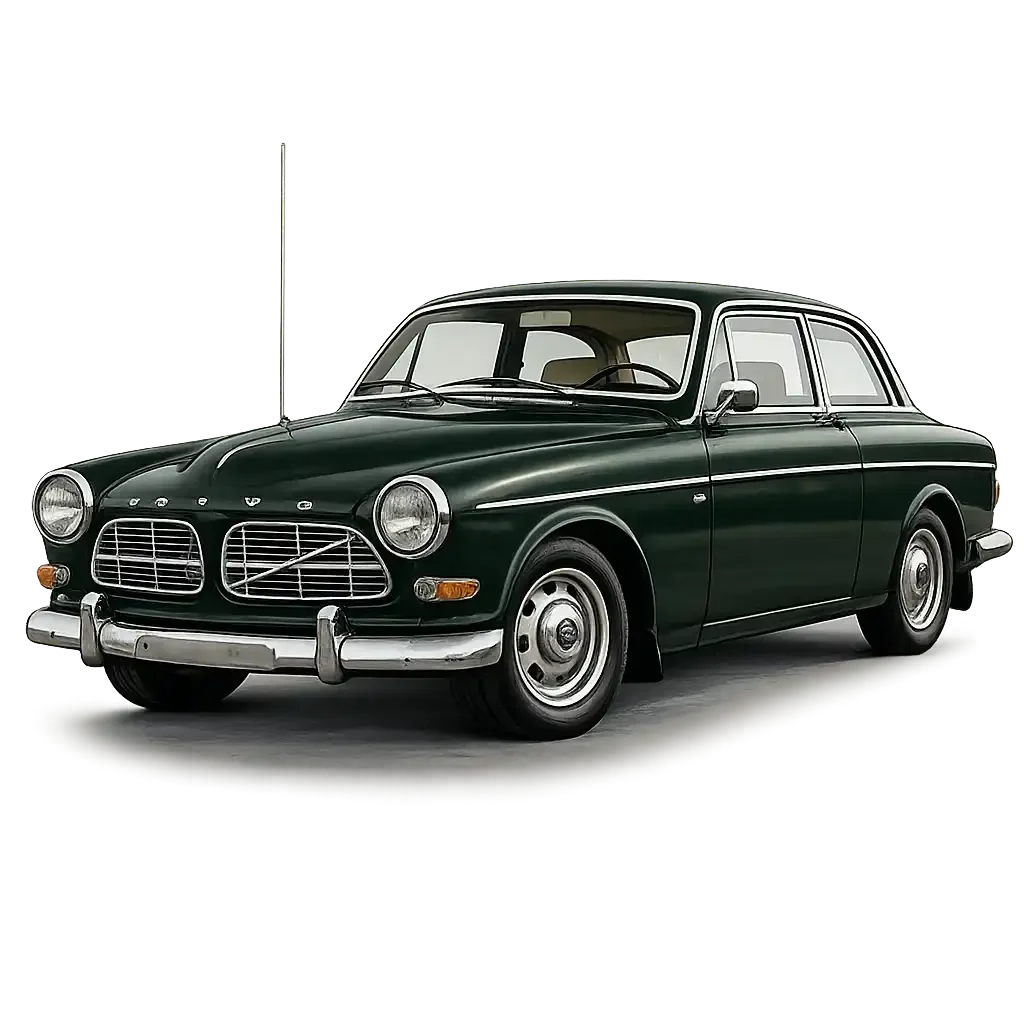
Written by Arthur Simitian | PartsAdvisory
The Volvo 122 is better known by its nickname than its model number. The Amazon - a name Volvo used in markets where it did not conflict with trademark issues - was designed by Jan Wilsgaard and introduced in 1956 as the PV544's successor in Volvo's lineup. The 122 designation refers to the four-door version that became the volume seller; the two-door variant was the 121, and a wagon variant (the 221/222) rounded out the family. It was the car that established Volvo's export business in North America and laid the mechanical foundation for every Volvo that followed through the 1970s.
For aftermarket parts sellers, the 122 is the oldest Volvo model with a meaningful enthusiast and restoration parts market. The cars are between 55 and 65 years old. The buyers searching for parts are almost exclusively restorers and collectors who know the car in detail. The parts universe is narrower than for the 140 or 200 series, the buyers are more technically demanding, and the catalog errors that generate returns are often more obscure - but no less consistent.
This post covers the 1959 to 1968 Volvo 122, the mechanical and cosmetic evolution across that window, the body style variants within the Amazon family, and the fitment variables that determine whether a part fits or not.
The Amazon Family: 121, 122, and 221/222
Model designations
The Amazon body style was sold under several model designations across its production run:
121: Two-door sedan, lower specification
122/122S: Four-door sedan. The S designation indicated a higher-specification trim level with the higher-output engine. In common usage, "122" covers both specification levels of the four-door car.
221: Two-door station wagon (estate)
222: Two-door station wagon, higher specification
For parts sellers, the most important body style distinction is four-door sedan (122) vs. two-door sedan (121) vs. wagon (221/222). The front end is shared across all body styles within the same production year. The rear body, doors, rear lighting, and rear cargo structure are body-style-specific.
This guide focuses on the 122 four-door sedan but covers the cross-reference logic for the full Amazon family throughout.
Production window
The Amazon was produced from 1956 to 1970, but the 122 designation and the model years most commonly covered by aftermarket catalogs run from 1959 to 1968. The 1959 start date reflects the introduction of the four-door body and the B16 engine that defines the early production window. The 1968 end date reflects the final year before the 140 series fully replaced the Amazon in most markets.
Some markets received 121/122 production into 1969 and 1970, but parts for these final-production cars are generally covered by the same fitment data as the 1968 models. Sellers should verify late-production specifications on a case-by-case basis.
Production Overview: Three Distinct Mechanical Periods
The 122 production window from 1959 to 1968 encompasses three engine families - the B16, the B18, and the B20 - and several significant mechanical updates. These transitions create hard parts boundaries that define the primary fitment splits in the Amazon catalog.
1959 to 1961: B16 engine
The early 122 used the B16 engine - a 1.6L pushrod overhead valve design that predates the overhead cam B18 and B20 families. The B16 is a distinct engine architecture, not simply a smaller displacement version of the B18. Cylinder head design, valve train layout, camshaft location, and accessory drive are all different from the B18.
The B16 came in two variants:
B16A: Lower-output single-carburetor version
B16B: Higher-output twin-carburetor version
B16-equipped 122s are the earliest production cars in the common aftermarket window and the ones with the most 122-specific parts requirements. The B16 does not cross-reference with the B18 or B20 on any engine-internal component.
1961 to 1966: B18 engine introduced
The B18 overhead cam engine replaced the B16 starting with the 1961 model year. The B18 is the same engine family used in the early 140 series (144, 142, 145) and the 1800 series, making it one of the most widely cross-referenced engines in the Volvo catalog.
B18 variants in the 122:
B18A: Lower-output single-carburetor version for standard specification
B18B: Higher-output twin-carburetor version for the S specification and sporting markets
B18D: A further variant used in some markets
The B18A and B18B differ on cylinder head specification, camshaft, carburetor setup, and compression ratio. Engine code is required for all B18 listings. Cross-referencing B18 components with the 142/144 B18 application is valid for most engine internals, but accessory mounting, some cooling system routing, and certain bracket configurations may differ between the Amazon and 140 series applications. Verify individual part numbers rather than assuming full interchangeability.
1967 to 1968: B20 engine
The B20 replaced the B18 in the 122 starting with the 1967 model year in most markets. The 122 was one of the first Volvo models to receive the B20, which would go on to power the 140 series and 1800 series through the mid-1970s.
B20 variants in the 122:
B20A: Lower-output single-carburetor version
B20B: Higher-output twin-carburetor version
The 122 did not receive D-Jetronic fuel injection during its production run - that system arrived on the 140 series and 1800 series after the 122 was effectively replaced. All 122 B20 applications are carbureted.
The B18 to B20 transition is a hard parts boundary for all displacement-specific components: head gaskets, pistons, crankshaft, connecting rods, and intake manifold all differ. The B20 in the 122 cross-references with the B20A and B20B applications in the early 144 and 145 for most engine internal components.
Fuel System
B16: separate carburetor family
The B16 used a single Zenith or SU carburetor depending on the variant and market, with the B16B using twin carburetors. The carburetor specifications for the B16 are specific to that engine and do not cross-reference with B18 or B20 applications. Intake manifold dimensions, carburetor mounting flange, and jetting are all B16-specific.
B18: SU and Stromberg carburetors
The B18A typically used a single SU carburetor. The B18B used twin SU HS6 units on most European markets. North American specification cars increasingly received Zenith-Stromberg carburetors from the mid-1960s onward to meet tightening emission and certification requirements.
Carburetor type is a required attribute for all B18 fuel system listings. SU and Stromberg rebuild kits, needles, jets, and float valves are not interchangeable. Market designation (North American vs. European) is a proxy for carburetor family on later B18 production but should be verified rather than assumed.
B20: same market-dependent carburetor split
The B20 in the 122 followed the same carburetor family split as the B18: SU on most European cars, with Stromberg units on North American specification cars. The B20B twin-carburetor setup used twin SU or Stromberg units depending on market. Carburetor type and market designation are required qualifiers for all B20 fuel system listings on the 122.
Exterior: Body Style Splits and Production Year Changes
Front end
The 122 front end used the classic Amazon styling throughout its production run - a chrome grille with horizontal bars, round headlights in chrome bezels, and a front bumper with a distinctive curved profile. The basic front end design was a point of continuity across the Amazon production run, but several detail changes occurred:
Grille: The grille design evolved through the production run with minor updates to bar pattern, badging, and trim details. The early 1959 to 1961 grille is different from the mid-production grille, which differs again from the late-production 1966 to 1968 unit. Sellers spanning the full 1959 to 1968 range with a single grille listing should verify whether the part covers a specific production window or the full range.
Headlights: Round sealed beam headlights were used throughout, but the headlight housing and bezel design were updated at various points in production. U.S. market cars used sealed beam units compliant with federal regulations; European market cars may have used different lens and bulb configurations (H4 or equivalent). Market designation is relevant for headlight and headlight bezel listings.
Front bumper: The front bumper profile is specific to the Amazon body and changed in detail across the production run. U.S. market cars received overriders and guards on some specifications. The specific production year window matters for bumper trim listings.
Hood: The hood is specific to the Amazon body and changed slightly between early and late production to accommodate updates to the engine bay and front body geometry.
Rear body: four-door vs. two-door vs. wagon
Four-door 122 rear body: The 122 four-door rear body is specific to that configuration. Rear doors, rear quarter panels, trunk lid, taillights, and rear bumper are all four-door-specific. The rear door glass, window regulators, and door handles for the rear doors have no equivalent on the 121 two-door.
Two-door 121 rear body: The 121 two-door used longer rear door skins covering the full front-to-rear passenger opening, similar to the 142 two-door relationship to the 144. Fixed rear quarter windows are integrated into the rear quarter panels. Rear body components - taillights, trunk lid, rear quarter panels - are 121-specific and differ from the 122 four-door units.
221/222 wagon: The wagon used a liftgate in place of a trunk lid, wagon-specific rear quarter panels with an extended roofline, and wagon-specific taillights. The wagon rear body is unique to the estate body style and does not cross-reference with either the 121 or 122 rear body.
Taillights
The Amazon taillights changed across the production run. Early production (1959 to approximately 1961) used a design different from mid-production (1962 to 1965) and late production (1966 to 1968). Within each production period, the four-door, two-door, and wagon taillights are different parts.
Taillight listings for the Amazon must specify: the body style (four-door/122, two-door/121, or wagon/221), and the production year window. A single "Volvo Amazon taillight" listing without both qualifiers will cross-match parts from up to six different taillight designs.
Transmissions
The 122 was available with the following transmissions:
M30: 3-speed manual, used on earlier production and lower-specification cars. A relatively uncommon specification in the U.S. market but present on some European-market cars.
M40: 4-speed manual without overdrive. The standard manual gearbox for most 122 production from the mid-1960s onward. Internal components cross-reference with the M40 in the 140 series.
M41: 4-speed manual with electric Laycock overdrive. The overdrive unit adds length and changes driveshaft requirements relative to the M40.
BW35: 3-speed Borg-Warner automatic. Available on the 122 from the early 1960s onward.
Transmission code is required for all drivetrain parts. The M30 vs. M40 distinction changes gear ratio and shifter specifications. The M40 vs. M41 distinction changes driveshaft length. The presence of the M30 on some 122 applications is a variable that does not exist on the later 140 series catalog, making it a 122-specific fitment consideration.
Driveshaft length on the 122 is specific to the Amazon wheelbase, which differs from the 140 series wheelbase. Even where the transmission unit itself cross-references (M40 internal components), the driveshaft is Amazon-specific.
Suspension and Brakes
Suspension
The 122 used a front MacPherson strut design and a rear live axle with coil springs and a Panhard rod - the same basic layout carried forward into the 140 series and ultimately the 200 series. However, the specific component dimensions, spring rates, and strut specifications are Amazon-specific and differ from the 140 series applications despite the shared layout concept.
Front strut cartridges, springs, and rear spring listings for the 122 should not be assumed to cross-reference with the 140 series. The wheelbase, body weight, and suspension geometry were revised between the Amazon and the 140 series.
Brakes
The 122 braking system evolved significantly across the production run:
Early production (1959 to approximately 1962): four-wheel drums. The original 122 used drum brakes at all four corners. Drum brake components - shoes, wheel cylinders, drums, and hardware kits - are specific to this configuration.
Mid to late production (approximately 1962 to 1968): front discs introduced. Volvo was among the first manufacturers to offer front disc brakes as standard equipment on a production car, and the 122 was an early recipient of this technology. The introduction of front disc brakes created a hard parts boundary:
Front disc caliper, rotor, pads, and hoses replaced the front drum assembly entirely
Master cylinder bore and specification changed for the disc/drum combination
Brake proportioning valve may differ between four-drum and front-disc configurations
The exact year of front disc brake introduction varied by market. North American specification cars may have received front discs at a different production point than European cars. Brake configuration (four-drum vs. front disc/rear drum) is a required qualifier for all brake system listings on the 122.
Rear drum brakes were retained through the end of 122 production. Rear brake components (shoes, drums, wheel cylinders) are consistent across the disc-brake-equipped production window but differ from the four-drum early cars.
Electrical System
The 122 used a 12-volt electrical system throughout the production window covered in this guide, though very early Amazon production (pre-1959) used 6-volt systems. Within the 1959 to 1968 window, the electrical architecture is 12-volt throughout.
The wiring harness, switch specifications, and instrument cluster layout evolved across the production run with minor updates. Electrical component listings - switches, relays, lighting assemblies, and instrument cluster components - should specify the production year range rather than spanning the full 1959 to 1968 window without verification.
U.S. market cars had federally mandated sealed beam headlights and turn signal configurations that differ from European market cars. Market designation is relevant for lighting and electrical component listings.
The 122 and the 140 Series: Cross-Reference Boundaries
The B18 and B20 engine families create the primary cross-reference bridge between the 122 and the 140 series. This is commercially significant because the 140 series parts pool is larger and more accessible than the Amazon-specific pool. Where a B18 or B20 internal component fits both the 122 and the 142/144, a seller can serve both buyer bases from the same inventory.
The cross-reference is real but requires discipline:
B18 and B20 rotating assembly: Crankshaft, pistons, connecting rods, and main bearings cross-reference between 122 and 142/144 for the same engine variant code. This is the most reliable cross-reference category.
Cylinder head and gaskets: Cross-reference for the same variant code (B18A to B18A, B18B to B18B) but verify that the combustion chamber and port dimensions are identical between Amazon and 140 series applications, as minor casting updates occurred over production.
Accessories and brackets: Do not assume cross-reference. Alternator brackets, water pump mounting, and accessory drive configurations may differ between the Amazon and 140 series engine bays even for the same engine family.
Suspension: Do not cross-reference. Amazon wheelbase and body weight differ from the 140 series.
Brakes: Do not cross-reference. Amazon brake system specifications differ from the 140 series.
Body components: Do not cross-reference under any circumstances. The Amazon and 140 series are completely different body structures.
Common ACES/PIES Mistakes for 1959 to 1968 Volvo 122
Listing a single "Volvo Amazon taillight" application without body style (four-door/121/122, two-door/121, or wagon) and production year window. Up to six different taillight designs exist across the body styles and production periods.
Treating the B16, B18, and B20 as a single "Amazon 4-cylinder" application for engine parts. These are three distinct engine families with no internal component interchangeability between them.
Listing B18 or B20 engine parts as direct cross-fits from the 140 series without part number verification. The engine families are shared but accessory mounting, some cooling components, and certain bracket configurations may differ between Amazon and 140 series engine bay installations.
Listing carburetor components without specifying the carburetor family (SU vs. Zenith-Stromberg) and engine variant (single vs. twin carburetor). The B16, B18, and B20 all have different carburetor specifications, and within each engine family the market determines the carburetor type.
Spanning the four-wheel-drum and front-disc production periods with a single brake system listing. The master cylinder, front caliper, and associated components changed when front discs were introduced.
Listing transmission parts without the specific code. The M30 3-speed is an Amazon-specific variable that does not appear in the 140 series catalog.
Cross-referencing suspension components with the 140 series. The Amazon wheelbase and suspension geometry are different.
Listing driveshafts from the 140 series as fitting the 122. The Amazon wheelbase is different from the 140 series wheelbase, making the driveshaft length application-specific.
Treating the 121 two-door, 122 four-door, and 221/222 wagon as a single fitment window for rear body components. Each body style has its own taillights, rear body panels, and trunk/liftgate configuration.
Catalog Checklist for 1959 to 1968 Volvo 122
Require engine code (B16A, B16B, B18A, B18B, B18D, B20A, B20B) for all engine, fuel, and exhaust parts
Require production year window for grille, front bumper, taillight, and other cosmetic components that changed across the production run
Require body style (122 four-door, 121 two-door, 221/222 wagon) for all rear body components: taillights, trunk lid/liftgate, rear doors or quarter windows, rear quarter panels, rear bumper
Require fuel delivery type (single carburetor, twin carburetors) and carburetor family (SU or Zenith-Stromberg) for all fuel system components
Require transmission code (M30, M40, M41, BW35) for all drivetrain parts
Require brake configuration (four-wheel drum vs. front disc/rear drum) for all brake system components
Require market designation (U.S./North America vs. Europe) for headlights, carburetor type, and emission equipment
Do not cross-reference suspension components with the 140 series
Do not cross-reference driveshafts with the 140 series
Verify B18 and B20 accessory and bracket cross-references with 140 series at part number level before listing as shared fit
Cross-Reference Logic
Volvo 121 (same year): Front end, engine, transmission, and front suspension components shared. Rear body, taillights, trunk lid, rear quarter panels, and rear doors/quarter windows are body-style-specific.
Volvo 221/222 wagon (same year): Same front-end and mechanical cross-reference logic. Rear body, liftgate, wagon taillights, and cargo area components are wagon-specific.
Volvo 142/144/145 (B18 and B20 applications): B18 and B20 rotating assembly and cylinder head internals may cross-reference at the part number level. Accessories, brackets, and cooling system routing should be verified individually. Body, suspension, brake, and drivetrain components do not cross-reference.
Volvo 1800/1800S (B18 and early B20): B18 engine internals may cross-reference for the same variant code. The 1800 and 122 both used the B18B in high-output form. Verify part numbers. Body and platform components do not interchange.
Frame all cross-references as "may also fit" with engine code, variant, and production year qualifiers.
The Restoration Market
The 122 is firmly in classic car territory. At 55 to 65 years of age, these cars are not daily drivers. They are weekend cars, show cars, and long-term restoration projects. The buyer searching for a 122 taillight or a B16 carburetor rebuild kit is not a casual parts buyer - they are an enthusiast who has invested time and money in the car and expects the parts they order to be correct.
The Amazon community is active in North America and Europe, with dedicated clubs, registries, and online communities that share parts sourcing information freely. A seller who gets the 122 catalog right earns word-of-mouth referrals from a community that talks to itself. A seller who lists a 140 series B18 part as fitting the Amazon and ships the wrong bracket or the wrong suspension component earns the opposite.
The 221/222 wagon is the rarest and most sought-after Amazon body style, with a strong following among collectors who value the estate body. Wagon-specific rear body parts - taillights, liftgate, rear quarter panels - are among the hardest to source and the most valued when correctly listed.
Final Take
The Volvo 122 is the oldest Volvo model with an active aftermarket parts market, and it rewards catalog accuracy more than most. The buyer base is small, technically sophisticated, and connected within a community that shares sourcing information. The parts universe is narrower than the 140 or 200 series, which means a seller who gets the fitment right has fewer competitors for each correctly listed part.
The fitment boundaries that define the 122 catalog: engine family (B16, B18, or B20) for all mechanical parts, production year window for cosmetic and trim components that evolved across the run, body style (four-door, two-door, or wagon) for all rear body components, brake configuration (four-drum or front disc/rear drum) for all brake system parts, and carburetor type (SU or Stromberg) for all fuel system listings.
Apply those boundaries, resist the temptation to cross-reference suspension and driveline components with the 140 series without verification, and the 122 becomes a well-cataloged entry that serves a loyal restoration community accurately.
Disclaimer: This guide is based on publicly available specifications, Volvo press materials, and independent research. Part interchangeability should always be confirmed via VIN and OEM part number lookup. Specifications may change without notice. This document does not constitute official Volvo parts catalog data.