
Written by Arthur Simitian | PartsAdvisory
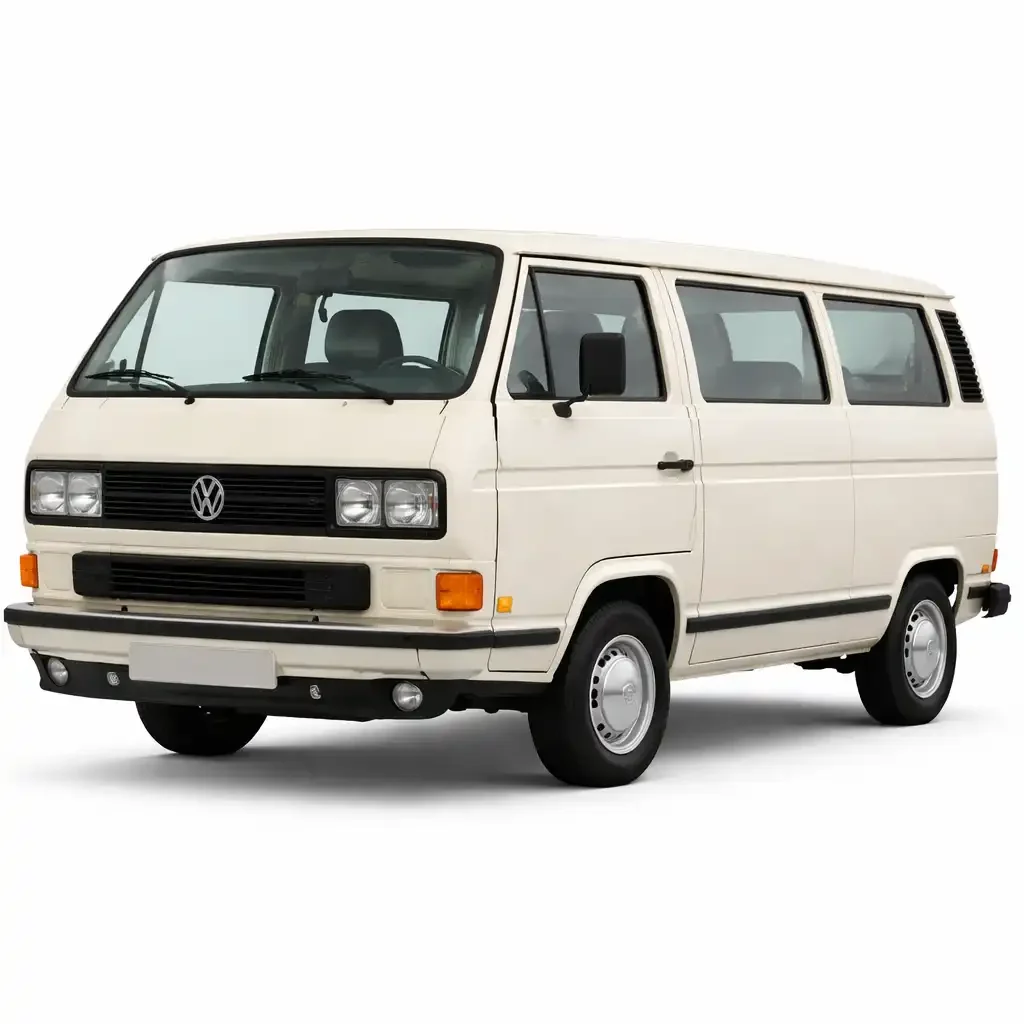
The 1986 to 1991 Volkswagen Vanagon is the final and most commercially stable chapter of the T3's North American run. Where the 1980 to 1985 window was defined by engine family transitions and a disruptive mid-year production split, the 1986 to 1991 window has a single petrol engine throughout -- the 2.1-litre Wasserboxer with Bosch Digifant engine management -- and no powertrain changeover at any point during the six-year run. This apparent simplicity is what makes the catalog dangerous. Sellers read a clean model year range, a single engine displacement, and a consistent body style, and conclude the window is one application. It is not.
The fitment variables that generate returns on this production window are not engine changes -- they are drivetrain splits between the 2WD and Syncro variants, transaxle code differences within the same manual transmission category, Syncro-specific brake specifications that vary again by wheel size, an air conditioning ductwork change at the 1988 model year, California versus federal emission calibrations that affect ECU and sensor specifications, and the fact that the Digifant system on the 2.1-litre Wasserboxer introduced grounding sensitivity issues that make ECU sourcing a VIN-level exercise rather than a model year one.
This post maps the 1986 to 1991 Vanagon across its engine, transmission, drivetrain, and trim variables, and identifies the fitment boundaries that determine whether a part is correct.
Platform Overview: Stable Body, Redesigned Powertrain Lineup for 1986
The 1986 model year brought the most significant package of changes the Vanagon received at any single model year boundary during its U.S. production run. The body shell was unchanged. The wheelbase of 2,460 mm, the cab-over rear-engine layout, the double-wishbone front and semi-trailing arm rear suspension, and the overall dimensions carried forward without modification from 1985.
What changed for 1986 was substantial in powertrain and equipment terms. The 1.9-litre Wasserboxer (engine code DH, Digijet) was replaced by the 2.1-litre Wasserboxer (engine code MV, Digifant). This is not a displacement update within the same injection system -- Digifant is a different engine management architecture from Digijet. Digifant integrates ignition timing control into the ECU alongside fuel delivery, whereas Digijet managed fuel delivery only with a separate ignition system. The 1986 and later Vanagon ECU, sensors, and wiring harness are Digifant-specific. Parts for the Digijet system on the 1983.5 to 1985 DH engine do not cross-reference to the Digifant system on the 1986 to 1991 MV engine without part number verification.
Additional 1986 changes included a redesigned and substantially improved air conditioning system, a tachometer added to the instrument cluster, new interior fabric choices, and a fully redesigned transmission lineup that standardized the 094 transaxle family across manual transmission variants. Exterior changes introduced rectangular headlights in place of the round sealed beam units used on all 1980 to 1985 models -- a hard boundary for headlight assembly fitment.
The Syncro 4WD variant, which debuted in limited U.S. availability for 1985, was offered across a wider range of trim levels from 1986 onward and represents the most complex fitment sub-category in this production window.
The 2.1-Litre Wasserboxer (Engine Code MV): The Only Petrol Engine in This Window
Every U.S. market Vanagon sold from 1986 through 1991 used the same basic engine: the 2.1-litre (2,109 cc) Wasserboxer with engine code MV, producing 95 hp, managed by the Bosch Digifant I engine management system.
The MV Wasserboxer is a horizontally opposed overhead-valve four-cylinder with an aluminum case, aluminum cylinder heads, aluminum pistons, and a forged steel crankshaft. It shares its basic architecture with the 1.9-litre DH that preceded it -- same camshaft drive arrangement, same general block geometry -- but the 2.1-litre displacement, different bore and stroke, and the Digifant management system make it a distinct engine for parts purposes.
Key fitment points for the MV engine:
The Digifant I system manages both fuel injection and ignition from a single ECU. The ECU communicates with a Hall sender in the distributor for engine speed and position, an air mass meter (MAF sensor) for load calculation, and a coolant temperature sensor. All of these sensors are Digifant-specific. An O2 sensor provides closed-loop lambda feedback on catalyst-equipped vehicles. The Digifant ECU was known to be sensitive to poor grounding -- a well-documented issue in the Vanagon community. This means ECU replacement requires a Vanagon-specific MV Digifant unit. ECUs from other Digifant applications (such as the 1.8-litre Golf or Jetta Digifant II) share the Digifant name but use different intake measurement strategies and different calibrations. A Vanagon-specific MV ECU is the only correct replacement, and California-spec ECUs carry different emission calibrations from federal-spec units.
The MV Wasserboxer shares the same cooling system vulnerability as its DH predecessor. The aluminum water jackets corrode when incorrect coolant or phosphated coolant is used. Head gasket failures and coolant leak from the cylinder head sealing surfaces are the most common engine-specific failure mode. Head gasket sets, cylinder head sealing kits, and coolant system components are among the highest-volume aftermarket items for this engine and are all MV/2.1-litre specific. They do not interchange with the 1.9-litre DH components without part number verification.
The MV engine does not use a timing belt or timing chain. The camshaft is driven directly by a gear on the crankshaft via an internal gear train -- a design inherited from all VW boxer engines. This means there is no timing belt service interval for the petrol engine and no timing belt component to catalog. Sellers cross-referencing from other VW applications should confirm this before listing belt-related components.
Transmissions
The 1986 model year redesigned the Vanagon transaxle lineup, and the changes are significant for parts fitment across the rest of the production window.
4-Speed Manual (094)
Beginning with the 1986 model year, the 094 became the standard 4-speed manual transaxle for 2WD Vanagons, replacing the 091/091-1 family used through 1985. The 094 is a different transaxle from the 091. It has a heavier-duty case design, different gear ratios, different internal components, and different bearing and seal specifications.
Parts for the 091 or 091-1 transaxle from the 1980 to 1985 production window do not cross-reference to the 094 for internal components. A seller who runs a single "4-speed manual transmission rebuild kit" listing across the full 1980 to 1991 Vanagon range will supply incorrect parts to a significant share of buyers. The transaxle code (091, 091-1, or 094) must be specified for all internal components, bearings, synchronizer rings, seals, and shift mechanism parts.
4+G Manual (Syncro Only)
The Syncro 4WD Vanagon uses a version of the 094 transaxle modified with a "G" or Gelande (terrain) gear below 1st gear, giving it four standard gears plus the low range crawl gear. This is commonly referred to as the "4+G" configuration. The 1st gear in the Syncro transaxle is the same low range gear used in the granny position, with different ratios across the remaining gears compared to the standard 2WD 094. The Syncro transaxle is also connected to the front axle transfer case and viscous coupling.
Internal components for the Syncro 4+G transaxle are not interchangeable with the standard 2WD 094. The Syncro was manufactured by Steyr-Daimler-Puch in Graz, Austria, adding further assembly variation to consider when cross-referencing. Drivetrain parts for the Syncro must be qualified as Syncro-specific.
3-Speed Automatic
The 3-speed hydraulic torque converter automatic continued unchanged through the 1986 to 1991 production window. It is the same unit used on the 1983.5 to 1985 Wasserboxer Vanagon -- the same 090/010 hydraulic automatic shared with Audi products of the era. The automatic was not available on the Syncro variant. ATF specification, filter kit, and internal components for the 3-speed automatic are consistent across the 1983.5 to 1991 Wasserboxer Vanagon.
Transmission type (4MT 094 / Syncro 4+G / 3AT) is a mandatory qualifier for all drivetrain parts, clutch kits, transmission fluids, and service components.
2WD vs. Syncro: The Primary Fitment Split in This Window
The Syncro is the most consequential parts split in the 1986 to 1991 Vanagon catalog. From a body and engine standpoint, the 2WD and Syncro Vanagon are the same vehicle. From a drivetrain standpoint, they are fundamentally different, and those differences cascade into brake specifications, suspension geometry, and wheel fitment.
Syncro Drivetrain
The Syncro uses a full-time 4WD system engineered by Steyr-Daimler-Puch. The rear-wheel-drive transaxle delivers power to the rear wheels directly. A front axle is added with a viscous coupling that engages automatically when rear wheel slip is detected. The system requires Syncro-specific front axle components -- front differential, front driveshaft, CV joints, and front hub assemblies -- that have no application on the 2WD Vanagon.
Front CV joint and axle shaft listings for the Vanagon must specify 2WD vs. Syncro. On the 2WD, the front axle carries no drivetrain load and uses conventional non-driven hub assemblies. On the Syncro, the front hub assembly integrates with the driven front axle and uses different bearings and hub geometry.
Syncro Brake Specifications
The Syncro was produced in two wheel size configurations, and the brake specifications differ between them.
The 14-inch wheel Syncro uses 254 mm front brake discs -- the same diameter as the standard 2WD Vanagon. However, the 16-inch wheel Syncro uses larger 280 mm front brake discs sourced from VW LT commercial vehicle applications. These are different rotors and different calipers. The 14-inch and 16-inch Syncro variants also share the same brake pads despite the disc size difference, which can create confusion when pad listings are cross-referenced without disc diameter verification.
Rear brakes on the 16-inch Syncro are also upgraded relative to the 14-inch variant and the 2WD, using components sourced from the VW LT. The 16-inch Syncro has flared fenders to accommodate the wider track and larger tires, which is a useful visual identifier.
For brake components, the required qualifiers on 1986 to 1991 Vanagons are: 2WD vs. Syncro, and for Syncro, 14-inch vs. 16-inch wheel configuration. Applying standard 2WD brake specifications to a 16-inch Syncro will result in incorrect rotor and caliper fitment.
Exterior: The 1986 Headlight Change and What It Means for Parts
The transition to rectangular headlights for 1986 is the single most visually obvious change from the previous production window and creates a hard fitment boundary for all headlight assembly listings across the entire Vanagon production run.
1980 to 1985 Vanagons use round sealed beam headlights. 1986 to 1991 Vanagons use rectangular headlights with a two-lamp configuration (primary outboard, high beam inboard). These are completely different assemblies with different housings, different mounting brackets, and different wiring connectors. A headlight assembly listed for "Volkswagen Vanagon" without a year qualifier spans this boundary and will be incorrect for half the applicable population.
The 1986 bumper change is also relevant. Larger fiberglass bumpers with rocker panel trim were standard on Wolfsburg Edition models and available as options on others, replacing the smaller plastic bumpers used on lower-spec earlier models. Bumper cover and trim components should be qualified by trim level for any model year where both configurations were available.
The air conditioning system was redesigned for 1986 with an airliner-style center duct running the length of the vehicle, replacing the earlier single-bank rear outlet design. A further change occurred for 1988 when the AC controls moved from above the sun visors to the dashboard, and the duct housing color changed from beige to grey. AC duct, housing, and vent components must be qualified by production year (1986 to 1987 vs. 1988 to 1991) and by the presence of AC as an option or standard fit on a given trim level.
Trim Levels and Their Parts Implications
The 1986 to 1991 Vanagon was offered across several trim configurations in the U.S. market, and the lineup evolved over the production window.
From 1986, the core U.S. trim levels were the Vanagon L, Vanagon GL, Camper GL (Westfalia conversion), and Wolfsburg Edition (Westfalia Weekender and full Camper). The GL added deluxe seats, power heated mirrors, rear window wiper, carpeting, and AC. The Wolfsburg Edition added alloy wheels, the larger fiberglass bumpers, and the Westfalia interior conversion. Syncro was available on GL and Wolfsburg Edition Camper trims from 1986.
For 1989 onward, a Carat trim level was introduced as the top passenger van configuration, adding power door locks, privacy curtains, and power front windows. The Carat was not available with the Westfalia conversion or with Syncro.
For 1990 and 1991, a Multivan trim was offered, featuring rear-facing seats, a sleeping loft, and additional interior storage. The Multivan used the Wolfsburg-style interior conversion without the full Westfalia camper fitout.
The Wolfsburg Edition and all Camper variants were converted by the Westfalia factory and include pop-top roof hardware, cabinetry, sink, stove, and refrigerator that are specific to the Westfalia conversion. Pop-top mechanism components, roof canvas, and camper interior parts apply to Westfalia-converted vehicles only and must be so specified.
California vs. Federal Emission Specification
California-market 1986 to 1991 Vanagons were built to more stringent emission standards than federal (49-state) market vehicles. The California specification affects the ECU calibration, O2 sensor specification, catalytic converter substrate, and in certain model years the addition of evaporative emission control components not required on federal-spec vehicles.
The Digifant ECU is a particularly sensitive item in this respect. California-spec and federal-spec ECUs carry different calibration maps. A California-spec ECU replacement on a federal-spec vehicle or vice versa will produce driveability issues. VIN decoding to determine the original market specification is the only reliable method for ECU sourcing on the MV Digifant engine.
California vs. federal specification is a mandatory qualifier for ECU, catalytic converter, O2 sensor, and evaporative emission system component listings across the full 1986 to 1991 production window.
Common ACES/PIES Mistakes for 1986 to 1991 Volkswagen Vanagon
Treating the 1986 to 1991 window as a single uniform application because it uses one engine code (MV). The Syncro vs. 2WD split, the 14-inch vs. 16-inch Syncro brake split, and California vs. federal ECU differences all create hard parts boundaries within the window.
Cross-referencing Digijet components (from the 1983.5 to 1985 DH engine) to the Digifant system on the MV engine. Digijet and Digifant are different engine management architectures. ECU, airflow sensor, throttle body, and injection wiring components are not interchangeable.
Listing Digifant ECUs from other VW applications (Golf, Jetta, Corrado) as compatible with the MV Vanagon. Digifant was used across multiple VW platforms but with different sensor inputs, intake geometries, and calibrations. A Vanagon MV Digifant ECU is a specific part. Do not cross-reference by system name alone.
Spanning the 1985 to 1986 headlight boundary. Round sealed beam headlights (1980 to 1985) and rectangular headlights (1986 to 1991) are different assemblies. Any headlight listing that covers both sides of this boundary is incorrect for one of them.
Listing front brake components for the Syncro without specifying 14-inch vs. 16-inch wheel configuration. The 16-inch Syncro uses 280 mm front discs and VW LT-sourced calipers. The 14-inch Syncro and the 2WD both use 254 mm front discs. These are different parts.
Applying 2WD front axle, hub, and CV joint components to the Syncro. The Syncro front axle is a driven axle with its own CV joints, driveshafts, and hub assemblies. Front drivetrain components are not shared with the 2WD.
Not specifying California vs. federal emission specification for ECU, catalyst, and O2 sensor listings. California-spec Digifant calibrations differ from federal-spec, and substituting one for the other causes driveability problems.
Listing AC ductwork, housing, or vent components without a year split at 1988. The duct system was redesigned for 1988 with different housing geometry and color. Pre-1988 and post-1988 AC interior components are not the same parts.
Cross-referencing MV Wasserboxer head gasket sets from the 1.9-litre DH engine. Different displacement, different bore dimensions, different sealing specifications. These are different parts.
Listing Westfalia pop-top roof components, camper interior hardware, or Westfalia-specific electrical items as applying to all trim levels. These components apply only to Westfalia-converted vehicles (Camper GL, Wolfsburg Camper, Multivan). Standard Vanagon, GL, and Carat trims have fixed roofs and no Westfalia interior.
Catalog Checklist for 1986 to 1991 Volkswagen Vanagon
Require engine code (MV) for all engine, cooling, and fuel system parts -- and explicitly exclude Digijet (DH) cross-references without part number verification
Require Digifant ECU sourcing at the Vanagon MV level specifically -- do not cross-reference from Golf, Jetta, or Corrado Digifant applications
Require California vs. federal emission specification for ECU, catalytic converter, O2 sensor, and evaporative emission system listings
Require drivetrain designation (2WD vs. Syncro) for all front axle, hub, CV joint, and brake component listings
Require wheel size (14-inch vs. 16-inch) for Syncro brake component listings
Require production year window (1986 to 1987 vs. 1988 to 1991) for AC ductwork and interior vent components
Require headlight style (rectangular) for all headlight assembly listings -- round sealed beam headlights belong to 1985 and earlier only
Require body configuration (standard vs. Westfalia) for all pop-top, roof, and camper interior components
Require transmission code (094 4MT / Syncro 4+G / 3AT) for all drivetrain parts and service fluids
Note that the 3-speed automatic was not available on the Syncro -- do not apply automatic transmission listings to Syncro applications
Note that the MV Wasserboxer does not use a timing belt -- do not list timing belt components for this engine
Cross-Reference Logic
Volkswagen Vanagon 1983.5 to 1985 (Wasserboxer DH, Digijet): Predecessor engine window. Cooling system architecture is similar, but the 1.9-litre DH and 2.1-litre MV have different displacement, different head gasket specifications, and different injection systems (Digijet vs. Digifant). Cross-reference cooling structural components (radiator, hoses) by part number only -- do not assume universal fit.
Volkswagen Vanagon 1983.5 to 1985 (3-speed automatic): The 3-speed automatic transaxle is the same unit across the 1983.5 to 1991 2WD Wasserboxer Vanagon. ATF, filter kit, and torque converter components cross-reference within this range.
Volkswagen T4 Eurovan (1993 onward): Direct platform successor in the U.S. market. Different architecture entirely -- front-engine, front-wheel-drive layout replacing the rear-engine, rear-wheel-drive T3. No platform, engine, or major mechanical component interchangeability with the T3 Vanagon.
Volkswagen LT (commercial van, same era): The 16-inch wheel Syncro uses front and rear brake components sourced from the VW LT. These cross-reference in one direction only: LT brake components may fit the 16-inch Syncro where VW specified the LT part. Standard T3 brake components do not upgrade to LT specification by default.
Steyr-Daimler-Puch (Syncro manufacturer): All Syncro variants were assembled at the Puch facility in Graz, Austria, after completion of the body and powertrain at Hannover. Syncro-specific components -- transfer case, viscous coupler, front axle assembly -- are Puch-assembled items and must be qualified as Syncro-specific in every application record.
Frame all cross-references as "may also fit" with engine code, drivetrain, and emission specification qualifiers.
Final Take
The 1986 to 1991 Volkswagen Vanagon is as close to a single-application production window as the T3 gets -- one engine code, one injection system, a stable body, and no mid-year powertrain changes. That consistency makes it the most cataloged and most commonly over-simplified segment of the Vanagon's North American run. The splits that generate returns are not obvious from a year range. They are the 2WD vs. Syncro drivetrain divide, the 14-inch vs. 16-inch Syncro brake difference, the Digifant ECU's California vs. federal calibration sensitivity, the 1986 headlight change that severs fitment from the earlier production window, and the 1988 AC system update that creates a split within the window itself.
The four attributes that determine correct fitment on a 1986 to 1991 Vanagon: drivetrain (2WD vs. Syncro, and for Syncro, wheel size), emission specification (California vs. federal) for all ECU and catalyst parts, production year for exterior lighting and AC components, and body configuration (standard vs. Westfalia) for roof and camper hardware. The engine is consistent. Everything around it requires qualification.
Disclaimer: This guide is based on publicly available specifications, manufacturer documentation, and independent research. Part interchangeability should always be confirmed via VIN and OEM part number lookup. Specifications may change without notice. This document does not constitute official Volkswagen parts catalog data.