
Written by Arthur Simitian | PartsAdvisory
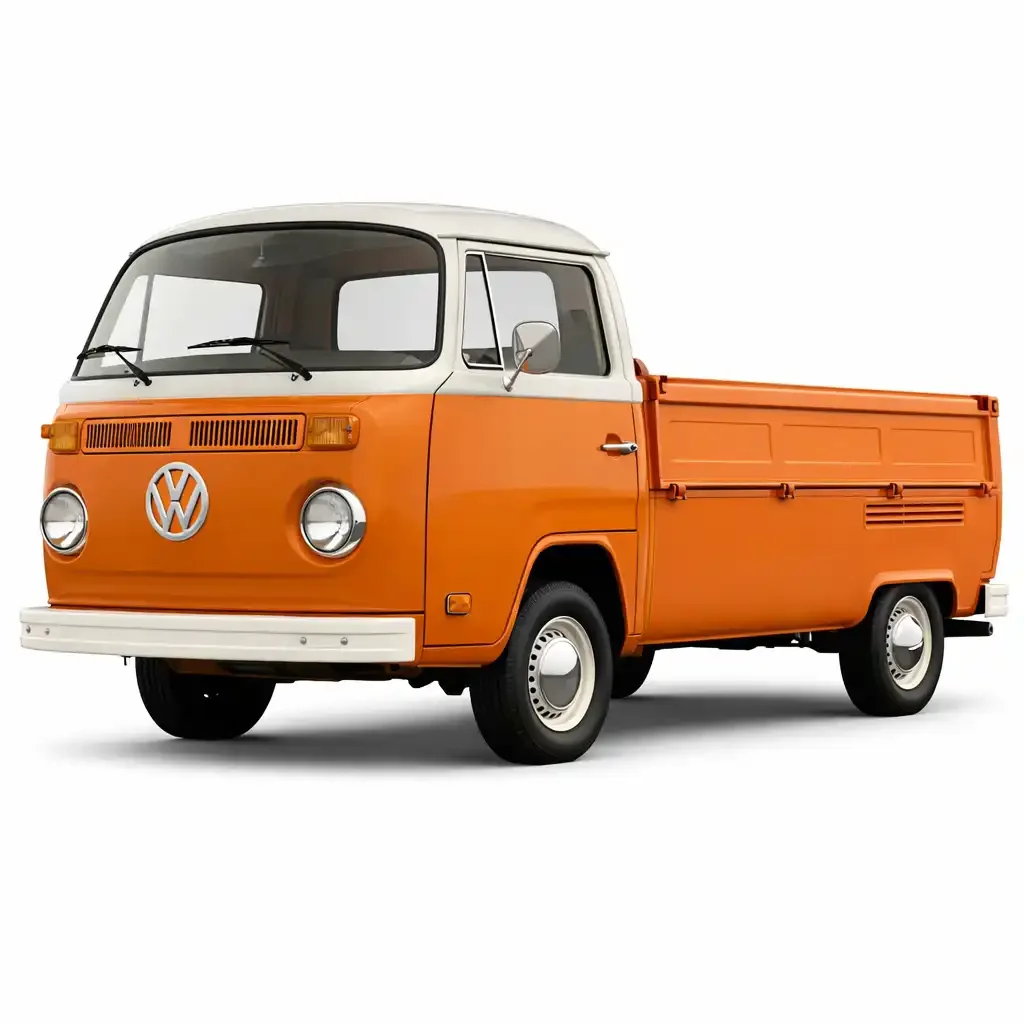
The Volkswagen Type 2 T2 Transporter Pickup is the second-generation Bay Window single-cab and double-cab truck, produced in Germany from August 1967 through the end of the 1974 model year covered in this guide. The T2 replaced the split-windshield T1 with a substantially larger, heavier, and more modern vehicle. It arrived 12 volts from day one, with revised rear suspension replacing the swing axle of its predecessor, and a progressively updated powertrain that over the course of seven model years introduced front disc brakes, the Type 4 engine family from the VW 411/412, an automatic transmission option, and an alternator replacing the earlier generator.
For aftermarket parts sellers, the T2 Pickup occupies a different catalog position from the T1. The T2 is better documented, more parts are available, and the collector community is larger and more active. But the production window from 1967 to 1974 contains a series of year-specific engineering changes -- most of them concentrated between 1971 and 1973 -- that create hard parts boundaries within the window. The introduction of the Type 4 engine for the 1972 model year is the single largest fitment split, dividing the T2 Pickup into two fundamentally different powertrain applications. The 1971 front disc brake introduction creates a brake system split. The 1972 alternator introduction divides electrical charging system components. And the T2a to T2b body transition affects exterior trim.
This guide maps the 1967 to 1974 T2 Pickup across its body sub-variants, engine families, transmission options, cab configurations, and the year-specific engineering changes that require production year qualification for a significant share of parts listings.
Platform Overview: Bay Window Body, New Suspension, 12-Volt from Launch
The T2 introduced several platform improvements over the T1 that are relevant to parts fitment from the first year of production:
The T2 arrived with 12-volt electrics as standard from the 1968 model year onward. Unlike the T1, which transitioned from 6-volt to 12-volt at the 1967 model year boundary, the T2 never had a 6-volt production period in the US market. All T2 Pickups in the 1967 to 1974 window are 12-volt. This eliminates the 6-volt vs. 12-volt split that complicates the T1 catalog, but it does not eliminate electrical splits entirely -- the switch from generator to alternator at the 1972 model year creates a different electrical charging system boundary within the T2 window.
The T2 replaced the T1's swing-axle rear suspension with half-shaft axles using constant velocity joints. This is a fundamentally different rear axle geometry. T1 rear axle components do not apply to the T2 and vice versa. The CV joint-based rear half-shafts on the T2 are specific to this generation and require T2-specific CV joint boots, joints, and axle shaft components.
The front suspension retained a beam axle design but was updated for the T2. T1 front suspension components do not cross-reference to the T2. Within the T2 production window, the introduction of front disc brakes for the 1971 model year creates a brake system boundary that is addressed in detail below.
Body Sub-Variants: T2a Early Bay and T2b Late Bay
The T2a and T2b designations follow the same retrospective naming convention as the T1a/T1b/T1c -- collector-era names applied since the 1990s to distinguish two meaningfully different body configurations within the T2 production run.
T2a: Early Bay (1967 to 1971)
The T2a covers the first production years of the Bay Window, distinguished externally by front turn indicators positioned low on the nose below the headlights -- the source of the enthusiast nickname "Low Lights." The T2a also uses a removable rear apron at the lower rear of the engine bay, unique engine hatches, and a single-port 1.6-litre engine (1968 to 1970) as the standard US powertrain.
Front indicator lenses, front bumpers, engine hatch hardware, and the removable rear apron are T2a-specific. They do not interchange with T2b exterior trim components. The T2a also uses drum brakes front and rear through the 1970 model year -- front disc brakes did not arrive until 1971.
T2b: Late Bay (1972 to 1974 in this window)
The T2b introduced squared-off front bumpers with a compressible energy-absorbing structure behind them, front turn indicators repositioned higher in the valance above the headlights, a redesigned rear end eliminating the removable rear apron and introducing larger triple-element tail lights, and a significantly enlarged engine compartment to accommodate the Type 4 engine family. The air intake scoops above the rear wheel arches changed from crescent-shaped to rectangular at this boundary.
All of the following are T2b-specific and do not apply to T2a production: the square-profile front bumpers, the high-position front indicators, the larger triple-element tail lamps, the rear apron delete, and the enlarged engine bay rear panel with rectangular air intake scoops. The T2b's enlarged engine bay is physically required to fit the Type 4 engine -- the T2a rear bodywork cannot accommodate the Type 4 without modification.
Body sub-variant (T2a vs. T2b) is a mandatory qualifier for all front exterior trim, front indicator, front bumper, rear tail lamp, and engine bay rear panel listings.
Engine Families: Two Architectures, Hard Parts Boundary at 1972
The T2 Pickup used two entirely different engine architectures across the 1967 to 1974 window. These are not variants of the same engine. They have different block designs, different cooling fan arrangements, different intake and exhaust geometries, and different carburetor systems. Parts for one engine family do not cross to the other.
Type 1 Engine: 1.6-Litre (1967 to 1971)
The T2 launched with a 1.6-litre Type 1-derived air-cooled flat-four, a development of the same basic engine family used in the Beetle and the T1. For US market production:
The 1968 to 1970 T2 uses the single-port 1.6-litre engine, producing approximately 47 hp. One intake port per cylinder head, single Solex carburetor. This is the same basic engine architecture as the late T1 but in larger 1,584 cc displacement.
The 1971 T2 introduces the dual-port 1.6-litre engine, now with two intake ports per cylinder head, producing 50 hp. The dual-port cylinder heads are different castings from single-port heads and require different intake manifold components, intake manifold gaskets, and carburetor configuration. A single-port carburetor setup does not fit the dual-port head without modification. Cylinder head, intake manifold, and carburetor components are single-port vs. dual-port specific.
Both single-port and dual-port 1.6-litre Type 1 engines share the same basic block, crankshaft family, and lower end architecture. Internal engine components below the cylinder heads -- pistons, connecting rods, crankshaft bearings, oil pump -- cross-reference between single-port and dual-port applications where dimensions match. Verify by part number rather than assuming full cross-reference.
The 1.6-litre Type 1 engine also cross-references to Beetle 1600 applications of the same era at the part number level for most shared components.
Type 4 Engine: 1.7-Litre (1972) and 1.8-Litre (1974)
The Type 4 engine -- so called because it was originally designed for the VW 411 and 412 passenger cars -- replaced the Type 1 engine as the standard powerplant for US market T2 Transporters from the 1972 model year onward. This is the most consequential parts boundary in the entire 1967 to 1974 T2 Pickup catalog.
The Type 4 engine is a horizontally opposed flat-four, air-cooled -- the same basic layout as the Type 1 -- but it is a completely different engine. The crankcase, cylinder heads, cooling fan arrangement, oil cooling system, intake manifold geometry, carburetor count, and engine mounting configuration all differ from the Type 1. The Type 4 uses dual carburetors (Solex 34 PDSIT-2 and 34 PDSIT-3) compared to the single carburetor of the Type 1 1.6-litre.
The 1972 model year T2 uses the 1.7-litre Type 4 (1,679 cc), producing 66 hp with the manual transmission. The 1974 model year T2 uses the enlarged 1.8-litre Type 4 (1,795 cc), producing 68 hp. Both are the same basic Type 4 architecture with different displacement. Internal engine parts -- pistons, cylinder dimensions -- differ between 1.7 and 1.8 variants.
The T2b's enlarged engine bay is a direct result of the Type 4's larger physical footprint. The crescent-shaped air intake scoops of the T2a were replaced with rectangular scoops specifically to accommodate the increased cooling air requirements of the Type 4. This body change and the Type 4 engine introduction are therefore linked at the 1972 model year boundary -- they arrived together.
Engine family (Type 1 1.6-litre vs. Type 4 1.7 or 1.8-litre) is a mandatory qualifier for all engine, carburetor, intake, exhaust, ignition, and oil system parts. These are different engines. No component from the Type 1 engine applies to the Type 4, and vice versa.
Transmissions
4-Speed Manual
The standard transmission across the full 1967 to 1974 T2 Pickup window is a 4-speed manual transaxle. The specific transaxle code and internal specifications differ between the Type 1-engined and Type 4-engined variants -- the Type 4's greater torque output required a matched transaxle. Internal components, clutch specifications, and CV joint specifications for the transaxle may differ between Type 1 and Type 4 applications. Transaxle code is required for internal drivetrain components.
The 1972 model year also introduced a diaphragm clutch replacing the earlier coil spring clutch design. Clutch kits for 1972 and later T2 Pickups with the Type 4 engine use a diaphragm pressure plate. Pre-1972 clutch kits use a coil spring pressure plate. Clutch kit specifications require both engine type and production year confirmation.
3-Speed Automatic
An automatic transmission became available for the first time on any Volkswagen commercial vehicle with the 1973 model year T2 -- and only on the Type 4-engined variant. The automatic was never available with the Type 1 1.6-litre engine on the T2 in this production window.
The 3-speed automatic is a hydraulic torque converter unit. It is a distinct application from the manual transaxle in every drivetrain part category: fluid type, filter, gasket kit, clutch packs, governor, and associated hydraulic components. Transmission type (4-speed manual vs. 3-speed automatic) is a mandatory qualifier for all drivetrain service parts from the 1973 model year onward.
Brakes: The 1971 Front Disc Transition
Through the 1970 model year, the T2 Pickup used front drum brakes. The 1971 model year introduced front disc brakes -- a significant change that affects all front brake component listings.
The front disc brake system introduced in 1971 uses ventilated front rotors, new front wheel hub assemblies to accommodate the disc caliper mounting, and new front roadwheels with ventilation holes and flatter hubcaps. These are different wheel hub assemblies and different brake components from the 1967 to 1970 drum brake system.
The 1973 model year further updated the front disc brake system with heavier disc rotors and a revised steering box as part of the energy-absorbing front bumper package. 1973 and later front discs are heavier specification than the 1971 to 1972 units. Front disc rotor, caliper, and hub specifications require year confirmation within the disc brake era.
Rear brakes remained drums throughout the 1967 to 1974 production window.
Brake system type (front drum 1967 to 1970 vs. front disc 1971 onward) is a mandatory qualifier for all front brake component listings. Within the disc brake era, production year (1971 to 1972 vs. 1973 onward heavier spec) is required for front rotor listings.
Electrical Charging System: Generator to Alternator at 1972
The T2a Early Bay (1967 to 1971) used a generator for electrical charging. The 1972 model year T2b introduced an alternator rated at 55 amps, replacing the generator. This is a complete charging system change.
Generator and alternator are not interchangeable. The voltage regulator, wiring harness connector at the charging unit, and the charging unit mounting bracket differ between generator and alternator configurations. Replacement charging units, voltage regulators, and associated wiring components must be specified as generator (1967 to 1971) or alternator (1972 to 1974).
Cab Configurations: Single-Cab and Double-Cab
As on the T1, the T2 Pickup was produced in single-cab and double-cab configurations. All powertrain, suspension, brake, and chassis components are shared. Everything aft of the cab structure splits by configuration.
The single-cab has a two-door cab and a full-length open cargo bed. The double-cab (DoKa) has a four-door cab with a second row of seating and a shorter cargo bed. Double-cab-specific components include the rear cab doors, rear cab door glass, rear cab door hinges, rear cab weatherstrips, and the shorter cargo bed side rails.
The T2 Pickup also offered under-bed storage compartments accessible from outside the vehicle -- a design feature carried from the T1 single-cab. Hardware for these storage compartments is pickup-specific and does not apply to van or bus variants.
Cab configuration (single-cab vs. double-cab) is a mandatory qualifier for all rear cab body, rear cab door, and cargo bed component listings.
The Chicken Tax and US Market Context
The Chicken Tax imposed in 1963 continued to affect T2 Pickup availability in the United States through this production window. After 1971, US imports of commercial vans and pickups practically disappeared from the market. T2 Pickups and panel vans became extremely rare in the US market from 1972 onward, with any surviving post-1971 specimen having had its 25 percent import tariff paid individually.
The practical implication for the aftermarket: T2 Pickups in the United States are rare collector vehicles, with the 1971 and earlier T2a Early Bay models more commonly found than the 1972 to 1974 T2b models. Parts buyers are restoration specialists and the knowledgeable collector community, not fleet operators. Sellers should expect buyers who know exactly what year and configuration they have.
Year-by-Year Summary of Hard Parts Boundaries
1968: T2 production begins. 12-volt. Single-port 1.6-litre Type 1 engine. Front drum brakes. Generator. 1971: Dual-port 1.6-litre engine introduced. Front disc brakes introduced. New front roadwheels with ventilated design. Front drum components discontinued for front brake applications. 1972: Type 4 1.7-litre engine becomes standard for US market. T2b body introduced -- squared bumpers, high indicators, rectangular rear air scoops, enlarged engine bay, triple tail lamps. Alternator replaces generator. Diaphragm clutch introduced. Removable rear apron eliminated. 1973: 3-speed automatic available for first time (Type 4 only). Heavier front disc specification. Energy-absorbing front bumper structure. 1974: Type 4 enlarged to 1.8-litre.
Common ACES/PIES Mistakes for 1967 to 1974 Volkswagen Transporter T2 Pickup
Cross-referencing Type 1 engine components to the Type 4 engine. Different engine families. No component interchangeability across this boundary.
Listing single-port 1.6-litre carburetor or intake manifold components as applying to the dual-port 1.6-litre engine. Single-port and dual-port cylinder heads are different castings requiring different intake hardware.
Applying front drum brake components to 1971 and later T2 Pickups. Front discs were introduced for 1971. Drum brake front components apply to 1967 to 1970 only.
Not distinguishing 1971 to 1972 front disc specification from 1973 onward heavier disc specification. 1973 introduced upgraded front discs. Rotor listings must specify year range within the disc era.
Listing generator components for 1972 and later T2 Pickups. The alternator replaced the generator at the 1972 model year. Generator and alternator are not interchangeable.
Applying clutch kits across the 1972 diaphragm clutch transition. Pre-1972 uses a coil spring pressure plate. 1972 onward with the Type 4 uses a diaphragm pressure plate.
Listing the 3-speed automatic as applicable before the 1973 model year. The automatic was introduced for 1973 only with the Type 4 engine. It was never available with the Type 1 1.6-litre on the T2.
Cross-referencing T2a exterior trim to T2b applications. Front indicators, front bumpers, rear tail lamps, and engine bay rear panel are different between T2a and T2b.
Applying T1 CV joint or rear axle components to the T2. The T2 uses CV joint half-shafts replacing the T1's swing axle. These are completely different rear axle architectures.
Cross-referencing double-cab rear cab and bed components to single-cab applications. Rear cab doors, rear cab glass, and cargo bed length differ between configurations.
Catalog Checklist for 1967 to 1974 Volkswagen Transporter T2 Pickup
Require body sub-variant (T2a Early Bay 1967 to 1971 / T2b Late Bay 1972 onward) for all exterior trim, front indicator, bumper, rear tail lamp, and engine bay panel listings
Require engine family (Type 1 1.6-litre single-port / Type 1 1.6-litre dual-port / Type 4 1.7-litre / Type 4 1.8-litre) for all engine, carburetor, intake, exhaust, and ignition components
Require production year for front brake type (drum 1967 to 1970 / disc 1971 onward) and disc specification (standard 1971 to 1972 / heavier 1973 onward)
Require production year for electrical charging system (generator 1967 to 1971 / alternator 1972 onward)
Require production year and engine type for clutch specification (coil spring pre-1972 / diaphragm 1972 onward with Type 4)
Require transmission type (4-speed manual / 3-speed automatic) for all drivetrain parts -- automatic available from 1973 with Type 4 only
Require cab configuration (single-cab / double-cab) for all rear cab body, door, and cargo bed component listings
Note that the Type 4 engine requires the T2b enlarged engine bay -- it cannot be fitted to T2a bodywork without modification
Cross-reference Type 1 1.6-litre components to Beetle 1600 single-port and dual-port applications of the same era -- verify by part number
Cross-reference Type 4 engine components to VW 411 and 412 passenger car applications of the same era -- verify by part number
Cross-Reference Logic
Volkswagen Beetle (Type 1), 1.6-litre era: The Type 1 1.6-litre engine in the T2 shares architecture with the 1600 Beetle engine. Internal engine components cross-reference at the part number level for matching single-port or dual-port specification. Body, suspension, and vehicle-specific systems do not cross.
Volkswagen 411 and 412 (Type 4): The Type 4 engine in the 1972 to 1974 T2 is the same engine family used in the VW 411 and 412 passenger cars. Engine components cross-reference at the part number level for the same displacement variant. Body and vehicle-specific components do not apply.
Volkswagen Type 2 T1 Pickup (1950 to 1967): The T1 predecessor. Different suspension geometry (swing axle vs. CV half-shafts), different body dimensions, different engine mounting. No running gear or body components cross between T1 and T2. Engines overlap in architecture (the T2 1.6-litre is related to T1 1.5-litre family) but verify by part number rather than assuming direct cross.
Volkswagen Type 2 T2 (1975 to 1979, US market): The continuation of the T2 production window beyond this guide. The Type 4 engine continued and grew to 2.0 litres, and fuel injection was introduced for US market cars from 1975. The 1975 onward T2 is the same body but with different fuel system components for fuel-injected applications.
Frame all cross-references as "may also fit" with engine family, production year, and body sub-variant qualifiers.
Final Take
The 1967 to 1974 Volkswagen Transporter T2 Pickup is a more technically evolved vehicle than the T1 it replaced, but it carries more within-window engineering changes than its relatively short seven-year span suggests. The Type 4 engine introduction for 1972 splits the entire powertrain catalog in two. The 1971 front disc brake transition splits the brake catalog. The 1972 generator-to-alternator change splits the charging system. And the T2a to T2b body transition splits all exterior trim at the 1972 model year boundary -- the same year as three of those four other changes.
The five attributes that determine correct fitment on the 1967 to 1974 T2 Pickup: engine family (Type 1 vs. Type 4), production year (for brake type, electrical system, and clutch specification), body sub-variant (T2a vs. T2b), transmission type (manual vs. automatic from 1973), and cab configuration (single-cab vs. double-cab). Apply all five and the T2 Pickup becomes a well-served collector catalog entry with a large and growing enthusiast parts market. Ignore year-specific changes and the combination of back-to-back engineering updates between 1971 and 1973 will generate returns across brakes, engine, electrical, and clutch parts simultaneously.
Disclaimer: This guide is based on publicly available specifications, manufacturer documentation, and independent research. Part interchangeability should always be confirmed via VIN and OEM part number lookup. Specifications may change without notice. This document does not constitute official Volkswagen parts catalog data.