
Written by Arthur Simitian | PartsAdvisory
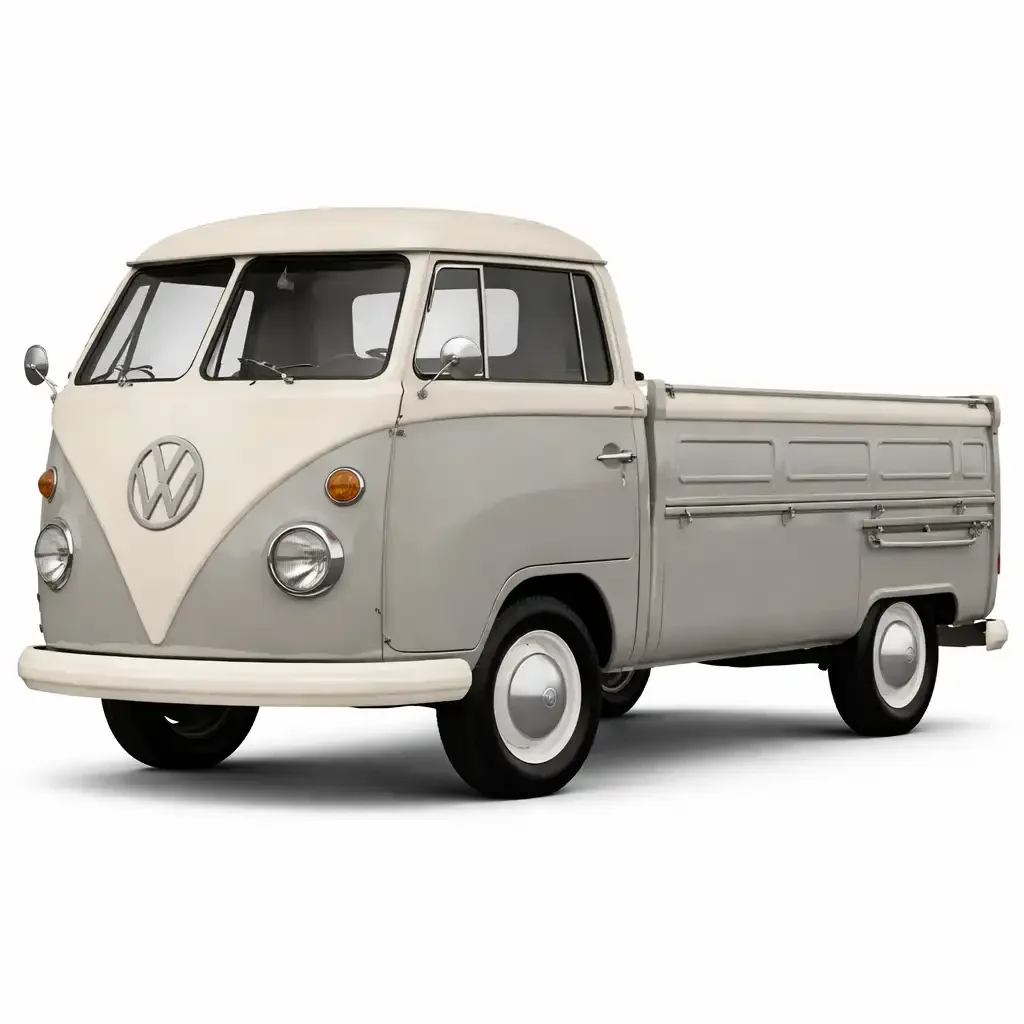
The Volkswagen Type 2 T1 Transporter Pickup is the single-cab and double-cab truck variant of the first-generation Type 2, produced from August 1952 -- when the single-cab joined the Transporter lineup -- through the end of German production in 1967. It is the least changed of all T1 body variants across the production run, retaining its basic cab-forward, rear-engine architecture through 17 years of incremental refinement while the bus and van variants around it evolved more visibly.
For aftermarket parts sellers, the T1 Pickup is among the most complex catalog entries in the VW aftermarket precisely because of how long and gradually it evolved. Four distinct engine displacements were used across the production window. The electrical system changed from 6-volt to 12-volt at the 1967 model year. Wheel size changed from 16 inches to 15 inches in 1955, and again to 14 inches with the introduction of the heavy-duty variant in 1962. Sub-body designations -- T1a Barndoor, T1b, and T1c -- are collector-era naming conventions that correspond to real physical differences in the body, engine bay, and chassis that determine parts fitment in several categories. And the single-cab and double-cab configurations differ in everything aft of the cab.
This guide maps the T1 Pickup's production window from 1952 to 1967 across its engine generations, body sub-variants, cab configurations, electrical systems, and the fitment boundaries that determine whether a part is correct.
Platform Overview: Rear-Engine, Rear-Wheel Drive, Unibody Construction
The T1 Transporter uses a unibody (unit-body) construction without a separate frame -- chassis and body are welded together as a single structure, which was an advanced design for a commercial vehicle in 1950. The engine is a rear-mounted air-cooled flat-four boxer unit, driving the rear wheels through a rear-mounted transaxle. The cab is forward of the front axle in a cab-over configuration.
The front suspension uses a beam axle design with kingpin-type spindles, camber, caster, and toe-in specifications that remained consistent through the production run but require period-correct replacement parts because the kingpin-based geometry predates the ball joint designs used on later Volkswagen products. Front suspension components from T2 (1968-onward) or T3 applications do not apply to the T1.
The rear suspension uses swing-axle half-shafts throughout the T1 production window. The swing-axle design is specific to the T1 and T1-era Beetle-derived running gear. Rear suspension and axle components for the T1 do not interchange with the T2 Bay Window's revised rear suspension geometry.
Body Sub-Variants: T1a, T1b, and T1c
The T1a, T1b, and T1c designations are retrospective collector-era names applied since the 1990s to distinguish three meaningfully different body configurations within the 1950 to 1967 production run. Volkswagen did not use these designations at the time. They are, however, widely used in the parts and collector community because they correspond to physical differences that affect body panel, engine bay, and chassis part fitment.
T1a: Barndoor (1950 to 1955)
The T1a, or Barndoor, is defined by its enormous rear engine access panel -- colloquially the barn door -- which covers virtually the entire rear face of the vehicle below the bumper. This large engine bay opening was necessitated by the original engine's fan shroud and cooling architecture. The T1a also uses 16-inch roadwheels.
The single-cab pickup was introduced in August 1952, meaning the earliest T1 pickups are T1a Barndoors. T1a rear body panels, engine lid, engine lid hinges, and rear valance are specific to the Barndoor configuration. They do not interchange with T1b or T1c components. The T1a is also a 6-volt electrical system vehicle throughout its production.
T1b (1955 to 1963)
The T1b introduced a revised, smaller engine bay with a narrower engine access panel replacing the Barndoor design. The roofline above the windshield was also extended, giving the cab a slightly different profile. Wheel size changed from 16 to 15 inches. The 6-volt electrical system continued through this sub-variant.
The T1b engine lid, rear valance, and associated rear body hardware are different from T1a components. Rear body panels are T1b-specific. 15-inch wheel specifications (brake drum diameter, lug pattern) differ from 16-inch T1a specifications. Sellers listing rear body or wheel-specific brake components must specify T1a vs. T1b configuration.
T1c (1963 to 1967)
The T1c is distinguished by a wider rear door on van and bus variants, matching the bay-window T2 rear door width. On the pickup specifically, the cab doors and associated body hardware reflect the 1963-onward updates. The 1967 model year brought the most significant engineering change across all T1 variants: the electrical system switched from 6 volts to 12 volts. This is the hardest electrical parts boundary in the entire T1 production window.
The 1967 12-volt transition affects every electrical component on the vehicle: battery, alternator (replacing the earlier generator on 6-volt cars), starter motor, ignition coil, headlamps, tail lamps, horn, wipers, and all switches and relays. A 6-volt component is not a safe substitute for a 12-volt component and vice versa. The 1967 model year boundary (6-volt vs. 12-volt) is a mandatory qualifier for every electrical part listing across the entire T1 production window.
Engine Generations: Four Displacements Across 17 Years
The T1 Pickup used four distinct engine displacements across its 1952 to 1967 production window, each shared with the Beetle and other Type 1-based Volkswagens of the era. All are air-cooled horizontally opposed flat-four boxer engines, rear-mounted, with a single carburetor on the firewall side of the engine.
1.1-Litre (1,131 cc) -- 1952 to 1953
The original 1100 engine, producing 25 PS (18 kW). This is the same basic unit as the early Beetle engine, carried over directly. It uses a single Solex carburetor and 6-volt electrical system. Parts for the 1100 engine are specific to the early 1952 to 1953 production period and are among the rarest in the T1 aftermarket.
1.2-Litre (1,192 cc) -- 1953 to 1962
The 1200 engine replaced the 1100 in 1953, producing 30 PS (22 kW), rising to approximately 34 PS with the higher compression ratio introduced in 1955. The 1200 was also the engine in the Beetle during this period. A problematic early version of the 34 PS 1200 debuted exclusively on the Type 2 in 1959 and proved unreliable -- Volkswagen recalled all 1959 Transporters and replaced the engines with a corrected version. Any surviving 1959 T1 Pickup with its original engine is extremely rare, and parts for the recalled 1959 engine variant were never made available.
The 1200 engine uses a single Solex carburetor throughout. Carburetor rebuild kits, ignition components, and engine gaskets are 1200-specific and cross-reference to Beetle 1200 applications of the same era at the part number level -- the engine is mechanically the same unit across both vehicles.
1.5-Litre (1,493 cc) Heavy-Duty -- 1962 to 1965
In 1962, Volkswagen introduced a heavy-duty Transporter option with a 1,000 kg (2,205 lb) cargo capacity, up from the standard 750 kg. This heavy-duty variant used a 1.5-litre engine producing 42 PS (31 kW), along with smaller but wider 14-inch roadwheels replacing the 15-inch units on standard models. The heavy-duty variant with the 1.5-litre engine and 14-inch wheels was successful enough that by 1963, the standard 750 kg 1.2-litre Transporter was discontinued entirely. All T1 Transporters from 1963 onward used the 1.5-litre engine.
The transition from 15-inch to 14-inch wheels on the heavy-duty variant and from 1963 onward on all models creates a brake specification split within the T1b production period. Brake drum diameter and lug specifications differ between 15-inch and 14-inch wheel configurations. Wheel size is a mandatory qualifier for all brake drum, wheel bearing, and lug hardware listings from 1962 onward.
1.5-Litre Standard (1,493 cc) -- 1963 to 1967
From 1963, the 1.5-litre engine became the standard equipment across all T1 Transporters for the US market, producing 51 PS (38 kW) at 7.8:1 compression ratio. The carburetor is a Solex unit appropriate to this displacement and era. When the Beetle received its own 1.5-litre engine for 1967, a minor power increase was applied; the T1 Pickup used the same engine family.
Parts for the 1.5-litre T1 engine cross-reference to Beetle 1500 applications of the same era at the part number level for most internal engine components. Carburetor specification, carburetor rebuild kit, and ignition timing specifications should be verified by application rather than assumed from Beetle cross-reference, as Transporter-specific calibrations existed for some components.
Transmission
The T1 Pickup used a 4-speed manual transaxle throughout its production run. An important change occurred in 1959: a fully synchronized 4-speed gearbox became available, replacing the earlier non-synchronized or partially synchronized units. Pre-1959 and post-1959 transmission internal components are not fully interchangeable. Synchronizer ring specifications and gear shift mechanism components differ.
Production year is a required qualifier for internal transmission components. Pre-1959 (non-synchronized or early synchromesh) and post-1959 (fully synchronized) are different transmission specifications.
Cab Configurations: Single-Cab and Double-Cab
The pickup was produced in two cab configurations across the T1 production window:
The single-cab (Einzel-Kabine, factory code Pritschenwagen) was introduced in August 1952. It has a two-door cab seating the driver and one passenger, with an open cargo bed behind. The bed sides and tailgate are pickup-specific body components that have no equivalent on any T1 van or bus variant.
The double-cab (Doppelkabine, DoKa) introduced a second row of seating behind the driver and passenger, with a shorter cargo bed to compensate. Double-cab cab doors, rear cab structure, and associated body hardware are specific to the DoKa configuration and do not interchange with single-cab components.
All powertrain, suspension, braking, and chassis components are shared between single-cab and double-cab configurations. Body components from the cab doors rearward are configuration-specific.
Cab configuration (single-cab vs. double-cab) is a mandatory qualifier for all cab structure, rear cab body, and cargo bed component listings.
The Chicken Tax and US Market Availability
The T1 Pickup is unusually rare in the United States compared to the bus and van variants. In 1963, the United States imposed a 25 percent tariff on light truck imports -- the so-called Chicken Tax -- in retaliation for European tariffs on American chicken. Panel vans and pickup trucks were the targeted vehicle types. After 1963, US imports of T1 commercial vehicles including pickups dropped sharply. After 1971, T1 single-cab and double-cab pickups practically disappeared from the US market.
This tariff history has a direct implication for the aftermarket catalog. T1 Pickups in the United States today are rare collector vehicles rather than active working trucks, and the parts population is a specialty collector market rather than a mainstream aftermarket category. Any seller listing T1 Pickup applications must understand this context: the active parts buyers are restoration specialists and collectors, not fleet operators.
Electrical System: 6-Volt vs. 12-Volt
Every T1 produced from 1950 through the 1966 model year uses a 6-volt electrical system. The 1967 model year introduced the 12-volt system. This is a universal change that applied to all T1 body variants simultaneously for 1967.
The 6-volt to 12-volt transition is the hardest single parts boundary in the T1 catalog for electrical components. No 6-volt electrical part substitutes for a 12-volt part. The specific components affected include the battery, generator (6-volt) vs. alternator (12-volt), starter motor, ignition coil, all bulbs (headlamps, tail lamps, instrument lamps, interior lamps), horn, wiper motor, and all switches and relays.
Model year (1966 and earlier = 6-volt; 1967 = 12-volt) is a mandatory qualifier for every electrical component listing. This applies to all T1 body variants, not just the pickup.
Common ACES/PIES Mistakes for 1950 to 1967 Volkswagen Transporter Pickup
Applying T1b body components to T1a Barndoor applications or vice versa. The rear engine lid, rear valance, and associated hardware differ between the Barndoor (T1a, 1950 to 1955) and subsequent body variants. These are not interchangeable.
Listing brake drum specifications without specifying wheel size. The 16-inch T1a, 15-inch T1b, and 14-inch 1962-onward heavy-duty and 1963-onward standard all have different drum diameters. Brake drum must be qualified by wheel size.
Listing electrical components without specifying 6-volt vs. 12-volt. The 1967 model year is the transition boundary. All 1966 and earlier T1 Pickups are 6-volt. The 1967 model year is 12-volt. No electrical component crosses this boundary.
Cross-referencing internal transmission components across the 1959 synchromesh transition. Pre-1959 and post-1959 transmissions have different synchronizer specifications. Internal components are not fully interchangeable.
Applying cab body components across single-cab and double-cab configurations. Rear cab structure, DoKa-specific doors, and cargo bed components are configuration-specific.
Cross-referencing T2 Bay Window (1968 onward) front suspension or rear axle components to the T1. The T1 uses a kingpin-based front beam axle and swing-axle rear suspension. The T2 uses a different front suspension and revised rear geometry. These do not interchange.
Listing the 1.2-litre Beetle engine components as confirmed fits for the 1.5-litre T1 applications, or vice versa. Different displacement means different pistons, rings, cylinder heads, and carburetor specifications. Verify by engine displacement and application.
Treating the 1959 recalled engine variant as a parts source for other 1959 applications. VW recalled and replaced all 1959 T1 engines. Original recalled engines and their specific parts were discontinued immediately. No aftermarket parts supply was established for the recalled variant.
Applying single-cab bed and tailgate hardware to double-cab applications. The DoKa has a shorter bed than the single-cab. Bed side rails, tailgate hardware, and associated trim are not interchangeable between cab configurations.
Listing T1 components for Brazilian T1.5 production (1975 to 1996). The Brazilian T1.5, while based on T1 body dies, incorporates T2-era front-end components and different specifications. It is a distinct catalog application from the German-production T1.
Catalog Checklist for 1950 to 1967 Volkswagen Transporter Pickup
Require body sub-variant (T1a Barndoor 1950 to 1955 / T1b 1955 to 1963 / T1c 1963 to 1967) for all rear body, engine lid, and associated panel components
Require engine displacement (1100 / 1200 / 1500 heavy-duty / 1500 standard) for all engine, carburetor, ignition, and exhaust components
Require wheel size (16-inch T1a / 15-inch T1b / 14-inch 1962 onward) for all brake drum, wheel bearing, and lug hardware listings
Require electrical system (6-volt 1966 and earlier / 12-volt 1967) for all electrical components
Require cab configuration (single-cab vs. double-cab) for all cab structure, rear cab body, and cargo bed components
Require production year for internal transmission components (pre-1959 non/partial synchromesh vs. 1959 onward fully synchronized)
Note that the 1959 recalled engine and its specific parts are discontinued -- do not catalog parts for this variant
Note that T2 Bay Window suspension and axle components do not apply to the T1
Cross-reference to Beetle 1200 and 1500 applications for internal engine components only -- not for body, chassis, or vehicle-specific systems
Note that Brazilian T1.5 production (1975 to 1996) is a distinct application requiring separate catalog records
Cross-Reference Logic
Volkswagen Beetle (Type 1), same era: The T1 Pickup shares engine architecture with the Beetle of the same production period. Internal engine components -- pistons, rings, connecting rods, valves, camshaft -- cross-reference at the part number level for the same displacement variant. Carburetor specifications require application verification. Body, chassis, and suspension components do not cross-reference.
Volkswagen Type 2 T1 Van and Bus (same years): All T1 Transporters share the same powertrain, front suspension, and rear axle. Engine, transaxle, and running gear components cross-reference fully within the T1 family across all body variants for the same engine and wheel specification. Body components from van and bus variants do not apply to the pickup cab or cargo bed.
Volkswagen Type 2 T2 Bay Window (1968 onward): The T2 replaces the T1 but is a different vehicle with different suspension geometry, larger body, and updated running gear. Parts do not cross between generations except for certain engine components where the same engine family was carried forward into early T2 production.
Brazilian T1.5 (1975 to 1996): Uses T1 body stampings but incorporates T2 front-end components and different specifications. Not a direct cross-reference for T1 body or chassis parts without part number verification.
Frame all cross-references as "may also fit" with engine displacement, body sub-variant, wheel size, and electrical system qualifiers.
Final Take
The Volkswagen Transporter Pickup T1 production window from 1952 to 1967 covers four engine displacements, three body sub-variants with real physical differences, a critical 6-volt to 12-volt electrical transition in the final model year, two cab configurations that split everything aft of the cab structure, and a wheel size evolution that changes brake specifications at three points across the production run. The vehicle is also a specialist collector market in the United States due to the Chicken Tax -- meaning the buyers are knowledgeable, condition-sensitive, and unlikely to accept incorrect parts.
The five attributes that determine correct fitment on the T1 Pickup: body sub-variant (T1a / T1b / T1c), engine displacement (1100 / 1200 / 1500), wheel size (16 / 15 / 14 inch), electrical system (6-volt / 12-volt), and cab configuration (single-cab / double-cab). Apply all five consistently and the T1 Pickup becomes a well-served, enthusiast-grade catalog entry. Leave any of them undefined, and the combination of a 17-year production run, multiple engine generations, and an evolving body will generate returns across nearly every parts category.
Disclaimer: This guide is based on publicly available specifications, manufacturer documentation, and independent research. Part interchangeability should always be confirmed via VIN and OEM part number lookup. Specifications may change without notice. This document does not constitute official Volkswagen parts catalog data.