
Written by Arthur Simitian | PartsAdvisory
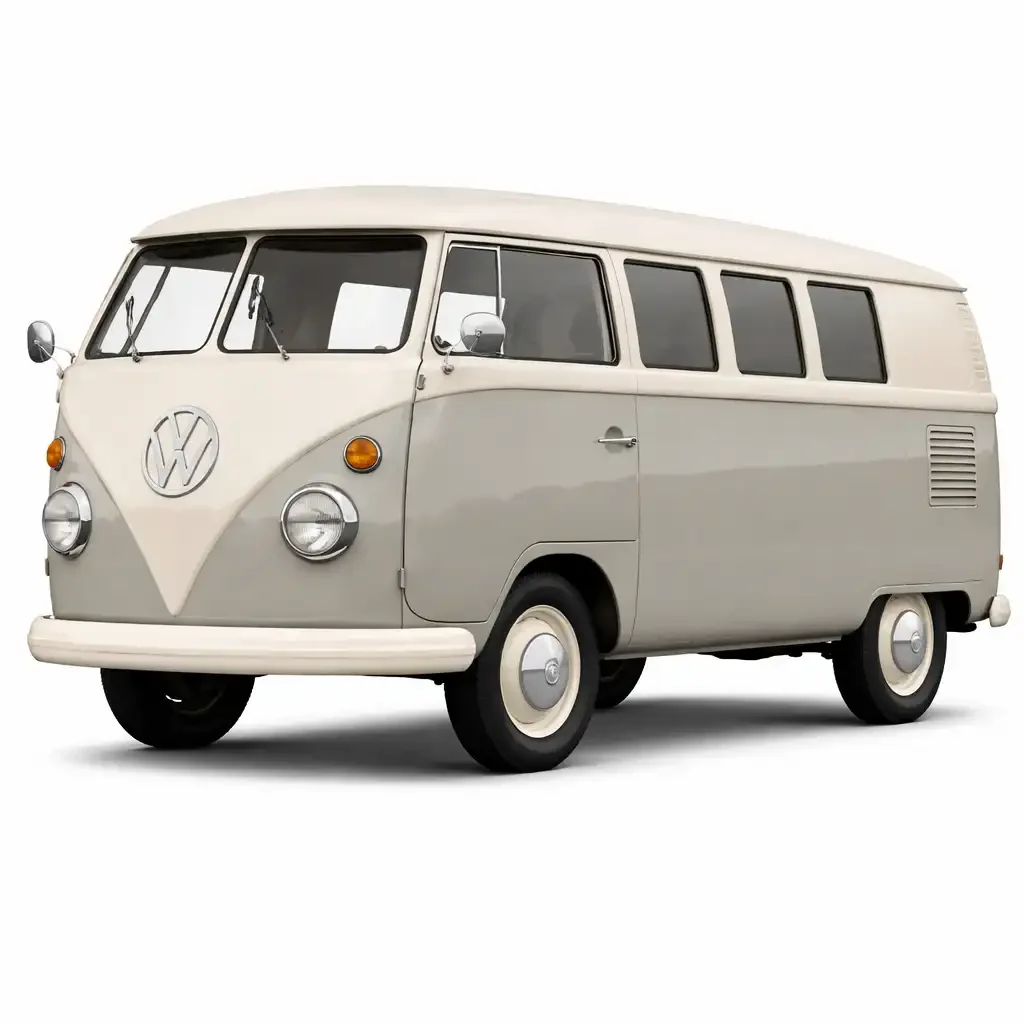
The Volkswagen Transporter T1 is the first generation of the Type 2 -- the split-windshield van introduced in prototype form at the 1949 Geneva Motor Show and entering series production on 8 March 1950. German production ran through the end of the 1967 model year. Brazilian production of a modified variant continued until 1975 and then as the T1.5 until 1996. The T1 is the most commercially significant classic commercial vehicle in the European aftermarket and occupies an important collector and restoration parts category in the North American market as well, primarily for the bus and camper variants.
For aftermarket parts sellers, the T1 Transporter is the most complex catalog entry in the entire Type 2 lineage. The production window spans 17 years and contains five distinct engine displacements, three body sub-variants with real structural and dimensional differences, eight distinct body configurations whose components do not interchange with each other, a 6-volt to 12-volt electrical transition at the 1967 model year, two wheel size changes that affect brake specifications, and a recalled 1959 engine variant whose specific parts were never produced for the aftermarket. The T1 also produced the most expensive collector vehicles in the VW market -- pristine 23-window Samba buses commanding six figures -- which means the buyers are knowledgeable and the tolerance for incorrect parts is very low.
This guide maps the full T1 Transporter production window across all body configurations, engine generations, chassis sub-variants, and the fitment boundaries that determine whether a part is correct.
Platform Overview: Rear-Engine, Rear-Wheel Drive, Unibody Construction
The T1 uses unibody (unit-body) construction with no separate frame -- the body shell and chassis are welded together as a single structure. This was an advanced approach for a commercial vehicle in 1950 and gives the T1 its characteristic structural rigidity. The engine is a rear-mounted air-cooled flat-four boxer unit sharing its basic architecture with the Beetle, driving the rear wheels through a rear-mounted transaxle.
The front suspension uses a king-pin beam axle. This is the same front suspension architecture as the period Beetle, predating the ball-joint designs used on later VW products. Front suspension components from the T2 Bay Window (1968 onward) or T3 Vanagon do not apply to the T1.
The rear suspension uses swing-axle half-shafts with reduction gear hubs for the early production T1a Barndoor, transitioning to a revised swing-axle without reduction gears on T1b and T1c production. This is a fundamentally different rear axle geometry from the T2's CV joint half-shaft rear suspension. Rear axle and suspension components do not cross between T1 and T2 generations.
The wheelbase is 2,400 mm (94.5 inches) throughout the T1 production run -- shared with the Type 1 Beetle and carried forward identically into the T2. This dimensional consistency is one of the few reliable cross-generation references available.
Body Sub-Variants: T1a, T1b, and T1c
Three body sub-variants are recognized within the T1 production window. These are retrospective collector-era designations (applied since the 1990s) that correspond to physical differences relevant to parts fitment.
T1a: Barndoor (1950 to 1955)
The T1a is defined by its enormous rear engine access panel -- the Barndoor -- which covers virtually the entire rear face of the vehicle below the bumper. This large panel was required by the cooling architecture of the original engine and fan shroud. The T1a also uses 16-inch roadwheels and the earliest production had reduction gear hubs at the rear wheels (a feature carried from the Beetle that raised ride height via the reduction gearing).
T1a-specific parts include the rear engine lid (the Barndoor itself), the rear valance, the engine lid hinges and latches, and all rear body components shaped around the large engine lid. These are different stampings from T1b or T1c rear body panels. The T1a is also a 6-volt electrical system vehicle throughout its production. Barndoor examples are the rarest and most valuable of all T1 Transporters.
T1b (1955 to 1963)
The T1b introduced a revised, narrower engine access panel replacing the Barndoor. The roofline above the windshield was extended slightly, giving the cab a subtly different profile. Wheel size changed from 16 to 15 inches in March 1955. The 6-volt electrical system continued through the T1b production period.
T1b rear engine lid, rear valance, and associated rear body hardware are different from T1a Barndoor components. 15-inch wheel specifications differ from 16-inch T1a specifications for brake drums, wheel bearings, and lug hardware. The T1b represents the largest portion of surviving T1 Transporters by volume.
T1c (1963 to 1967)
The T1c is distinguished by a wider rear cargo/passenger door (matching the width used on the later T2 Bay Window), wider rear hatch, and a sliding door option introduced in 1964 as an alternative to the hinged outward-opening cargo doors of earlier production. The 1967 model year brought the single most significant engineering change of the entire T1 run: the switch from 6-volt to 12-volt electrics.
The 12-volt transition at the 1967 model year affects every electrical component on the vehicle: battery, ignition coil, starter motor, generator (6-volt era) or alternator (some late T1c applications), headlamps, tail lamps, horn, wipers, and all switches, relays, and fuses. A 6-volt electrical component cannot be substituted for a 12-volt component. Production year (1966 and earlier = 6-volt; 1967 = 12-volt) is a mandatory qualifier for every electrical parts listing across the entire T1 Transporter catalog.
The T1c also introduced the sliding door option in 1964. Door hardware -- track, rollers, handles, and latches -- differs between hinged-door and sliding-door equipped vehicles. Body configuration (hinged rear cargo doors vs. sliding door) is required for all door mechanism and hardware listings on T1c production.
Engine Generations: Five Displacements Across 17 Years
All T1 Transporter engines are air-cooled horizontally opposed (flat-four) boxer units, rear-mounted, sharing their basic architecture with the contemporary Beetle. They are differentiated by displacement, carburetion, and compression ratio. All use 6-volt electrics through the 1966 model year.
1.1-Litre (1,131 cc) -- 1950 to 1953
The original 1100 engine, 25 PS (18 kW). Single Solex carburetor. The same basic unit as the early Beetle engine. This engine was available only in the earliest T1a Barndoor production. Parts for the 1100 engine are among the rarest in the T1 aftermarket. Verify all 1100-specific component listings against the Beetle 1100 cross-reference, as the engine architecture is shared.
1.2-Litre (1,192 cc) -- 1953 to 1962
The 1200 engine replaced the 1100 in 1953, producing 30 PS (22 kW), rising to approximately 34 PS with the higher-compression variant introduced in 1955. The 1200 was also the Beetle engine throughout this period, and internal engine components cross-reference to Beetle 1200 applications at the part number level.
A special note on the 1959 T1 Transporter: an early version of the 34 PS 1200 debuted exclusively on the Type 2 Transporter in 1959. It proved unreliable, and Volkswagen recalled all 1959 Transporters and replaced the engines with a corrected version. The original recalled 1959 engine variant and its specific components were discontinued immediately and were never supplied to the aftermarket. Any surviving 1959 T1 with its original engine is an extreme rarity. Do not catalog parts for the recalled 1959 variant -- it has no aftermarket parts supply.
1.5-Litre Heavy-Duty (1,493 cc) -- 1962 to 1963
In 1962 Volkswagen introduced a heavy-duty Transporter option with 1,000 kg payload capacity, 14-inch roadwheels (replacing the 15-inch standard wheels), and a 1.5-litre engine producing 42 PS (31 kW). This heavy-duty variant was introduced alongside the standard 1.2-litre, but was so successful that by 1963 the 1.2-litre was discontinued entirely across the range. The 14-inch wheel specification changes brake drum diameter and wheel bearing specifications compared to the 15-inch T1b standard.
1.5-Litre Standard (1,493 cc) -- 1963 to 1967
From 1963, the 1.5-litre became the standard engine for all T1 Transporters, producing 51 PS (38 kW) for the US market. This is the same basic engine used in the contemporary Beetle 1500 and cross-references to those applications at the part number level for shared internal components. When the Beetle received its own 1.5-litre for 1967, a minor power increase was applied; carburetor and ignition timing specifications should be verified by application rather than assumed from the Beetle cross-reference.
All T1 Transporters from 1963 onward use 14-inch roadwheels as standard, meaning 14-inch brake drum specifications apply across all body variants from this point forward.
Wheel Size Summary: Three Specifications, Hard Brake Boundaries
Wheel size changed twice across the T1 production window, creating three distinct brake drum, wheel bearing, and lug hardware specifications:
16-inch: T1a Barndoor, 1950 to March 1955. 15-inch: T1b standard models, March 1955 to 1962. 14-inch: Heavy-duty 1.5-litre from 1962; all models from 1963 onward.
Wheel size is a mandatory qualifier for all brake drum, wheel bearing, and lug hardware listings. A seller who spans the entire T1 production window under a single brake drum application is incorrect for two of the three wheel size periods.
Transmission
The T1 used a 4-speed manual transaxle throughout. A fully synchronized gearbox became available in 1959, replacing the earlier non-synchronized or partially synchronized design. Pre-1959 and post-1959 internal transmission components are not fully interchangeable. Synchronizer ring specifications and shift mechanism components differ.
Production year is required for internal transmission components: pre-1959 (non/partial synchromesh) vs. 1959 onward (full synchromesh).
Body Configurations: Eight Distinct Applications
The T1 was produced in a wider range of factory body configurations than any other vehicle in the VW Transporter lineup. Each configuration has body-specific components that do not apply to any other variant, even where the underlying platform, powertrain, and chassis are shared.
Panel Van (Kastenwagen)
The base commercial variant with no side windows and no rear passenger seating. Solid rear quarter panels are Panel Van-specific. The Panel Van is the simplest body for parts cataloging -- all panels are opaque and no window hardware applies.
Kombi (Kombinationskraftwagen)
The Kombi has removable rear seats and side windows, making it convertible between passenger and cargo use. The Kombi's side window glass, window rubbers, and associated body seals differ from the Panel Van (no windows) and from the Microbus (different window count and configuration). Kombi rear door and side window components are Kombi-specific.
Microbus (Standard Bus, 11-Window)
The standard Microbus is the basic passenger-focused bus with fixed rear seating, three side windows per side, and a total of 11 windows in the American enthusiast counting convention. Microbus interior components -- seat frames, upholstery panels, headliner sections -- are specific to the Microbus configuration.
Microbus Deluxe (15-Window and 23-Window Samba)
The Microbus Deluxe, or Samba (unofficial name), is the top-trim passenger bus variant. The 15-window configuration added rear corner windows. The 23-window Samba added eight small skylight windows above the beltline, giving it the most glass of any T1 variant. The 1964 model year widened the rear door, eliminating the rear corner windows on Deluxe models, reducing them to 13-window and 21-window configurations.
The Samba's skylight windows, their frames, sealing rubbers, and associated roof structure components are entirely specific to the Samba/Sunroof Deluxe configuration. They apply to no other T1 variant. The Samba roof structure is also different from standard roof configurations -- Samba-specific roof components must be specified as such.
Sunroof Deluxe (Samba) designation is a mandatory qualifier for all skylight window, skylight frame, roof seal, and associated roof structure component listings.
Westfalia Camper
The Westfalia factory conversion produced camping versions of the T1 Kombi and Microbus throughout the production window, adding cabinetry, folding beds, optional icebox or cold-box, laminated interior panels, and from certain model years a pop-up roof. Westfalia-specific interior components -- the cabinet assembly, fold-out bed mechanism, and pop-up roof hardware -- apply only to Westfalia-converted vehicles. Standard body components (glass, door hardware, exterior panels) are shared with the base vehicle configuration.
Westfalia conversion designation is a mandatory qualifier for all interior cabinet, bed mechanism, and pop-up roof component listings.
Single-Cab Pickup (Pritschenwagen)
Introduced August 1952. Two-door cab with open cargo bed. The pickup bed sides, tailgate, and bed floor hardware are specific to the pickup configuration. Of note: the T1 single-cab changed the least of all T1 body variants across the production run and is the most mechanically stable application within the window. However it is also among the rarest variants in the United States due to the Chicken Tax, making it primarily a specialist restoration market.
Double-Cab Pickup (Doppelkabine / DoKa)
Four-door cab with shorter bed. Rear cab doors, rear cab glass, and rear cab structure are DoKa-specific. The cargo bed is shorter than the single-cab bed. An optional wide-bed single-cab was available from 1960 on special order, creating a further bed configuration variant for bed hardware listings.
Ambulance (Krankenwagen) and Special Variants
Factory ambulance versions repositioned the fuel tank, relocated the spare tire, and added a tailgate-style rear door -- features that became standard on all T1 production from 1955 onward. Purpose-built ambulance equipment, specialized partition hardware, and medical fitout components are ambulance-specific. There were also factory fire truck conversions and, in 1955, 30 rail-going draisines built for Deutsche Bundesbahn -- the latter are essentially uncatalogable specialty vehicles.
Body configuration is a mandatory qualifier for all body panels, glass, door hardware, window rubber, interior trim, seat hardware, and roof components. No body component from one T1 configuration applies to another configuration without explicit part number verification.
Electrical System: 6-Volt vs. 12-Volt
All T1 production through the 1966 model year uses a 6-volt electrical system. The 1967 model year T1c introduced 12-volt electrics as a direct preparation for the T2 Bay Window that would follow in 1968.
The 6-volt to 12-volt boundary at the 1967 model year affects every electrical component. Battery, ignition coil, starter motor, charging unit (generator on 6-volt; alternator on 12-volt late T1c), all bulbs, horn, and wiper motor are all voltage-specific. 6-volt and 12-volt electrical components are not interchangeable.
1966 and earlier = 6-volt. 1967 = 12-volt. This is an absolute qualifier for every electrical listing across the T1 Transporter catalog.
Cross-Reference Logic: T1 to Beetle and Within the T1 Family
The T1 Transporter and the contemporaneous Beetle (Type 1) share engine architecture. Internal engine components -- pistons, rings, connecting rods, camshaft, crankshaft bearings, cylinder heads -- cross-reference to Beetle applications of the same displacement at the part number level. The T1 engine is physically the same unit as the Beetle engine of the same year and displacement.
Vehicle-specific components -- carburetor calibration, engine mounting brackets, engine lid hardware, and transaxle mounting -- differ between the Beetle and the T1. Cross-reference engine internals by displacement and year; verify vehicle-specific components by T1 application before assuming a Beetle part fits.
Within the T1 family, all body variants share the same powertrain, front suspension, and rear axle for the same production year and engine displacement. Engine, transaxle, front suspension, and running gear components cross-reference fully across all T1 body configurations for the same year and specification. Body, glass, interior, and configuration-specific hardware do not cross.
The T2 Bay Window (1968 onward) replaced the T1 but uses different suspension geometry, different body dimensions, and updated running gear. No suspension, axle, or body component crosses between T1 and T2. The 1.6-litre T2 engine is an evolutionary development of the T1 1.5-litre, and some internal engine components may cross-reference at the part number level -- verify before assuming.
Common ACES/PIES Mistakes for 1949 to 1967 Volkswagen Transporter T1
Treating the full 1950 to 1967 window as a single application for brake, wheel, or electrical components. Wheel size changed at 1955 (16 to 15 inch) and 1962/1963 (15 to 14 inch). Electrical system changed at 1967 (6-volt to 12-volt). These are hard boundaries within the window.
Applying T1a Barndoor rear body components to T1b or T1c applications. The rear engine lid, valance, and associated rear hardware are different stampings specific to the Barndoor era.
Listing a single brake drum application across the full production window without wheel size qualification. Three different wheel size specifications (16, 15, and 14 inch) require three distinct brake drum applications.
Not qualifying electrical components by 6-volt vs. 12-volt. All pre-1967 T1 production is 6-volt. 1967 is 12-volt. No electrical component crosses this boundary.
Applying Samba/Sunroof Deluxe skylight window or roof components to standard Microbus or Kombi applications. The Samba's skylight windows and associated roof structure are configuration-specific.
Listing Westfalia interior cabinet, bed mechanism, or pop-up roof hardware as applying to all T1 body variants. Westfalia conversion components apply to Westfalia-converted vehicles only.
Cross-referencing T2 Bay Window suspension, axle, or body components to the T1. Different suspension geometry, different rear axle architecture, different body dimensions. No component crosses between generations.
Applying Panel Van body components to Kombi, Microbus, or other windowed variants. Panel Van rear quarters are solid panels; all other variants have window openings of different sizes.
Not specifying hinged cargo door vs. sliding door configuration for T1c (1964 onward) door hardware listings. The sliding door option introduced in 1964 uses different track, roller, handle, and latch hardware from the original hinged outward-opening doors.
Listing the 1959 recalled engine variant's specific components. Parts for the recalled 1959 engine were never produced for the aftermarket. Do not catalog this variant.
Catalog Checklist for 1949 to 1967 Volkswagen Transporter T1
Require body sub-variant (T1a Barndoor 1950 to 1955 / T1b 1955 to 1963 / T1c 1963 to 1967) for all rear body, engine lid, and associated panel listings
Require body configuration (Panel Van / Kombi / Microbus standard / Samba / Westfalia / Single-Cab / Double-Cab) for all body panel, glass, door hardware, interior, and roof component listings
Require engine displacement (1100 / 1200 / 1500 heavy-duty / 1500 standard) for all engine, carburetor, ignition, and exhaust components
Require wheel size (16-inch 1950 to 1955 / 15-inch 1955 to 1962 / 14-inch 1962 onward) for all brake drum, wheel bearing, and lug hardware listings
Require electrical system (6-volt 1966 and earlier / 12-volt 1967) for all electrical components
Require production year for internal transmission components (pre-1959 non/partial synchromesh vs. 1959 onward fully synchronized)
Require Samba/Sunroof Deluxe designation for all skylight window, skylight frame, and associated roof structure component listings
Require Westfalia conversion designation for all interior cabinet, bed mechanism, and pop-up roof component listings
Require door type (hinged vs. sliding) for all T1c door mechanism and hardware listings from 1964 onward
Note that the 1959 recalled engine and its specific parts are discontinued -- do not catalog parts for this variant
Note that Brazilian T1.5 production (1975 to 1996) uses T1 body dies but incorporates T2 front-end components and is a distinct catalog application
Cross-reference to Beetle applications of matching displacement for internal engine components only -- verify vehicle-specific components by T1 application
Final Take
The Volkswagen Transporter T1 production window from 1949 to 1967 is the most catalog-complex application in the Type 2 family. Eight body configurations whose components do not interchange with each other. Five engine displacements. Three wheel sizes. Three body sub-variants with structural differences. A 6-volt to 12-volt electrical transition in the final model year. A recalled 1959 engine variant with no aftermarket parts supply. And a parts buyer population that includes some of the most knowledgeable and condition-sensitive collectors in the classic VW market.
The attributes that determine correct T1 Transporter fitment: body sub-variant (T1a / T1b / T1c), body configuration (Panel Van / Kombi / Microbus / Samba / Westfalia / Single-Cab / Double-Cab), engine displacement (1100 / 1200 / 1500), wheel size (16 / 15 / 14 inch), and electrical system (6-volt / 12-volt). Apply all five consistently and the T1 Transporter becomes a well-served, high-value catalog entry with a devoted and growing enthusiast parts market. Leave any of them undefined and the combination of configuration-specific body hardware, three brake specifications, and the 6-volt boundary will generate returns across nearly every parts category.
Disclaimer: This guide is based on publicly available specifications, manufacturer documentation, and independent research. Part interchangeability should always be confirmed via VIN and OEM part number lookup. Specifications may change without notice. This document does not constitute official Volkswagen parts catalog data.