
Volkswagen Transporter (1967 to 1979): Type 2 T2 Bay Window, Two Engine Families, and the Fitment Splits That Define 12 Years of the Bus
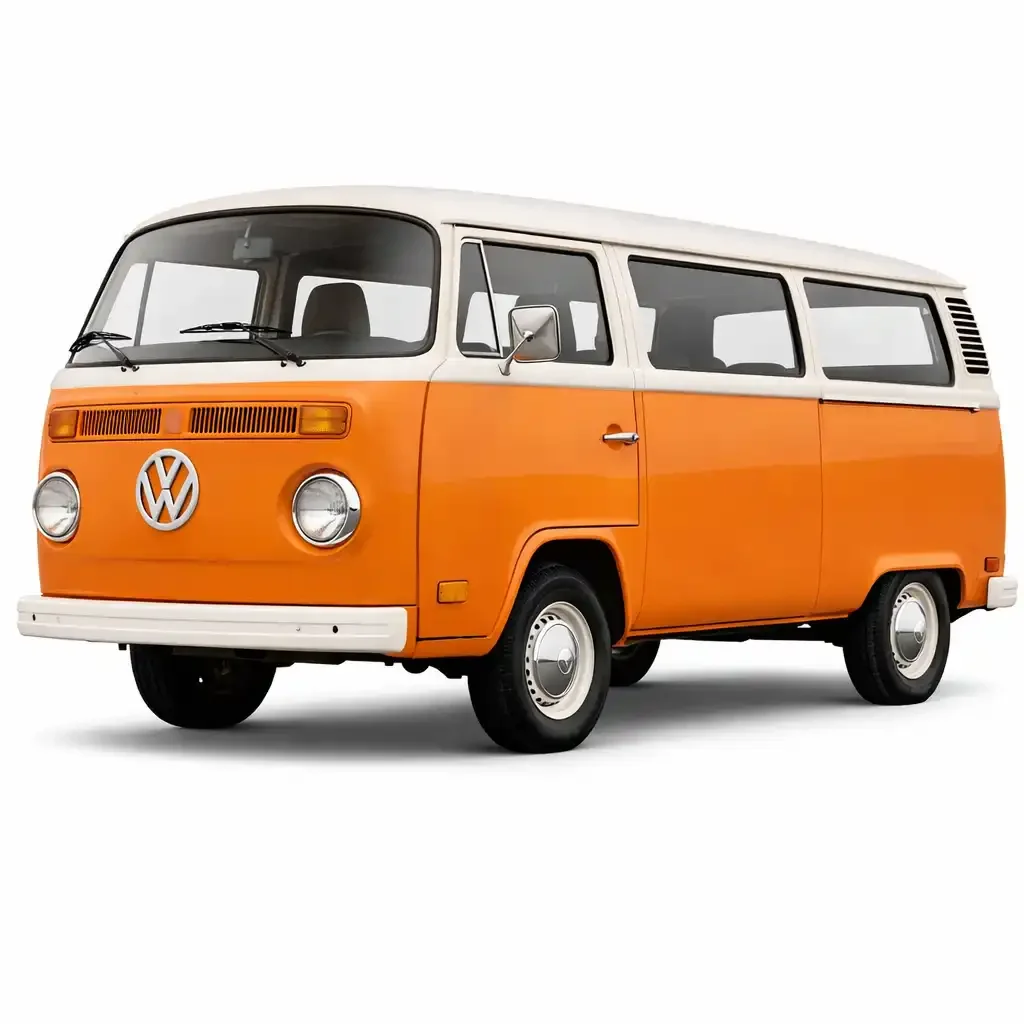
Written by Arthur Simitian | PartsAdvisory
The Volkswagen Type 2 T2 Bay Window Transporter replaced the split-windshield T1 in August 1967 and remained in German production until August 1979, when it was replaced by the T3 Vanagon. The T2 was also built in Mexico (1970 to 1994), Brazil (1976 to 2013), Argentina (1981 to 1986), and Australia (1968 to 1979). This guide focuses on the German production window of 1967 to 1979, which is the primary aftermarket catalog population for the US and European markets.
The T2 arrived as a substantially modernized vehicle relative to the T1. The split windshield was replaced by a single curved bay window. The swing-axle rear suspension was replaced by independent rear suspension with CV joint half-shafts. Ball-joint front suspension replaced the king-pin design. The electrical system was 12-volt from day one. And the body was 22.5 cm longer and considerably heavier than its predecessor.
For aftermarket parts sellers, the T2's 12-year German production window contains a concentrated cluster of engineering changes between 1971 and 1975 that create hard parts boundaries for brakes, engines, electrical charging systems, transmissions, and fuel delivery. The single-port to dual-port 1.6-litre transition in 1971, the Type 4 engine introduction for 1972, the alternator change for 1972, the automatic transmission introduction for 1973, the Bosch AFC fuel injection introduction for 1975, and the 2.0-litre engine enlargement for 1976 are all distinct boundaries within a window that many catalog entries treat as a single application. This post maps the full production window across all those boundaries and across the T2's body configuration variants.
Platform Overview: Modern Architecture, 12-Volt from Launch
The T2 introduced several platform changes from the T1 that are permanently relevant to the catalog:
All T2 production is 12-volt. There is no 6-volt T2 production. The 6-volt to 12-volt boundary that complicates the T1 catalog does not exist on the T2. All electrical components can be cataloged across the full 1967 to 1979 window as 12-volt -- with the single exception of the generator-to-alternator transition at the 1972 model year, which is an upgrade within the 12-volt system, not a voltage change.
The T2 uses ball-joint front suspension replacing the T1's king-pin beam axle. Ball joint specifications and front suspension components are T2-specific and do not cross to the T1.
The T2 uses CV joint independent rear suspension replacing the T1's swing axle. Rear axle half-shaft CV joints, boots, and axle components are T2-specific.
The wheelbase is 2,400 mm, unchanged from the T1 and maintained through the T2 production run.
Body Sub-Variants: T2a Early Bay and T2b Late Bay
Two body sub-variants are recognized within the T2 production window, corresponding to meaningful exterior differences relevant to body parts fitment.
T2a: Early Bay (1967 to 1971)
The T2a is the initial Bay Window design. Its most distinctive external features are the front turn indicators positioned low on the nose below the headlights -- the source of the enthusiast term "Low Lights" -- and rounded blade-style front bumpers. The T2a also uses crescent-shaped engine air intake scoops in the upper rear quarters, unique engine hatch hardware, and a removable lower rear apron.
T2a-specific external components include the low-position front indicator lenses and housings, the rounded front bumper, the crescent-shaped rear air intake scoops, and the removable rear apron. These are different stampings and assemblies from T2b equivalents.
T2b: Late Bay (1972 to 1979)
The T2b introduced squared-off front bumpers with a compressible energy-absorbing structure behind them for improved crash safety, front turn indicators repositioned above the headlights in the front valance, rectangular rear air intake scoops replacing the crescent design, a redesigned rear end eliminating the removable rear apron, and larger triple-element tail lamps replacing the earlier two-element design. The T2b engine bay was also physically enlarged to accommodate the Type 4 engine family -- the crescent air scoops could not provide sufficient cooling air volume for the larger Type 4 engines.
T2b-specific external components include the squared front bumpers, the high-position front indicator lenses and housings, the rectangular rear air scoops, the enlarged rear apron panel, and the triple-element tail lamps.
Body sub-variant (T2a vs. T2b) is a mandatory qualifier for all front exterior trim, front indicator, bumper, rear tail lamp, and rear apron component listings.
Engine Families: Two Architectures, the Most Critical Split in This Catalog
The T2 used two entirely different engine architectures across the 1967 to 1979 production window. This is the most consequential fitment boundary in the entire T2 catalog.
Type 1 Engine: 1.6-Litre (1967 to 1971 US Market)
The T2 launched with the Type 1-derived 1.6-litre air-cooled flat-four, the same engine architecture shared with the Beetle. For US market production this engine was available in two configurations:
The single-port 1.6-litre (1968 to 1970): one intake port per cylinder head, single Solex 30 PICT-1 carburetor, approximately 57 hp. Single-port cylinder heads, intake manifold, and carburetor are specific to the single-port configuration.
The dual-port 1.6-litre (1971): two intake ports per cylinder head, producing 50 PS (DIN) with improved breathing. Dual-port cylinder heads are different castings from single-port heads. The intake manifold, carburetor configuration, and associated gaskets differ between single-port and dual-port applications.
The Type 1 engine is often referred to as the "upright engine" by T2 enthusiasts, reflecting the fan shroud and fan position. It has a single carburetor, a single intake manifold, and an engine mounting that includes an extra rear crankcase mount compared to the Beetle version. Internal engine components -- pistons, connecting rods, crankshaft bearings, cylinder heads of matching port specification -- cross-reference to Beetle 1600 applications of the same era at the part number level.
In most of Europe, the Type 1 1.6-litre remained available as an option through the end of T2 production in 1979. For the US and Canadian markets, the Type 4 engine became standard from 1972 onward.
Type 4 Engine: 1.7-Litre (1972), 1.8-Litre (1974 to 1975), and 2.0-Litre (1976 to 1979)
The Type 4 engine -- designed originally for the VW 411 and 412 passenger cars -- replaced the Type 1 as the standard US market T2 engine from the 1972 model year. It is often called the "pancake engine" by T2 enthusiasts, reflecting its lower, flatter profile compared to the upright Type 1.
The Type 4 is a horizontally opposed flat-four, air-cooled -- same basic layout as the Type 1 -- but it is a completely different engine architecture. Different crankcase, different cylinder heads, different cooling fan arrangement, different oil circulation system, dual carburetors on carbureted versions (Solex 34 PDSIT-2 and 34 PDSIT-3), and different engine mounting hardware. The Type 4's enlarged physical footprint required the T2b's enlarged engine bay and rectangular air intake scoops -- the body change and the engine introduction are physically linked.
The Type 4 went through three displacement variants during the T2 production window:
1.7-litre (1,679 cc): 1972 and 1973 model years. Dual carburetors. 66 hp manual / 61 hp automatic. 1.8-litre (1,795 cc): 1974 and 1975 model years. Dual carburetors in 1974; Bosch AFC fuel injection for US market from 1975. 68 hp. 2.0-litre (1,970 cc): 1976 to 1979 model years. Bosch AFC fuel injection. 67 hp. Hydraulic valve lifters introduced during 1977 production and standard from 1978.
These three displacements are different internal engine specifications. Pistons, cylinders, and displacement-dependent gasket dimensions differ between the 1.7, 1.8, and 2.0-litre variants. Internal engine parts must be specified by displacement, not just by "Type 4."
No component from the Type 1 engine applies to the Type 4 engine, and vice versa. This is the first and most important qualification for any engine, carburetor, intake, exhaust, or ignition component listing on the T2.
Fuel Delivery: Carbureted vs. Fuel Injected
The introduction of Bosch AFC (Air Flow Controlled, also called L-Jetronic) fuel injection for the US market 1975 T2 is the second major powertrain boundary within the Type 4 era.
The 1972 to 1974 Type 4 engines use carburetors -- dual Solex PDSIT units. The 1975 to 1979 Type 4 engines use Bosch AFC electronic fuel injection. These are fundamentally different fuel delivery systems. Carburetor rebuild kits, float valves, jets, accelerator pumps, and choke components apply only to 1972 to 1974 carbureted applications. Fuel injection components -- fuel distributor (Bosch L-Jetronic mechanical unit), airflow meter, injectors, fuel pressure regulator, and cold-start valve -- apply only to 1975 to 1979 fuel-injected applications.
An important structural note: carbureted Type 4 engines have a fuel pump mounting hole in the lower right crankcase half. Fuel-injected Type 4 engines do not have this hole (the electric fuel pump is remote-mounted). This case difference means that a carbureted and fuel-injected Type 4 crankcase are different castings, and fuel system components cannot be simply swapped between the two without additional work.
Fuel delivery system (carbureted 1972 to 1974 / fuel injected 1975 to 1979) is a mandatory qualifier for all fuel system component listings on Type 4-equipped T2s.
Hydraulic Valve Lifters: The 1978 Internal Engine Split
The 2.0-litre Type 4 engine introduced hydraulic valve lifters during late 1977 production, with hydraulic lifters becoming standard for all 1978 and 1979 production. This is an internal engine change that eliminates the periodic valve clearance adjustment required on earlier solid-lifter engines.
Hydraulic lifter engines require hydraulic-specific rocker arm assemblies and pushrods. Solid lifter components and hydraulic lifter components are not interchangeable. For cylinder head, valve train, and upper engine component listings on the 2.0-litre Type 4, production year (pre-1978 solid lifters vs. 1978 onward hydraulic lifters) is required.
Brakes: The 1971 Front Disc Transition
Through the 1970 model year, the T2 uses front drum brakes. The 1971 model year introduced front disc brakes with new ventilated rotors and new front wheel hub assemblies sized for disc caliper mounting. New roadwheels with ventilation holes and flatter hubcaps accompanied the disc brake introduction.
The 1973 model year upgraded the front disc specification with heavier rotors and a revised steering box as part of the energy-absorbing bumper package.
Rear brakes remained drums throughout the full 1967 to 1979 production window.
Three front brake specifications exist across the T2 production window: front drum (1967 to 1970), front disc standard specification (1971 to 1972), and front disc upgraded specification (1973 to 1979). Rotor, caliper, and hub specifications differ across these three periods. Front brake component listings must specify year range within the appropriate specification.
Electrical Charging System: Generator to Alternator at 1972
The T2a Early Bay (1967 to 1971) used a generator for electrical charging. The 1972 model year T2b introduced a 55-amp alternator replacing the generator. Generator and alternator are not interchangeable -- different mounting, different wiring connector, different voltage regulator specification.
Production year (generator 1967 to 1971 / alternator 1972 to 1979) is a mandatory qualifier for all charging system component listings.
Transmissions
4-Speed Manual
The standard transmission across the full 1967 to 1979 production window. Transaxle code and internal specifications differ between Type 1-engined and Type 4-engined variants due to the different torque output of the two engine families. The 1972 model year also introduced a diaphragm clutch replacing the earlier coil-spring design. Clutch kit specifications require both engine type and production year confirmation.
3-Speed Automatic
Available from the 1973 model year, with the Type 4 engine only. This was the first automatic transmission ever offered on a Volkswagen commercial vehicle. The automatic was never available with the Type 1 1.6-litre engine on the T2. It is a hydraulic torque converter unit, entirely separate from the manual transaxle in all service part categories.
Transmission type (4-speed manual / 3-speed automatic) and production year are mandatory qualifiers for all drivetrain component listings. The automatic applies from 1973 with Type 4 only.
Body Configurations
The T2 was produced in the same range of factory body configurations as the T1, with all sharing the same powertrain, suspension, and chassis. Body-specific components -- glass, door hardware, interior panels, roof components -- do not interchange between configurations.
Panel Van (no side windows, solid rear quarters), Kombi (removable rear seats, side windows), Microbus (fixed passenger seating, windows throughout), Westfalia Camper (factory Westfalia interior conversion with cabinetry, beds, and optional pop-top), Single-Cab Pickup, and Double-Cab Pickup were all offered through the T2 production run. The Westfalia camper conversion components -- interior cabinetry, fold-out bed mechanism, and pop-top hardware -- apply only to Westfalia-converted vehicles. Single-cab and double-cab bed and rear cab components are configuration-specific.
Body configuration is a mandatory qualifier for all body panels, glass, door hardware, interior trim, and roof components.
Year-by-Year Summary of Hard Parts Boundaries
1968: T2 production begins (US market). 12-volt. Type 1 1.6-litre single-port. Front drum brakes. Generator. Ball-joint front suspension. CV joint IRS. 1969: New fuel tank position (behind bulkhead). Door handle change. 1971: Dual-port 1.6-litre Type 1 engine introduced. Front disc brakes introduced. New ventilated front wheels. 1972: T2b body introduced (squared bumpers, high indicators, rectangular rear scoops, triple tail lamps, enlarged engine bay). Type 4 1.7-litre engine becomes standard for US market. Alternator replaces generator. Diaphragm clutch. Removable rear apron eliminated. 1973: 3-speed automatic available (Type 4 only). Heavier front disc specification. Energy-absorbing front bumper structure. 1974: Type 4 enlarged to 1.8-litre. 1975: Bosch AFC fuel injection introduced for US market, replacing dual carburetors on the 1.8-litre Type 4. 1976: Type 4 enlarged to 2.0-litre. 1977/1978: Hydraulic valve lifters introduced during 1977 production; standard from 1978. 1978: Sliding rear windows replace swing-vent rear windows. 1979: Final year of German production.
Common ACES/PIES Mistakes for 1967 to 1979 Volkswagen Transporter T2
Cross-referencing Type 1 engine components to the Type 4 engine. Completely different engine architectures. No component crosses this boundary.
Listing single-port 1.6-litre induction components as applying to the dual-port 1.6-litre. Single-port and dual-port cylinder heads are different castings requiring different intake hardware.
Applying front drum brake components to 1971 and later T2s. Front discs were introduced for 1971. Drum components apply only to 1967 to 1970.
Not distinguishing front disc specification between 1971 to 1972 standard and 1973 onward heavier specification.
Listing generator components for 1972 and later T2s. Alternator replaced generator at the 1972 model year.
Applying carburetor components to fuel-injected 1975 to 1979 T2s. Bosch AFC fuel injection replaced dual carburetors for US market from 1975 onward.
Not distinguishing carbureted Type 4 crankcase (with fuel pump hole) from fuel-injected Type 4 crankcase (without fuel pump hole). These are different castings.
Listing 1.7-litre, 1.8-litre, and 2.0-litre Type 4 engine components as a single application. Different displacements mean different pistons, cylinder dimensions, and related internal components.
Cross-referencing T2a exterior trim (low indicators, rounded bumpers, crescent scoops) to T2b applications and vice versa. Front indicators, bumpers, rear air scoops, and tail lamps are body sub-variant specific.
Not specifying solid vs. hydraulic valve lifter specification on 2.0-litre Type 4 applications. Hydraulic lifters became standard for 1978; pre-1978 uses solid lifters requiring different valve train components.
Listing the 3-speed automatic as applicable before 1973 or with the Type 1 1.6-litre engine. The automatic was introduced for 1973 only and only with the Type 4 engine.
Applying Westfalia interior components to standard Kombi, Microbus, or Panel Van variants. Westfalia conversion hardware applies only to Westfalia-converted vehicles.
Catalog Checklist for 1967 to 1979 Volkswagen Transporter T2
Require body sub-variant (T2a Early Bay 1967 to 1971 / T2b Late Bay 1972 to 1979) for all front exterior trim, indicator, bumper, rear tail lamp, and engine bay panel listings
Require engine family (Type 1 1.6-litre single-port / Type 1 1.6-litre dual-port / Type 4 1.7-litre / Type 4 1.8-litre / Type 4 2.0-litre) for all engine, induction, exhaust, and ignition components
Require fuel delivery system (carbureted dual PDSIT 1972 to 1974 / Bosch AFC fuel injected 1975 to 1979) for all fuel system components on Type 4-equipped vehicles
Require production year for front brake type (front drum 1967 to 1970 / front disc standard 1971 to 1972 / front disc upgraded 1973 to 1979)
Require production year for charging system (generator 1967 to 1971 / alternator 1972 to 1979)
Require production year and engine type for clutch specification (coil spring pre-1972 / diaphragm 1972 onward with Type 4)
Require transmission type (4-speed manual / 3-speed automatic 1973 onward Type 4 only) for all drivetrain parts
Require production year for valve train specification on 2.0-litre Type 4 (solid lifters pre-1978 / hydraulic lifters 1978 to 1979)
Require body configuration (Panel Van / Kombi / Microbus / Westfalia / Single-Cab / Double-Cab) for all body panels, glass, door hardware, interior trim, and roof components
Note that the Type 4 engine requires the T2b enlarged engine bay -- it cannot be fitted to the T2a body without modification to the engine bay panels
Cross-reference Type 1 1.6-litre components to Beetle 1600 of matching port specification -- verify vehicle-specific items by T2 application
Cross-reference Type 4 components to VW 411 and 412 applications of matching displacement -- verify by part number
Cross-Reference Logic
Volkswagen Beetle (Type 1), 1.6-litre era: The Type 1 1.6-litre in the T2 shares architecture with the 1600 Beetle. Internal engine components cross-reference at the part number level for matching single-port or dual-port specification. Vehicle-specific components (engine mounting bracket, cooling tin configuration) differ.
Volkswagen 411 and 412 (Type 4): The Type 4 engine used in the 1972 to 1979 T2 is the same engine family as the VW 411 and 412. Engine components cross-reference for matching displacement. Vehicle-specific items require T2 verification.
Volkswagen Transporter T1 (1950 to 1967): The T1 predecessor. Different front suspension (king-pin vs. ball joint), different rear axle (swing axle vs. CV IRS), different body dimensions. No running gear or body component crosses. Engine architecture overlaps in family (T2 Type 1 is evolutionary descendant of T1 1500/1600) but verify by part number.
Volkswagen Transporter T3 / Vanagon (1979 onward): The T3 successor. Entirely new body, different engine (air-cooled 2.0-litre initially, then Wasserboxer), different suspension. No component crosses between T2 and T3. Same 2.0-litre displacement on US market 1979 T2 and early T3 but these are different engines in different families.
Frame all cross-references as "may also fit" with engine family, displacement, production year, and fuel delivery system qualifiers.
Final Take
The Volkswagen Transporter T2 Bay Window production window from 1967 to 1979 is the most parts-active classic commercial vehicle catalog in the European aftermarket, with a large and growing enthusiast and restoration community worldwide. It is also a window that compresses more engineering changes into fewer years than any other Type 2 generation -- five distinct engine configurations, two fuel delivery systems, three front brake specifications, two charging systems, two clutch types, and two body sub-variants, with most of the major boundaries clustered between 1971 and 1975.
The six attributes that determine correct T2 fitment: engine family and displacement (Type 1 single-port / Type 1 dual-port / Type 4 1.7 / Type 4 1.8 / Type 4 2.0), fuel delivery system (carbureted / fuel injected), body sub-variant (T2a / T2b), production year for brake and charging system specification, transmission type (manual / automatic from 1973 Type 4 only), and body configuration for all exterior and interior component listings. Apply all six and the T2 Bay Window becomes a well-served, high-demand catalog with a parts community that rewards accuracy.
Disclaimer: This guide is based on publicly available specifications, manufacturer documentation, and independent research. Part interchangeability should always be confirmed via VIN and OEM part number lookup. Specifications may change without notice. This document does not constitute official Volkswagen parts catalog data.