
Written by Arthur Simitian | PartsAdvisory
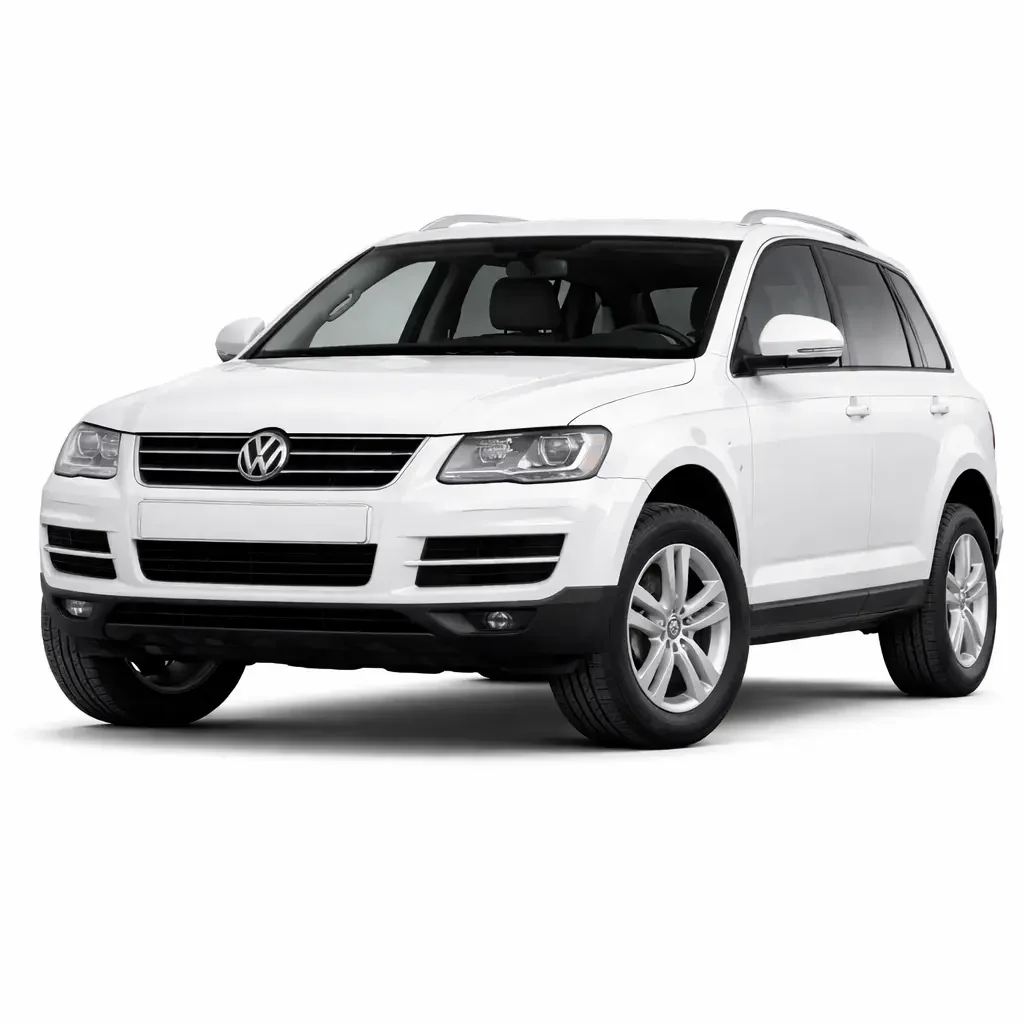
The first-generation Volkswagen Touareg, internal designation 7L, ran from the 2003 model year through the 2010 model year, with production beginning in late 2002 and ending in 2010. It was the first SUV Volkswagen had produced under the VW brand and was built on the PL71 platform shared with the Porsche Cayenne (955/957) and, from 2006, the first-generation Audi Q7 (4L). This platform relationship is the most commercially significant fact in the 7L's parts story: a large proportion of the 7L's suspension geometry, brake hardware, and chassis components cross-reference directly to the Cayenne 955 and 957 and the Q7 4L, expanding the aftermarket pool considerably.
The 7L is a complex vehicle for aftermarket catalog management. It was offered with an unusually wide engine range spanning a V6 petrol, a V8, a 5.0-litre V10 TDI diesel, a 6.0-litre W12 petrol, and a petrol-electric hybrid system, across a production run that includes a significant mid-cycle facelift in 2006 that changed exterior components, suspension tune, and some interior hardware. Air suspension was a factory option on most variants and standard on some, making suspension type a mandatory catalog qualifier that cannot be inferred from engine or trim alone.
This guide maps the engine codes, transmission codes, suspension variants, body configurations, and facelift boundaries that determine correct parts application for the Touareg 7L.
Platform Overview
The PL71 platform is a traditional body-on-ladder-adjacent architecture with a fully independent suspension front and rear. All Touareg 7L variants are four-wheel drive; there is no two-wheel-drive configuration in this generation. The permanent four-wheel-drive system uses a Torsen center differential with a 50:50 default torque split, with locking capability. Rear axle locking differential was available as an option on some markets and trim levels.
The shared PL71 platform with the Porsche Cayenne means that many underbody components, including front lower control arms, wheel bearings, front and rear subframe hardware, and related geometry components, cross between the 7L Touareg and the Cayenne. This cross-reference applies to first-generation Cayenne (955, 2003 to 2006) and second-generation Cayenne (957, 2007 to 2010) with care, as the Cayenne received its own mid-cycle revision. All Cayenne cross-references must be validated against production period and specification; do not treat all Cayenne 9PA applications as interchangeable with all 7L applications.
The Audi Q7 4L joined the PL71 platform family for 2006. Some Q7 4L underbody components also cross to the 7L, but the Q7 is a longer vehicle with a longer wheelbase and rear-seat package, so body, floor, and wheelbase-dependent components do not cross.
Production Periods and the 2006 Facelift
The Touareg 7L has two distinct production phases divided by a facelift introduced for the 2007 model year (production approximately mid-2006 onward).
Pre-facelift (2003 to 2006 model years): Rounder front fascia with circular fog lamp housings, chrome grille with narrower slats, and round headlight cluster. Pre-facelift exterior trim components, including bumper covers, grille, headlight assemblies, and fog lamp bezels, are pre-facelift specific and do not fit the post-facelift body.
Post-facelift (2007 to 2010 model years): Revised front end with more angular headlights, larger air intakes, updated grille design, revised bumper. The post-facelift also introduced updates to the interior including a revised MMI-adjacent infotainment system and updated instrument cluster on some markets. Post-facelift exterior trim components are post-facelift specific.
Facelift period (pre vs. post 2006 production) is a mandatory qualifier for all exterior body components, headlight assemblies, bumper covers, grille assemblies, and any trim-specific interior components.
Engine Variants and Codes
The Touareg 7L was offered with the following factory engines. Engine code is mandatory for all engine-specific components including filters, gaskets, timing components, fuel system hardware, sensors, and ancillaries.
Petrol Engines
3.2-litre V6 (AZZ, BKJ): The entry-level petrol engine at launch, a naturally aspirated 3.2-litre VR6 producing 220 PS. The AZZ code covers the early application; BKJ is the later revised code. Both are narrow-angle VR6 configurations. Timing chain (not belt) is VR6-specific. Oil filter, air filter, and spark plug applications differ from the V8.
4.2-litre V8 (AXQ, BAR): A 310 PS naturally aspirated V8. AXQ covers the early application through approximately 2006; BAR covers later production. The V8 uses a timing chain. Valve cover gaskets, oil filter housing, and fuel system hardware are V8-specific and do not apply to the V6 or V10 TDI.
6.0-litre W12 (BHX): A 450 PS twin-turbocharged W12 produced in very low volume, market-restricted primarily to Europe and some Asian markets. The W12 uses a unique engine code (BHX) shared with the Bentley Continental GT application of the same engine family; however, ancillary specifications, engine management calibration, and emission system hardware differ between Touareg and Bentley applications and must not be assumed to cross. The W12 Touareg is identifiable by its unique front bumper with enlarged lower air intakes required for cooling. W12 Touareg production was limited and parts availability reflects this; sellers should note low volume when setting inventory levels.
Hybrid (BHT petrol component): See hybrid section below.
Diesel Engines
2.5-litre R5 TDI (BAC, BPE, BPD): A five-cylinder 2.5-litre TDI producing 174 PS, offered in European markets. The inline-five configuration is unique in the 7L lineup. BAC is the early code; BPE and BPD cover later production. Timing belt (not chain); service interval and belt kit specifications are R5-specific. Injectors, glow plugs, and fuel filter applications differ from the V6 TDI and V10 TDI. The 2.5 R5 TDI is the most mechanically straightforward diesel in the 7L range and the most common diesel variant in high-volume European markets.
3.0-litre V6 TDI (BMX, BKS, CASA): A 225 PS to 240 PS common-rail V6 TDI. BMX covers earlier production; BKS and CASA cover later variants including post-facelift production. The V6 TDI uses a timing belt. Injector type, high-pressure fuel pump specification, and EGR system hardware differ across the BMX, BKS, and CASA codes; cross-referencing any V6 TDI component requires engine code confirmation. The V6 TDI is the dominant diesel variant in most European markets and is the primary diesel application sellers will encounter in volume.
5.0-litre V10 TDI (AYH, BLE): The 7L's signature engine, a 313 PS twin-turbocharged 5.0-litre V10 TDI producing 750 Nm of torque. AYH is the early code; BLE is the revised post-emission-update code. The V10 TDI is shared with the Audi Q7 4L (in BLE form) and the early Porsche Cayenne diesel (in related tune). This is a mechanically complex unit with large-volume injectors, a high-pressure common-rail system calibrated for V10 configuration, and twin turbochargers. Turbocharger specifications for AYH and BLE differ; confirming engine code is mandatory for turbocharger applications. The V10 TDI also uses a specific engine oil specification (5W-40 VW 507.00 rated) that differs from petrol variant recommendations. Timing belt (not chain). The V10 TDI is subject to known high-pressure fuel pump failure issues and EGR system fouling; service parts for these failure modes represent high-velocity aftermarket volume on this variant.
Engine code confirmation is mandatory for all fuel system, timing system, turbocharger, emission system, and lubrication system components. Engine displacement alone is insufficient; the 3.0 V6 TDI for example spans multiple codes with differing specifications.
Transmission Codes
All Touareg 7L variants use a six-speed automatic transmission -- there is no manual gearbox option in this generation. The specific transmission unit varies by engine application.
09D (TR-60SN, ZF 6HP26): Used with the V6 petrol, V8, and V6 TDI applications. This is a ZF-sourced six-speed automatic. ATF specification is ZF LifeGuard Fluid 6 (or equivalent meeting ZF 6HP approval). The 09D is also found in other Volkswagen Group vehicles of this era including the Audi Q7 and Porsche Cayenne, and cross-references apply for many internal components including solenoids, filter kits, and conductor plates.
09F (TR-80SD, ZF 8HP predecessor family): Used with the V10 TDI and V8 in some applications. This is a heavier-duty ZF unit suited for the higher torque output of the V10 TDI. ATF specification and internal hardware differ from the 09D; the two transmission codes are not interchangeable for any service component. Torque converter specifications also differ.
09E (0AT): Used with the W12 and in some hybrid applications.
Transmission code is mandatory for all ATF, filter kit, conductor plate, solenoid, torque converter, and valve body component listings. Specifying only "6-speed automatic" is insufficient -- the 09D, 09F, and 09E differ in ATF spec, internal hardware, and service procedures.
Suspension Variants
The Touareg 7L suspension is one of the most consequential fitment variables in the catalog. Two fundamentally different suspension systems were offered:
Coil Spring Suspension: Standard on base and mid-range trim levels. Front MacPherson-adjacent double wishbone setup, rear multi-link. Standard steel coil spring applications apply. Shock absorber specifications, spring rates, and related hardware are coil-spring specific.
Air Suspension (Pneumatic): Factory option on most variants and standard equipment on V10 TDI and W12 variants in most markets. The air suspension system uses air struts at all four corners, an air compressor, air reservoir, height sensors at each corner, and a control module. Air suspension component applications, including air struts, compressor, air lines, level sensors, solenoid valves, and control unit, are air-suspension specific and have zero application on coil spring vehicles.
This is a common and commercially costly catalog error: listing a front strut assembly without specifying suspension type results in incorrect parts on a high proportion of orders. Suspension type (coil spring vs. air suspension) is a mandatory qualifier for every suspension component listing on the Touareg 7L.
Air suspension failure rates on the 7L are high relative to the broader market; compressor failure, air strut bladder failure, and solenoid valve failure are frequent. This makes air suspension service components high-velocity aftermarket items for the 7L. Sellers covering this application should maintain separate, clearly differentiated listings for air suspension and coil spring variants.
Hybrid Variant
A petrol-electric hybrid system was available in some markets from approximately 2006 onward. The hybrid uses the 3.0-litre V6 petrol engine (hybrid-specific calibration) combined with an electric motor integrated into the transmission. The hybrid high-voltage battery, electric motor-generator, power electronics, and hybrid-specific transmission hardware are hybrid-specific. Standard V6 petrol engine service components apply to the combustion side of the hybrid, but transmission fluid specification and transmission internal hardware differ from the standard 09D used with the non-hybrid V6. Hybrid variant identification is essential before listing any transmission or electrical component.
Common ACES/PIES Mistakes for the Touareg 7L
Not specifying suspension type (coil spring vs. air suspension) for any suspension component. This single omission generates more incorrect parts orders on the 7L than any other fitment error.
Specifying only engine displacement without engine code for diesel applications. The V6 TDI spans multiple codes (BMX, BKS, CASA) with differing injector, fuel pump, and EGR specifications.
Not distinguishing pre-facelift (2003 to 2006 model year) from post-facelift (2007 to 2010 model year) for exterior body components. Bumper covers, headlight assemblies, and grille components are not interchangeable across the facelift boundary.
Applying 09D transmission service components to 09F applications or vice versa. ATF specification, solenoid hardware, and filter kits differ between these units.
Treating all Porsche Cayenne 9PA cross-references as applying equally to pre-facelift and post-facelift Touareg 7L. Confirm production period alignment before applying any Cayenne cross-reference.
Listing V10 TDI turbocharger applications without specifying AYH vs. BLE engine code. These are different specifications.
Applying standard coil spring shock absorber applications to air suspension vehicles, or listing air strut assemblies without specifying air suspension fitment.
Assuming the W12 engine (BHX) uses the same ancillary specifications as the Bentley Continental GT application of the same engine family. Calibration, emission system, and ancillary specifications differ.
Not specifying engine code for the 2.5 R5 TDI across BAC, BPE, and BPD variants -- timing belt kits and injector specifications differ.
Listing Audi Q7 4L platform cross-references for body or floor components. The Q7 has a longer wheelbase and different body dimensions -- running gear may cross but body components do not.
Catalog Checklist for Touareg 7L (2004 to 2010)
Require model year or production date for facelift distinction (pre vs. post 2006 production) for all exterior components
Require engine code (not just displacement or fuel type) for all engine, fuel system, emission system, and timing component listings
Require suspension type (coil spring / air suspension) for all suspension component listings; treat this as the primary qualifier for the suspension category
Require transmission code (09D / 09F / 09E) for all transmission service component listings
Confirm hybrid designation before listing any transmission or electrical system component
Frame Porsche Cayenne cross-references as "may also fit" with production period and specification qualifiers
Frame Audi Q7 4L cross-references as "may also fit" for underbody running gear only; exclude body, floor, and wheelbase-dependent components
Note that V10 TDI air suspension and W12 air suspension are standard equipment in most markets -- coil spring should not be assumed for these variants
Maintain separate catalog entries for air suspension and coil spring suspension variants -- do not combine into a single application
Final Take
The Touareg 7L is a parts-intensive application with above-average order complexity. The combination of a wide engine range spanning V6, V8, V10 TDI, W12, and hybrid, with two suspension systems, a facelift boundary that splits exterior components, and a shared platform with the Porsche Cayenne and Audi Q7 creates a catalog environment where underdefined listings generate incorrect parts consistently.
The highest-value discipline for sellers covering the 7L is the suspension type qualifier. Air suspension is common, failure-prone, and accounts for significant parts volume; it cannot be correctly served without suspension type confirmation. The second-highest-value discipline is engine code for diesel applications, where the V6 TDI across BMX, BKS, and CASA codes and the V10 TDI across AYH and BLE represent meaningfully different specifications. Sellers who enforce both qualifiers at the listing level will dramatically reduce returns on this application.
Disclaimer: This guide is based on publicly available specifications, manufacturer documentation, and independent research. Part interchangeability should always be confirmed via VIN and OEM part number lookup. Specifications may change without notice. This document does not constitute official Volkswagen parts catalog data.