
Written by Arthur Simitian | PartsAdvisory
The 2024 to 2027 production window covers the seventh-generation Volkswagen Transporter nameplate, but unlike any previous generation in this guide series, the T7 era encompasses two entirely separate vehicles built on two entirely different platforms that share no running gear, no body structure, no powertrain components, and no chassis hardware. Understanding which vehicle an application covers is the foundational requirement for any parts listing in this window -- more foundational than engine code, transmission type, or body configuration.
The Volkswagen Multivan T7 is a passenger-focused large MPV built on Volkswagen Group's MQB Evo platform -- the same front-wheel-drive architecture underpinning the Audi A3 and Volkswagen Caddy. It went on sale in Europe in 2022 and is produced at VW's Hannover plant. It is a passenger car category vehicle.
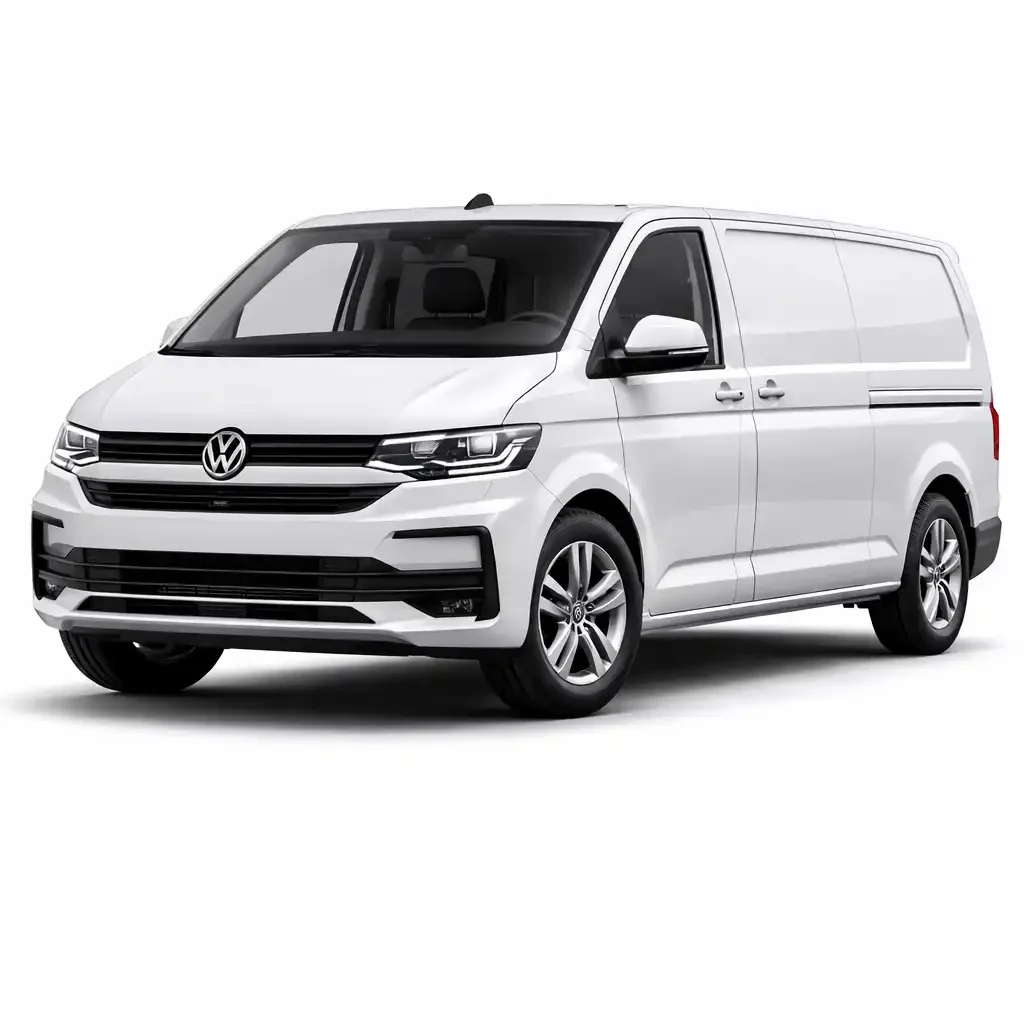
The Volkswagen Transporter T7 (commercial) is a medium van for commercial applications built on a platform co-developed with Ford, sharing its underpinnings with the Ford Transit Custom and Tourneo Custom and assembled at the Ford Otosan facility in Turkey. It was unveiled at IAA Transportation 2024 in Hannover and entered pre-sales in Germany in December 2024, with full market rollout commencing in 2025.
These are two different vehicles. They share design language and the VW badge. They share nothing else that matters for aftermarket parts fitment. A seller who catalogs them as variants of a single "Volkswagen T7" application for any running gear, engine, or chassis component will generate incorrect parts on every affected order.
This guide maps both vehicles -- their platforms, powertrain families, body variants, and the fitment variables specific to each -- and addresses the parts implications of the Ford Transit Custom platform foundation in the commercial T7.
Section One: Volkswagen Multivan T7 (MQB Evo Platform, 2022 Onward)
Platform and Market Context
The Multivan T7 is built on the MQB Evo platform, a transversely mounted front-engine, front-wheel-drive architecture. This is a complete platform break from all previous Transporters -- the T6.1 used the PL46 commercial van platform while the Multivan T7 uses a passenger car platform. This means no suspension component, no axle component, no drivetrain component, and no body structure component from any previous Transporter generation applies to the Multivan T7. The MQB Evo platform is shared with the Audi A3, Volkswagen Golf 8, Volkswagen Caddy, Skoda Octavia, and related vehicles. Suspension components from those applications may cross-reference to the Multivan T7 where the same specifications apply.
The Multivan T7 is produced solely as a passenger car. It is not available as a panel van, cargo van, or commercial body. It replaces the Caravelle and Multivan in VW's passenger van role. It is not the platform for the commercial Transporter T7 -- that role belongs to the Ford-derived platform described in Section Two.
Multivan T7 Engines
The Multivan T7 is offered with the following powertrain options. All are MQB Evo-specific applications.
1.5-litre TSI (eTSI mild hybrid): A 150 PS 1.5-litre turbocharged petrol engine with a 48-volt mild hybrid system providing start-stop and energy recovery. The mild hybrid belt-integrated starter generator (BSG) and 48-volt battery are eTSI-specific components with no application on any non-mild-hybrid variant.
2.0-litre TSI: A 204 PS turbocharged petrol engine. 7-speed DSG standard.
2.0-litre TDI: A 204 PS turbocharged diesel engine. 7-speed DSG standard. This is an EA288 family diesel as used in the Golf 8 and related MQB Evo applications -- it is not the same TDI used in the commercial T7 Transporter.
1.4-litre eHybrid (PHEV): The plug-in hybrid combines a 1.4-litre TSI EA211 petrol engine with an electric motor for a combined system output of 218 PS. The 6-speed DSG is specific to the eHybrid application. The eHybrid's high-voltage battery, electric motor, power electronics, and PHEV-specific charging hardware are eHybrid-specific. The eHybrid is the most complex powertrain in the Multivan T7 lineup for parts fitment purposes -- it has three distinct power sources (petrol engine, electric motor, battery) each with their own service parts that do not apply to non-PHEV variants.
eHybrid AWD (from 2024): A 245 PS AWD PHEV version with a rear electric motor producing 136 PS and a doubled usable battery capacity of 19.7 kWh. The rear electric motor, rear power electronics, and rear axle drive unit are AWD eHybrid-specific and have no application on the FWD eHybrid or any non-PHEV variant.
Engine and powertrain type is a mandatory qualifier for all engine, fuel system, electrical, high-voltage battery, and charging system component listings on the Multivan T7.
Multivan T7 Transmissions
The 7-speed DSG is standard on TSI, TDI, and higher-output configurations. The 6-speed DSG is used with the 1.4 eHybrid PHEV. DSG-specific fluid, clutch pack specifications, and mechatronic hardware differ between the 6-speed and 7-speed DSG. Transmission code is required for all DSG service component listings.
Multivan T7 Body Variants
The Multivan T7 is offered in SWB and LWB versions, with the SWB measuring approximately 4,973 mm and the LWB approximately 120 mm longer. It seats up to seven occupants with three rows of seating, including a rotating second-row bench that can face rearward. Floor length, seat rail configuration, and rear body components differ between SWB and LWB.
Trim levels include Life (base), Style (mid), and Energetic (top). Higher trims add IQ.Light LED Matrix headlights, larger infotainment screens, and additional electronic features. Trim-specific headlight assemblies, dashboard components, and electronic modules are trim-level dependent.
Section Two: Volkswagen Transporter T7 Commercial (Ford Transit Custom Platform, 2024 Onward)
Platform and Market Context
The commercial Transporter T7 -- panel van, Kombi, Caravelle passenger van, and chassis cab -- is built on a platform co-developed with Ford and shared with the Ford Transit Custom and Tourneo Custom. Production takes place at Ford Otosan in Kocaeli, Turkey. Volkswagen has not officially designated this vehicle "T7" but it is the commercial successor to the T6.1 Transporter.
This is the most consequential platform change in the Transporter's commercial history since the T4 moved to front-wheel drive in 1990. The commercial T7 Transporter is a fundamentally different vehicle from all previous Transporters in every mechanical respect -- different platform, different engine mounting, different suspension architecture, different body structure. No running gear or chassis component from any T6.1 or earlier Transporter applies to the commercial T7.
The shared Ford platform also means that a significant proportion of the commercial T7's underbody running gear, suspension components, and some powertrain hardware cross-references directly to Ford Transit Custom applications of the same production period. This is a commercially important cross-reference that expands the aftermarket parts pool. However it requires careful management: VW-specific front-end body components, dashboard, and brand-specific trim do not cross to the Transit Custom.
The commercial Transporter T7 is larger than the T6.1 it replaces -- 146 mm longer and 128 mm wider, with a 97 mm longer wheelbase. SWB wheelbase is 3,101 mm; LWB wheelbase is 3,501 mm.
Commercial T7 Powertrain Options
2.0-litre TDI (110 PS / 81 kW): Entry-level diesel. 6-speed manual gearbox. Front-wheel drive only. 2.0-litre TDI (150 PS / 110 kW): Mid-range diesel. 6-speed manual gearbox. 4MOTION AWD available. 2.0-litre TDI (170 PS / 125 kW):Top diesel output. Ford-developed 8-speed automatic gearbox standard. 4MOTION AWD available.
Note that the 170 PS TDI uses a Ford-developed 8-speed automatic transmission -- this is a different unit from the 7-speed DSG used in the T5 GP and T6/T6.1. DSG service components, DSG fluid specifications, and DSG mechatronic hardware do not apply to the commercial T7 automatic transmission. The 8-speed automatic in the commercial T7 uses Ford-specification ATF and Ford-specification service procedures.
eHybrid (232 PS / 171 kW combined): A plug-in hybrid combining a 2.5-litre petrol engine with an electric motor -- the same system used in the Ford Transit Custom PHEV. Combined system output of 232 PS. The eHybrid high-voltage battery, electric motor, power electronics, and PHEV charging hardware are eHybrid-specific. The 2.5-litre petrol engine in the eHybrid is a Ford-derived unit, not a VW EA family engine. This is the first time the Transporter commercial lineup has used a Ford-origin engine.
e-Transporter / e-Caravelle (BEV): Fully electric versions with a 64 kWh battery and rear-wheel drive. Power outputs of 136 PS, 218 PS, or 286 PS depending on variant. All-wheel drive planned as a later addition. The BEV drivetrain -- battery pack, electric motor, power electronics, onboard charger, and charging port assembly -- is electric-specific and has no application on any combustion or hybrid variant.
Engine and powertrain type is a mandatory qualifier for all engine, fuel system, electrical, high-voltage, and transmission component listings on the commercial Transporter T7.
Commercial T7 Transmissions
6-speed manual: Standard on 110 PS and 150 PS TDI variants. 8-speed automatic (Ford-developed): Standard on 170 PS TDI. This is a Ford-origin unit, not a VW DSG. ATF specification, filter kit, and service procedures are Ford-specification and differ from any VW DSG or previous Transporter automatic.
Transmission type and specification source (VW DSG vs. Ford 8-speed automatic) is a mandatory qualifier for all transmission service components on the commercial T7.
Commercial T7 Body Configurations
The commercial T7 is offered in the following factory configurations at launch:
Panel Van: Standard commercial cargo configuration. Two wheelbases and two roof heights available. Panel Van Plus: Extended storage solutions with additional interior partitioning. Kombi: Panel van with rear side windows and optional second-row seating. Caravelle: Passenger van configuration with full multi-row seating for up to nine occupants. Available in three trim levels. Double Cab Chassis: Commercial chassis cab with crew cab and load platform. Long wheelbase only.
Body configuration and wheelbase are mandatory qualifiers for all floor, sliding door rail, roof panel, glass, seat hardware, and body length-dependent component listings.
The PanAmericana trim is an off-road appearance package available on panel van and Caravelle, adding specific exterior cladding, bumper trim, and optional 4MOTION specification. PanAmericana exterior trim components are trim-level specific.
The Critical Catalog Rule: Multivan T7 and Commercial T7 Are Different Vehicles
Every parts listing for "VW Transporter T7" must specify which vehicle is intended -- Multivan T7 (MQB Evo) or commercial Transporter T7 (Ford Transit Custom platform). The consequences of conflating them are severe:
Platform is different. Suspension geometry, front subframe, rear axle architecture, and underbody components are different and do not cross.
Engine families are different. The Multivan T7 uses VW EA family engines (1.5 TSI, 2.0 TSI, 2.0 TDI EA288, 1.4 PHEV). The commercial T7 uses 2.0 TDI, a Ford PHEV 2.5-litre petrol, and Ford/VW BEV drivetrain. The 2.0 TDI in the Multivan T7 is an MQB Evo EA288 application; the 2.0 TDI in the commercial T7 is a Ford Transit Custom-platform application. These may be different engine mounting configurations and different ancillary specifications despite the same displacement family.
Body structure is different. The Multivan T7 has a passenger car body structure. The commercial T7 has a van body structure based on the Ford platform. No body panel, glass, or interior component crosses between them.
Transmission systems differ. The Multivan T7 uses the 7-speed and 6-speed VW DSG. The commercial T7 uses the 6-speed manual and Ford 8-speed automatic or the Ford-derived eHybrid automatic. DSG service parts do not apply to the commercial T7 automatic transmission.
Vehicle category designation (Multivan T7 MQB Evo / commercial Transporter T7 Ford platform) is the primary mandatory qualifier for every parts listing in this window.
Ford Transit Custom Cross-Reference Opportunity
The commercial Transporter T7's Ford Transit Custom platform foundation creates a commercially valuable cross-reference opportunity for suspension, braking, and certain powertrain components. Sellers with existing Ford Transit Custom catalog coverage can expand to the commercial VW Transporter T7 for shared platform components -- specifically suspension arms, wheel bearings, brake discs and pads, and associated underbody hardware where the same Ford-origin parts apply.
This cross-reference must be framed carefully:
Front body panels (bumper, grille, headlights, bonnet) are VW-specific and do not cross to the Transit Custom. Dashboard, instrument cluster, and VW-branded interior trim are VW-specific. Engine ancillaries specific to VW emission system calibration or VW-specific intake/exhaust routing may differ from Ford Transit Custom applications. Rear lighting is different between VW and Ford versions on diesel models (same on BEV models).
Frame all Ford Transit Custom cross-references for the commercial T7 as "may also fit" with powertrain type, wheelbase, and body configuration qualifiers.
Common ACES/PIES Mistakes for 2024 to 2027 Volkswagen Transporter T7 Family
Listing any component as applying to "VW Transporter T7" without specifying Multivan T7 (MQB Evo) vs. commercial Transporter T7 (Ford platform). These are different vehicles on different platforms.
Cross-referencing T6.1 running gear components to the commercial T7. The commercial T7 is on a new Ford-derived platform. No T6.1 suspension, axle, or chassis component applies.
Cross-referencing T6.1 engine components to the commercial T7. New engine configurations on a new platform. Engine mounting, ancillary specifications, and emission system hardware may differ from T6.1 equivalents.
Applying VW DSG service components (fluid, filter, mechatronic) to the commercial T7's Ford 8-speed automatic transmission. The Ford 8-speed uses Ford-specification ATF and service procedures.
Listing eHybrid battery, electric motor, or charging system components as applying to diesel or mild hybrid variants. High-voltage eHybrid components apply only to eHybrid-designated vehicles.
Applying Multivan T7 MQB Evo suspension or drivetrain components to the commercial T7 Ford platform. These vehicles share a platform with different cars and do not cross with each other.
Applying 48-volt mild hybrid BSG and battery components from the eTSI Multivan T7 to non-eTSI variants.
Not specifying wheelbase (SWB 3,101 mm / LWB 3,501 mm) for commercial T7 floor, sliding door rail, and body length-dependent component listings.
Applying FWD front axle components to 4MOTION commercial T7 rear axle applications or vice versa.
Treating the commercial T7 and Ford Transit Custom as fully interchangeable for all components. Body panels, front-end styling, dashboard, and VW-specific emission calibration components are VW-specific and do not cross to the Ford equivalent.
Catalog Checklist for 2024 to 2027 Volkswagen Transporter T7 Family
Require vehicle designation (Multivan T7 MQB Evo / commercial Transporter T7 Ford platform) as the primary qualifier for every listing
Require engine and powertrain type (1.5 TSI eTSI / 2.0 TSI / 2.0 TDI / 1.4 eHybrid PHEV / eHybrid AWD for Multivan T7; 2.0 TDI 110/150/170 PS / eHybrid / BEV for commercial T7) for all powertrain component listings
Require transmission type (7-speed DSG / 6-speed DSG for Multivan T7; 6-speed manual / Ford 8-speed automatic for commercial T7) for all transmission service component listings
Require drivetrain (FWD / AWD / RWD for BEV) for all axle and drivetrain component listings on commercial T7
Require high-voltage system confirmation for eHybrid battery, motor, power electronics, and charging system components
Require body configuration (Panel Van / Kombi / Caravelle / Double Cab Chassis) and wheelbase (SWB / LWB) for commercial T7 body and floor component listings
Note that commercial T7 running gear may cross-reference to Ford Transit Custom applications of the same production period -- frame as "may also fit" with configuration qualifiers
Do not cross T6.1 or earlier Transporter running gear to the commercial T7
Do not cross Multivan T7 MQB Evo components to the commercial T7 Ford platform
Final Take
The 2024 to 2027 Volkswagen Transporter window is the most structurally complex catalog challenge in the entire Transporter parts history. Two vehicles share a generation name and design language while sitting on entirely different platforms with entirely different component trees. The Multivan T7 on MQB Evo is effectively a passenger car MPV whose running gear cross-references to Golf 8 and Audi A3 applications. The commercial Transporter T7 on the Ford Transit Custom platform is a medium commercial van whose running gear cross-references to the Ford Transit Custom.
The single most important catalog discipline for this window is establishing which vehicle an application covers before any other qualification is applied. Once that is established, the engine and powertrain type, transmission, drivetrain, and body configuration qualifiers follow the same logic as any modern VW application -- with the added dimension that the commercial T7's Ford platform creates a commercially valuable cross-reference pool that sellers with existing Ford Transit Custom catalog coverage can leverage immediately for suspension and brake components.
Disclaimer: This guide is based on publicly available specifications, manufacturer documentation, and independent research. Part interchangeability should always be confirmed via VIN and OEM part number lookup. Specifications may change without notice. This document does not constitute official Volkswagen parts catalog data.