
Written by Arthur Simitian | PartsAdvisory
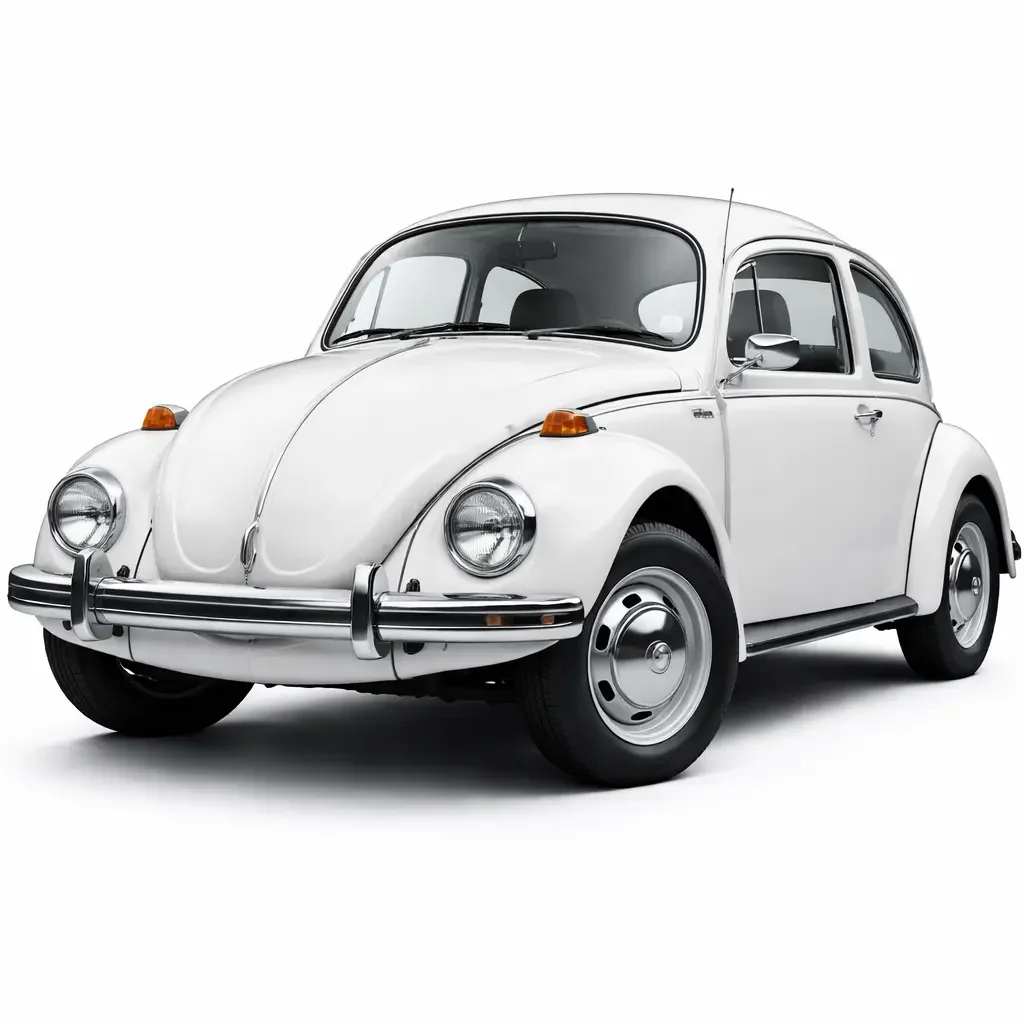
The Volkswagen 1302, sold in North America and most markets as the Super Beetle, was produced for the 1971 and 1972 model years before being superseded by the 1303, which introduced a curved windshield and padded dashboard for 1973. The 1302 represents the most significant mechanical revision the Beetle received in its production history up to that point, introducing MacPherson strut front suspension in place of the torsion bar front axle that had been used since the original Type 1 design. This suspension change cascaded through a complete redesign of every panel in the front end, the chassis frame head, the front trunk floor, and the fuel tank shape, creating a vehicle that shares the Beetle's rear half but is completely different at the front.
The commercial significance of the 1302 for aftermarket sellers cannot be overstated. The Super Beetle's front suspension, front body panels, front fenders, hood, front valance, spare tire well, and fuel tank are all specific to the 1302 and 1303 Super Beetle family and do not cross to the standard Beetle of any year. The standard Beetle's torsion bar front end components do not cross to the 1302 in the reverse direction. These are two fundamentally different front ends beneath the same recognizable silhouette, and a catalog that does not distinguish between them at the component level will generate incorrect parts on every front-end order.
This guide maps the 1302 platform architecture, the sub-variants (1302 and 1302S), engine codes, rear suspension configuration, brake configuration, the chassis number identification system, and the complete catalog accuracy requirements for the 1971 to 1972 Super Beetle.
Platform Overview: The 1302 Front End Redesign
The 1302 retains the standard Type 1 platform from the firewall rearward. The floor pan, chassis tunnel, torsion bar rear suspension, transaxle, engine compartment, rear body from the B-pillar back, doors, and greenhouse are shared with or closely related to the contemporary standard Beetle production. The difference begins at the front axle and extends forward: every component from the front wheel centerline forward is specific to the Super Beetle.
The chassis frame head, the structural element at the very front of the platform that mounts the front suspension, was substantially modified and made flatter to accommodate the MacPherson strut geometry. This flattened frame head is unique to the 1302 and 1303 and is not interchangeable with the standard Beetle frame head, which carries the torsion bar tubes. The inner fenders, which in the standard Beetle are relatively simple pressed panels, were made heavier and redesigned to serve as strut towers, carrying the top mounts for the MacPherson struts and transmitting suspension loads into the body structure. These inner fenders are 1302 and 1303 specific.
The practical result of the suspension change was an 86 percent increase in front trunk capacity. The torsion bar front suspension of the standard Beetle required a large portion of the front trunk to house the torsion bar tubes, and the spare tire was stored diagonally in this space. The MacPherson front suspension freed up the entire front trunk floor, the fuel tank was redesigned to a flatter profile to maximize this space, and the spare tire now lies flat in a recessed well in the trunk floor. The flat spare tire, visible when the front trunk lid is opened, is the simplest visual identifier for a Super Beetle from any production year.
Sub-Variants: 1302 and 1302S
The 1302 was offered in four sub-variants in global markets during the 1971 to 1972 production run, defined primarily by engine displacement and equipment level. Understanding these sub-variants is essential for correct brake system, clutch, and engine component catalog entries.
1302: The base Super Beetle equipped with the 1285cc dual-port engine producing 44 PS and standard equipment. This variant uses drum brakes at all four corners. In the US market, the 1285cc engine was not offered; the 1302 in North America was always equipped with the 1584cc engine.
1302 L: The luxury-equipped version of the 1285cc Super Beetle, with the same drum brake configuration as the base 1302 but with higher-specification interior trim, additional comfort features, and optional equipment packages.
1302 S: The high-performance Super Beetle equipped with the 1584cc dual-port engine producing 50 PS in European specification or 60 HP SAE in US specification (engine code AE for US, AD for European 50 PS). The 1302S is distinguished by front disc brakes, which require a different master cylinder and brake circuit configuration from the all-drum 1302. In North America, this was the only 1302 variant offered and was simply called the Super Beetle without the S suffix.
1302 LS: The luxury-equipped 1584cc variant combining the performance specification of the 1302S with the higher-trim equipment of the 1302L. Same disc front brake configuration as the 1302S.
The sub-variant distinction creates a hard brake system split within the 1302 range. All listings for master cylinders, front brake hardware, brake calipers, and brake lines must specify whether they apply to the drum-front 1302 and 1302L or the disc-front 1302S and 1302LS. A generic 1302 brake listing that does not distinguish between these two configurations will generate incorrect parts on every front brake service order.
Front Suspension: MacPherson Struts
The MacPherson strut front suspension is the defining mechanical feature of the 1302 Super Beetle and the component category that most frequently generates catalog errors. The strut assembly consists of a coil spring over a hydraulic strut insert, mounted within a strut outer housing that bolts to the inner fender strut tower at the top and connects to a transverse control arm at the bottom through a ball joint. This entire front suspension assembly, including strut towers, strut outers, coil springs, strut inserts, control arms, ball joints, and associated steering hardware, is specific to the 1302 and 1303 Super Beetle family.
None of the MacPherson strut front suspension components cross to the standard Beetle. The standard Beetle's torsion bar front axle, torsion tubes, king and link pin or ball joint beam, and associated steering components are a completely different suspension architecture. Sellers must never cross-reference standard Beetle front suspension components to the 1302, or 1302 strut components to the standard Beetle.
The 1302 strut components do cross to the 1303 Super Beetle (1973 to 1979), which uses the same MacPherson strut front suspension. The strut outer, coil spring, strut insert, ball joint, control arm, and strut top mount applications are shared between the 1302 and 1303, making the 1303 production pool an important secondary source for 1302 front suspension parts. This cross-reference is well established in the air-cooled aftermarket and should be reflected in catalog entries for all 1302 front suspension listings.
The anti-roll bar on the 1302 is substantially larger than on the standard Beetle, as part of the suspension geometry package. The anti-roll bar end links and mounting hardware are specific to the Super Beetle strut suspension and must not be cross-referenced to the standard Beetle's smaller anti-roll bar specification.
Rear Suspension: IRS with Double-Jointed Half Shafts
The 1302 introduced independent rear suspension (IRS) with double-jointed half shafts for the standard production 1302 range. Prior to the 1302, the standard Beetle used a swing axle rear suspension in which the wheels were mounted directly to the transaxle output shafts without CV joints, creating camber changes as the suspension moved. The 1302's IRS uses semi-trailing arms with double-jointed CV axle shafts, reducing camber change through suspension travel and improving handling predictability.
The double-jointed IRS rear suspension had previously been available only on Beetles equipped with the semi-automatic Autostick transmission, on the Karmann Ghia with IRS, and on some export market vehicles. The 1302 made it standard across the entire Super Beetle lineup for the North American and most global markets.
The IRS rear transaxle used in the 1302 is designated AH in the gearbox code, covering the 1969 to 1972 production period. The AH transaxle has a 4.125:1 final drive ratio. This gearbox is distinct from the standard Beetle swing axle gearboxes of the same era, which carry different letter codes. The AH gearbox uses different CV joint flanges, different axle shafts, and a different differential carrier design from swing axle units. Sellers listing rear axle shafts, CV joints, CV boots, and differential components must specify IRS versus swing axle configuration before applying any cross-reference.
The IRS rear brake drums on the 1302 are different from the swing axle rear drums used on the standard Beetle, due to the different stub axle and CV joint flange design. This mirrors the situation covered in the VW Thing guide, where the IRS stub axle drives a specific drum specification. Sellers must confirm rear drum part numbers against IRS-specific references and must not cross-reference swing axle rear drums to the 1302 application.
Engine Codes and Configuration
All 1302 Super Beetles use air-cooled flat-four engines with dual-port cylinder heads. The dual-port head, which introduced two intake ports per cylinder (replacing the earlier single-port design), was new to the 1971 model year and provides better breathing than the preceding single-port configuration. Engine code is stamped on the engine case below the generator or alternator support flange and is the definitive identifier for engine specification on any air-cooled Volkswagen.
North American Market: Engine Code AE (1971 to 1972)
All US and Canadian market 1302 Super Beetles used the 1584cc dual-port engine under engine code AE, producing 47 horsepower DIN or 60 horsepower SAE. The AE engine is a full-emission-equipped US specification unit with all required smog equipment for the relevant model years. The AE case uses dual-relief oiling and is the improved case introduced from the 1971 model year, more robust than the earlier single-relief cases. The 200mm clutch is used with all 1600cc engines, distinguishing clutch component listings from the 180mm clutch used with 1200 and 1300cc engines in global market 1302 variants.
European Market: Engine Codes AD, AB, AC
In European markets, the 1302S used engine code AD, the 1600cc producing 50 PS DIN. The base 1302 and 1302L used the 1285cc engine in two codes: AB covering 44 PS and AC covering 40 PS in different calibrations. These engine codes represent meaningfully different specifications in terms of carburetor jetting, compression ratio, and associated tune components. Sellers covering European market 1302 applications must specify engine code rather than displacement alone, as the 1285cc engines in AB and AC specifications use different carburetor settings and the 1300cc-category clutch size (180mm) rather than the 1600cc specification (200mm).
Air-Cooled Engine Cross-Reference Pool
The AE engine shares its core architecture with the contemporary dual-port 1600cc engines used across the air-cooled Volkswagen family of the early 1970s, including the standard Beetle 1600cc engine of the same production years, the Type 2 Bus 1600cc engine, and the Karmann Ghia 1600cc application. Spark plugs, ignition points, condenser, distributor cap, rotor, valve cover gaskets, pushrod tube seals, oil drain gasket, and oil filter cross broadly across all 1600cc dual-port air-cooled applications of this era. Sellers who articulate these cross-references will serve a much larger buyer pool for consumable service parts.
As with the 1302 Thing guide, the engine case for the standard 1302 Super Beetle is a Type 1 case. It does not have the Type 2 or Universal case skid plate provisions of the Thing 181. The standard Beetle case is the correct reference for complete engine or short-block replacement on the 1302.
Transmission and Gearbox
All 1971 to 1972 North American 1302 Super Beetles use a four-speed manual transmission with IRS gearbox code AH and a 4.125:1 final drive ratio. The AH gearbox is specific to the IRS application of this era and differs from the swing axle gearboxes used in standard Beetles of the same production period in its CV joint flanges, differential carrier, and output shaft design. The AH gearbox does share the same general internal gear train and ratio set as contemporary swing axle gearboxes and some internal components cross, but the output shafts and differential are IRS-specific.
A semi-automatic transmission (Autostick) was available as an option on some 1302 variants. The semi-automatic uses a torque converter with an automatic clutch but retains manual gear selection without a conventional clutch pedal. Sellers listing clutch components, flywheel hardware, and bell housing parts must confirm whether the application is manual or semi-automatic, as the clutch system is absent on semi-automatic vehicles and a torque converter assembly replaces it.
The 1302's gearbox code system uses letter codes stamped on the starter side of the transaxle case. The AH code covers the IRS 1600cc application from August 1969 through August 1972, spanning the entire 1302 production period. From August 1972 onward, the AT code replaces AH as the IRS gearbox designation for the 1303. Gearbox code confirmation is essential for any rear axle, differential, output shaft, or CV joint listing to ensure IRS versus swing axle components are correctly applied.
Body Panels and Front End Components
The 1302 body is shared with the standard Beetle from the A-pillar rearward. Doors, door glass, rear quarter panels, rear fenders, decklid (engine cover), taillight assemblies, rear bumper, rear valance, and all greenhouse components cross between the 1302 and the contemporary standard Beetle of the same production years. The 1302 and 1303 also share the same body from the windshield rearward, noting that the 1303 has a different curved windshield while the 1302 retains the flat windshield of the standard Beetle.
Every front-end component is 1302 and 1303 specific and does not cross to the standard Beetle. This includes the front fenders, hood, front valance, front apron, front inner fenders including the strut towers, front trunk floor, fuel tank (different shape from standard Beetle tank to fit the Super Beetle trunk floor), front bumper support, and hood hinge hardware. The front fenders of the 1302 have a rounder, fuller shape than standard Beetle fenders and are bolted to the Super Beetle-specific inner fender panels that incorporate the strut tower welded-in structures.
The 1302 and 1303 front fenders are interchangeable with each other for the basic sheet metal shape, though detail differences in the front turn signal apertures and trim holes exist between the flat-windshield 1302 and the curved-windshield 1303. Sellers should confirm production year compatibility when cross-referencing 1302 front fenders to 1303 fender listings.
Chassis Number Identification
The 1302 Super Beetle carries a specific VIN range that identifies it unambiguously from the standard Beetle production of the same model years. For North American market 1302s, the VIN is located under the rear seat cushion on an inspection plate. The 1971 Super Beetle VIN range spans 1112000001 to 1113000000 for the sedan, and 1972 spans 1122000001 to 1123200000 for the sedan. These ranges are distinct from the standard Beetle VIN ranges of the same years.
The data sticker typically located in the spare tire well area of the front trunk encodes the chassis number, type number, engine code, gearbox code, paint color code, and factory-fitted option codes. For any ambiguous 1302 application where the owner is uncertain of the exact specification, the data sticker is the authoritative reference. Sellers should encourage customers to provide the data sticker information for any suspension, brake, or engine-specific component order.
Common ACES/PIES Mistakes for the 1302 Super Beetle (1971 to 1972)
1. Applying standard Beetle torsion bar front suspension components to the 1302 Super Beetle, or applying 1302 MacPherson strut components to the standard Beetle. These two front suspension architectures are completely different and share no components whatsoever.
2. Not specifying the 1302 or 1303 Super Beetle application when listing front fenders, hood, front valance, front apron, front inner fenders, and front trunk floor. All of these components are Super Beetle specific and do not cross to the standard Beetle.
3. Cross-referencing the standard Beetle fuel tank to the 1302. The Super Beetle fuel tank has a different shape specifically designed to maximize front trunk space and fit the flat spare tire configuration. The standard Beetle tank is not interchangeable.
4. Not distinguishing the 1302 drum-front brake system from the 1302S disc-front brake system. Master cylinders, front brake hardware, front calipers, brake discs, and brake lines differ between these two configurations. A generic 1302 brake listing that does not specify drum-front or disc-front will generate incorrect parts on a significant share of brake orders.
5. Applying swing axle rear gearbox components (axle shafts, CV joints, differential) to the 1302 IRS application, or applying IRS components to standard Beetle swing axle applications. The AH IRS gearbox and the swing axle gearboxes of the same era use different output shafts, different CV joint flanges, and different differential carriers.
6. Cross-referencing the standard Beetle swing axle rear brake drums to the 1302 IRS rear drums. The different stub axle geometry of the IRS results in different rear drum fitment specifications, consistent with the IRS drum distinction discussed in the VW Thing guide.
7. Not confirming whether a 1302 is equipped with the semi-automatic Autostick transmission before listing clutch components, flywheel hardware, or bell housing parts. Semi-automatic 1302 vehicles have no conventional clutch; the standard clutch part listings have no application on Autostick vehicles.
8. Applying 1300cc-sized clutch hardware (180mm) to the North American AE-engined 1302 Super Beetle. All North American 1302 Super Beetles use the 1600cc engine and the 200mm clutch specification. The 180mm clutch applies only to European market 1302 and 1302L variants with the 1285cc engine.
9. Not cross-referencing 1303 Super Beetle (1973 to 1979) front suspension components to the 1302. The MacPherson strut front suspension is shared between the 1302 and 1303, and the 1303's longer production run created a larger parts pool for strut inserts, coil springs, strut outers, control arms, and ball joints that cross directly to the 1302.
10. Listing standard Beetle anti-roll bar end links and mounting hardware as applicable to the 1302. The 1302 uses a substantially larger anti-roll bar than the standard Beetle as part of the MacPherson strut suspension package. The end link and mounting hardware specifications are different from the standard Beetle application and are specific to the Super Beetle strut front suspension.
Catalog Checklist for 1302 Super Beetle (1971 to 1972)
• Establish 1302 or 1303 Super Beetle as a distinct catalog entity from the standard Beetle for all front-end component categories; never combine front suspension, front body panels, or front trunk components into shared standard Beetle listings
• Require sub-variant (1302 drum-front versus 1302S disc-front) for all brake system component listings including master cylinder, front caliper, front rotor, front brake hose, and associated hardware
• Require gearbox type (IRS AH code versus swing axle) for all rear axle shaft, CV joint, CV boot, rear drum, and differential component listings; confirm gearbox code from data sticker before serving these categories
• Apply 1303 Super Beetle cross-references for all MacPherson strut front suspension components including strut inserts, coil springs, control arms, and ball joints
• Confirm clutch diameter (180mm for 1285cc European variants versus 200mm for all North American AE 1600cc variants) before serving any clutch system component listing
• Confirm semi-automatic versus manual transmission before listing any clutch, flywheel, or bell housing component; Autostick vehicles have no conventional clutch
• Apply the broad 1600cc dual-port air-cooled cross-reference pool for engine service consumables including spark plugs, ignition components, valve cover gaskets, and oil service items
• Use chassis number ranges (1112000001 to 1113000000 for 1971 sedan; 1122000001 to 1123200000 for 1972 sedan) to confirm Super Beetle versus standard Beetle identity for ambiguous customer orders
• List fuel tank as 1302 and 1303 Super Beetle specific; explicitly exclude standard Beetle fuel tank cross-references
• List all rear-of-A-pillar body components including doors, rear fenders, decklid, rear valance, and taillights as shared with contemporary standard Beetle production; these components do cross between Super and standard Beetle
Final Take
The 1302 Super Beetle is the most mechanically bifurcated vehicle in the Volkswagen Type 1 family. It is simultaneously one of the most familiar vehicles in the air-cooled aftermarket and one of the most frequently miscataloged. The familiarity comes from the shared rear half and engine family with the standard Beetle; the miscatalog risk comes from the complete front-end departure that sellers often underestimate.
The single highest-value catalog discipline on the 1302 is the front suspension distinction. Every strut, spring, control arm, ball joint, inner fender, front fender, hood, front valance, and fuel tank is Super Beetle specific. None of it crosses to the standard Beetle. Sellers who enforce this boundary at the listing level will eliminate the most common and most consequential return scenario on this application.
The secondary disciplines, namely the 1302 versus 1302S brake system split and the IRS versus swing axle rear drivetrain split, generate fewer orders but carry just as high an error rate when undifferentiated. The brake split requires sub-variant confirmation before every front brake order; the IRS drivetrain requires gearbox code confirmation before every rear axle component order.
The air-cooled engine service part cross-reference pool is the commercial reward for covering this application correctly. The 1600cc dual-port engine's shared architecture with the Type 2 Bus, Karmann Ghia, and standard Beetle of the same era makes the 1302 a gateway into a broad buyer ecosystem for anyone who catalogs it accurately from the front end back.
Disclaimer: This guide is based on publicly available specifications, manufacturer documentation, and independent research. Part interchangeability should always be confirmed via chassis number, data sticker, and OEM part number lookup. Specifications may vary by production date within a model year. This document does not constitute official Volkswagen parts catalog data.