
Written by Arthur Simitian | PartsAdvisory
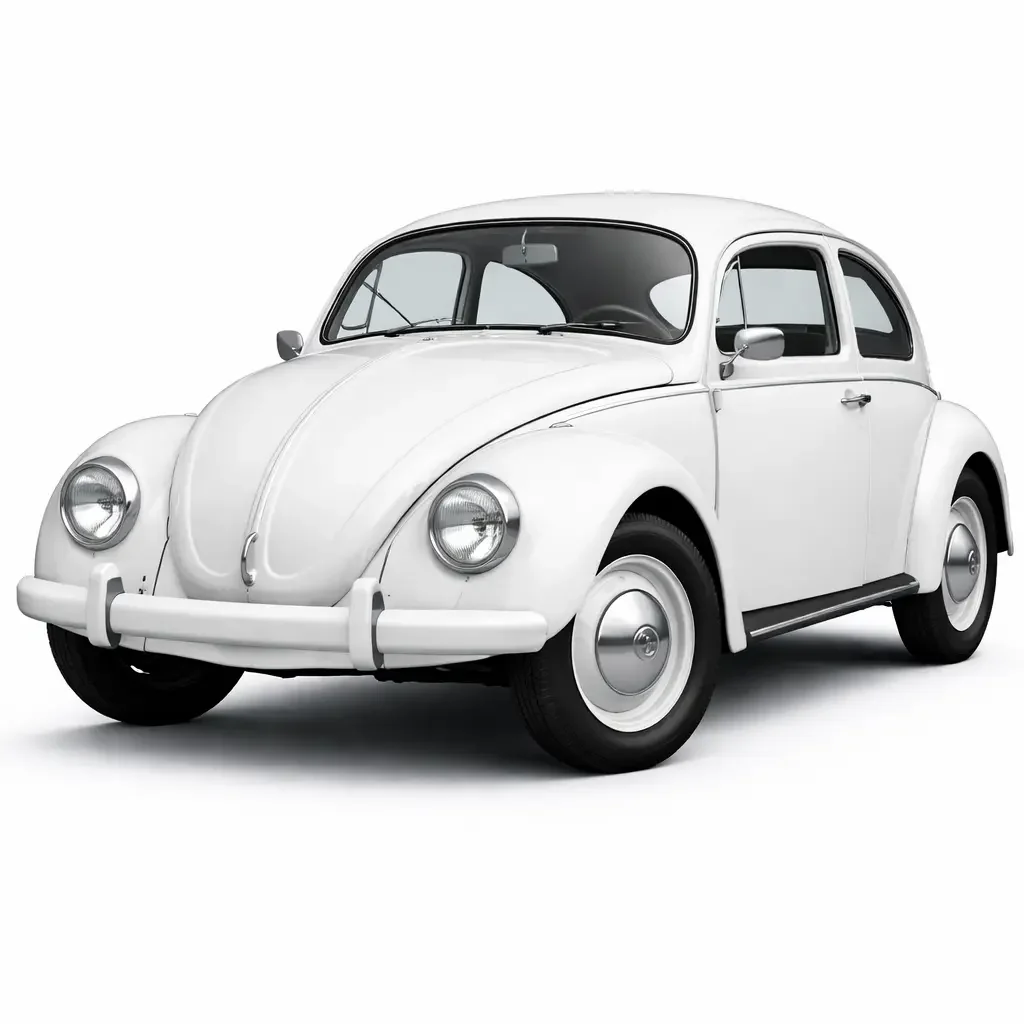
The Volkswagen Standard Beetle produced from the close of World War Two through the end of 1949 represents the foundation of the entire Type 1 production story and, by extension, the starting point for every air-cooled Volkswagen parts catalog ever written. These cars were built in a bombed-out factory under British military administration, with materials rationed and sheet steel scarce enough that the earliest roof panels had to be fabricated from two separate pieces because larger steel sheets were not available. They are the rarest and most historically significant Beetles ever produced, and their parts requirements are more distinct from the later standard Beetle family than most catalog structures acknowledge.
Official series production began on 27 December 1945 with 55 cars completed by year end. By March 1946 the Wolfsburg plant was producing approximately 1,000 units per month, almost exclusively in army green for the British occupying forces. Civilian sales began in 1946 but required ration coupons. By the end of 1946 a cumulative total of roughly 10,000 units had been built. The cars built in this period are designated internally as Type 11, a designation used until the Type 60 nomenclature from the prewar KdF-Wagen era was formally retired in favor of the Volkswagen Type 1 name.
Heinrich Nordhoff took control of the Wolfsburg plant on 1 January 1948, under British authority, and immediately began expanding production and quality. Under Nordhoff, output roughly doubled in 1948 to approximately 19,244 units compared to the 8,973 units produced in 1947. On 1 July 1949 the Export model was introduced, featuring chrome bumpers, chrome trim, hydraulic brakes on early Export units, and a higher-specification interior. This introduction of the Export model is the event that formally closes the Standard Beetle period covered by this guide: from that date forward there are two distinct Beetle product lines, and the Standard continues as a stripped-down civilian offering while the Export becomes the primary commercial product.
Ownership of the Volkswagenwerk GmbH was formally transferred to the newly constituted West German government on 8 October 1949, ending the British administration period entirely. The cars covered by this guide therefore span the complete British military administration of the factory and end precisely at the establishment of the Export model and the West German handover.
Production Context and Catalog Significance
The 1945 to 1949 Standard Beetle is not a well-served application in the modern aftermarket catalog. Total production across the five-year window is small: 1,785 units in 1945, 9,878 in 1946, 8,973 in 1947, 19,244 in 1948, and an additional volume in 1949 before the Export split. The cars did not reach North America until late 1949 at the earliest, and known US survivors are extremely rare. The restoration market for these vehicles is specialized and internationally sourced, meaning catalog accuracy matters enormously to the handful of restorers and collectors who work on them.
For a parts seller, the practical catalog question with the 1945 to 1949 Standard is knowing precisely which components are shared with the 1950s and 1960s standard Beetle production and which are unique to this early period. The answer is that the mechanical architecture is largely continuous but that several specific components changed at boundaries within and immediately following this production window, and that the absence of hydraulic brakes, the cable brake system, and the 6-volt electrical architecture create fundamental incompatibilities with later parts listings that are not always flagged in catalog entries.
The Split Rear Window and Early Body Details
The defining exterior feature of the 1945 to 1949 Standard Beetle is the vertically divided split rear window, known colloquially as the pretzel window because the thick central pillar dividing the two small panes creates a shape that collectors associate with that term. This rear window configuration was retained from the prewar KdF-Wagen design and remained in production through 1952 on the Standard, with the single-piece oval rear window introduced in March 1953 replacing it entirely.
The split rear window and its associated body structure, including the rear window frame, the central dividing pillar pressed into the body, the window seals for both panes, and the chrome surround trim where fitted, are specific to the 1945 to 1952 production period. They have no cross-reference to the later oval-window Beetle or to any subsequent Beetle body glass. A seller listing rear window glass for the 1945 to 1949 Standard must specify the split-window application and must not suggest any cross-reference to oval-window or later production.
Additional body details specific to the earliest production include the two-piece roof panel on the very first cars due to steel sheet shortages, the T-shaped exterior luggage compartment handle used from 1945 through 1949 (replaced by a different handle design at the end of this production period), pull-out exterior door handles (which continued into later production, lasting through 1959), and the license plate pressing stamped into the rear engine cover, which was present through 1949 and then dropped. The front hood had a mechanical pull-cable release and no separate lock on the bonnet handle during this period.
The taillights of the 1945 to 1949 Standard are small units mounted low on the valanced rear fenders, distinctly different from the progressively larger and repositioned taillights that characterized later Beetle evolution. The turn signals in this period are not incorporated into any fixed light cluster.
Semaphore Turn Signals (Trafficators)
The 1945 to 1949 Standard Beetle uses semaphore turn signals, also called trafficators, rather than flashing directional indicator lights. These are small illuminated orange arms that extend outward from housings mounted on the B-pillars, visible from both the front and the rear of the vehicle when deployed. They are activated by a dashboard-mounted switch. The semaphore unit includes a small bulb within the arm itself so that the extended arm is lit at night.
Semaphore signals remained the standard European turn indication method through the 1950s. The Type 1 Beetle used them through the 1957 model year in Europe, Canada, and Australia, with flashing blinker indicators introduced for North American market Beetles from 1955 onward. The 1945 to 1949 Standard therefore uses semaphores exclusively.
For catalog purposes this means: no flashing indicator lamp housing, no indicator relay, and no front or rear turn signal light fixture applies to the 1945 to 1949 Standard for its OEM turn signal system. The semaphore arm assembly, its housing, its bulb, its return spring, and the dashboard switch are the correct parts. Any listing that applies flashing indicator light components to this production period is incorrect. Sellers must not cross-reference front or rear indicator lamp assemblies from 1955 and later Beetle listings to the 1945 to 1949 Standard.
The 1131cc 25 Horsepower Engine
The 1945 to 1949 Standard Beetle uses a single engine specification: the 1131cc air-cooled horizontally opposed four-cylinder unit producing approximately 24.5 to 25 horsepower DIN at 3,000 rpm. This engine is characterized by a 75mm bore and 64mm stroke, a 5.8:1 compression ratio, a Solex 26 VFJ downdraft carburetor positioned at the center of the engine, a light alloy engine case with cast-iron cylinders, solid valve lifters, and a 6-volt electrical system with a generator rather than an alternator. The engine number series for 1945 production begins at approximately 1-077,683 and runs through 1-079,093, with 1946 production picking up at 1-079,094 through 1-090,732, continuing through subsequent years.
This 25 horsepower 1131cc specification was used continuously from the start of production in 1945 through 1954, when the engine was upgraded to 30 horsepower through enlarged 77mm pistons producing 1192cc displacement. The 1945 to 1949 Standard therefore sits within a long-running 1131cc engine production period, and many 1131cc engine service components cross broadly across the full 1945 to 1954 period. However, within this range there are incremental changes that sellers must track: the pushrod tubes received compressible ends replacing springs in 1946, the fuel tank was raised in 1946, and a grease nipple was added to the brake cables in 1946. In 1947 the rear hub bearings were reinforced, and a summer/winter flap was added to the fan housing. These year-specific changes mean that some internal engine and fuel system components have narrow-year applicability within the otherwise long-running 1131cc service pool.
The 6-volt electrical architecture of the 1945 to 1949 Standard is a fundamental catalog boundary. The starter motor, generator, voltage regulator, ignition coil, light bulbs, horn, fuse box, and all wiring loom components are 6-volt items and are not interchangeable with the 12-volt electrical components introduced on later Beetle production. Sellers must never cross-reference 12-volt electrical components to the 1945 to 1949 Standard, and any listing that does not specify voltage as a qualifier for electrical components in this application will produce incorrect parts on every order.
The gearbox is a four-speed manual unit without synchronization on any gear, requiring double-clutching for clean downshifts. The final drive ratio is 4.43:1. The unsynchronized first gear specification is a critical distinction from the later Beetle gearboxes: any gearbox component listing that specifies synchronized gears as a feature or that derives from post-1952 gearbox stock will not be applicable here. The 5.00 x 16 tire specification was standardized in 1946, replacing the earlier 4.50 x 16 size used on the very first cars.
Front Suspension: Kingpin and Trailing Arm with Torsion Bars
The 1945 to 1949 Standard Beetle uses the same front suspension architecture that Ferdinand Porsche developed for the original KdF-Wagen design and which remained in production, with incremental updates, through the entire standard Beetle family until the introduction of the ball-joint front suspension in August 1966. This is the kingpin and trailing arm front suspension with transverse torsion bars, also described in period technical documentation as double longitudinal trailing arm suspension.
Each front wheel is located by two longitudinal trailing arms, one above and one below, connected to a kingpin at the wheel end. The kingpin is the pivot on which the wheel assembly steers, and it requires lubrication at grease fittings. The front torsion bars run transversely through a tube that forms the front axle beam, providing the spring medium. A front anti-roll bar was not present on these earliest cars and was introduced later in the production evolution of the standard Beetle.
The steering on the 1945 to 1949 Standard is a worm and cap nut arrangement, also described as worm and sector steering. This is the correct steering gear designation for this period. The steering specifications note that the 1946 cars had lubrication fittings on the inner track rod joints and that these fittings were repositioned relative to their prewar location. Turn circle is approximately 37 feet.
For catalog purposes, kingpins, kingpin bushings, trailing arm bushings, torsion bar adjusters, and front wheel bearing sets for this period share a general cross-reference pool with the entire standard Beetle trailing arm front suspension family from 1945 through 1965. However, sellers must be aware that within this long production run there are incremental changes to components such as control arm bushings transitioning from plain bushings to needle roller bearings at later dates, and that the absence of a front anti-roll bar on the earliest cars means that any anti-roll bar end link or mount listing does not apply to the 1945 to 1949 Standard.
Rear Suspension: Swing Axle with Torsion Bars
The rear suspension of the 1945 to 1949 Standard Beetle is the swing axle design inherited from the prewar KdF-Wagen, using torsion bars as the spring medium and a single-joint swing axle at each rear wheel. This swing axle configuration remained in production on the standard Beetle through the entire Type 1 run in Germany and Brazil, continuing until the very last Mexican-produced standard Beetles in 2003. It is the baseline rear suspension architecture for the entire non-Super-Beetle Volkswagen Type 1 family.
The rear shock absorbers on the 1945 to 1949 Standard are single-acting units, meaning they resist only the extension stroke and offer no damping on the compression stroke. This single-acting rear shock specification remained in place through 1951. From 1952 onward the rear shocks were upgraded to double-acting units. This distinction is a catalog boundary for rear shock absorbers: the single-acting rear shocks of the 1945 to 1951 period are not the same specification as the double-acting units used on later production, and a seller listing rear shocks must apply this boundary.
The swing axle rear drums on the 1945 to 1949 Standard are the foundation of the air-cooled Volkswagen rear drum pool. As established across the other guides in this series, swing axle rear drums are specific to the swing axle hub geometry and must never be cross-referenced to the IRS stub axle rear drums of the Super Beetle (1302 and 1303), the Type 181 Thing, or any other IRS-equipped VW application. Within the swing axle drum pool, the 1945 to 1949 Standard occupies the earliest production stratum, and any drum brake component listings should confirm the hub and drum diameter specification for this exact period rather than assuming full continuity with later production.
Cable-Operated Mechanical Drum Brakes
The most commercially significant technical distinction of the 1945 to 1949 Standard Beetle, from a parts catalog perspective, is the brake system. These cars use cable-operated mechanical drum brakes at all four wheels. There is no hydraulic brake master cylinder, no wheel cylinder, no brake fluid, and no brake line on these cars. Every brake actuation force is transmitted through steel cables running from the brake pedal to the front and rear drum brake assemblies.
Hydraulic brakes were introduced on the Export model beginning approximately March 1950, becoming standard across the Export by April 1950. The Standard model continued with cable brakes after the Export's transition to hydraulics, but the 1945 to 1949 production window predates the hydraulic introduction entirely. Every car in this guide uses cable brakes. Sellers must apply this as an absolute filter: brake master cylinders, wheel cylinders, brake hoses, and brake lines do not apply to the 1945 to 1949 Standard. The applicable brake components are brake cables, cable adjusters, cable grease nipples (standardized from 1946), drum linings, drum housings, and wheel bearing assemblies at the drum hubs.
A grease nipple for lubrication of the brake cables was added as a running production change in 1946, meaning the very earliest 1945 production did not have this provision while 1946 and later Standard production did. For restorers seeking concours-correct detail, the presence or absence of the cable grease nipple fitting on the brake cable anchors is a year-specific distinction within the 1945 to 1949 range.
The four-wheel drum brake configuration uses mechanically actuated leading and trailing shoes. The drum and shoe specification established here carries forward into the later standard Beetle production, but sellers must confirm the exact drum diameter and shoe width for this early application as these dimensions were updated at various points in the production evolution. The parking brake is mechanically operated via cable to the rear drums, integrated with the main cable brake system.
Dashboard, Interior, and Convenience Features
The 1945 to 1949 Standard Beetle interior is extremely spartan, consistent with both the original KdF-Wagen design intent and the material austerity of the immediate postwar period. The dashboard is a simple metal pressing carrying a speedometer positioned to the right of the steering column and two open glove compartment recesses with no doors. The semaphore switch for turn signal activation sits on the dashboard. There is no fuel gauge: instead a reserve fuel tap is mounted on the firewall and the driver manually turns it to access approximately one gallon of reserve fuel when the main supply runs low.
The headlight and light switch configuration is basic, with the 6-volt system powering sealed-beam headlights appropriate to the period. The instrument panel layout and the switch gear of this period are specific to the early Standard and do not cross to the revised instrument panels introduced in 1953 or any subsequent Beetle dashboard redesign. Any dashboard, instrument cluster, switch, or interior trim component listing must specify the pre-1950 Standard application to avoid cross-referencing to Export or later Standard revision parts.
Early Beetle roof sections, particularly from 1945 production, were fabricated from two pieces of steel welded at the centerline because larger sheet steel was not available in the immediate postwar period. This two-piece roof construction is a production expedient specific to the earliest cars and is not relevant to any aftermarket component listing, but restorers seeking absolute period correctness are aware of it and sellers should be knowledgeable about it when fielding detailed restoration inquiries.
The steering wheel uses a Wolfsburg crest badge. The 5.00 x 16 tire size standardized in 1946 means that 16-inch wheel components apply to this production from 1946 onward. The 1945 cars used 4.50 x 16 tires. The wheel diameter change to 15 inches from 16 inches occurred in 1952 and is well outside this production window.
Chassis Numbers and Production Year Identification
The 1945 to 1949 Standard Beetle uses a chassis numbering system that allows year identification with reasonable precision. The production dates and chassis ranges documented for this period are as follows: 1945 production covers chassis numbers 1-052,000 through 1-053,814 with engine numbers 1-077,683 through 1-079,093. The 1946 production year runs from chassis 1-053,815 through 1-063,796 with engine numbers 1-079,094 through 1-090,732. The 1947 year covers chassis 1-063,797 through 1-072,743 with engine numbers 1-090,733 through 1-100,788. The 1948 year runs from chassis 072,744 through 091,921 with engine numbers 100,789 through 122,649.
These chassis number ranges are the authoritative method for confirming production year within the 1945 to 1949 Standard. Sellers and restorers who need to confirm which year-specific running changes apply to a particular vehicle must locate the chassis number stamped in two locations: in the front luggage compartment near the bonnet lock, and on the central tunnel under the rear seat. Engine number stamping location is on the engine case at the generator support flange. Cross-referencing chassis and engine numbers against the known production ranges confirms the production year and therefore which of the incremental running changes are applicable to a specific vehicle.
Common ACES/PIES Catalog Mistakes for the 1945 to 1949 Standard Beetle
1. Listing hydraulic brake master cylinders, wheel cylinders, brake hoses, or brake lines as applicable to the 1945 to 1949 Standard. These cars use cable-operated mechanical brakes exclusively. There are no hydraulic brake components on any car in this production window.
2. Applying 12-volt electrical components to the 1945 to 1949 Standard. This application is a 6-volt system throughout. Starter motors, generators, ignition coils, light bulbs, relays, and wiring loom sections from later 12-volt Beetle production are electrically incompatible.
3. Listing flashing directional indicator lamp assemblies, relay units, or front and rear blinker housings as applicable to the 1945 to 1949 Standard. These cars use semaphore turn signals. There are no flashing indicator lamp circuits, housings, or bulbs in this application.
4. Cross-referencing single-piece oval rear window glass or later split rear window replacement glass to the 1945 to 1949 Standard without confirming the exact two-pane split window specification. The split pretzel window is specific to this and the early 1950s production period, and the window, its seals, and its surround trim must be listed as split-window specific with no cross-reference to oval or later glass.
5. Applying double-acting rear shock absorbers to the 1945 to 1949 Standard. Rear shocks for this period are single-acting units. Double-acting rear shocks were introduced from 1952 onward. Any rear shock absorber listing for this application must specify single-acting specification.
6. Not distinguishing the unsynchronized four-speed gearbox of the 1945 to 1949 Standard from synchronized gearboxes introduced on later Beetle production. Gearbox internal components are not shared between unsynchronized and synchronized gear sets.
7. Applying anti-roll bar end links, bushings, or anti-roll bar mount hardware to the front suspension of the 1945 to 1949 Standard. A front anti-roll bar was not fitted to these earliest cars. Any front suspension anti-roll bar component listing does not apply to this production window.
8. Listing the rear deck lid license plate pressing as a separate body component applicable through 1949. The license plate indentation stamped into the rear engine cover was a feature through 1949 and then dropped. Any rear deck lid listing for the period after 1949 should note this change, and replacement deck lids for the 1945 to 1949 Standard must carry this pressing.
9. Applying the Export model brake system, trim, or interior components to the 1945 to 1949 Standard. The Export model introduced 1 July 1949 has chrome bumpers, chrome trim, and hydraulic brakes on its earliest units and is a different product line from the Standard. The two models coexist from July 1949 onward and must be distinguished in all listings covering 1949 Beetle production.
10. Treating the 1945 to 1949 Standard as a single undifferentiated application without tracking the running production changes within the period. The pushrod tube end change of 1946, the tire size change of 1946, the rear hub bearing reinforcement of 1947, and other incremental changes create year-specific distinctions within this five-year window that affect the accuracy of engine, suspension, and brake cable component listings.
Catalog Checklist for the 1945 to 1949 Standard Beetle
• Confirm cable brake system as the exclusive brake architecture for all 1945 to 1949 Standard production; exclude all hydraulic brake master cylinder, wheel cylinder, hose, and line listings from this application
• Confirm 6-volt electrical system for all electrical component listings; exclude all 12-volt starter, generator, ignition coil, light bulb, and wiring loom components from this application
• Confirm semaphore turn signal system for all turn signal component listings; exclude all flashing indicator lamp housings, bulbs, and relay units from this application
• Confirm split two-pane pretzel rear window specification for all rear glass, seal, and surround trim listings; exclude oval and later rear window glass from this application
• Confirm single-acting rear shock absorber specification for all rear shock listings through this production period; double-acting shocks apply from 1952 onward
• Confirm unsynchronized four-speed gearbox for all transmission component listings; synchronized gear components from later production do not apply
• Confirm absence of front anti-roll bar for all front suspension component listings in this period; front anti-roll bar hardware does not apply
• Apply chassis number range lookup to confirm production year when determining which incremental running changes apply to a specific vehicle
• Distinguish the 1949 Standard from the 1949 Export at the 1 July 1949 introduction of the Export model; the two lines coexist from that date and require separate catalog entries
• Apply the broad 1131cc 25-horsepower engine service part pool to consumable and maintenance components, confirming that items spanning 1945 to 1954 are applicable while tracking year-specific sub-changes to pushrod tubes, carburetor specification, and fan housing within this pool
Final Take
The 1945 to 1949 Standard Beetle occupies a unique position in the Type 1 catalog story. It is the car that established the entire Volkswagen production identity, built in the worst possible industrial conditions by a workforce that had survived the war with the factory they worked in still largely in ruins around them. The parts catalog for these vehicles is correspondingly elemental: no hydraulics, no synchronization, no 12-volt systems, no flashing indicators, no anti-roll bar. What the car has is the core Porsche-designed mechanical architecture in its purest postwar form.
The brake system is where sellers most reliably create problems with these cars. The transition from cable to hydraulic brakes happened after this production window closes, and any catalog structure that does not enforce that boundary as an absolute filter will direct hydraulic parts to cable-brake cars on a regular basis. The 6-volt electrical boundary is the second most consequential distinction, as the later 12-volt service parts are completely incompatible and widely available, making incorrect 12-volt parts the default result of any ambiguous catalog entry in this application.
The split rear window, semaphore signals, and single-acting rear shocks are the characteristic details that define these cars visually and technically to collectors and restorers. A seller who catalogs them as discreet application-specific items, rather than as variations within a general Beetle pool, will serve the small but highly knowledgeable community that restores and maintains these vehicles with the accuracy that the application demands. These are not cars that tolerate approximate parts matching.
Disclaimer: This guide is based on publicly available specifications, manufacturer documentation, and independent research. Part interchangeability should always be confirmed via chassis number, production date stamp, and OEM part number lookup. Specifications may vary by exact production date within a year. This document does not constitute official Volkswagen parts catalog data.