
Written by Arthur Simitian | PartsAdvisory
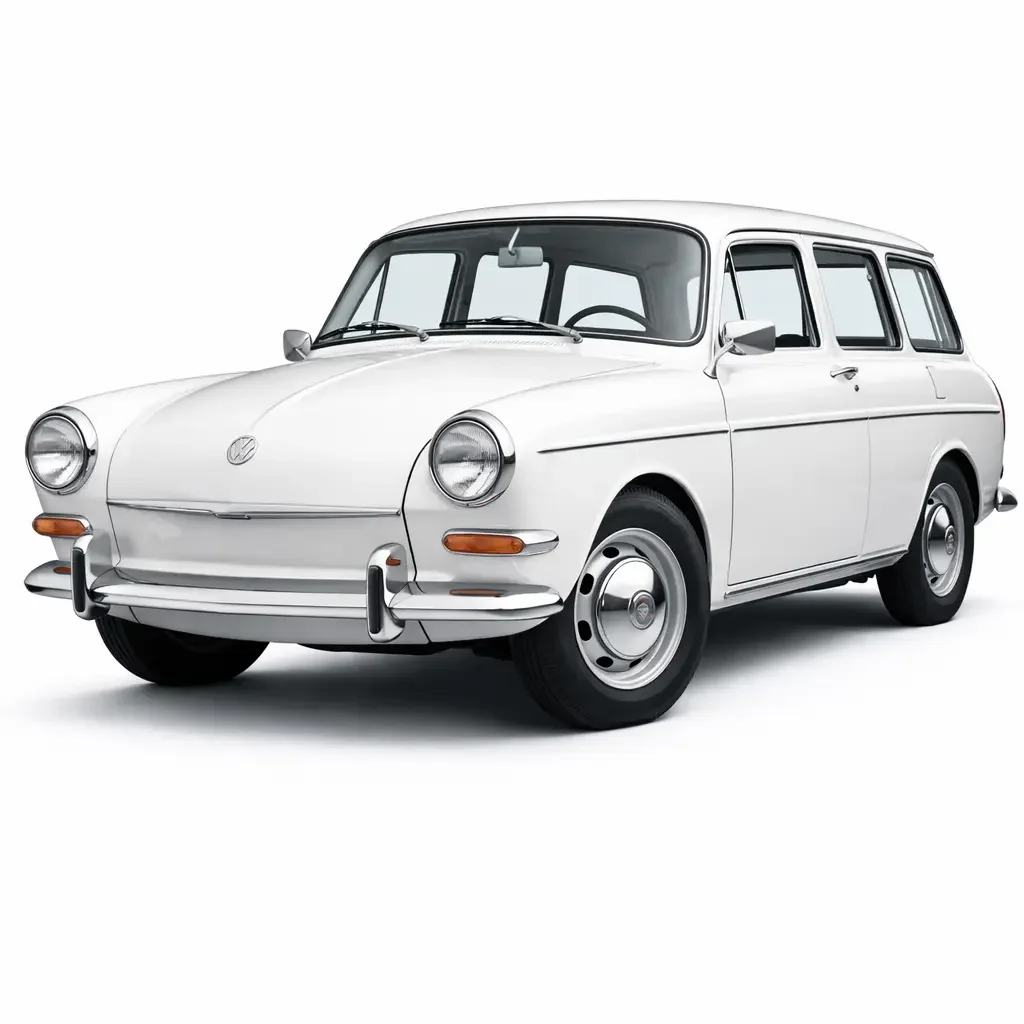
The Volkswagen Type 3 Squareback occupies a unique commercial position in the air-cooled Volkswagen aftermarket. It is a direct evolutionary descendant of the Beetle platform in terms of suspension geometry and basic mechanical DNA, yet it diverges from the Type 1 in ways that create persistent catalog errors when sellers treat the two as interchangeable applications. The Type 3 uses an entirely different engine cooling architecture, a different front suspension variant, a different transmission ratio set, a different fuel system progression culminating in the world's first production electronic fuel injection, and a rear suspension that transitioned through two distinct configurations within the 1966 to 1969 production window covered by this guide.
Volkswagen of America began official importation of the Type 3 for the 1966 model year, bringing in only the Squareback and Fastback variants. The Notchback was never officially imported to the United States, and the Type 34 Karmann Ghia based on the Type 3 platform was likewise never offered in the US market. For a parts seller covering the North American air-cooled VW market, the Type 3 Squareback is therefore the dominant Type 3 application. It was sold continuously through 1973 in the US and remains the most commonly encountered Type 3 body style in the North American restoration and maintenance market today.
The four-year window from 1966 to 1969 is the most mechanically eventful in the Squareback's US production history. Within these four model years: the 1600cc engine replaced the earlier 1493cc unit, front disc brakes became standard, the electrical system transitioned from 6-volt to 12-volt, dual-circuit brakes replaced the single-circuit system, the world's first volume-production electronic fuel injection was introduced, and the rear suspension architecture changed from the swing axle configuration to a double-jointed CV semi-trailing arm design. Each of these changes creates a catalog boundary that sellers must manage at the model-year level.
The Type 3 Platform and the Suitcase Engine
The Type 3 shares its basic mechanical DNA with the Type 1 Beetle but represents a distinct platform with one defining engineering departure: the cooling fan is driven from the end of the crankshaft rather than from the generator shaft. On the Type 1, the cooling fan sits atop the engine, driven by a belt from the generator. This arrangement makes the Type 1 engine relatively tall and positions the spare tire diagonally in the front compartment. On the Type 3, relocating the fan to the crankshaft end reduces the engine profile dramatically, allowing the unit to fit entirely beneath the floor of the rear cargo area under an access panel. The engine is therefore invisible to anyone opening the rear gate, a layout that Volkswagen promoted actively in US advertising.
This fan relocation creates a complete incompatibility between Type 3 and Type 1 engine cooling components. The Type 3 engine tin, fan shroud, fan housing, and related cooling air ducting are engineered to the crankshaft-driven fan geometry and are specific to the Type 3. Type 1 fan shrouds, cooling tins, and fan housings do not fit the Type 3. Conversely, the Type 3 cooling system components have no application on the Type 1. A seller who lists Type 3 cooling tin or fan shroud must apply the Type 3 designation as an absolute qualifier and must not suggest any cross-reference to Type 1 Beetle applications.
The engine and transmission assembly on the Type 3 is mounted as a complete unit into a dedicated rear subframe, which also houses the rear suspension. The subframe is rubber-mounted to the floor pan, providing a degree of vibration isolation that the Type 1's direct body mount does not offer. The transmission uses higher gear ratios than the Type 1, with a 4.125:1 ring and pinion ratio compared to the Beetle's 4.375:1, and longer rear axle shafts to account for the wider rear track. These differences mean that Type 1 gearbox components, ring and pinion sets, and axle shafts are not interchangeable with their Type 3 counterparts despite sharing a superficially similar architecture.
The long block architecture of the Type 3 engine shares its basic cylinder, piston, valve, and pushrod geometry with the Type 1 engine family, meaning that many internal engine service components do cross between the two platforms. Spark plugs, valve cover gaskets, pushrod tube seals, piston rings for a given bore size, and carburetor jets for the same carburetor model can apply across both. Sellers must be careful to distinguish the long block service parts pool, where Type 1 and Type 3 cross-reference is valid, from the cooling system and external engine component pool, where it is not.
Squareback, Fastback, and Notchback: Body Variant Distinctions
The Type 3 platform supports three body styles that are sold under distinct names in different markets. In the United States, the estate or shooting-brake body is called the Squareback, while in European markets it is called the Variant. The fastback coupe body is called the Fastback in the US and the TL in European nomenclature. The three-box sedan body is the Notchback in both markets, though as noted it was never officially sold in the US.
The Squareback body style is characterized by its tall roofline extending over the rear cargo area, a rear gate with a paddle-style exterior handle, large rear quarter glass panels, and a panoramic rear window providing good visibility into the cargo area. The roofline, rear bodywork, rear gate, rear glass, and rear hatch seal are all Squareback-specific body components with no cross-reference to the Fastback or Notchback. The Fastback uses a sloping fastback roofline that runs from the roof peak down to the tail, a completely different rear glass shape, and different rear body panels. The two body styles ride on the same floor pan and share the same mechanical components beneath the body, but they have no exchangeable glass, no exchangeable rear body panels, and no exchangeable rear interior trim.
For parts sellers, the body style is therefore the primary qualifier for all glass, seals, body panels, rear interior trim, and rear cargo area components. Listings for rear window glass must specify Squareback or Fastback. Rear body seals must specify body style. Rear gate hardware, including the paddle handle specific to the Squareback, must specify the Squareback application. Any listing that presents body-specific components as applying broadly to the Type 3 without a body style qualifier will generate incorrect orders from Fastback owners purchasing Squareback items and vice versa.
1966 Model Year: US Market Introduction and Key Specifications
The 1966 model year marks the formal beginning of the North American Type 3 Squareback catalog story. The 1966 Squareback arrived in the US with the 1584cc dual-carburetor engine producing 65 gross horsepower, making it the most powerful Volkswagen offered in the US market at that time. The engine uses twin downdraft carburetors, high-compression domed pistons at 8.5:1 compression ratio, and the crankshaft-driven fan cooling architecture described above. This 1600cc engine replaced the earlier 1493cc unit that had been available on European and pre-US-import Type 3 production.
Front brakes on the 1966 Squareback are disc units, a significant advance over the earlier Type 3 production that used twin leading shoe drum brakes at the front. The disc brake introduction coincided with the 1966 model year and the 1600cc engine introduction for all markets except Australia, where drum front brakes were retained until August 1967. For the North American market, all 1966 and later Squarebacks have front disc brakes as standard. The front disc caliper, front rotor, and front brake pad specification for the 1966 to 1969 Squareback are Type 3 specific and must be listed separately from the Type 1 Beetle drum-front brake pool.
The 1966 Squareback uses a 6-volt electrical system, the same architecture as the Type 1 Beetle of the same era. This is the last year of 6-volt electrical architecture for the Type 3 in the US market. The starter motor, generator, ignition coil, and all light bulbs are 6-volt items in 1966. The transition to 12-volt electrical architecture occurs for the 1967 model year. A seller must apply the 6-volt qualifier to all 1966 electrical component listings and the 12-volt qualifier to all 1967 and later listings. Presenting a single electrical component listing as spanning the full 1966 to 1969 range without a voltage qualifier will produce incorrect parts on either end of the range.
The front suspension on the 1966 Squareback uses ball joints rather than the kingpin and link-pin arrangement used on the early Type 1 Beetle. Ball-joint front suspension was introduced on the Type 1 Beetle for the 1966 model year as well, so both vehicles transitioned simultaneously. The Type 3 ball-joint geometry uses transverse round torsion bars cross-mounted in the lower front beam tube, with an anti-roll bar running through the upper tube connecting the upper trailing links. This torsion bar arrangement is distinct from the Type 1's torsion leaf design even though both use torsion-based front springing. Front ball joints, control arm bushings, and front beam components are Type 3 specific and must not be cross-referenced to Type 1 front suspension items.
Wheel lug pattern on the 1966 Squareback is a 4-bolt pattern, a change from the 5-bolt 205mm PCD used on earlier Type 3 production. The 1966 model year introduced 4-lug wheels simultaneously with the front disc brakes. Any wheel, wheel bearing, or hub component listing for the 1966 to 1969 Squareback must specify the 4-bolt pattern.
1967 Model Year: 12-Volt Electrics, Dual-Circuit Brakes, and US Safety Compliance
The 1967 model year introduces the most consequential catalog boundary within the 1966 to 1969 window, because it combines a voltage architecture change with a brake system architecture change and a package of US federal safety compliance upgrades that affect multiple component categories simultaneously.
The transition from 6-volt to 12-volt electrical architecture means that every electrical component on the 1967 Squareback is incompatible with its 1966 predecessor and with the 1966 Type 1 Beetle. The starter motor, generator, voltage regulator, ignition coil, all dashboard and instrument lighting bulbs, exterior light bulbs, horn, and wiring loom are 12-volt items from 1967 onward. Any seller covering both 1966 and 1967 Type 3 Squareback applications must split all electrical component listings at this boundary. Presenting a combined 1966 to 1969 electrical listing without a voltage qualifier is a catalog error that will direct 6-volt parts to 12-volt cars or vice versa on every order.
The brake system on the 1967 Squareback transitions from a single-circuit hydraulic system to a dual-circuit system with a dual-outlet master cylinder. The dual-circuit design provides a backup braking capability: if one brake circuit fails, the other circuit retains braking function at two wheels. The master cylinder for the dual-circuit system has two separate hydraulic chambers and two outlet ports, making it fundamentally different from the single-circuit master cylinder it replaces. Brake master cylinders, brake lines from the master cylinder to the distribution points, and the brake proportioning arrangement are different between 1966 single-circuit and 1967 dual-circuit applications. A seller must apply a 1966 single-circuit versus 1967 and later dual-circuit qualifier to all master cylinder and primary brake line listings.
Additional changes introduced for the 1967 model year in response to US safety requirements include: a padded dashboard, a safety steering column designed to collapse in a frontal impact, trigger-style exterior door handles replacing the earlier twist pull type, two-speed windshield wipers with longer 15-inch blades, flexible plastic knobs on switches and vent-wing catches, front seatback release knobs, and a backup light integrated into the rear bumper. The dual-port cylinder heads also appear in 1967. These changes affect dashboard components, steering column specification, door handle specification, and wiper mechanism specification. A comprehensive parts listing for the 1966 versus 1967 Squareback must apply model year qualifiers across all of these component categories.
1968 Model Year: D-Jetronic Fuel Injection and CV-Joint Rear Suspension
The 1968 model year introduces two changes that create the most technically significant catalog boundaries within the entire 1966 to 1969 Squareback production window. First, the Bosch D-Jetronic electronic fuel injection system becomes available, making the Type 3 the first volume-production vehicle in the world equipped with this technology. Second, the rear suspension is upgraded to a double-jointed CV semi-trailing arm design available in conjunction with the automatic transmission from mid-year 1968, replacing the earlier swing axle configuration on those vehicles.
The D-Jetronic system is offered on the TE and LE trim variants of the Type 3, with the E suffix indicating Einspritzung, the German word for injection. The 1600 TE and LE Squareback with D-Jetronic injection is one of the rarest and most technically demanding Type 3 applications in the catalog. The fuel injection system includes a Bosch electronic control unit, manifold pressure sensors, throttle position sensors, fuel injectors, a fuel pump of higher pressure specification than the carburetor fuel pump, a fuel pressure regulator, and an injection wiring harness. None of these components cross to the carbureted 1600cc application. A seller must apply a carburetor versus fuel injection qualifier to all fuel system, fuel delivery, and engine management component listings for the 1968 and 1969 Squareback.
The carbureted 1968 Squareback retains the twin-carburetor 1600cc engine with no fundamental fuel system change, but receives a package of detail changes: integrated door handle and lock replacing the earlier separate units, small chrome rear reflectors, a return to bullet-style front turn signal lenses reversing a previous style change, high-back seat designs, revised dash knobs and vent-wing locks, revised front armrests, and a redesigned license plate light on the Squareback specifically. The fuel filler was moved from the front trunk to the right front fender, a change that affects the filler neck, cap, fender-mounted surround, and associated fuel line routing. This filler location change is significant for all fuel filler and related listings: pre-1968 Squareback listings apply to the front-trunk filler location, while 1968 and later apply to the fender-mounted location.
The rear suspension change introduced mid-year 1968 with the automatic transmission option moves from the swing axle design to a double-jointed CV semi-trailing arm arrangement. The swing axle design had been the rear suspension architecture for all Type 3 production since the model's introduction in 1961, and it continued to be used on manual transmission Type 3 models through the 1968 model year. The CV-joint rear suspension uses completely different axle shafts with two CV joints per side, different rear trailing arms, different hub carriers, and a different rear differential engagement geometry. The CV-joint rear axle shafts and associated hub bearings are not interchangeable with the swing axle components. A seller listing rear axle shafts, rear CV boots, rear wheel bearings, or rear hub seals for the 1968 Squareback must apply a swing axle versus double-joint qualifier.
1969 Model Year: CV Rear Suspension Standardized Across the Lineup
For the 1969 model year the double-jointed CV semi-trailing arm rear suspension becomes standard across all Type 3 production with both manual and automatic transmissions. The swing axle rear suspension is no longer standard for the North American market 1969 Squareback, though it remained available for some export markets with poorer road conditions. From 1969 onward every North American Squareback uses the CV-jointed rear suspension, meaning that all rear axle shaft, rear CV boot, rear wheel bearing, and rear hub seal listings for the 1969 Squareback reference the double-joint specification.
Additional 1969 changes include: rear window defrost becoming standard equipment, and the addition of an interior release handle for the fuel filler flap, replacing the non-lockable exterior finger-hole used in 1968. The VIN plate location also changes for 1969 production, moving from behind the spare tire (pre-1969 location) to the door jamb and dashboard as well. The chassis number identification method is therefore different between pre-1969 and 1969 Squareback production, and any chassis-number-based parts lookup must account for this location change.
The 1969 model year also sees the automatic transmission become available in conjunction with the D-Jetronic fuel injection engine, an option that was not available in 1968 when the automatic was paired only with the dual-carburetor engine. The combination of automatic transmission and fuel injection creates a specific powertrain variant with its own parts requirements distinct from both the manual fuel injection car and the automatic carbureted car. Sellers covering the 1969 Squareback must distinguish among the manual carburetor, manual fuel injection, automatic carburetor, and automatic fuel injection powertrain configurations when listing fuel system, transmission, and associated driveline components.
Rear Suspension Architecture Summary and Cross-Reference Rules
The rear suspension transition across the 1966 to 1969 Squareback production window is one of the most error-prone catalog areas for this application. A clear summary of the applicable suspension architecture by model year helps structure accurate listings.
For 1966 and 1967, all North American Squareback production uses swing axle rear suspension. The swing axle uses a single-joint axle shaft that pivots at the differential and locates the rear wheel through a trailing arm and torsion bar arrangement. Swing axle rear axle shafts, rear drums, rear wheel bearings, and rear seals for the Type 3 share a cross-reference pool with other Type 3 swing axle production but must not be cross-referenced to Type 1 swing axle components, as the Type 3 uses longer axle shafts and different hub specifications to accommodate its wider rear track.
For 1968, the production splits mid-year. Squarebacks built with the manual transmission continue to use the swing axle through the 1968 model year. Squarebacks built with the automatic transmission from mid-1968 use the double-jointed CV semi-trailing arm rear suspension. This transmission-dependent suspension split within a single model year is the most acute catalog risk in the entire 1966 to 1969 Squareback range. A seller listing rear axle components for the 1968 Squareback without confirming transmission type will be producing incorrect parts for a meaningful proportion of orders.
For 1969, all North American production uses the double-jointed CV rear suspension regardless of transmission. The 1969 Squareback rear axle shaft, CV boots, CV joints, rear hub bearings, and associated seals reference the double-joint specification. These components cross to the 1969 Type 3 Fastback with the same rear suspension, but they do not cross to the 1966 or 1967 Squareback's swing axle specification.
Engine Component Cross-Reference: What Crosses and What Does Not
The relationship between the Type 3 and Type 1 long-block engine families is one of the most commercially important cross-reference questions in the air-cooled VW aftermarket, and it is also one of the most misunderstood. The answer is nuanced: the internal long-block components share significant interchangeability, while the external cooling system components share none.
Components that cross between the Type 3 1600cc and Type 1 1600cc engine families include: pistons and cylinders for a given bore size, piston rings, cylinder head gaskets, pushrod tube seals, valve springs, valve cover gaskets, rocker arm assemblies, carburetor jets and needle valves for the same carburetor model (Solex or Weber), oil pressure sender specifications, spark plug specifications, and ignition contact point sets for the same distributor type. These long-block consumables and maintenance items can be sourced from the same supply pool across both platforms, and cross-reference listings are valid.
Components that do not cross between Type 3 and Type 1 include: fan shrouds, cooling tins, engine tin panels, fan housings, fan blades (the Type 3 fan is integrated differently due to crankshaft drive), generator pedestal and mounting geometry, oil cooler housing and mounting geometry, exhaust manifolds (the Type 3 engine has different cylinder orientation relative to the exhaust exit points), and the engine subframe mounts. These are Type 3 specific items. Any seller who cross-references Type 1 cooling tin or fan shroud to the Type 3 will generate parts returns on every order in that category.
Common ACES/PIES Catalog Mistakes for the Type 3 Squareback (1966 to 1969)
1. Listing Type 1 Beetle fan shrouds, cooling tins, and engine cooling tin panels as applicable to the Type 3 Squareback. The Type 3 crankshaft-driven fan requires entirely different cooling architecture. No Type 1 cooling system external component applies to the Type 3.
2. Not applying a 6-volt versus 12-volt qualifier to electrical component listings. The 1966 Squareback is 6-volt; 1967 and later are 12-volt. Starter motors, generators, ignition coils, bulbs, and wiring harnesses must carry this year-dependent voltage qualifier.
3. Not applying a single-circuit versus dual-circuit qualifier to brake master cylinder and primary brake line listings. The 1966 Squareback uses a single-circuit master cylinder; 1967 and later use a dual-circuit master cylinder with two chambers and two outlet ports. These are not interchangeable.
4. Applying Squareback body components to the Fastback or vice versa. The rear window glass, rear gate, rear gate seal, rear quarter glass, rear interior trim, and rear body panels are body-style specific and have no cross-reference between the two body styles despite sharing the same floor pan.
5. Not applying a carburetor versus D-Jetronic fuel injection qualifier to fuel system, fuel pump, and fuel delivery component listings for 1968 and 1969. The D-Jetronic fuel pump, injectors, pressure regulator, and control unit are entirely distinct from the dual-carburetor fuel system and must be listed separately.
6. Applying a single rear axle shaft listing to the full 1966 to 1969 Squareback production range without applying the swing axle versus double-jointed CV suspension qualifier. The 1966 and 1967 models use swing axle shafts; 1968 manual transmission models use swing axles and 1968 automatic transmission models use CV-jointed shafts; 1969 models all use CV-jointed shafts. A single undifferentiated listing will be wrong for a large proportion of orders.
7. Cross-referencing Type 3 rear axle shafts to Type 1 Beetle swing axle shafts. The Type 3 uses longer rear axle shafts to accommodate its wider rear track, and the differential housing engagement geometry differs. These are not interchangeable with Type 1 swing axle components despite similar design principles.
8. Not applying the front trunk versus right fender fuel filler location qualifier to fuel filler cap, filler neck, and filler surround listings. Pre-1968 Squareback fuel filler is in the front trunk; 1968 and later is on the right front fender. These require different components.
9. Applying Type 1 front suspension components to the Type 3 ball-joint front suspension. The Type 3 torsion bar arrangement is a transverse round torsion bar design cross-mounted in the lower beam tube, distinct from the Type 1's torsion leaf system. Front ball joints, front beam components, and front torsion bar adjusters are Type 3 specific.
10. Not distinguishing the 1966 pre-safety-update Squareback from the 1967 post-safety-update Squareback for dashboard, steering column, door handle, and wiper system component listings. The 1967 safety package introduced padded dash, collapsible steering column, trigger door handles, and two-speed wipers. These are not interchangeable with 1966 components in the same categories.
Catalog Checklist for the Type 3 Squareback (1966 to 1969)
• Apply body style (Squareback versus Fastback) as the primary qualifier for all rear glass, rear body panels, rear gate, rear gate seal, and rear interior trim listings; these do not cross between body styles
• Confirm engine cooling components as Type 3 specific for all fan shroud, cooling tin, and fan housing listings; exclude all Type 1 cooling system external components from Type 3 applications
• Apply 6-volt qualifier to all 1966 electrical component listings and 12-volt qualifier to all 1967 through 1969 listings; never present a combined voltage listing across this boundary
• Apply single-circuit qualifier to 1966 brake master cylinder listings and dual-circuit qualifier to 1967 through 1969 listings; these are fundamentally different master cylinder architectures
• Apply carburetor qualifier to all fuel system listings for 1966 through 1967 carbureted applications; apply D-Jetronic fuel injection qualifier to all 1968 and 1969 fuel system listings for the injected application, distinguishing fuel pump, injectors, pressure regulator, and ECU from carburetor system components
• Apply swing axle qualifier to rear suspension and driveline listings for 1966 and 1967, and for 1968 manual transmission Squarebacks; apply double-joint CV qualifier to rear suspension listings for 1968 automatic transmission Squarebacks and all 1969 production
• Confirm transmission type (manual versus automatic) as a required qualifier for all 1968 rear suspension and driveline component listings due to the mid-year suspension split by transmission type
• Apply front trunk filler location qualifier to fuel filler and related listings for 1966 and 1967; apply right fender filler location qualifier for 1968 and 1969
• Use VIN-based production date confirmation for all 1968 Squareback rear suspension orders; title year may reflect dealer inventory year rather than production year, creating misidentification risk
• Apply Type 3 specific qualifier to all transmission ring and pinion, rear axle shaft, and gearbox component listings; do not cross-reference to Type 1 gearbox components despite architectural similarity
Final Take
The Type 3 Squareback is the air-cooled Volkswagen application that most consistently falls into the gap between two catalog structures: sellers who treat it as a Beetle variant and apply Type 1 parts pools, and sellers who list it as a monolithic 1966 to 1969 entity without applying the significant year-by-year changes that transform the car across those four model years. Both approaches generate returns.
The engine cooling architecture is the most persistent source of cross-reference error. The suitcase engine's crankshaft-driven fan is not a cosmetic difference from the Type 1's generator-driven fan, it is a fundamental engineering departure that makes every piece of engine tin and cooling system hardware exclusive to the Type 3. A seller who builds their Type 3 catalog on the assumption that the long-block parts pool extends to cooling components will produce incorrect parts on those categories every time.
The rear suspension split at 1968 is the second most commercially consequential catalog issue, because it is transmission-dependent within a single model year. No other boundary in this production window requires the seller to know both the year and the transmission type before serving a rear driveline component. The 1969 full standardization of the CV rear suspension resolves the split for that year, but any catalog structure that does not enforce the mid-year 1968 transmission qualifier will generate rear axle mismatches on a predictable share of 1968 Squareback orders.
For sellers who invest in accurate year-by-year qualification across the 1966 to 1969 Squareback, the reward is access to a restoration and maintenance market that is underserved precisely because accurate catalog entries for this application are uncommon. The Squareback is not a high-volume daily-driver application, but its buyers are technically informed, restoration-focused, and willing to pay premium prices for correctly identified parts. Catalog accuracy in this application is a direct commercial differentiator.
Disclaimer: This guide is based on publicly available specifications, manufacturer documentation, and independent research. Part interchangeability should always be confirmed via VIN, production date stamp, and OEM part number lookup. Specifications may vary by trim level and market. Title year on US vehicles may not reflect production year due to dealer inventory practices; always use chassis number for production date confirmation. This document does not constitute official Volkswagen parts catalog data.