
Written by Arthur Simitian | PartsAdvisory
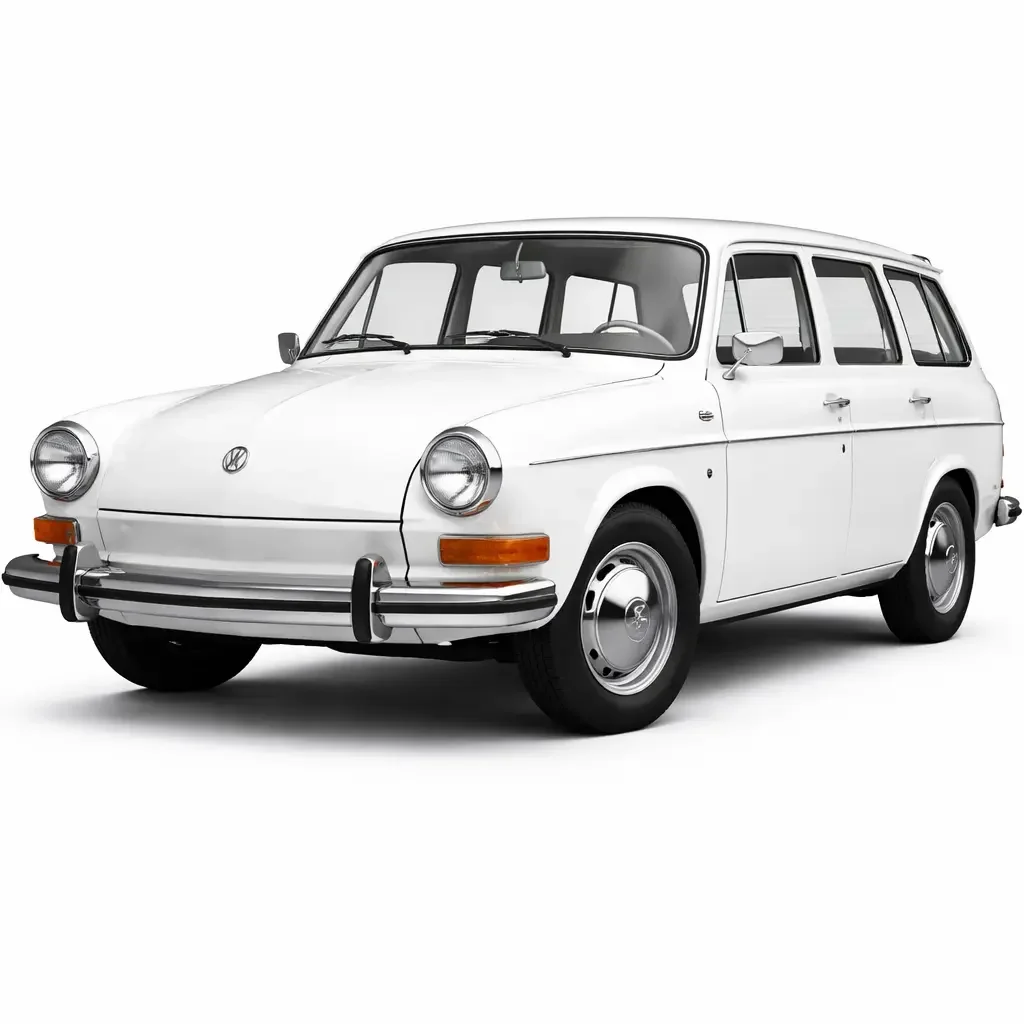
The 1970 to 1973 Volkswagen Type 3 Squareback is the final chapter of the Type 3 story in the United States and, for the aftermarket catalog, the most technically settled period of the car's American life. The major mechanical revolutions that defined the 1966 to 1969 window are behind it: the shift to 12-volt electrics happened in 1967, the Bosch D-Jetronic fuel injection became standard for all US market cars in 1968, and the double-jointed CV semi-trailing arm rear suspension was standardized across all transmissions for 1969. What the 1970 to 1973 window brings is a significant exterior facelift, a series of interior and brake detail refinements, and the final production run of an application that closed with no direct successor when the Wolfsburg line stopped in July 1973.
For parts sellers the 1970 to 1973 Squareback carries forward the catalog structure established in the prior guide with one major addition: the 1970 facelift creates a hard body component split from the pre-1970 production. Front hood, front bumper, front turn signals, rear tail lights, and several associated body trim items changed at the 1970 model year boundary and do not cross to the 1966 to 1969 cars. Within the 1970 to 1973 window there are further year-specific refinements at 1971 and 1972 that affect brake caliper specification, dashboard layout, and exterior trim details. And the D-Jetronic fuel injection system, now the universal US market fuel system for this window, requires its own service parts logic that is entirely separate from the carbureted applications sold in other markets during the same years.
This guide covers the 1970 facelift and its body component implications, the D-Jetronic system as the baseline US fuel system for all four years, the year-specific changes within the window, the automatic transmission application, and the complete ACES/PIES catalog error set for the final US Squareback production run.
The 1970 Facelift: New Front End, New Bumpers, New Tail Lights
The 1970 model year introduced the most significant exterior change in the Type 3 Squareback's US production history since its 1966 introduction. The front end was completely redesigned with the nose extended by 115 millimeters, adding approximately 1.5 cubic feet of additional front luggage capacity. This nose extension required a new front hood panel, a new front valance, new front fender tips, and new front bumper mounting geometry. The front bumpers changed from the rounded overrider style of the 1966 to 1969 cars to a squared-off cross-section profile, a design direction consistent with the safety bumper aesthetics of the early 1970s.
The front turn signal lenses were enlarged and repositioned as part of the facelift. At the rear, the tail lights were revised with larger housings that integrated the rear reflectors directly into the tail light cluster, replacing the separate small chrome rear reflectors fitted to the 1968 and 1969 cars. The rear bumper likewise received the squared-off profile matching the new front unit.
For parts catalog purposes, the 1970 facelift creates a clean break for all front and rear exterior body components. The front hood, front bumper, front bumper brackets, front valance, front turn signal lenses and housings, rear tail light clusters, rear bumper, and rear bumper brackets are all 1970 and later specific items that do not cross to the 1966 to 1969 production. Conversely, pre-1970 front and rear exterior trim has no application on the 1970 to 1973 cars. Sellers must apply a pre-1970 versus 1970 and later qualifier to every front and rear exterior trim listing in the Type 3 Squareback catalog, and must never present these as a unified application spanning the full 1966 to 1973 production run.
The Squareback body-specific components introduced with and after the facelift include the revised rear gate latch introduced for 1973 and the anti-burst lock added to the Squareback tailgate for 1971. These are Squareback-specific items that have no cross-reference to the Fastback, which uses a different rear closure. All body-style-specific qualifiers established in the prior guide carry forward: rear gate hardware, rear gate glass, rear quarter glass, rear cargo area trim, and Squareback-specific seals remain distinct from Fastback equivalents throughout the 1970 to 1973 window.
The US Market Engine: D-Jetronic Fuel Injection as the Baseline
From 1968 through the final 1973 model year, the D-Jetronic fuel injection 1584cc engine was standard equipment on every Type 3 sold in the United States. There was no carbureted US market Squareback after 1967. This is the single most important catalog fact for the 1970 to 1973 North American application: a seller who lists carbureted fuel system components as applicable to the US market Squareback in this window is listing wrong parts for every order in that category.
The D-Jetronic system is a manifold pressure-based electronic injection system developed by Bosch. It uses a throttle body assembly, a manifold pressure sensor, a throttle position switch, engine speed and crankshaft position inputs from a distributor-mounted trigger, temperature sensors for coolant and intake air, fuel injectors in the intake ports, a high-pressure electric fuel pump, and a fuel pressure regulator. All of these components are unique to the D-Jetronic application and have no relationship to carburetor, needle and seat, float bowl, or choke components. The fuel pump for the injected engine is an electric high-pressure unit and is not interchangeable with the mechanical fuel pumps used on carbureted Type 3 engines in other markets.
The engine number prefix system is essential for confirming fuel system specification at the part number level. For the 1584cc engine, the fuel injection variants carry the prefix U for most production years. The 1972 and 1973 California-market cars carry the prefix X, reflecting emissions equipment differences specific to California. The California X-prefix engines have different emissions components from the standard U-prefix injected engines used in the other 49 states, and sellers covering the California market must account for this distinction in fuel system and emissions component listings. Carbureted 1600cc engines use the prefix T for high-compression dual-carb or P for low-compression dual-carb applications, but these did not appear in the US market during this window.
D-Jetronic service parts are a specialized category that the general air-cooled VW aftermarket does not always carry with full depth. The injectors, pressure sensor, throttle switches, and ECU are application-specific to the D-Jetronic system. These components also appeared on the VW Type 4 (411 and 412), the VW-Porsche 914/4, and certain Porsche 914 applications, providing a meaningful cross-reference pool for sellers covering those platforms simultaneously. The fuel injector specification, pressure regulator setting, and sensor calibration are matched to the Type 3 application and must be confirmed by part number rather than assumed interchangeable across all D-Jetronic applications.
Year-by-Year Changes Within the 1970 to 1973 Window
1970 Model Year
Beyond the facelift exterior changes already described, the 1970 Squareback adds rear ventilation slots to the body and introduces a thermostatic intake pre-heater for twin-carburetor engines in non-US markets. For the US market, the 1970 model year is principally characterized by the facelift body components and the continuation of the D-Jetronic fuel injection as standard equipment. The E suffix trim designation applies to the US-spec injected Squareback, with the E standing for Einspritzung as established in 1968.
1971 Model Year
The 1971 model year brings the most component-specific changes within the 1970 to 1973 window. Front disc brake calipers were upgraded to units sourced from the contemporary VW 411, providing increased pad contact area and improved braking performance. This caliper upgrade is a catalog-significant change: the 1971 and later front brake calipers are a different specification from the 1970 and earlier units. Brake pad listings must therefore apply a pre-1971 versus 1971 and later qualifier for front pad specification, and caliper listings must similarly distinguish the earlier and later units.
Interior changes for 1971 include a rearranged dashboard with a slimmer ashtray, fresh air vents integrated into the dash panel, and a two-speed switch for a new fresh air fan. The instrument cluster receives black-faced instruments replacing the prior light-faced dials, and the steering wheel is updated to a four-spoke design. The wiper control moves to a column-mounted lever with a single-wipe option. The exterior door lock triggers are lengthened and the door recess deepened. The front bumper corners receive cut-away treatment. The turn signal housings receive an aluminum-painted finish replacing the chrome of earlier production. The Squareback-specific tailgate receives an anti-burst lock mechanism. These changes affect dashboard components, steering wheel, wiper switch, exterior door hardware, bumper, and turn signal housing listings, all of which require the 1971 and later qualifier.
1972 Model Year
The 1972 model year brings fewer structural changes than 1971. The most significant addition is the front footwell heater outlets with tunnel controls, introduced in April 1972 as a mid-year running change. Seat track redesign also arrives mid-year. Wiper arms and blade holders are finished in black from late May 1972. The hood and decklid badges are simplified to a brushed finish. The larger front disc specification introduced for 1972 represents an upgrade from the 1971 units: the 1972 disc rotors are a different heavier specification than the 1971 units. Rotor listings for the 1970 to 1973 Squareback therefore require a three-way qualifier: pre-1971 original disc, 1971 upgraded disc with 411-sourced calipers, and 1972 larger-diameter disc. Presenting a single rotor listing across the full 1970 to 1973 disc brake era will produce incorrect parts for all three sub-periods.
1973 Model Year
The 1973 model year is the final US production year for the Type 3 Squareback, with manufacturing ending at the Wolfsburg plant in July 1973 before the facility was retooled for Golf production. The 1973 cars receive yellow-handled heater control levers on the dashboard, replacing the earlier style, and a new rear hatch latch specific to the Squareback. The steering wheel loses the metal horn ring in favor of a solid plastic surround. A seatbelt warning light is added to the instrument cluster as a US federal safety requirement. The California-market 1973 Squareback uses the X engine prefix distinguishing it from the standard 49-state U-prefix application, as noted in the engine section above. No further mechanical engineering changes were made from the 1972 specification: the 1973 model year is mechanically identical to the 1972 except for the California emissions distinction.
Automatic Transmission Application
The three-speed automatic transaxle, introduced mid-year 1968 and available with the D-Jetronic injection engine from 1969, continued as an option through the end of 1973 production. The automatic Squareback is the rarest powertrain configuration in the 1970 to 1973 US market application. It uses the same CV-jointed semi-trailing arm rear suspension as the manual transmission car, as the rear suspension architecture was standardized across all transmissions from 1969. The automatic and manual cars therefore share all rear suspension components.
Where the automatic diverges from the manual is in the transaxle itself, the associated fluid type, the clutch arrangement (the automatic uses a torque converter rather than a mechanical clutch), and the shift linkage. Automatic transaxle fluid, filter, and gasket kits are distinct from manual transaxle gear oil specifications. A seller must apply a manual versus automatic transmission qualifier to all transaxle service component listings. The automatic transaxle has extremely low internal friction by the design standards of its era, which Volkswagen noted as a feature, and its service requirements differ from the manual accordingly.
Cross-Reference Logic: 1970 to 1973 Versus the Prior Window and Other Platforms
The 1970 to 1973 Squareback shares its complete mechanical underbody with the 1969 Squareback in terms of suspension geometry, rear axle architecture, brake system design, and engine family. The CV rear axle shafts, CV boots, rear wheel bearings, front disc calipers (pre-1971 spec), front ball joints, front beam components, and all D-Jetronic engine internal long-block service parts that were applicable to the 1969 Squareback remain applicable to the 1970 Squareback with the same part number logic. The facelift created a body component split but not a mechanical split at the 1970 boundary.
Within the 1970 to 1973 window, the 1971 caliper and pad upgrade and the 1972 rotor upgrade create two mechanical sub-periods within the front brake catalog despite the platform being otherwise continuous. Sellers should structure front brake listings with three year ranges: 1966 to 1970, 1971, and 1972 to 1973, reflecting the two sequential front brake changes.
D-Jetronic cross-references to the Type 4 VW 411 and 412 are valid at the component level for injectors, pressure sensors, and ECU, but must be confirmed by part number. The Type 4 engine application has different calibration from the Type 3 in some sensor specifications, and the physical installation differs. The cross-reference is most reliable for injectors and pressure regulators where part numbers directly align. For all cross-references to other D-Jetronic applications, frame as may also fit with part number confirmation required.
The Fastback and Squareback share all mechanical and powertrain components throughout the 1970 to 1973 window. Rear body components, rear glass, rear gate hardware, and rear cargo area trim remain body-style specific and do not cross. The Notchback was not sold in the US during this period and does not factor into North American cross-reference logic for this window.
Common ACES/PIES Catalog Mistakes for the Type 3 Squareback (1970 to 1973)
1. Applying pre-1970 front hood, front bumper, front turn signal housings, or rear tail light clusters to the 1970 to 1973 Squareback. The 1970 facelift changed all of these components. Pre-1970 exterior trim items have no application on the facelifted car.
2. Listing carbureted fuel system components (carburetor, needle and seat, float, mechanical fuel pump) as applicable to the US market 1970 to 1973 Squareback. The D-Jetronic injection system was the only fuel system on US market Type 3 production from 1968 through 1973. There were no carbureted US market Squarebacks in this window.
3. Not distinguishing pre-1971 from 1971 and later front brake calipers and pads. The 1971 model year introduced 411-sourced calipers with increased pad area. Pad and caliper listings spanning the full 1970 to 1973 range without this qualifier will produce incorrect parts for 1970 and 1971 cars simultaneously.
4. Not distinguishing 1971 disc rotors from 1972 and later larger disc rotors. The 1972 model year introduced a heavier and larger front disc specification. A single rotor listing covering 1971 to 1973 is wrong for either year.
5. Applying a single front rotor listing to the entire post-1966 disc brake era. The correct structure is three distinct front rotor specifications: 1966 to 1970 original disc, 1971 upgraded disc with 411-sourced calipers, and 1972 to 1973 larger disc.
6. Not applying the California versus 49-state qualifier to 1972 and 1973 D-Jetronic fuel injection and emissions component listings. California cars use the X engine prefix and have different emissions equipment from the U-prefix 49-state application.
7. Cross-referencing Type 3 D-Jetronic components to Type 4 D-Jetronic components without part number confirmation. The systems share architecture and some parts, but calibration and specifications differ between platforms. Frame all D-Jetronic cross-references as may also fit with part number verification required.
8. Applying Fastback rear body, rear glass, or rear gate hardware to the Squareback. The Squareback and Fastback share all mechanical components but have entirely different rear bodywork, rear glass, and rear closure hardware. These must carry a body-style qualifier throughout the 1970 to 1973 window as in prior years.
9. Presenting automatic transaxle fluid, filter, or service components as applicable to manual transmission Squarebacks. The automatic transaxle requires different service specifications from the manual. Transmission type is a mandatory qualifier for all transaxle service parts in the automatic era.
10. Treating the 1970 to 1973 Squareback as mechanically distinct from the 1969 Squareback in the underbody components. The CV rear suspension, rear axle shafts, front ball joints, and engine long-block service parts are continuous from 1969 into the 1970 to 1973 window. The facelift created a body split, not a mechanical split. Sellers who apply an excessive break at 1970 for mechanical components will fragment a valid cross-reference pool unnecessarily.
Catalog Checklist for the Type 3 Squareback (1970 to 1973)
• Apply the 1970 facelift as a mandatory break for all front hood, front bumper, front turn signal, rear tail light, and rear bumper listings; pre-1970 exterior trim does not cross to the facelifted car
• Confirm D-Jetronic fuel injection as the universal US market fuel system for all 1970 to 1973 listings; exclude all carbureted fuel system components from North American application listings in this window
• Apply the 1971 caliper upgrade as a break for front brake caliper and pad listings; 1970 and earlier use the original caliper, 1971 and later use the 411-sourced higher-area caliper
• Apply the 1972 rotor upgrade as a further break within the disc brake era; structure front rotor listings as three distinct year ranges: 1966 to 1970, 1971, and 1972 to 1973
• Apply California versus 49-state qualifier to 1972 and 1973 fuel injection and emissions component listings using the X versus U engine prefix distinction
• Apply body-style qualifier (Squareback versus Fastback) to all rear glass, rear gate, rear body panel, and rear cargo trim listings throughout the 1970 to 1973 window
• Apply transmission-type qualifier (manual versus automatic) to all transaxle service component listings; automatic fluid, filter, and internal components are distinct from manual transaxle specifications
• Maintain mechanical continuity with the 1969 Squareback for CV rear axle shafts, rear wheel bearings, front ball joints, engine long-block service parts, and other underbody components; the 1970 facelift does not create a mechanical break
• Frame all D-Jetronic cross-references to Type 4 VW 411 and 412 applications as may also fit with part number confirmation required
• Note the 1973 final production year and the absence of any 1974 US market Type 3; catalog end date for all North American Squareback listings is 1973
Final Take
The 1970 to 1973 Squareback is in some ways the most straightforward window in the entire Type 3 US catalog story because the fundamental architecture questions were already answered before it begins. The fuel system is universally D-Jetronic for the US market, the rear suspension is universally CV-jointed, and the electrical system is universally 12-volt. A seller does not have to manage the mid-year splits and architecture transitions that complicate the 1966 to 1969 window. What they do have to manage is the facelift body boundary at 1970 and the two sequential front brake upgrades inside the window.
The D-Jetronic system is where the most commercially damaging errors originate in this application. Because the general air-cooled VW catalog is dominated by Beetle and Bus applications that used carburetors for most of their production lives, carbureted fuel system components are widely available and easily cross-referenced. The D-Jetronic is comparatively exotic in the air-cooled catalog context, and sellers who do not maintain a clean separation between the injected and carbureted fuel system pools will consistently direct carburetor components to injected cars. For a car where the injection system is not merely an option but the only US market fuel delivery architecture for the entire production window, this error is not occasional but systematic.
The 1970 to 1973 Squareback closes the Type 3 chapter in the US market with a refined, mechanically mature vehicle that the restoration community values precisely because of its technical sophistication relative to the Beetle. Accurate catalog coverage for this application serves a buyer community that is knowledgeable about their vehicles and highly motivated to source correct parts. The sellers who get the facelift boundary, the brake evolution, and the injection system separation right will own that market. Those who default to a generic air-cooled Volkswagen pool will generate returns on all three categories with reliable consistency.
Disclaimer: This guide is based on publicly available specifications, manufacturer documentation, and independent research. Part interchangeability should always be confirmed via VIN, production date stamp, and OEM part number lookup. California emissions specifications may differ from 49-state specifications within the same model year. This document does not constitute official Volkswagen parts catalog data.