
Written by Arthur Simitian | PartsAdvisory
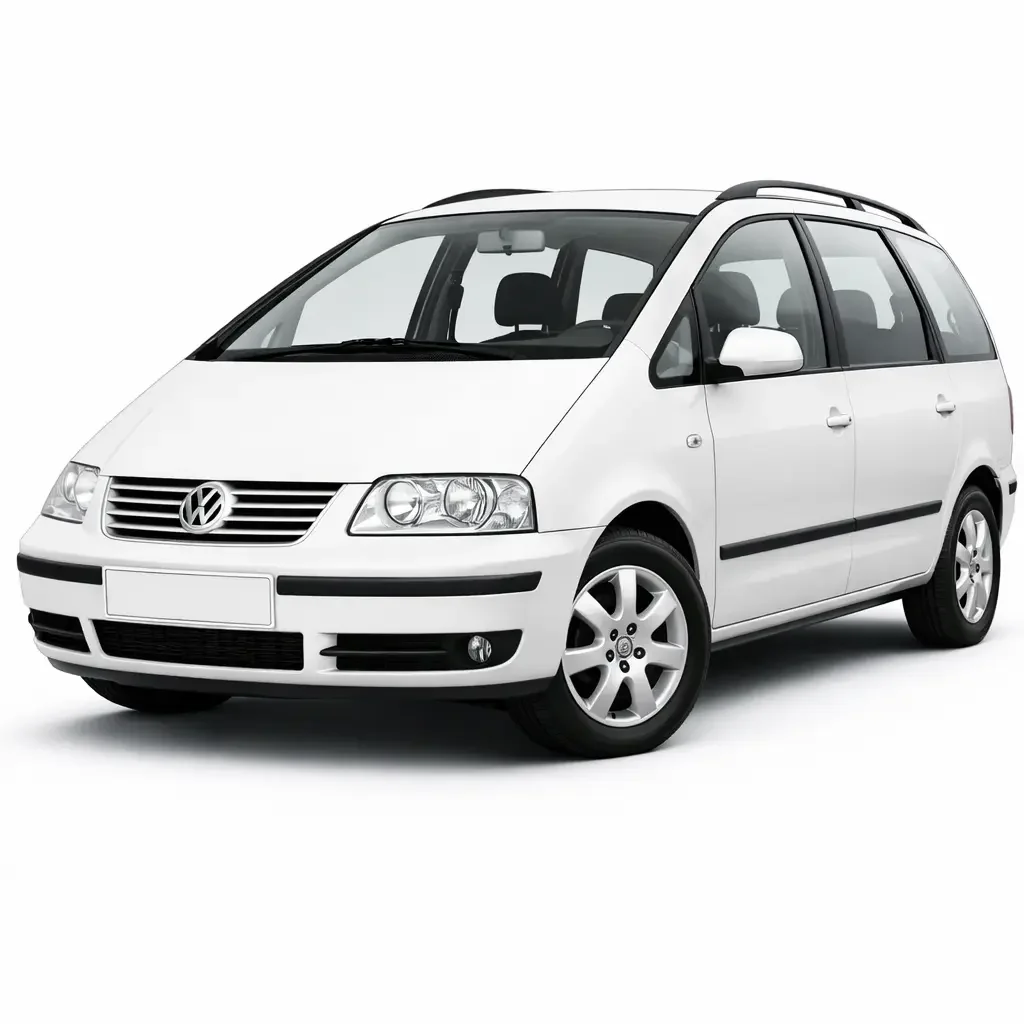
The Volkswagen Sharan is one of the most catalog-complex MPV applications in the European aftermarket because its parts identity is shaped by three overlapping factors that sellers must navigate simultaneously: it shares a platform with the SEAT Alhambra and, until 2005, with the Ford Galaxy; it spans a facelift boundary in 2004 that changes exterior trim and adds engine variants; and it carries a broad engine matrix of petrol and diesel options with different transmission pairings, fuel system architectures, and emissions equipment. A seller who approaches the Sharan as a single undifferentiated application across the 2002 to 2008 window will generate incorrect parts on engine, exterior trim, transmission, and braking categories simultaneously.
This guide covers the 2002 to 2008 model years of the first-generation Sharan, which encompasses the post-2000 facelift specification and the 2004 second facelift boundary, and closes with the 2008 introduction of the BlueMotion variant. The first generation ran from 1995 to 2010, but the 2002 to 2008 window is the most commercially active period for parts demand today, covering the majority of surviving UK, German, and wider European examples that are now in the independent aftermarket maintenance and restoration cycle.
Platform Identity: Typ 7M, AutoEuropa, and the Three-Badge Family
The first-generation Volkswagen Sharan is built on the Volkswagen Group Typ 7M platform, also designated B-VX62 in internal documentation. This platform was developed jointly by Volkswagen and Ford as the foundation for their shared MPV venture, and all three resulting vehicles, the VW Sharan, SEAT Alhambra, and Ford Galaxy, were assembled at the AutoEuropa joint venture plant in Palmela, Portugal. The Sharan and SEAT Alhambra are badge-engineered variants of the same vehicle. The Ford Galaxy, while mechanically closely related, had its own interior design and some different engine calibrations. All three ran on the same AutoEuropa production line from 1995 through the end of 2005, when the last first-generation Ford Galaxy was produced. The Sharan and Alhambra continued at AutoEuropa without Ford through 2010.
The VW-Ford cooperation formally ended in 2006, when Ford independently introduced a second-generation Galaxy built at a dedicated plant in Limburg, Belgium. From 2006 onward the Sharan and Alhambra were pure Volkswagen Group products at AutoEuropa with no ongoing Ford co-production. For catalog purposes this means: Galaxy first-generation cross-references to the Sharan are valid through 2005 production, after which the Galaxy is an entirely different platform. Any catalog entry that extends Sharan-to-Galaxy cross-reference into 2006 and beyond is referencing a different vehicle.
The SEAT Alhambra cross-reference to the Sharan is valid for the entirety of the 2002 to 2008 window and beyond through the first generation's 2010 end of production. SEAT Alhambra Typ 7M engine components, suspension components, brake components, and underbody mechanical parts apply directly to the VW Sharan of the same production year and engine variant. Sellers should maintain this cross-reference as a confirmed pool, not a may-also-fit suggestion, for all mechanical component categories.
Note on platform naming: the Typ 7M designation is the correct internal platform code for the first-generation Sharan. Some aftermarket catalog systems reference this as PQ35, which is incorrect: PQ35 is the platform used by the Golf Mk5, Jetta, Tiguan, and related VW Group products of the 2003 to 2010 era. The Sharan and Alhambra predate and sit entirely outside the PQ35 family. Any catalog system that assigns PQ35 to the first-generation Sharan is applying an incorrect platform designation and will generate cross-reference errors by pulling Golf Mk5 or Jetta mechanical components into the Sharan pool.
The 2000 and 2004 Facelift Boundaries Within the Production Window
The first-generation Sharan received two facelifts. The major facelift of 2000 is outside the scope of this guide but establishes the baseline specification for the 2002 to 2008 window: angular VW-family headlights, Passat-influenced grille with four horizontal slats, revised dashboard, extended wheelbase of 2,840 millimeters, and an updated engine range. All 2002 to 2008 Sharans are post-2000 facelift specification.
The second facelift, announced at the Frankfurt Motor Show in September 2003 and implemented for the 2004 model year, introduces changes that create catalog boundaries within the 2002 to 2008 window. The primary exterior changes are a revised grille design and the introduction of round tail lights, replacing the prior tail light configuration. Curtain side airbags became standard equipment across the range at this boundary. Air conditioning also became standard specification rather than an option.
For parts sellers, the 2004 facelift boundary requires model year qualification for tail light assemblies, tail light seals, rear light clusters, and the grille. Pre-2004 and 2004 and later tail light assemblies are different items with different part numbers. The curtain airbag addition also means that any airbag system component listing must confirm pre-2004 versus 2004 and later specification, as the side airbag system and associated wiring harness changes are different between the two periods. The 2004 facelift also marked the practical introduction point for the 2.0 TDI engine and the DSG transmission in the Sharan range, which are covered in the engine and transmission sections below.
Engine Matrix: Petrol and Diesel Variants Across the Production Window
The Sharan carries one of the wider engine matrices in its class across the 2002 to 2008 production window, covering three petrol options and multiple diesel configurations from two distinct TDI generations. Engine designation is the mandatory first qualifier for every fuel system, intake, exhaust, ignition, and emissions component listing. No engine component applies across the full engine range, and the difference between the 1.9 TDI pump-injection and the 2.0 TDI common rail architectures in particular creates a complete fuel system incompatibility that sellers must enforce at the catalog level.
Petrol Engines
2.0 litre naturally aspirated (AZM and related codes): The base petrol option producing approximately 116 PS. Conventional multi-point fuel injection, single ignition coil per cylinder, standard catalytic converter. Available with five-speed manual or four-speed automatic transmission. The most basic petrol application in the range and the least demanding from a parts complexity standpoint.
1.8T (AWC and related codes): The 1,781cc turbocharged four-cylinder producing 150 PS. Uses a turbocharger, intercooler, and Bosch Motronic engine management. The 1.8T cross-references to the same engine family used in the contemporary Passat B5, Audi A4, and Golf Mk4, making this one of the best-supported engines in the VW Group aftermarket. Turbocharger, intercooler hoses, throttle body, and fuel system components cross to these related applications, but must be confirmed by engine code as calibration and some component specifications differ by application.
2.8 VR6 (AYL and related codes): The 2,792cc narrow-angle V6 producing 204 PS in the post-2000 specification. Available with optional 4Motion all-wheel drive and with Tiptronic automatic transmission. The VR6 is the highest-output engine in the Sharan range and the least commonly encountered in the independent aftermarket. 4Motion applications use a Haldex-based coupling at the rear axle, and the rear axle assembly, rear driveshafts, and Haldex unit are 4Motion-specific components with no cross-reference to the front-wheel-drive variants.
Diesel Engines: Two Generations, Different Fuel Systems
1.9 TDI pump-injection (AUY 115 PS, ANU 115 PS, ASZ 130 PS, and related codes): The 1,896cc unit injection diesel using the Pumpe Duse direct injection system, introduced to the Sharan range in the 2000 to 2003 timeframe and continuing through to 2008 as an available option. The unit injector system is characterized by individual combined pump-injector units mounted directly in the cylinder head, driven by the camshaft. This architecture uses no common fuel rail and requires specialized injector service. A 4Motion all-wheel drive variant using the 1.9 TDI 115 PS was offered briefly in late 2001 but deleted shortly thereafter.
2.0 TDI common rail (BRT 115 PS, BMM 136 PS, and related codes): The 1,968cc common rail diesel introduced to the Sharan for the 2005 model year, representing the transition to the third generation of VW Group diesel architecture. The common rail system uses a single high-pressure fuel rail supplying all injectors, driven by a high-pressure pump rather than camshaft-actuated unit injectors. The injectors, high-pressure pump, fuel rail, and pressure regulation system on the 2.0 TDI common rail are fundamentally different from the 1.9 TDI unit injection system. No fuel delivery component crosses between these two diesel architectures. The 2.0 TDI 140 PS with DSG became the dominant powertrain choice in the range from 2005 onward and represents the majority of later first-generation Sharans in the European aftermarket.
The fuel system incompatibility between the 1.9 TDI pump-injection and the 2.0 TDI common rail is the single most commercially consequential catalog boundary in the Sharan engine matrix. A seller who lists diesel fuel system components without specifying engine code and injection system architecture will produce incorrect parts on every order that crosses this boundary. Injectors, fuel pumps, fuel rails, pressure regulators, and injector seals for the two systems are entirely different items. Both systems also differ from the earlier 1.9 TDI with distributor injection used on pre-2000 Sharans outside this guide's scope.
Transmissions: Manual, Tiptronic, and DSG Introduction
The Sharan was offered with three transmission types across the 2002 to 2008 production window, and the transmission type determines service component specifications for fluid, filter, clutch, and internal drivetrain parts throughout.
The five-speed manual gearbox is paired with the 1.9 TDI and 1.8T engines in front-wheel-drive configuration. Gear oil specification, clutch kit, and shift linkage components are manual-specific. The clutch assembly for the 1.9 TDI and 1.8T applications differs by engine torque output, and clutch kit listings must specify engine variant as well as transmission type.
The Tiptronic four-speed automatic, also described as a torque converter automatic, was offered with the 2.0 naturally aspirated petrol, the 1.8T, and the 2.8 VR6. The Tiptronic uses ATF fluid and a torque converter rather than a clutch, and its service components are entirely separate from the manual transmission pool. ATF fluid specification, transmission filter, and valve body components must be listed as automatic-specific.
The six-speed DSG dual-clutch transmission became available on the Sharan from 2004, initially paired with the 2.0 TDI engine. The DSG is a distinct transmission architecture from both the manual and the Tiptronic, using two wet clutch packs within a single housing to provide sequential automated gear changes without a conventional torque converter. DSG service requirements include DSG-specific fluid (VW specification G 052 182, distinct from both manual gear oil and conventional ATF), a DSG-specific filter, and the mechatronic unit that controls clutch engagement. The DSG fluid and filter service interval is separate from the engine oil service, and sellers must never cross-reference DSG fluid with conventional ATF or manual gear oil. The introduction of the DSG on the Sharan coincides with the 2004 facelift boundary, meaning that 2002 and 2003 Sharan production predates DSG availability and any DSG component listing must carry a 2004 and later qualifier.
Cross-Reference Logic: SEAT Alhambra and Ford Galaxy
The SEAT Alhambra Typ 7M is mechanically identical to the VW Sharan for all platform components: front and rear suspension, steering, brakes, subframe, wheel hubs, and bearing specifications. Engine components cross directly between the Alhambra and Sharan where the engine code is the same. The SEAT Alhambra received slightly different interior trim and some market-specific equipment, but the underbody and powertrain are fully shared. Sellers should maintain confirmed Alhambra cross-references across all suspension, brake, and same-engine powertrain component listings for the full 2002 to 2008 Sharan window.
The Ford Galaxy first-generation cross-reference is more nuanced and requires careful year-range management. The Galaxy and Sharan share the same front suspension geometry, front subframe, front brake specification (confirming by year given brake updates), and overall body dimensions. However, the Galaxy offered different engine options in some markets, including Ford-sourced diesel units, and the interior, dashboard, and engine-specific components differ. Sellers should frame Galaxy cross-references as may also fit for suspension and brake platform components, with part number confirmation required, and must not extend this cross-reference to engine, fuel system, electrical, or interior components without specific part number verification. The cross-reference window closes for new Galaxy production at the end of 2005, when the first-generation Galaxy ceased production at AutoEuropa.
Brakes and Suspension
The Sharan uses MacPherson strut front suspension with a subframe-mounted lower arm and front anti-roll bar, and a multi-link rear suspension. This rear suspension architecture is more sophisticated than the torsion beam used on many contemporary VW Group products and provides better handling characteristics appropriate to the Sharan's higher weight and seven-seat capacity. Front strut inserts, front coil springs, front lower control arms, front ball joints, and front anti-roll bar components cross directly between the Sharan and Alhambra. Rear suspension arms, rear trailing arms, rear toe links, and rear coil springs are also platform-shared.
Front brakes are vented discs throughout the 2002 to 2008 range. Rear brakes are solid discs on higher specification variants and drum brakes on base variants. The combination of front and rear disc versus rear drum must be confirmed before serving any rear brake component listing. A seller who lists rear disc pads to a drum-brake Sharan will produce incorrect parts on every rear brake order for those variants. Brake master cylinder, servo, and ABS modulator specifications are shared across the platform for most configurations and cross to the SEAT Alhambra.
Common ACES/PIES Catalog Mistakes for the Sharan (2002 to 2008)
1. Assigning the PQ35 platform designation to the first-generation Sharan. The Sharan rides on the Typ 7M platform. PQ35 is the Golf Mk5 and Jetta platform. Applying PQ35 pulls incorrect cross-references from the Golf Mk5 and related vehicles into the Sharan mechanical pool.
2. Extending Ford Galaxy first-generation cross-references beyond 2005 production. The first-generation Galaxy ceased production at AutoEuropa at the end of 2005. The second-generation Galaxy from 2006 is a completely different platform built in Belgium. Any Sharan listing with a Galaxy cross-reference must carry a first-generation Galaxy qualifier with a production end date of 2005.
3. Listing diesel fuel system components without specifying injection architecture. The 1.9 TDI pump-injection and 2.0 TDI common rail systems are incompatible. Injectors, high-pressure pumps, fuel rails, and pressure regulators for one system do not apply to the other. A single diesel fuel system listing spanning both engine families will produce incorrect parts on every order in that category.
4. Not applying a 2004 and later qualifier to DSG transmission fluid, filter, and service components. The DSG was introduced on the Sharan from 2004. DSG fluid is a distinct specification from both manual gear oil and conventional ATF. Listing DSG service components as applicable to 2002 and 2003 Sharans, or cross-referencing DSG fluid to conventional ATF, are both catalog errors.
5. Not distinguishing rear disc from rear drum brake configurations when listing rear brake components. Base-specification Sharans use rear drums while higher-specification variants use rear discs. A single rear brake pad listing applied across the full range will produce incorrect parts on rear drum variants.
6. Cross-referencing VR6 4Motion rear axle, rear driveshaft, or Haldex coupling components to front-wheel-drive Sharan applications. The 4Motion rear axle system is specific to that drivetrain variant. Front-wheel-drive Sharans have no rear driveshafts, no rear differential, and no Haldex unit.
7. Applying pre-2004 tail light assemblies to post-2004 Sharans or vice versa. The 2004 facelift introduced round tail lights replacing the prior configuration. These are different assemblies with different part numbers and different body aperture fits.
8. Not distinguishing the 1.9 TDI 115 PS from the 1.9 TDI 130 PS for fuel system and turbocharger component listings. The 130 PS Pumpe Duse unit uses different injector nozzle specifications and a different turbocharger calibration from the 115 PS unit. Engine code is the mandatory qualifier for all diesel fuel system and turbocharger listings.
9. Treating the 1.8T engine as applying the same cross-references as the Golf Mk4 1.8T without part number confirmation. The Sharan 1.8T shares its engine family with the Passat B5 and Golf Mk4 but has different accessory mounting geometry due to transverse installation in a larger and heavier vehicle. Turbocharger oil feed line routing, engine mount geometry, and some ancillary brackets are Sharan-specific even within the shared 1.8T engine family.
10. Applying the same suspension component listings to the SEAT Alhambra and VW Sharan without noting that they are confirmed identical applications rather than may-also-fit cross-references. Sellers who frame Alhambra suspension cross-references as uncertain when they are confirmed identical will undersell parts availability and lose orders to sellers who correctly communicate the relationship.
Catalog Checklist for the VW Sharan (2002 to 2008)
• Classify the Sharan on the Typ 7M platform, not PQ35; maintain SEAT Alhambra as a confirmed identical cross-reference for all mechanical underbody components
• Apply the 2004 facelift as a mandatory boundary for tail light assemblies, grille, curtain airbag system, and associated wiring; pre-2004 and post-2004 exterior trim items are different part numbers
• Require engine code as the first qualifier for all fuel system, intake, exhaust, ignition, and emissions component listings before serving any engine-specific part
• Apply 1.9 TDI pump-injection versus 2.0 TDI common rail as a mandatory fuel system architecture split; no diesel fuel delivery component crosses between these two injection systems
• Apply manual, Tiptronic automatic, or DSG qualifier to all transmission fluid, filter, clutch, and internal drivetrain service listings; DSG fluid (G 052 182 specification) must never be cross-referenced to conventional ATF or manual gear oil
• Apply a 2004 and later qualifier to all DSG component listings; 2002 and 2003 Sharan production predates DSG availability entirely
• Confirm rear brake configuration (disc versus drum) before serving any rear brake component listing; do not present a single rear brake pad listing as applicable across the full specification range
• Apply 4Motion drivetrain qualifier to all rear axle, rear driveshaft, and Haldex coupling component listings; front-wheel-drive Sharans have no rear drivetrain
• Limit Ford Galaxy first-generation cross-references to platform and brake components only, framed as may also fit with part number confirmation, and set production end date of 2005 for all Galaxy cross-reference listings
• Note BlueMotion variant introduced in 2008 as a lower-emission 2.0 TDI specification with modified engine calibration and aerodynamic equipment; BlueMotion-specific components require a BlueMotion qualifier within the 2008 model year
Final Take
The first-generation Sharan's catalog complexity is almost entirely a product of its three-brand joint venture origin and the breadth of its engine matrix. The Typ 7M platform cross-reference pool that includes the SEAT Alhambra is actually a commercial advantage for sellers: it doubles the confirmed parts pool for every mechanical component and means that Alhambra stock serves Sharan demand and vice versa without the uncertainty of a may-also-fit qualifier. A seller who correctly identifies this as a confirmed relationship rather than an uncertain cross-reference earns buyer confidence that sellers who hedge on the Alhambra relationship do not.
The Ford Galaxy relationship is where most sellers either over-cross-reference or under-cross-reference. The correct position is narrow and time-bounded: first-generation Galaxy only, platform and brake suspension components only, with part number confirmation required, and a hard end date of 2005. Extending it to the second-generation Galaxy or to engine components on any generation is a catalog error. Refusing to acknowledge it at all for first-generation platform components is a missed cross-reference opportunity.
The diesel fuel system split between the 1.9 TDI pump-injection and 2.0 TDI common rail is the highest-frequency source of incorrect orders in the Sharan application. These are genuinely incompatible systems with different injection philosophies, different hardware architectures, and no component commonality in the fuel delivery path. A catalog that does not enforce engine code as the primary qualifier for diesel fuel system components will generate returns on that category with predictable regularity. The engine code is available on the VIN decode and should be required before any diesel fuel system order is processed.
Disclaimer: This guide is based on publicly available specifications, manufacturer documentation, and independent research. Part interchangeability should always be confirmed via VIN, engine code, and OEM part number lookup. Specifications may vary by market and equipment level. This document does not constitute official Volkswagen parts catalog data.