
Written by Arthur Simitian | PartsAdvisory
ACES Model Name, Body Type, and the Identity Problem Sellers Must Resolve First
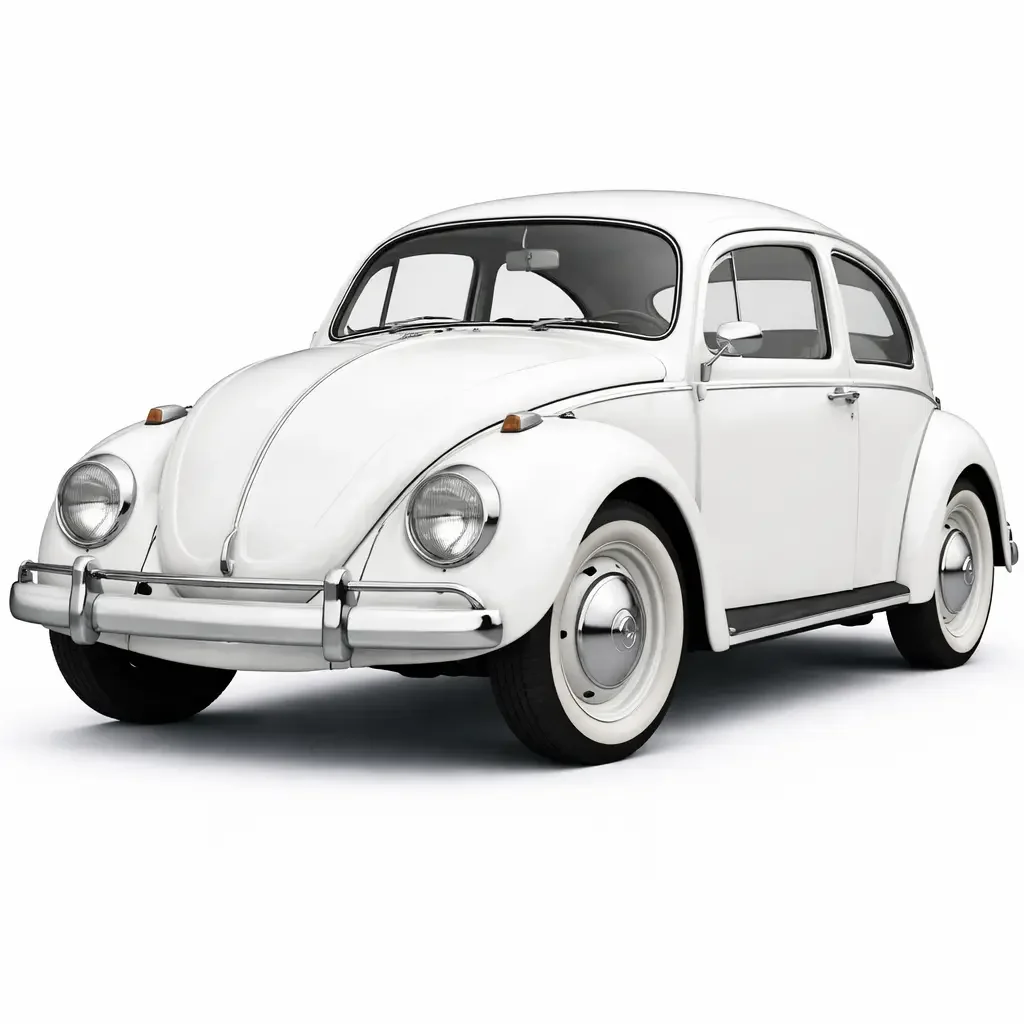
The first thing a seller must understand about this ACES application is that the model name and the body type, taken together, create a description that exists nowhere in Volkswagen's own nomenclature. ACES records this vehicle as the Volkswagen Sedan with a coupe body type for the years 1961 to 1977. The actual vehicle is the Volkswagen Type 3 Notchback, a two-door three-box saloon produced in Germany from August 1961 through July 1973. Volkswagen never used the name Sedan as a model designation for this car in any primary market. The body is a notchback, which ACES codes as a coupe because ACES treats all fixed-rear-window two-door saloon bodies as coupes in its body-type taxonomy. The production end date of 1977 in ACES does not reflect actual factory production, which ended in 1973. It almost certainly reflects the latest title year recorded in US DMV data for personally imported examples that entered the country after production ended, a known artifact of how ACES constructs year ranges from title records rather than factory production schedules.
For a parts seller, resolving this identity problem means being explicit with buyers from the first catalog interaction: the ACES Volkswagen Sedan 1961 to 1977 coupe body is the Type 3 Notchback, the three-box two-door saloon sharing a platform with the Squareback (Variant) and Fastback (TL) but distinguished by its fixed rear window, upright boot, and three-box body profile. Any listing that does not establish this equivalence will generate confusion among buyers who know their car as a Notchback and encounter a catalog entry named Sedan.
The Notchback was never officially imported to the United States by Volkswagen of America. When Volkswagen of America began importing the Type 3 for the 1966 model year, it brought only the Squareback and Fastback. Notchbacks in the US arrived through personal importation, primarily via returning military and government personnel stationed in Germany, or through Canadian market units that crossed the border. This means virtually every Type 3 Notchback that appears in a US parts lookup is a gray-market import, and its equipment specification reflects the European or Canadian market build rather than any US-specific configuration. D-Jetronic fuel injection was not standard equipment on the Notchback for the US market as it was on the Squareback and Fastback, because no official US market Notchback existed.
Platform Overview: Type 3 Architecture and the Notchback Position Within It
The Type 3 Notchback is the founding body style of the entire Type 3 family. It was the first Type 3 to enter production in August 1961, preceding the Squareback by six months and the Fastback by four years. The Squareback, Fastback, and Notchback all share the same floor pan, front and rear suspension geometry, suitcase engine architecture, engine subframe mounting, and all underbody mechanical components. For parts catalog purposes this means: every mechanical component that applies to the Type 3 Squareback or Fastback at the same model year and engine specification applies equally to the Notchback. The cross-reference between all three body styles is confirmed for all underbody mechanical, powertrain, and brake components. This is the most commercially useful fact in the Notchback catalog.
The body components that are Notchback-specific are the rear body panels, rear window glass and seal, boot lid, boot lid hinges and seal, rear valance, and rear interior trim. The Notchback uses a fixed rear window and a separate opening boot lid with a conventional notchback profile, as opposed to the Squareback's integrated rear hatch and extended wagon roofline, or the Fastback's sloping fastback rear window that opens with the decklid. These rear body differences mean that no rear glass, no rear bodywork, no boot lid, and no rear interior trim crosses between the three body styles. Any rear body component listing must carry a Notchback qualifier and must not suggest cross-reference to Fastback or Squareback rear body items.
The front body components, front doors, front glass, dashboard, engine lid, front suspension, and all floor pan components are shared across the three body styles and the confirmed Type 3 cross-reference pool applies fully.
The 1500cc Era: 1961 to 1965
The Notchback launched with a 1,493cc air-cooled flat-four engine using a single side-draft Solex 32 PHN carburetor, producing approximately 44 horsepower. The electrical system was 6-volt. The rear suspension used the swing axle design. The front suspension employed twin full-width torsion bars with a trailing arm and anti-roll bar arrangement unique to the Type 3: unlike the Type 1 Beetle's torsion leaf design, the Type 3 uses cross-mounted round torsion bars. The wheel pattern was 5-stud at 205mm PCD. Front brakes were drums. Total clutch size was increased from 180mm to 200mm in August 1962 as a running change within the first production year.
In August 1963 Volkswagen split the engine lineup into two variants. The 1500N used the original single-carburetor setup producing 54 PS in revised tune, while the new 1500S introduced twin downdraft Solex 32 PDSIT-2 and 32 PDSIT-3 carburetors, high-compression 8.5:1 domed pistons, and 66 PS output. The 1500N and 1500S use different cylinder heads, different intake manifolds, different carburetor setups, and different piston specifications. Any intake, carburetor, or piston listing for the 1500cc Notchback must carry a 1500N versus 1500S engine variant qualifier.
The 1500N used engine code prefix M and the 1500S used prefix K, allowing engine variant identification from the stamped engine number on the crankcase. This code-first discipline applies to all engine-specific parts listings for 1963 through 1965 production. For 1961 and 1962 production, the single-carburetor original 1500 engine used neither suffix, as the N and S designations did not exist until 1963.
The 1966 Boundary: Disc Brakes, 4-Stud Wheels, and the 1600cc Engine
The 1966 model year, introduced in August 1965, marks the most consequential single-year change in the Notchback's production run. Three simultaneous changes create catalog boundaries that apply to every brake, wheel, and engine listing for this application. First, front brakes changed from drums to vented discs. Second, the wheel bolt pattern changed from 5-stud at 5 x 205mm PCD to 4-stud at 4 x 130mm PCD, requiring new wheels and new hub hardware across all four corners. Third, the 1600cc engine became available for the Notchback, with the Fastback introduced simultaneously as the only 1600-only body style.
These three changes are linked. The disc brake system required new front hub geometry, which drove the wheel bolt pattern change. A seller who lists pre-1966 front drum components, pre-1966 5-stud wheels, or pre-1966 hub hardware to a post-1966 Notchback will produce three simultaneous incorrect parts categories. For all hub, rotor, caliper, drum, wheel, and wheel bearing listings, pre-1966 and 1966 and later are separate applications.
The 1600cc engine available from 1966 used engine code prefix T for the high-compression twin-carburetor variant and P for the low-compression twin-carburetor variant. The 1600cc engine uses the same basic block dimensions as the 1500cc but with enlarged 83mm bore pistons and cylinders. Pistons, cylinders, and cylinder head gaskets for the 1600cc do not cross to the 1500cc application. Carburetor and intake manifold components share the Solex 32 PDSIT carburetor type with the 1500S but are calibrated differently and must be confirmed by engine code.
The 1967 Boundary: 12-Volt Electrics and Dual-Circuit Brakes
The 1967 model year introduced 12-volt electrics replacing the 6-volt system, and dual-circuit brakes replacing the single-circuit hydraulic system. Both changes create hard catalog boundaries for all electrical components and all primary brake system components. The 6-volt to 12-volt transition means that starter motor, alternator or generator, ignition coil, all light bulbs, and the wiring loom are different specifications between 1966 and 1967 production. The dual-circuit brake master cylinder introduction means that the master cylinder specification is different between pre-1967 single-circuit and 1967 and later dual-circuit applications.
These two 1967 changes parallel exactly the same changes applied to the Squareback and Fastback at the same model year boundary, which are covered in the separate Type 3 Squareback guides in this series. The Notchback, Squareback, and Fastback received identical electrical and brake system changes simultaneously for 1967.
1968 and 1969: Rear Suspension Transition From Swing Axle to CV Semi-Trailing Arm
The swing axle rear suspension used from 1961 through 1967 was replaced by a double-jointed CV semi-trailing arm design beginning with the 1968 model year, following the same timeline as the Squareback and Fastback. For 1968, the CV rear suspension appeared on automatic transmission models from mid-year. For 1969, all production used the CV rear suspension regardless of transmission. Rear axle shafts, rear wheel bearings, rear CV boots, and associated hub seals are architecture-specific: swing axle components from 1961 to 1967 do not apply to the CV rear suspension from 1968 onward, and vice versa. All rear suspension driveline listings for the Notchback must carry a pre-1968 swing axle versus 1968 and later CV qualifier, with the 1968 model year requiring transmission-type confirmation as an additional qualifier.
The 1970 Facelift: Extended Front End and New Exterior Trim
The 1970 model year introduced the front-end extension of 115 millimeters that added approximately 1.5 cubic feet of front luggage capacity and changed the front hood, front bumper, front valance, front turn signal lenses and housings, and rear tail light clusters. This facelift applies equally to the Notchback as to the Squareback and Fastback. All front exterior trim component listings for the Notchback must carry a pre-1970 versus 1970 and later qualifier. The front hood, front bumper, and front turn signal hardware are different between the pre-facelift and facelifted specifications.
The rear tail lights also changed at the 1970 boundary to larger units. As with the Squareback guide, the Notchback-specific rear body components require the 1970 facelift boundary applied on top of the existing Notchback body-style qualifier. A Notchback tail light listing for 1966 to 1969 is a different part from a Notchback tail light listing for 1970 to 1973, and neither crosses to the Squareback or Fastback rear light applications.
The ACES 1977 End Date: Why It Is Wrong and How to Handle It
Factory production of the Type 3 Notchback ended in July 1973 at the Wolfsburg plant, alongside the Fastback and Squareback. ACES records a 1977 end date for the Volkswagen Sedan, which is four years beyond actual production end. This discrepancy has a straightforward explanation. ACES derives year ranges partly from title registration data in US state DMV records. When a European owner immigrated to the United States in 1975 or 1976 and registered a 1972 Notchback in their home state, that registration appeared as a 1972 Volkswagen Sedan in the 1975 or 1976 DMV data. When ACES aggregates across all title years, the range extends to the last year any example was newly titled in a US database, not to the last year the factory built one.
The practical catalog consequence is this: there are no 1974, 1975, 1976, or 1977 Type 3 Notchbacks. Any car appearing in a catalog lookup as a 1974 to 1977 Volkswagen Sedan is in fact a 1973 or earlier production vehicle titled in a later year. A seller listing 1974 to 1977 model year specific parts that differ from 1973 specification is listing parts for a model year that does not exist. The correct approach is to treat 1961 to 1973 as the authoritative production window, acknowledge the ACES 1977 end date as a DMV-artifact extension, and note in catalog entries that the model year on the title may post-date actual production.
Cross-Reference Pool: Squareback, Fastback, and Engine Family
The Notchback, Squareback, and Fastback share all underbody mechanical components for the same model year and engine specification. Front suspension, front brakes, front wheel bearings, engine, transmission, rear suspension, and rear brakes cross fully between the three body styles. This is a confirmed cross-reference, not a may-also-fit suggestion. A seller covering the Notchback should structure all mechanical listings as applying to the full Type 3 family: Notchback, Squareback, and Fastback, with the body-style qualifier applied only to rear body panels, rear glass, rear interior trim, and rear closure hardware.
The engine long-block service parts pool crosses between the Type 3 and the Type 1 Beetle for the same displacement and carburetor specification, as covered in the Squareback guides in this series. Spark plugs, valve cover gaskets, pushrod tube seals, and carburetor consumables for the 1600cc application cross to the contemporary Beetle 1600. Cooling system external components including the suitcase fan shroud, cooling tins, and fan housing do not cross to the Type 1 and are Type 3 specific. This boundary applies equally to the Notchback as to the Squareback and Fastback.
The Type 34 Karmann Ghia, which uses the Type 3 floor pan and mechanical architecture, is a related cross-reference for underbody mechanical components. The Type 34 was produced from 1962 to 1969 and uses the same floor pan, front and rear suspension, and engine family as the Type 3. Type 34 mechanical cross-references are valid for platform components but must be confirmed by part number. The Type 34 uses a different body structure and different body components with no cross-reference to any Type 3 body panel or glass.
Common ACES/PIES Catalog Mistakes for the VW Sedan (Type 3 Notchback) 1961 to 1977
1. Listing parts for 1974 through 1977 model years as distinct from 1973 specification. Factory production ended in July 1973. There are no 1974, 1975, 1976, or 1977 Type 3 Notchbacks. The ACES end date of 1977 is a DMV-artifact year range extension from late-titled European import vehicles, not a reflection of continued production.
2. Treating the ACES Sedan model name as applying to a different vehicle from the Type 3 Notchback. The VW Sedan in ACES is the Type 3 Notchback exclusively. Sellers who maintain separate catalog entries for Sedan and Notchback will fragment the parts pool and confuse buyers who know their car by its correct name.
3. Cross-referencing Notchback rear body panels, rear glass, boot lid, or rear interior trim to the Squareback or Fastback. The three body styles share a floor pan and all underbody components, but the rear bodywork above the beltline is body-style specific with no cross-reference in any category.
4. Not applying a 5-stud versus 4-stud wheel bolt pattern qualifier to wheel, hub, and wheel bearing listings at the 1966 model year boundary. Pre-1966 uses 5 x 205mm PCD; 1966 and later uses 4 x 130mm PCD. These are incompatible wheel patterns requiring different hubs and different wheel hardware.
5. Not applying a front drum versus front disc brake qualifier at the 1966 model year boundary. Pre-1966 front brakes are drums; 1966 and later are discs. All front brake component listings must carry this boundary as a year qualifier.
6. Not applying a 6-volt versus 12-volt qualifier to electrical component listings at the 1967 model year boundary. Starter motor, generator, ignition coil, bulbs, and wiring harness specifications are different between 1966 and 1967 production.
7. Not applying a 1500N versus 1500S engine variant qualifier to all carburetor, intake manifold, and piston listings for 1963 through 1965 production. The 1500N single-carburetor and 1500S twin-carburetor engines use different intake hardware and different piston specifications that are not interchangeable.
8. Applying Type 1 Beetle cooling system external components to the Notchback. The Type 3 suitcase engine uses a crankshaft-driven fan with a unique fan shroud, cooling tins, and fan housing that are Type 3 specific. No Type 1 cooling tin or fan shroud applies to any Type 3 body style.
9. Not applying the swing axle versus CV rear suspension qualifier to rear driveline listings at the 1968 to 1969 boundary. The swing axle applies through 1967. The CV semi-trailing arm applies from 1969 universally, with a transmission-type split in 1968. These rear axle architectures use entirely different axle shafts, bearings, and seals.
10. Omitting the Notchback from Type 3 mechanical listings that cover only the Squareback and Fastback. Because the Notchback was never officially US-imported, some sellers structure their Type 3 catalog around the Squareback and Fastback and exclude the Notchback. This is a missed coverage opportunity: the Notchback uses identical mechanical components and every platform-level Type 3 part listing should include the Notchback as a confirmed application.
Catalog Checklist for the VW Sedan (Type 3 Notchback) 1961 to 1977
• Establish the ACES Sedan entry as the Type 3 Notchback in all catalog-facing descriptions; never treat Sedan as a distinct vehicle from the Notchback
• Set the authoritative production window as 1961 to 1973; note that 1974 to 1977 ACES years reflect late-titled imports, not production years, and no model-year-specific parts changes exist after 1973
• Apply body-style qualifier (Notchback) to all rear body panel, rear glass, boot lid, and rear interior trim listings; these do not cross to the Squareback or Fastback
• Apply the full Type 3 cross-reference pool (Notchback, Squareback, Fastback) to all underbody mechanical, front suspension, brakes, engine, and transmission listings
• Apply 5-stud pre-1966 versus 4-stud 1966 and later qualifier to all wheel, hub, and wheel bearing listings
• Apply front drum pre-1966 versus front disc 1966 and later qualifier to all front brake component listings
• Apply 6-volt pre-1967 versus 12-volt 1967 and later qualifier to all electrical component listings
• Apply single-circuit pre-1967 versus dual-circuit 1967 and later qualifier to all master cylinder and primary brake line listings
• Apply 1500N single-carb versus 1500S twin-carb engine variant qualifier (using engine code prefix M versus K) to all carburetor, intake, and piston listings for 1963 to 1965 production
• Apply swing axle pre-1968 versus CV semi-trailing arm 1969 and later qualifier to all rear driveline listings, with transmission-type confirmation required for 1968 specifically
• Apply the 1970 facelift as a front exterior trim boundary for front hood, front bumper, front turn signals, and rear tail lights
• Note the Notchback's gray-market US import status in catalog descriptions; equipment specification reflects European or Canadian market builds, not US-specific configuration
Final Take
The ACES Volkswagen Sedan is one of the few applications in this series where the catalog problem is not primarily a parts cross-reference error but an identity error. The name Sedan means nothing to a buyer who knows their car as a Notchback or a 1500 or a Type 3. The ACES end date of 1977 means nothing to a parts system that takes it at face value and searches for 1976-specific production changes that do not exist. And the coupe body type designation, while internally consistent with ACES taxonomy, will confuse any buyer who looks up Volkswagen coupe and finds a three-box saloon.
A seller who solves the identity problem first, making clear in every catalog interaction that the ACES Sedan is the Type 3 Notchback, that it shares all mechanical components with the Squareback and Fastback, and that production ended in 1973 regardless of what year appears on the title, earns the confidence of every Notchback owner who has encountered catalog systems that either exclude the car entirely or bury it under a name they do not recognize.
The mechanical catalog for this vehicle, once the identity is established, is one of the most straightforward in the air-cooled VW family. The year-specific boundaries are the same ones that apply across the entire Type 3 body style family: 1966 for disc brakes and wheel pattern, 1967 for 12-volt and dual-circuit brakes, 1968 to 1969 for rear suspension, and 1970 for the facelift. A seller who applies these boundaries correctly and includes the Notchback in every Type 3 mechanical listing will have complete and accurate coverage for an application that the aftermarket consistently either misidentifies or ignores.
Disclaimer: This guide is based on publicly available specifications, manufacturer documentation, and independent research. The ACES production window of 1961 to 1977 reflects title registration records and extends beyond actual factory production, which ended in July 1973. Part interchangeability should always be confirmed via chassis number and OEM part number lookup. This document does not constitute official Volkswagen parts catalog data.