
Volkswagen Scirocco (1982 to 1989): Mk2 Platform and Fitment Guide
Written by Arthur Simitian | PartsAdvisory
Introduction: Same Platform, Entirely New Body
The Volkswagen Scirocco Mk2, internally designated Typ 53B, arrived in the United States for the 1982 model year as the successor to the Mk1 covered in the prior guide. It was first shown at the 1981 Geneva Motor Show and went into production at the same Karmann plant in Osnabruck that had assembled the Mk1 throughout its production run. The Mk2 retained the Golf A1 platform completely unchanged beneath its new bodywork, meaning the entire mechanical underbody cross-reference pool established for the Mk1 carries forward to the Mk2. Everything above the belt line is new and Mk2-specific, sharing nothing with the Mk1 despite being assembled in the same facility by the same coachbuilder.
The 1982 to 1989 ACES window covers the complete North American production lifespan of the Mk2. US sales ended after the 1988 model year; Canadian sales continued through 1989. European production of the Mk2 continued until September 1992, replaced by the Corrado, but those post-1989 European examples fall outside this guide's scope. The catalog for this window is structured around three hard boundaries: the engine progression from 1.7-litre carry-over to 1.8-litre eight-valve to 1.8-litre sixteen-valve, the 1984 mid-cycle update that changed the brake master cylinder and wiper system, and the 16V variant's introduction mid-1986 which created a completely different brake architecture, body kit, and wheel specification from the standard eight-valve car running alongside it.
Platform Continuity: A1 Mechanicals Carry Straight Through
The Mk2 Scirocco retained the Golf A1 platform without modification from the Mk1. MacPherson strut front suspension, torsion beam rear suspension, rack and pinion steering, the front subframe geometry, front lower control arm specification, and front anti-roll bar architecture are identical between the Mk1 and Mk2. The same confirmed cross-reference pool that applies the Golf Mk1, Rabbit, Jetta Mk1, and Scirocco Mk1 mechanical components to one another extends equally to the Scirocco Mk2 for all underbody mechanical components. A seller covering the Golf Mk1 and Rabbit for suspension, steering, and drivetrain components is already covering the Mk2 Scirocco's underbody without any additional catalog work beyond adding the Mk2 as a confirmed application.
The Mk2's continued use of the A1 platform while the Golf had already transitioned to the A2 platform for the Golf Mk2 in 1984 is a deliberate and commercially significant decision. Volkswagen did not develop a new Scirocco on the newer A2 platform; the Corrado, introduced in 1988 and sold from 1989, filled that role on the A2 chassis. The Mk2 Scirocco therefore coexisted with the Golf Mk2 (1985 onward in the US) on an older platform, which means that from 1985 onward the Scirocco Mk2's mechanical underbody cross-references to the Golf and Jetta point to the Mk1 family, not the Mk2 Golf family that was then in production. This is a catalog discipline point: a seller who lists Scirocco 1986 suspension components alongside Golf 1986 suspension components must confirm that they are applying A1 Golf Mk1 specifications to the Scirocco, not A2 Golf Mk2 specifications.
Karmann Body: New Design, Same Cross-Reference Rule
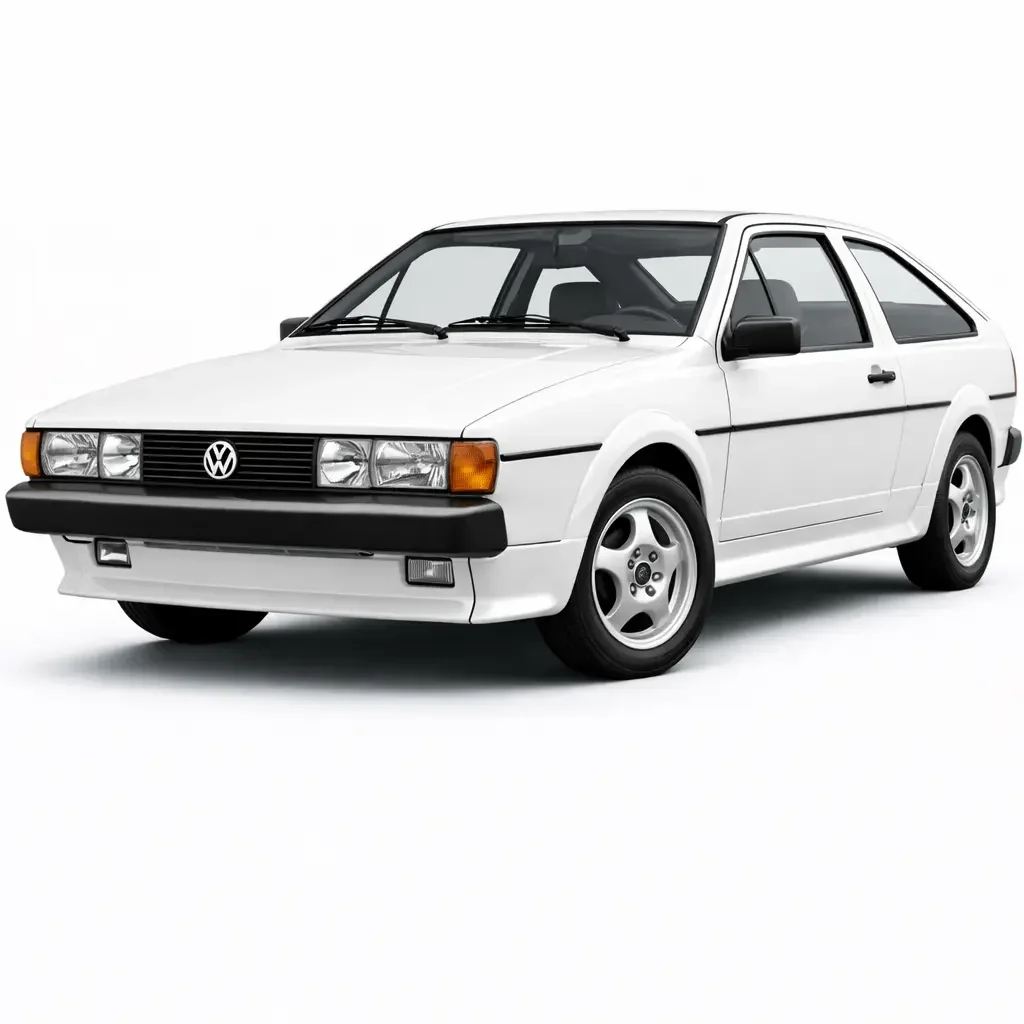
The Mk2 body was designed in-house by Volkswagen's own design team rather than by Giugiaro as the Mk1 had been. The new design featured a more upright, angular greenhouse with squared-off headlights replacing the Mk1's round units, increased front and rear headroom, expanded luggage capacity, and a reduced drag coefficient. The rear spoiler was repositioned to sit midway up the rear hatch glass rather than at the hatch lip, a distinctive styling feature that immediately identifies a Mk2.
Every body panel, glass item, body seal, bumper, headlight, and exterior trim piece on the Mk2 is specific to the Mk2 and has no cross-reference to the Mk1 Scirocco despite the shared Karmann assembly heritage. The Mk1 and Mk2 bodies were built on different stampings, with different door shapes, different windshield geometry, different rear hatch profiles, and different overall dimensions. A seller must never suggest that Mk1 exterior components apply to the Mk2 or vice versa. The cross-reference rule from the Mk1 guide applies equally here: nothing from the Golf Mk1 or Rabbit body crosses to the Scirocco Mk2, and nothing from the Scirocco Mk1 body crosses to the Mk2.
The squared headlight design of the Mk2 is itself a catalog-significant departure from the Mk1. The Mk1 guide noted that US market cars required four round headlights due to DOT regulations. The Mk2 arrived with rectangular sealed beam headlights already DOT-approved in the necessary size, allowing the US market Mk2 to use the same square headlight configuration as the European cars rather than requiring the four-round-headlight adaptation that defined every US market Mk1. Headlight housings, bezels, and associated wiring for the Mk1 and Mk2 are therefore different in both configuration and part number; no headlight component crosses between the two generations.
US Market Engine Progression: Three Distinct Eras
1982 to 1983: 1.7-Litre Carry-Over (Engine Code EN)
The Mk2 launched in the US with the same 1.7-litre (1,715cc) engine that had powered the final year of the Mk1, carried over into the new body. This engine produced 74 horsepower in US emissions trim. The EN engine code identifies this application. It uses Bosch CIS K-Jetronic continuous fuel injection, the same mechanical injection system found on the contemporary Golf GTI and Rabbit GTI. CIS fuel injection components, including the fuel distributor with its internal differential pressure valve, the fuel accumulator, the warm-up regulator, the cold start valve, and the control pressure regulator, are K-Jetronic specific items that cross-reference to other CIS-equipped VW Group applications of the same era.
The 1.7-litre EN engine represents a carry-over application shared with no other model year of the Mk2. Engine internal components, timing belt, water pump, and ignition components for the EN code 1.7-litre do not cross to the 1.8-litre JH or PL applications used in subsequent years. A parts listing that spans the full 1982 to 1989 engine range for internal engine components without an engine code qualifier will produce incorrect parts for the 1.7-litre application on every order in that category.
1984 to 1988: 1.8-Litre Eight-Valve (Engine Code JH)
From the 1984 model year the US market Scirocco Mk2 received the 1.8-litre (1,781cc) eight-valve engine with engine code JH, producing 90 horsepower in US emissions specification. This is the same basic 1.8-litre eight-valve engine used in the US-market Golf GTI and Rabbit GTI of the same period, making it one of the best-supported engines in the A1 platform aftermarket. Engine internal components, timing belt, water pump, thermostat, cylinder head gasket, and valve cover gasket cross-reference broadly across Golf GTI, Rabbit GTI, and Jetta GLI applications with the JH engine code. The fuel system is K-Jetronic CIS fuel injection continuing from the 1.7-litre predecessor.
The JH-engined standard Mk2 is the highest-volume engine application in the 1982 to 1989 US production window and represents the majority of surviving Mk2 examples in the North American market. For a seller, the JH engine cross-reference pool is the most commercially important single application in the entire Mk2 catalog, and establishing it accurately with confirmed Golf GTI, Rabbit GTI, and Jetta GLI cross-references is the highest-priority catalog investment for Scirocco Mk2 coverage.
Mid-1986 to 1988: 1.8-Litre Sixteen-Valve (Engine Code PL)
From mid-1986 the Scirocco 16V became available in the US and Canada, adding the 1.8-litre sixteen-valve engine with engine code PL producing 123 horsepower in North American specification. The European sixteen-valve engine used engine code KR and produced 139 horsepower without the emissions equipment fitted to the US PL specification; the KR code did not reach North America. The sixteen-valve engine uses a dual-overhead-camshaft cylinder head rather than the single-overhead-camshaft of all prior Scirocco engines, making it a fundamentally different cylinder head, valve train, and cam drive specification. The sixteen-valve timing belt drives both camshafts through a different belt routing from the eight-valve system. Sixteen-valve cylinder head gaskets, valve cover gaskets, camshaft seals, and all cylinder head components are PL-specific and must not be cross-referenced to the JH eight-valve applications.
The VW Newsroom confirms that the sixteen-valve Scirocco also received rear disc brakes as part of the 16V package, alongside reinforced drive shafts and revised wishbones and stabilizers. This rear disc brake specification is the only application of rear disc brakes on the Scirocco Mk2 and is limited entirely to the 16V variant. The standard eight-valve Mk2 uses rear drums throughout. Sellers must apply a sixteen-valve qualifier to all rear brake listings specifying discs, and must never cross-reference the sixteen-valve rear disc specification to the eight-valve cars.
The Scirocco 16V received a distinctive body package that visually separates it from the eight-valve car: full body skirts, a larger rear spoiler, teardrop-shaped alloy wheel slots, fender flares, and vinyl B-pillar trim. These exterior components are 16V-specific. The teardrop alloy wheels fitted to the 16V are themselves a distinct wheel specification from the wheels used on the standard Mk2. Any wheel, wheel bearing, or hub component listing must distinguish between the 16V and standard Mk2 where wheel and hub specifications differ. Recaro seats were also standard on the 16V, a trim specification difference from the standard Mk2 seat specification.
The 1984 Mid-Cycle Update: Brake Master Cylinder and Wiper System
The 1984 model year introduced a mid-cycle update to the Mk2 that creates two specific catalog boundaries within the production window. Both are brake or wiper system changes, and both create hard part incompatibilities between pre-1984 and 1984 and later production.
The brake master cylinder was replaced with a revised unit incorporating in-line proportioning valves, and the brake light switch was relocated from the master cylinder body to the brake pedal. Pre-1984 Mk2 production uses the earlier master cylinder with the brake light switch mounted on the cylinder itself. 1984 and later production uses the revised master cylinder with pedal-mounted brake switch. These are different master cylinder assemblies with different switch ports and different proportioning valve architecture. A seller must apply a pre-1984 versus 1984 and later qualifier to all brake master cylinder listings for the Mk2.
The 1984 model year also restored the dual windshield wiper system that had been absent since the 1976 model year of the Mk1. All 1982 and 1983 Mk2 Sciroccos use the single large wiper system carried over from the final years of the Mk1. From 1984 onward the dual wiper system returns. Wiper motor, wiper linkage, wiper arms, and wiper blade specifications differ between the single-wiper 1982 to 1983 system and the dual-wiper 1984 and later system. Any wiper system listing for the Mk2 must carry this pre-1984 versus 1984 and later qualifier.
Mid-way through the 1984 model year an additional running change introduced a space-saver spare wheel in place of the full-size spare, which allowed a larger fuel tank to be fitted with a second transfer fuel pump. This fuel tank and fuel pump specification applies to mid-1984 and later production within the 1984 model year. For all fuel tank and fuel system delivery component listings covering the 1984 Scirocco, sellers should note the mid-year fuel system change and confirm by VIN production date whether the specific vehicle has the earlier or later specification.
Cross-Reference Logic: A1 Mechanical Pool, Scirocco-Specific Body
The cross-reference discipline for the Mk2 is structurally identical to the Mk1: below the body the A1 platform pool applies with model year and engine code confirmation; above the body everything is Mk2-Scirocco-specific. Within the mechanical pool, the JH engine code application is the most productive cross-reference investment, linking the standard 1984 to 1988 Mk2 Scirocco to the Golf GTI, Rabbit GTI, and Jetta GLI with the same engine, and making the A1 platform engine service parts pool broadly available for the dominant Mk2 application.
The sixteen-valve PL engine cross-references to the Golf GTI 16V and other PL-coded A1 platform applications where they exist, but the sixteen-valve Scirocco is the primary North American application of this engine code in this body style, making the cross-reference pool narrower than the JH eight-valve. CIS K-Jetronic fuel injection components cross-reference to all K-Jetronic applications on the A1 platform of the same era, including the earlier Golf GTI and Rabbit GTI, with the caveat that component calibration must be confirmed by part number as different applications within the K-Jetronic family may use different warm-up regulator or fuel distributor specifications.
The Mk2 body has no cross-reference to the Mk1 body. A seller covering both Scirocco generations must maintain entirely separate body component pools and must be explicit with buyers that Mk1 and Mk2 parts are not interchangeable. The shared Karmann assembly origin and the visual family resemblance between the two generations create a persistent buyer assumption that some panels or glass items cross over. They do not.
One genuine cross-reference within the Mk2 body pool is to the Golf Cabriolet, also assembled by Karmann at Osnabruck. Some interior switchgear, some trim fasteners, and some items sourced from the same Karmann supplier pool may share part numbers, but these must be confirmed individually. No exterior body panel, glass, or body seal crosses from the Cabriolet to the Mk2 Scirocco.
Common ACES/PIES Catalog Mistakes for the Scirocco Mk2 (1982 to 1989)
1. Cross-referencing Mk1 Scirocco exterior body panels, glass, or seals to the Mk2. The Mk1 and Mk2 were built on different stampings with different body geometry throughout. No exterior body component crosses between generations despite the shared Karmann assembly facility.
2. Applying A2 Golf Mk2 mechanical components to the 1985 to 1989 Scirocco Mk2. After the Golf transitioned to the A2 platform for its own Mk2 in 1984, the Scirocco Mk2 continued on the A1 platform. All Scirocco Mk2 mechanical cross-references point to the Golf Mk1 and Rabbit, not to the Golf Mk2.
3. Not applying an engine code qualifier to internal engine, timing belt, and cylinder head component listings. Three different engine specifications are present across the 1982 to 1989 window: 1.7-litre EN (1982 to 1983), 1.8-litre eight-valve JH (1984 to 1988), and 1.8-litre sixteen-valve PL (mid-1986 to 1988). No internal engine component listing is valid across all three without engine code confirmation.
4. Applying rear drum brake components to the Scirocco 16V. The sixteen-valve variant received rear disc brakes as part of its suspension upgrade package. Rear drum shoes and wheel cylinders do not apply to the 16V; rear disc pads and calipers do not apply to the standard eight-valve Mk2.
5. Not distinguishing the sixteen-valve PL engine code from the eight-valve JH engine code for cylinder head, camshaft, valve cover, and timing belt listings. The sixteen-valve uses a dual-overhead-camshaft head with a different timing belt routing and different camshaft seal specifications. No cylinder head component crosses between the eight-valve and sixteen-valve applications.
6. Not applying the pre-1984 versus 1984 and later brake master cylinder qualifier. The 1984 mid-cycle update introduced a revised master cylinder with in-line proportioning valves and relocated the brake light switch from the master cylinder to the brake pedal. These are different assemblies requiring different part numbers.
7. Not applying the pre-1984 single-wiper versus 1984 and later dual-wiper qualifier to wiper motor, linkage, arm, and blade listings. Single-wiper and dual-wiper systems use different motor, linkage, and arm specifications that are not interchangeable.
8. Applying the European KR sixteen-valve engine specification to North American Sciroccos. The KR code 139-horsepower European sixteen-valve was not fitted to North American Sciroccos; the PL code 123-horsepower emissions-equipped engine was the North American sixteen-valve. Engine management, oxygen sensor, and catalytic converter components differ between KR and PL applications.
9. Cross-referencing Scirocco 16V body kit components, fender flares, or teardrop wheels to the standard eight-valve Mk2. The 16V body package including full skirts, flares, larger spoiler, and teardrop alloys is specific to the sixteen-valve variant and does not apply to the standard Mk2 body specification.
10. Listing pre-1984 fuel tank and single fuel pump specifications for mid-1984 and later production. The mid-1984 running change introduced a space-saver spare, a larger fuel tank, and a second transfer fuel pump. Fuel tank capacity and fuel pump quantity listings for 1984 must be confirmed by VIN production date to determine whether the vehicle has the early or late specification.
Catalog Checklist for the VW Scirocco Mk2 (1982 to 1989)
• Apply A1 Golf Mk1 and Rabbit cross-reference pool to all underbody suspension, brake, steering, and drivetrain mechanical listings, with model year and engine code confirmation; A2 Golf Mk2 components do not apply
• Apply Scirocco Mk2-specific qualifier to all exterior body panels, glass, seals, bumpers, headlights, and exterior trim; no Mk1 Scirocco or Golf Mk1 body components cross to the Mk2
• Apply engine code EN (1.7L) to 1982 to 1983 engine listings, JH (1.8L 8V) to 1984 to 1988 standard engine listings, and PL (1.8L 16V) to mid-1986 to 1988 sixteen-valve listings; no internal engine component spans more than one engine code without part number confirmation
• Apply rear disc brake qualifier to all rear brake listings for the sixteen-valve Scirocco 16V; apply rear drum qualifier to all rear brake listings for the standard eight-valve Mk2
• Apply dual-overhead-camshaft sixteen-valve cylinder head qualifier to all head gasket, cam seal, valve cover, and timing belt listings for PL-engined cars; single-overhead-camshaft specifications apply only to EN and JH eight-valve applications
• Apply pre-1984 versus 1984 and later qualifier to all brake master cylinder listings; the 1984 mid-cycle update changed the master cylinder specification and relocated the brake light switch
• Apply 1982 to 1983 single-wiper versus 1984 and later dual-wiper qualifier to all wiper motor, linkage, arm, and blade listings
• Apply US market PL engine code qualifier to sixteen-valve fuel system and emissions listings; European KR code specifications do not apply to North American Scirocco 16V cars
• Apply sixteen-valve body kit, fender flare, teardrop wheel, and rear spoiler qualifiers to 16V-specific exterior and wheel listings; these do not cross to the standard eight-valve Mk2
• Confirm mid-1984 fuel system change by VIN production date for any 1984 fuel tank or fuel pump listing; the space-saver spare, larger tank, and second transfer pump are mid-year running changes within the 1984 model year
Final Take
The Scirocco Mk2's catalog relationship to the Mk1 is best understood as: same mechanical rulebook, completely new body rulebook. The A1 platform continuity means that every suspension, brake, steering, and drivetrain principle from the Mk1 guide carries forward unchanged. The Karmann-built body change means that every body, glass, and seal principle starts fresh with a Mk2-specific pool that shares nothing with the Mk1 and nothing with the Golf hatchback.
Within the Mk2 window, the three-era engine progression creates the most order-accuracy risk. The 1.7-litre carry-over EN engine for 1982 and 1983 is the most isolated specification, shared with only the final Mk1 year and with a narrow aftermarket support pool relative to the 1.8-litre that followed. The JH eight-valve 1.8-litre for 1984 to 1988 is the commercially dominant application and benefits from the same broad Golf GTI and Rabbit GTI cross-reference pool that makes A1 platform engine parts readily available. The PL sixteen-valve is the highest-performance application and the one where catalog errors are most expensive, because the dual-overhead-camshaft cylinder head, the rear disc brake system, and the 16V-specific body components all require separate listings that must not leak across to the standard eight-valve cars.
The 1984 mid-cycle update's brake master cylinder change is the specific within-window boundary that most frequently produces incorrect parts when overlooked, because it is a technical change to a safety-critical component that leaves no obvious visual indicator distinguishing pre-1984 from post-1984 cars. Engine year lookup alone will not reveal it; the seller must know that 1984 introduced a different master cylinder and apply that boundary explicitly. A catalog that applies a single master cylinder listing to the full 1982 to 1989 range will send the wrong part to roughly half of all Scirocco Mk2 master cylinder orders.
Disclaimer: This guide is based on publicly available specifications, manufacturer documentation, and independent research. Part interchangeability should always be confirmed via VIN, engine code, and OEM part number lookup. US and European market specifications differ and must be confirmed before cross-referencing between markets. Mid-year production changes within the 1984 model year require VIN production date confirmation for fuel system component orders. This document does not constitute official Volkswagen parts catalog data.