
Written by Arthur Simitian | PartsAdvisory
Introduction: The Car That Launched Before the Golf
The Volkswagen Scirocco Mk1, sold in the United States from 1975 through the 1981 model year, is one of the most commercially underserved applications in the Golf A1 platform aftermarket. It carries the same fundamental architecture as the Golf Mk1, Rabbit, Jetta Mk1, and Golf Cabriolet, all of which generate substantially more parts demand and receive more dedicated catalog attention than the Scirocco. The result is that Scirocco-specific components are frequently either omitted from catalog entries that focus on the Golf family, or incorrectly cross-referenced to Golf components that do not physically fit the Scirocco's different body structure.
The Scirocco was deliberately launched six months before the Golf in 1974, a strategy Volkswagen used to work out any production and engineering issues on the lower-volume coupe before committing the same platform to the Golf's high-volume hatchback production. It was assembled not at Volkswagen's own plants but by coachbuilder Karmann at their Osnabruck facility, the same relationship Karmann had with Volkswagen for the Karmann Ghia and later the Golf Cabriolet. This coachbuilt assembly origin is the defining catalog fact: the Scirocco's body structure, all exterior body panels, all glass, all seals, and all body-specific trim items are Scirocco-specific and have no cross-reference to the Golf, Rabbit, or Jetta despite sharing the same mechanical underbody.
The 1975 to 1981 ACES window covers the entire US market lifespan of the Mk1 Scirocco. In Europe the Mk1 was replaced by the Mk2 for 1982, but the US market's 1981 model year was the last for the original body. The Mk2 Scirocco arrived in the US for 1982, remaining on the same A1 platform with an entirely redesigned body also built by Karmann. This guide covers only the Mk1.
Platform Architecture: Golf A1 Shared Mechanicals
The Scirocco Mk1 uses the Volkswagen A1 platform, internally designated Typ 53 for the Scirocco specifically. It shares this platform with the Golf Mk1, the Jetta Mk1, and the Golf Cabriolet (Typ 155). The platform provides MacPherson strut front suspension with lower control arms and front anti-roll bar, and a semi-independent torsion beam rear suspension with trailing arms and coil springs. Rack and pinion steering is standard. The front subframe, front strut assemblies, front lower control arms, front ball joints, front anti-roll bar, rear torsion beam, rear trailing arm bushings, and rear shock absorbers are all confirmed cross-references across the Golf Mk1, Rabbit, Jetta Mk1, and Scirocco Mk1 family for the same production year and engine configuration. A seller covering any one of these applications already has the foundation for the Scirocco's mechanical underbody.
The front disc brake system is also shared across the A1 platform family. Standard Sciroccos use solid front rotors of 239mm diameter, shared with the base Golf and Rabbit. The Scirocco GTi, the high-performance European variant with the 110 PS fuel-injected 1.6-litre engine, uses ventilated front rotors of the same 239mm diameter, a different specification from the standard solid rotors. Brake pad listings for the Scirocco must therefore specify standard solid rotor versus GTi ventilated rotor configuration. Rear brakes are drums throughout the Mk1 production run.
The transmission shares its basic architecture with the Golf Mk1 and Rabbit. A four-speed manual was standard for all US market Sciroccos from 1975 through 1978. A five-speed manual became available as an option from 1979 and became standard for 1981. An automatic transmission was available but rare in North America. Clutch specifications, transmission fluid, and internal gear components cross-reference to the Golf Mk1 and Rabbit for the same transmission type and model year, with confirmation by part number required for any specific internal component.
Karmann Coachbuilt Body: Where the Cross-Reference Stops
The Scirocco's body is the product of Karmann's coachbuilding operation in Osnabruck, not Volkswagen's own production lines. Karmann stamped and assembled the complete body structure from raw steel, installed all exterior panels, glass, and seals, and then fitted the Volkswagen-supplied mechanical components including engine, transmission, suspension subframe, and interior. This division of production means that the Scirocco's body is entirely its own design sharing no exterior panel, glass, seal, or structural body component with the Golf hatchback.
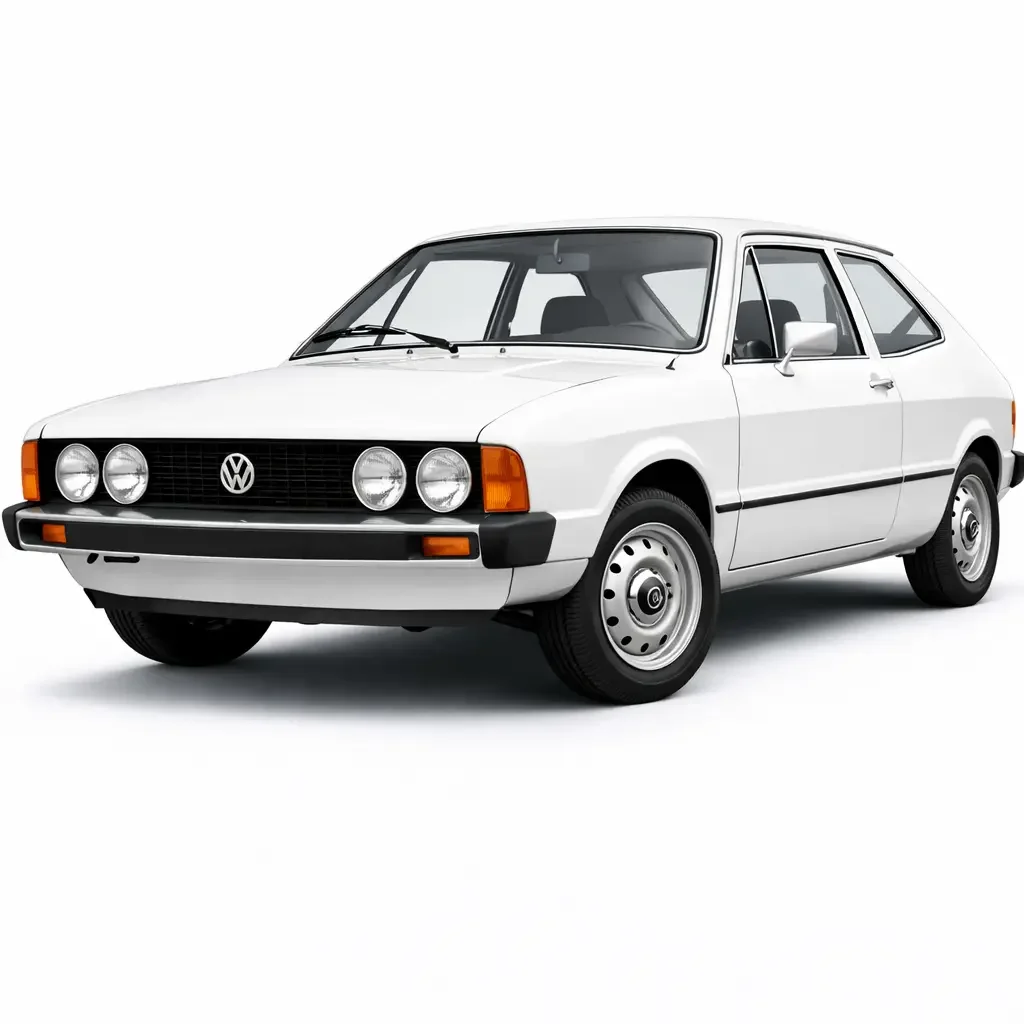
The front wings, front hood, front valance, front bumper, door skins, door glass, door seals, rear hatch, rear hatch glass, rear hatch seal, rear bumper, rear wings, and all window trim are Scirocco-specific items. The Scirocco's roofline, greenhouse, and overall body profile are a low fastback coupe design with a steeply raked windshield, B-pillar, and rear hatch, nothing like the upright Golf hatchback silhouette. Any listing that cross-references a Golf Mk1 front wing, hood, or door skin to the Scirocco is incorrect. The body cross-reference pool for exterior components is Scirocco Mk1 specific, full stop, with no application to any other vehicle in the A1 family.
The one partial exception is the Scirocco's relationship to the Golf Cabriolet, also assembled by Karmann. The Cabriolet shares some Karmann assembly tooling heritage with the Scirocco but uses a different body structure reinforced for convertible operation. Exterior body panels do not cross between the Cabriolet and the Scirocco. Some interior trim items and switchgear sourced from the same Karmann trim suppliers may share part numbers, but these must be confirmed individually rather than assumed as a general cross-reference.
US Market Engine Matrix: A Moving Target Across Seven Model Years
The US market Scirocco Mk1 used a different engine almost every model year across the 1975 to 1981 production window, making engine displacement and fuel system the most critical qualifiers in the entire catalog. No single engine specification applies across the full window. Every engine, intake, exhaust, ignition, and fuel system component listing must carry at minimum a year-range qualifier, and many require engine code confirmation.
1975: 1.5-litre (1,471cc) carbureted engine with single Solex carburetor, 70 PS European or approximately 70 bhp US gross. Four-speed manual standard.
1976 to 1977: 1.6-litre (1,588cc) carbureted engine, 76 hp (57 kW) for the US market in standard trim. The fuel-injected GTi variant with the 110 PS 1.6-litre Bosch K-Jetronic mechanical fuel injection was available in Europe from 1976 but was not sold in the standard US market lineup in this period.
1978: Back to a 1.5-litre (1,457cc) carbureted engine for the US market, a displacement reduction driven by emissions certification requirements. This is a different 1.5-litre specification from the 1975 engine, with slightly smaller displacement and different carburetor calibration. Engine and fuel system components for 1978 do not cross to 1975 despite both being labeled 1.5-litre.
1979 to 1980: 1.6-litre (1,588cc) carbureted engine returns for the US market. Five-speed manual available as an option from 1979. This is the same basic engine family as 1976 to 1977 but with updated emissions equipment for late 1970s US certification requirements.
1981: 1.7-litre (1,715cc) engine unique to the US market Scirocco in this generation. This engine is specific to the US market final year of the Mk1 and does not apply to any other model year or to European market Sciroccos. Five-speed manual becomes standard. Engine components for the 1.7-litre 1981 US Scirocco are specific to this engine and must not be cross-referenced to the 1.6-litre applications from prior years without part number confirmation.
The engine displacement changes across this seven-year window are not incremental refinements of the same engine. Several of them represent certification-driven substitutions where VW adapted the available EA111 engine family to meet US market requirements for that specific year. A seller who lists a single engine specification as applying to the full 1975 to 1981 US Scirocco range will be wrong for the majority of those model years simultaneously.
European Versus US Market Specification
The European and US market Sciroccos of the same model year often used different engines, different headlight configurations, different bumper designs, and different emissions equipment. The most significant European-exclusive powertrain in the Mk1 window is the Scirocco GTi with the 110 PS 1.6-litre Bosch K-Jetronic mechanical fuel injection engine. This is a carbureted versus fuel-injected split, and the K-Jetronic system with its continuous injection fuel distributor, fuel accumulator, cold start valve, warm-up regulator, and associated fuel delivery components has no cross-reference to the carbureted US market Sciroccos of the same years.
The headlight situation is one of the most visually distinctive US versus European differences on the Mk1. European models could be specified with two rectangular headlights on the TS and other higher-specification trims. US DOT regulations in the late 1970s required four round sealed beam headlights on vehicles where rectangular headlights were not yet DOT-approved in the specific size used by VW. All US market Sciroccos therefore use four round headlights, giving them a different front-end appearance from some European variants. Headlight housings, headlight bezels, and front grille trim are therefore market-specific: European two-round or two-rectangular headlight configurations do not apply to US market Sciroccos, and US four-round configurations do not apply to European models with the rectangular specification.
Bumpers also differ by market and by year within the Mk1 production run. Chrome bumpers with rubberized end caps were used on earlier production. A plastic-coated one-piece wraparound bumper replaced them during the Mk1 production period. US market cars received this bumper change at a different point than European market cars, and the specific bumper construction differs between the two markets due to impact energy absorption requirements. Bumper and bumper bracket listings must specify both market and production year.
Year-Specific Body and Trim Changes Within the Mk1
Several running production changes create catalog boundaries for specific body and trim components within the 1975 to 1981 Mk1 window. These affect sellers who carry exterior trim and glass components for the Scirocco restoration market.
From the 1976 model year, the dual windshield wiper system was replaced by a single large wiper that parks on the passenger side of the windscreen. Wiper mechanisms, wiper arms, and wiper blades for 1975 and pre-change production are different from 1976 and later single-wiper specification. A seller listing wiper components for the Mk1 Scirocco must apply a 1975 dual-wiper versus 1976 and later single-wiper qualifier.
For the 1978 model year, the separate front side marker lamp and turn signal were combined into a single wraparound orange lens unit. Front turn signal and side marker lamp housings, lenses, and associated trim from pre-1978 production do not apply to 1978 and later, and vice versa. Any front signal lamp listing for the Mk1 Scirocco must specify pre-1978 separate versus 1978 and later combined configuration.
Also in 1978, the B-pillar color changed from body color to black, a cosmetic change considered to improve the visual profile of the car. This is a factory paint and trim specification, not a parts boundary, but restorers seeking concours-correct specification must know the pre-1978 versus post-1978 B-pillar treatment.
In 1979, the one-piece flag-style exterior door mirrors were replaced by a two-piece shrouded mirror design. Mirror assemblies, mirror housings, and mirror mounting hardware for pre-1979 and 1979 and later are different specifications.
Cross-Reference Logic: What Crosses, What Does Not
The practical catalog structure for the Mk1 Scirocco divides into two clean pools with a hard boundary between them. Everything below the body, meaning the engine, transmission, front and rear suspension, brakes, and steering, crosses to the Golf Mk1 and Rabbit pool for the same model year and engine specification. Everything at or above the body structure, meaning exterior body panels, glass, body seals, exterior trim, headlights, bumpers, and body-mounted interior trim, is Scirocco-specific with no cross-reference to any other A1 platform vehicle.
Within the mechanical pool, engine specifications must be matched by displacement and fuel system type to the correct Golf Mk1 or Rabbit application. The 1.6-litre carbureted Scirocco of 1979 to 1980 crosses to the 1.6-litre carbureted Golf Mk1 and Rabbit of the same years for all engine internal, carburetor, ignition, and exhaust components. The 1.7-litre 1981 US Scirocco does not cross to any European Golf Mk1 or standard Rabbit, as this displacement was not used on those models in that configuration. The 1.7-litre is a US-market-specific engine and its parts pool is comparatively narrow.
The suspension hardware cross-reference is the most commercially productive for sellers, because front strut inserts, front coil springs, front lower control arms, front ball joints, front anti-roll bar links, rear shock absorbers, and rear wheel bearings are all confirmed Golf Mk1 and Rabbit cross-references. Suspension parts suppliers who do not specifically list Scirocco fitment almost universally cover the Golf Mk1, and the Scirocco can be served from that confirmed pool. Sellers who surface this cross-reference explicitly in their Scirocco listings will capture buyers who might otherwise not find applicable parts.
Common ACES/PIES Catalog Mistakes for the Scirocco Mk1 (1975 to 1981)
1. Cross-referencing Golf Mk1 or Rabbit exterior body panels, hood, wings, doors, or rear hatch to the Scirocco. The Scirocco's Karmann-built body shares no exterior sheetmetal with the Golf hatchback. These are entirely different body structures with different stampings, different panel geometry, and different glass.
2. Applying a single engine specification to the full 1975 to 1981 US market Scirocco range. The US market used 1.5-litre, 1.6-litre, and 1.7-litre engines across this window, with a 1.5-litre substitution in 1978 interrupting the 1.6-litre run. Every engine, carburetor, and fuel system listing must carry a model year qualifier.
3. Cross-referencing European GTi fuel injection components to carbureted US market Sciroccos. The European Scirocco GTi used Bosch K-Jetronic mechanical fuel injection. No US market Scirocco in the 1975 to 1981 window used this fuel injection system. K-Jetronic fuel distributor, accumulator, cold start valve, and related components do not apply to any US market Mk1 Scirocco.
4. Applying 1978 and later combination wraparound turn signal and side marker lenses to pre-1978 Sciroccos. The pre-1978 front uses separate side marker and turn signal housings. The 1978 and later single combined wraparound lens is a different housing that does not fit the earlier aperture.
5. Listing pre-1976 dual wiper arm and mechanism for 1976 and later Sciroccos. The single large wiper system introduced for 1976 uses different motor, linkage, wiper arm, and blade geometry from the dual system used in 1975.
6. Applying pre-1979 flag-style mirror assemblies to 1979 and later Sciroccos. The two-piece shrouded mirror introduced in 1979 is a different assembly from the one-piece flag mirror used in earlier production.
7. Applying the 1981 1.7-litre engine components to any other model year. The 1.7-litre is a US-specific engine used only in the final year of Mk1 production. Pistons, cylinder head gaskets, and carburetor specifications for the 1.7-litre are distinct from all 1.5-litre and 1.6-litre applications.
8. Cross-referencing US market four-round headlight housings to European market Sciroccos with two-rectangular or two-round headlight configurations. Market-specific headlight housing geometry differs between the US and European front-end specifications.
9. Not distinguishing the standard solid front rotors from the GTi ventilated front rotors. Although both measure 239mm in diameter, the solid and ventilated rotor specifications require different brake pad formulations and the rotor itself is a different part. Standard Scirocco listings must specify solid; GTi listings must specify ventilated.
10. Treating the Scirocco as simply a Golf with a different body and applying Golf Mk1 cross-references without qualification to all categories. The body, glass, seals, bumpers, lights, and exterior trim are all Scirocco-specific. Only the mechanical underbody, powertrain, and suspension components apply from the Golf Mk1 cross-reference pool, and these require year and engine matching before the cross-reference is valid.
Catalog Checklist for the VW Scirocco Mk1 (1975 to 1981)
• Apply model year as the mandatory first qualifier for all engine, carburetor, fuel system, and ignition component listings; six of the seven US market model years use a different engine specification
• Apply the Golf Mk1 and Rabbit cross-reference pool to all suspension, brake, steering, and powertrain underbody mechanical listings, with model year and engine specification matched to the applicable Golf Mk1 or Rabbit application
• Apply Scirocco-specific qualifier to all exterior body panel, glass, seal, bumper, headlight, and exterior trim listings; these do not cross to any other A1 platform vehicle
• Apply standard solid rotor versus GTi ventilated rotor qualifier to all front brake component listings
• Apply 1975 dual-wiper versus 1976 and later single-wiper qualifier to all wiper mechanism, arm, and blade listings
• Apply pre-1978 separate versus 1978 and later combined front signal and side marker lamp qualifier to all front lighting component listings
• Apply pre-1979 flag mirror versus 1979 and later shrouded mirror qualifier to all exterior mirror listings
• Apply US market versus European market qualifier to all headlight housing listings; US cars use four round headlights throughout; European cars may use two rectangular headlights on some trim levels
• Apply four-speed pre-1979 versus five-speed 1979 to 1980 optional versus five-speed standard 1981 qualifier to all transmission-type-specific drivetrain service component listings
• Note the 1.7-litre 1981 US engine as a US-market-specific application with a narrow parts pool; do not cross-reference 1.7-litre components to any 1.5-litre or 1.6-litre application
Final Take
The Scirocco Mk1 is the A1 platform application that most consistently falls through the catalog gap between Golf-focused sellers and air-cooled VW specialists. It is neither old enough nor rare enough to attract the dedicated restoration catalog coverage of the pre-war and early postwar cars, and it is too different in body to benefit cleanly from a Golf-oriented catalog that does not specifically call out the Scirocco. The result is that Scirocco owners routinely encounter either the wrong parts or no parts at all when shopping in catalogs that have not explicitly addressed the Scirocco's split identity.
That split identity is the defining catalog principle: below the body, the Scirocco is a Golf; above the body, it is its own animal. A seller who applies Golf Mk1 mechanical cross-references for underbody components and maintains a Scirocco-specific pool for exterior body items, with the wiper, lamp, and mirror year boundaries applied correctly within the body pool, will serve the Scirocco restoration and maintenance market with a precision that the majority of current catalog structures do not achieve.
The US market engine displacement instability across seven model years is the secondary discipline, and it is where the most embarrassing incorrect parts tend to ship. The 1978 reversion to a different 1.5-litre configuration is the specific year that catches sellers who assume the 1976 to 1977 1.6-litre simply continued. It did not. A seller who applies the model year engine lookup correctly, and maintains distinct engine pools for each of the US market configurations, will avoid those returns entirely.
Disclaimer: This guide is based on publicly available specifications, manufacturer documentation, and independent research. Part interchangeability should always be confirmed via VIN, engine code, and OEM part number lookup. US and European market specifications differ and must be confirmed before cross-referencing between markets. This document does not constitute official Volkswagen parts catalog data.