
Written by Arthur Simitian | PartsAdvisory
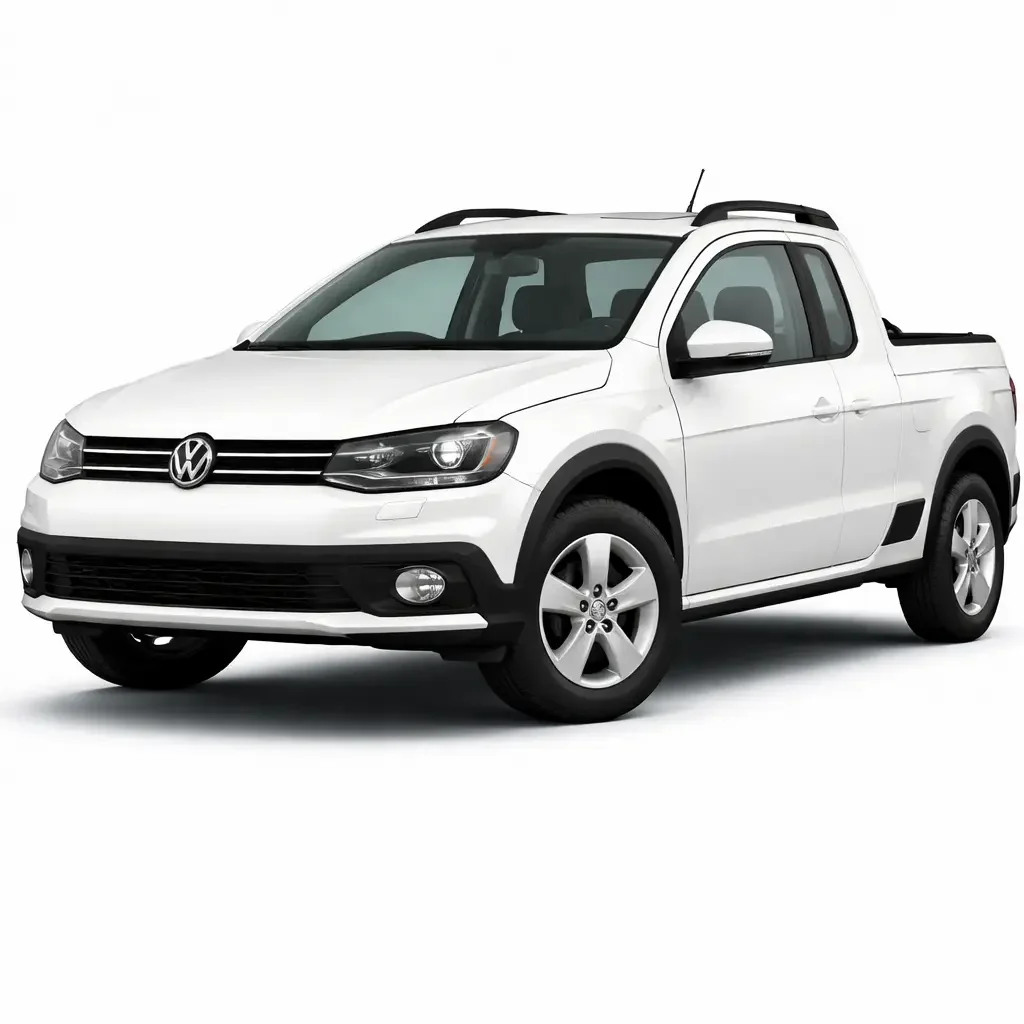
The Volkswagen Saveiro built between 2014 and 2016 represents the middle chapter of the third-generation pickup's lifecycle in Brazil. Riding on the same PQ24 platform that debuted with the G5 Saveiro in 2009, this window is defined by two simultaneous changes that matter enormously for parts fitment: the adoption of the G6-generation body styling introduced at the 2012 Sao Paulo Motor Show, and the addition of the 1.6L MSI engine alongside the continuing 1.6L VHT. Those two engine codes are the single most important fitment qualifier in this window. A catalog that collapses them into one entry, or that reads MSI power output as interchangeable with VHT specifications, will generate returns on fuel system, ignition, and intake components every time.
This guide covers platform continuity, the G6 facelift boundaries, both engine specifications, mandatory safety equipment changes that took effect in 2014, cab and trim configuration splits, and the ACES/PIES catalog errors most commonly attached to this generation.
Platform Identity and Generation Boundaries
The 2014 to 2016 Saveiro continues on the PQ24 platform without modification to the underbody architecture. The wheelbase remains 280 mm longer than the Gol and Voyage hatchback, a Saveiro-specific dimension introduced when the third generation launched in August 2009. The front suspension is MacPherson strut, shared with the Gol G5 and G6 hatchback and the Voyage sedan. The rear suspension is a solid axle with coil springs, and this is a fundamental distinction from the Gol hatchback rear setup. Catalogs that pull cross-references from Gol G6 hatchback to Saveiro rear suspension are incorrect for this reason; the body and underhood architecture may overlap, but the rear axle does not.
The generation designation requires clarity. The third-generation Gol and Saveiro family uses an internal Brazilian market shorthand of G5 for the original 2009 to 2012 body and G6 for the facelifted 2013 onward body. When sources cite the 2014 to 2016 Saveiro as G6, they are referring to the facelift body style, not a new platform or a new generation. The PQ24 platform, the 5Z chassis code family, and the core dimensional specifications carry through without interruption from G5 to G6. Parts that are platform-based and dimension-based, such as the front subframe, steering rack, front hub and bearing, brake master cylinder, and fuel tank, do not change at the G6 facelift boundary.
The G6 facelift itself, applied to the Gol hatchback at the 2012 Sao Paulo Motor Show, brought more angular front headlights and tail lights styled in reference to the sixth-generation Jetta, a revised front grille, and interior updates including improved material texture on the dashboard and revised air vent and instrument cluster layout. The Saveiro received this same visual update, which means the body panels forward of the firewall, the front fascia components, and the lens and housing designs for both front and rear lighting changed at the 2013 model year boundary. Fitment of pre-facelift G5 body panels onto G6 vehicles is not straightforward and in most cases produces alignment gaps.
The upper boundary of this window is 2016. The second facelift, referred to as G7, arrived in 2016 and brought a new dashboard design oriented around modern infotainment integration, a new front-end styling update inspired by the fifth-generation Polo and seventh-generation Golf, and a new 1.0L three-cylinder EA211 engine option. The 2016 G7 Saveiro is outside the scope of this guide. Catalogs that extend the MSI and VHT 1.6L engine listings into the G7 window without qualification are making an assumption that may not hold once the EA211 begins to appear in fleet.
Engine Codes and the MSI/VHT Split
The introduction of the 1.6L MSI alongside the continuing 1.6L VHT is the defining catalog challenge for this window. Both engines are 1.6L inline-four flex-fuel units. Both are longitudinally mounted in the same engine bay. From the outside, the vehicles look identical. However, the fuel delivery architecture, the injection timing strategy, and the power output are different enough that fuel system, ignition system, and intake manifold components must be listed separately by engine designation.
1.6L VHT (Carry-Over)
VHT stands for Vantagem em Horsepower e Torque. The 1.6L VHT was the sole engine in the G5 Saveiro from 2009 through 2012, and it continued as an available option into the G6 window. Running on gasoline it produces 101 horsepower and 154 Nm of torque at 2,500 rpm. On ethanol it produces 104 horsepower and 156 Nm at 2,500 rpm. The VHT uses multi-point injection but with a different calibration strategy than the MSI. Peak torque arriving at 2,500 rpm is an important operating characteristic for a truck used in load-carrying duty cycles, and VHT-equipped Saveiros remained in production through this window for buyers and fleet operators who preferred that low-end torque delivery.
1.6L MSI (New in this Window)
MSI stands for Multi-point Sequential Injection. The 1.6L MSI produces 110 horsepower on gasoline and 120 horsepower on ethanol, with torque figures of 158 Nm on gasoline and 168 Nm on ethanol, both at 3,000 rpm. The sequential injection architecture sequences injector firing individually to each cylinder based on the intake stroke rather than firing in paired or grouped batches. This produces more precise fuel metering, which accounts for the higher peak power figure. However, it also means the injectors, fuel rail, injection control module calibration, and associated sensors are not interchangeable with VHT components even though both engines share the same displacement and flex-fuel capability.
Torque peak shifts from 2,500 rpm on the VHT to 3,000 rpm on the MSI. This is a meaningful operating difference for a light truck, and Brazilian buyers and fleet managers were aware of it. The VHT remained the lower-cost option and continued to be sold in this window; the MSI was positioned as the higher-performance specification.
For catalog purposes, every fuel system component, injector, fuel pressure regulator, injection control module, air intake sensor, and throttle body assembly must carry a sub-application note specifying VHT or MSI. Listings that apply a single entry to both engines are structurally incorrect for this window and for all subsequent windows where both engines co-exist in the Saveiro lineup.
Shared Engine Components
The two engines do share components where the architecture converges. Both use the same engine block displacement and bore/stroke family. Both are flex-fuel and share the same flex-fuel sensor and compatible fuel tank lining. Both use the same engine mounts in the G6 Saveiro application. Both use compatible accessory belt routing with the same alternator bracket geometry. Listings for these components can reasonably apply to both engine codes provided the catalog note specifies that the application is for the 1.6L engine family in the G6 Saveiro and that fuel system components are excluded from the cross-application.
Flex-Fuel Specification
Both the VHT and MSI engines in the 2014 to 2016 Saveiro are total flex-fuel units compatible with any blend of gasoline and ethanol from E20 through E100. Volkswagen Brazil introduced flex-fuel in the Gol family in 2003, and by the time of this Saveiro window it is a standard, non-optional feature of every drivetrain in the Brazilian market lineup.
Flex-fuel compatibility has direct implications for parts fitment. The fuel system components, including fuel lines, fuel pump assembly, fuel injectors, and fuel rail seals, must be rated for ethanol exposure and for the corrosive properties of high-ethanol blends. Parts sourced from European Gol or Polo applications, which are gasoline-only, are not compatible even when the displacement and injection configuration appear similar. Parts sourced from the Mexico Gol Sedan application, which uses gasoline-only specification throughout its production life, are similarly incompatible with the Brazilian flex-fuel fuel system.
Catalogs that pull cross-references from European or Mexican PQ24-platform vehicles into Brazilian Saveiro fuel system listings must tag those entries with a market-of-origin qualifier or exclude them entirely from the flex-fuel application. The consequence of omitting this qualifier is that a customer running E85 or E100 fuel in a Saveiro will receive a gasoline-rated fuel pump or injector seal that will degrade on contact with high ethanol concentration.
Transmission
The 2014 to 2016 Saveiro is offered exclusively with a five-speed MQ200 manual transmission. No automatic or automated-manual option is available in this window for the Saveiro. This is a carry-over from the G5 generation. The MQ200 is a compact, light-duty unit well suited to the Saveiro's gross vehicle weight and payload capacity. It mates to both the VHT and MSI 1.6L engines through the same clutch housing and bellhousing interface.
Clutch disc and pressure plate assemblies must be specified by engine code in this window. The MSI produces higher peak torque than the VHT, and while the MQ200 unit is shared, the clutch clamping force and disc friction material specification may differ between the two applications. Listings that apply a single clutch assembly to both engine codes without qualification should be flagged for engineering review.
Brakes and Mandatory Safety Equipment
The brake configuration in this window is front disc and rear drum, unchanged from the G5 Saveiro. The front disc rotors and calipers are shared with the Gol G6 front axle, and this cross-reference holds. The rear drum assemblies are Saveiro-specific due to the solid rear axle geometry, and cross-references to Gol G6 rear drums should not be applied without confirming that the drum diameter and wheel cylinder bore specification match the solid axle fitment rather than the Gol independent rear geometry.
A significant change took effect at the 2014 model year boundary. Brazilian federal law mandated ABS brakes and dual front airbags as standard equipment on all new passenger and light commercial vehicles beginning in 2014. The last G4-generation Gol and Saveiro models were discontinued in early 2014 in part because the cost of upgrading the older platform to meet this requirement was not commercially viable. All G6 Saveiro models produced from the 2014 model year onward are therefore equipped with ABS and dual front airbags as standard equipment.
This has direct catalog implications. ABS wheel speed sensors, ABS control modules, ABS hydraulic modulators, and airbag system components, including the airbag clock spring, inflator units, and impact sensors, are legitimate fitment categories for all 2014 to 2016 Saveiro applications. Catalogs that omit these categories from the G6 Saveiro because the G5 generation listed the ABS as optional rather than standard are out of date for this window. Conversely, catalogs that attempt to list pre-mandate ABS or airbag components from early G5 production as compatible with G6 applications should verify that the control module firmware and sensor specifications match before extending the cross-reference.
Cab Configurations and Payload Ratings
The 2014 to 2016 Saveiro is available in three cab configurations: single cab, extended cab, and double cab. The single cab provides a standard two-door layout with the full cargo bed length and a rated payload capacity of 715 kilograms. The extended cab adds a small secondary seating area behind the front seats, accessed by a secondary door or jump seat depending on trim, and carries a rated payload of 700 kilograms. The double cab provides four doors and a shorter cargo bed and carries 660 kilograms.
For catalog purposes, cab configuration affects sheet metal, door assemblies, door glass, door seals, and interior trim panel fitment. The wheelbase is shared across single and extended cab configurations; the double cab uses a longer wheelbase. This means that running gear components, suspension, steering, brake, and drivetrain parts, apply uniformly across single and extended cab but the double cab should be confirmed separately for any component that is dimension-sensitive relative to wheelbase. In practice, for suspension and brake hardware the double cab shares the same components, but it is better practice to call out the cab configuration in the application listing than to assume uniformity.
Trim Levels
Three trim levels are offered within the 2014 to 2016 Saveiro lineup. The base trim is identified by black bumpers and 14-inch steel wheels. The Trend package adds 14-inch alloy wheels and color-coded exterior door handle and mirror covers. The Trooper is the top specification and features 15-inch alloy wheels and a more aggressive exterior appearance package.
Trim level is a catalog qualifier for wheels, wheel covers, exterior plastic cladding pieces, and in some cases for the specific alloy wheel hub bore and lug seat geometry if VW Brazil sourced different wheel suppliers for the 14-inch and 15-inch fitments. For mechanical components, trim level is not a primary qualifier unless the trim specifies a different engine, which it does not in this window. Both VHT and MSI engines were available across the trim range depending on market period and regional availability within Brazil.
Assembly and Market Notes
The 2014 to 2016 Saveiro was assembled at the Volkswagen do Brasil plant in Sao Jose dos Pinhais, Parana, Brazil. This is the same facility that produced the G5 Saveiro. The vehicle is a Brazil-market product and was not sold in North America, Europe, or Australia in this form. The Saveiro nameplate and the PQ24 platform appear in other South American markets, but engine specification, emissions compliance hardware, and fuel system components may differ by country even within the same platform.
Parts sourced for Brazilian-market vehicles must be verified against the Brazilian flex-fuel and Brazilian PROCONVE emissions standards. Catalogs that present European Golf-based or European Polo-based PQ24 components as interchangeable with Brazilian Saveiro components without market qualification are not reliable for fuel system, exhaust, and emissions hardware even when the displacement and body family appear to match.
Cross-References That Hold
Several cross-references from the G5 Saveiro carry forward into this window without qualification. The front MacPherson strut assembly, front control arm, front wheel bearing and hub, and front brake disc and caliper assembly all transfer directly from the G5 Saveiro to the G6 Saveiro because the platform and front axle geometry did not change at the facelift boundary. The steering rack and tie rod assemblies also carry through. The MQ200 transmission housing, gear cluster, and associated driveshaft flanges are unchanged.
For engine components shared between VHT and MSI, the engine mounts, timing belt, timing belt tensioner, water pump, thermostat housing, and accessory belt and tensioner assembly apply to both engine codes in the G6 Saveiro, provided the supplier has confirmed fitment against both calibration codes.
Front suspension cross-references to the Gol G6 hatchback and the Voyage G6 sedan hold for the components listed above. These vehicles share the same front axle architecture with the Saveiro, and their front suspension and brake hardware is genuinely interchangeable. This cross-reference stops at the firewall; rear suspension, rear brakes, and body panels do not cross between Saveiro and Gol or Voyage.
Cross-References That Do Not Hold
Rear suspension components from the Gol G6 hatchback do not fit the Saveiro. The Gol hatchback uses an independent rear suspension, while the Saveiro uses a solid rear axle. This is the most commonly incorrect cross-reference in the Brazilian economy vehicle segment of aftermarket catalogs, and it appears repeatedly in systems that pull Gol G5 and G6 rear suspension listings into the Saveiro application by vehicle family without checking the actual rear architecture.
Fuel system components from the G5 Saveiro VHT application do not cross to the MSI engine in this window. The injection control module, fuel injectors, fuel rail, and fuel pressure regulator are engine-code specific. A catalog that lists G5 VHT fuel system parts as compatible with G6 MSI applications is wrong on two dimensions simultaneously: the engine code is wrong, and for any injector or fuel control component, the injection strategy architecture is different.
Body panels from the G5 Saveiro (2009 to 2012) do not interfit cleanly with the G6 body (2013 to 2016). The facelift changed the front clip geometry, including the hood, fenders, headlight housings, front bumper cover, and associated mounting brackets. The doors, tailgate, cargo bed panels, and roof structure are unchanged between G5 and G6 and cross-references for those components are valid.
Fuel system components from the Mexico Pointer Pick Up application, which was the Saveiro equivalent sold in Mexico based on the G2-platform Gol, do not apply to this vehicle. The Mexico Pointer Pick Up is a different generation, a different platform, a different fuel system, and a gasoline-only application. Any catalog cross-reference between the Mexico Pointer Pick Up and the Brazilian G6 Saveiro requires engineering review before publication.
Common ACES/PIES Catalog Mistakes
1. Collapsing VHT and MSI engine codes into a single 1.6L entry. The displacement is identical but the injection architecture, power output, and fuel system component specifications are not. Every fuel system, injection system, and intake system listing for this window must carry the engine code as a required qualifier. Entries without engine code subdivision will generate mismatched injector and injection module returns.
2. Extending G5 VHT-only listings into the G6 window without noting the MSI availability. Catalogs built against the G5 Saveiro (2009 to 2012) had only one engine code to worry about. When those listings are rolled forward into the 2014 to 2016 ACES window without adding the MSI sub-application, the catalog is incomplete. Customers with MSI vehicles will either find no listing or will receive VHT parts that are incorrect for their injection system.
3. Applying Gol G6 hatchback rear suspension listings to the Saveiro by vehicle family. The Gol hatchback rear and the Saveiro rear are not the same architecture. The Gol uses independent rear suspension; the Saveiro uses a solid rear axle. Rear shock absorbers, rear springs, rear wheel bearings, and rear brake drums and shoes are not interchangeable. This error appears when catalog systems group the Gol family and Saveiro together at the model family level without checking the body style qualifier.
4. Omitting ABS and airbag component categories from the 2014 to 2016 Saveiro application. Pre-2014 G5 Saveiros had ABS as optional equipment. Post-mandate 2014 to 2016 G6 Saveiros have ABS and dual airbags as standard. Catalogs that carry forward a G5 listing structure without adding ABS wheel sensors, ABS modulator, clock spring, and airbag sensor categories are incomplete for this window.
5. Treating the G6 facelift front clip as interchangeable with G5 parts. The 2013 facelift changed the headlight housing geometry, the hood profile, the front fender shape, and the front bumper architecture. G5 front body panel listings extended into the G6 ACES window without a facelift qualifier will supply dimensionally incorrect parts. The rear body, cargo bed, and doors are unaffected and cross freely.
6. Applying European or Mexican PQ24 fuel system components to the Brazilian Saveiro without a market qualifier. The Brazilian market uses flex-fuel rated components throughout the fuel system. European market vehicles of the same platform family use gasoline-only rated materials in the fuel pump, injector seals, and fuel lines. The Mexico market Pointer and Gol Sedan applications are also gasoline-only. These components are not safe substitutes in high-ethanol fuel environments.
7. Misassigning the assembly origin to Argentina rather than Brazil. The G6 Saveiro was built in Sao Jose dos Pinhais, Parana, Brazil. The SpaceFox wagon, which shares the PQ24 platform and was sometimes sold alongside the Saveiro in regional Latin American markets, was assembled in General Pacheco, Argentina. Assembly origin matters for regulatory compliance documentation and for emissions component specifications that differ between PROCONVE (Brazil) and Argentine standards.
8. Cross-referencing the Amarok into G6 Saveiro suspension or brake listings. The Amarok is a completely different vehicle on a different platform with a different architecture at every system level. The Saveiro is a light duty PQ24 derivative; the Amarok is a body-on-frame midsize pickup. No mechanical component crosses between them. This error occurs when catalog systems search for Volkswagen pickup trucks by body style and group results without platform confirmation.
Pre-Listing Checklist for the 2014 to 2016 Saveiro
• Engine code confirmed as VHT or MSI before any fuel system, injection system, or intake component is listed
• Flex-fuel rating verified for all fuel system components; European and Mexican gasoline-only cross-references excluded from fuel system listings
• Facelift boundary confirmed: G6 body panels apply from 2013 onward; G5 front clip does not interfit
• Rear suspension listed specifically for solid rear axle; Gol G6 hatchback independent rear listings excluded
• ABS and airbag component categories included for all units in this window; pre-mandate optional-ABS structure not used
• Cab configuration (single, extended, double) noted for body panel, door, and glass listings; wheelbase confirmation for dimension-sensitive components on double cab
• Assembly origin recorded as Sao Jose dos Pinhais, Brazil; not General Pacheco, Argentina
• Upper window boundary set at end of 2016 G6 production; G7 facelift (new dashboard, EA211 engine) is a separate application
• No cross-reference to Amarok at any system level
Final Take
The 2014 to 2016 Volkswagen Saveiro is a well-defined catalog window with two primary fitment challenges: the VHT versus MSI engine split, and the G5-to-G6 body panel boundary. Every other complexity in this guide, the flex-fuel specification, the solid rear axle, the ABS mandate, the cab configuration splits, flows from those two entry points. A catalog that handles the engine code split correctly and marks the facelift boundary precisely will get the majority of part numbers right. A catalog that collapses the two engine codes or ignores the facelift boundary will generate returns on the components most frequently ordered: fuel system parts and body panels.
The PQ24 platform is one of the most widely produced light vehicle architectures in South American automotive history. Its longevity means that parts supply chains are generally well-established for the structural and suspension components. The engine code specificity required for the MSI introduction is the place where existing catalogs built against earlier Saveiro windows are most likely to be incomplete, and it is the place where a parts advisor will encounter the most customer friction if the listing does not distinguish between the two 1.6L applications.
Disclaimer
This guide is intended for catalog research, fitment analysis, and parts advisory reference. Production specifications, option availability, and regulatory compliance requirements vary by model year, regional market, and assembly date within any given window. Always confirm application data against vehicle identification number decoding, factory build sheets, and OEM parts documentation before finalizing a listing or parts recommendation. PartsAdvisory and its contributors are not responsible for fitment errors arising from catalog data that has not been independently verified against physical vehicle inspection or official OEM sources.