
Written by Arthur Simitian | PartsAdvisory
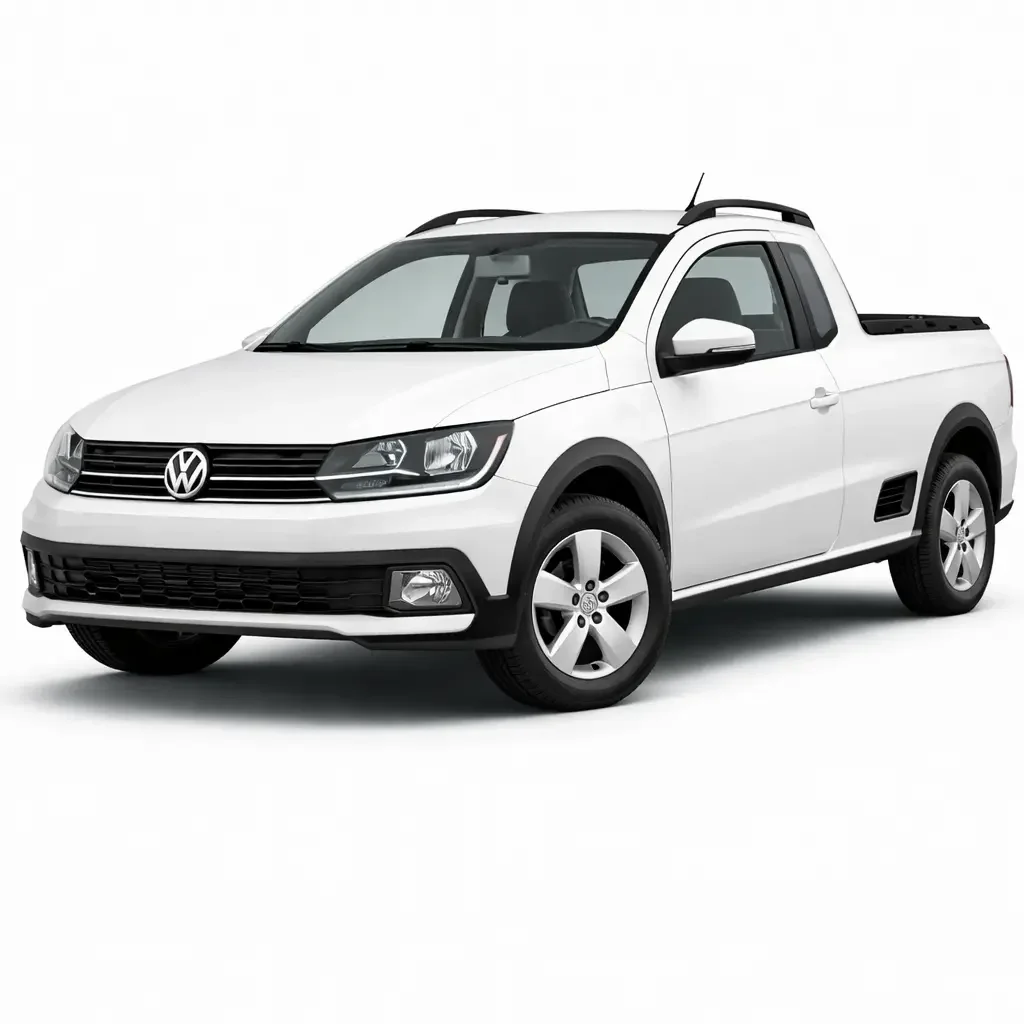
The Volkswagen Saveiro built from 2017 through 2023 is the final window of the third-generation platform that launched in Brazil in 2009. It spans two distinct facelift events, the G7 update that arrived in 2017 and the minor G8 update that followed in 2018, and it ends with a vehicle that in 2023 was the last survivor of an entire family line. The Gol hatchback ended production in late 2022. The Voyage sedan went with it. The Saveiro kept going, outliving both siblings, and received a further refresh in August 2023 that defines the separate post-2023 window covered in the next guide in this series.
For catalog purposes this window has a deceptively simple engine story. The 1.6L MSI, which is the four-cylinder naturally aspirated member of the EA211 engine family as applied in Brazil, is the only engine available in the Saveiro throughout the entire 2017 to 2023 span. No 1.0L three-cylinder was offered in the Saveiro during this window despite the Gol G7 adding that engine to the hatchback lineup. The EA211 1.6L in the Saveiro is a flex-fuel unit rated at 110 horsepower on gasoline and 120 horsepower on ethanol. That single engine code governs every fuel system, injection, and ignition listing in this window. The fitment complexity is concentrated elsewhere: in the two facelift boundaries, in the trim and cab configuration matrix, and in the cross-reference errors that accumulate when a platform outlives its sibling vehicles and catalog systems stop updating it.
Platform Identity and Window Boundaries
The 2017 to 2023 Saveiro sits on the same PQ24 platform carried through every generation since the G5 launch in 2009. The wheelbase, the 5Z chassis code family, the front MacPherson strut geometry, the solid rear axle architecture, and the front-wheel-drive drivetrain are all unchanged from the G5 and G6 windows. A catalog entry that correctly identifies a 2015 Saveiro front strut assembly will fit a 2020 Saveiro front strut assembly. Platform-based cross-references from the prior window carry forward without amendment for structural and suspension components.
The lower boundary is the 2017 G7 facelift. Competition from the Renault Duster Oroch and the Fiat Toro prompted Volkswagen do Brasil to refresh the Saveiro with styling elements drawn from the 2016 Gol G7, which itself referenced the seventh-generation Golf and fifth-generation Polo design language. The G7 Saveiro received new headlight housings, a revised taller grille, new character lines on the hood, fog lights with cornering light function, and a substantially redesigned interior. The dashboard was replaced with a Passat and Golf-influenced design featuring square air vents in place of the round flappy vents of the G6 generation, a new steering wheel, aluminum-finish pedal covers, and an infotainment system with a phone cradle and improved connectivity.
The G8 update arrived in 2018 and is primarily a powertrain-adjacent event in the Gol hatchback context rather than a Saveiro-specific redesign. For the Gol, the G8 introduced a six-speed automatic transmission option paired to the 1.6L EA211. For the Saveiro, the transmission remained a five-speed MQ200 manual throughout. The G8 label in the Saveiro context refers to the minor cosmetic updates that accompanied the 2018 model year introduction rather than a fundamental body or mechanical change. Some catalog and technical database sources describe the 2017 onward Saveiro as a single facelift generation without subdividing G7 and G8; for parts fitment purposes this approach is acceptable because no mechanical changes separate the two within the Saveiro lineup.
The upper boundary of this window is the end of the 2023 model year, just before the August 2023 facelift that introduced the Robust, Trendline, and Extreme trim structure and made further front-end styling changes. The 2024 and onward Saveiro is a separate ACES window. Catalogs that extend 2017 to 2023 G7 and G8 body panel listings into the 2024 window will supply incorrect front clip components.
Engine: 1.6L MSI EA211 Only
The 1.6L MSI is the sole engine available in the Saveiro for the entire 2017 to 2023 window. MSI designates Multi-point Sequential Injection. The engine belongs to the EA211 four-cylinder family as applied to Brazilian market flex-fuel applications. The rated output is 110 horsepower on gasoline and 120 horsepower on ethanol, with torque of 158 Nm on gasoline and 168 Nm on ethanol at 3,000 rpm. These figures are unchanged from the MSI introduction in the prior G6 window.
A critical clarification is required here regarding the EA211 family name and what it does and does not include in the Saveiro application. The EA211 is a modular engine family encompassing inline-three and inline-four petrol engines developed by Volkswagen Group. In European and global markets, the EA211 family is best known for the 1.0L TSI three-cylinder that appeared in the Polo and Golf from 2015 onward, and for various 1.2L and 1.4L TSI four-cylinder turbocharged variants. The Brazilian market application of the EA211 is different in character: the Saveiro uses a naturally aspirated 1.6L four-cylinder variant, not turbocharged, running on flex-fuel, and sharing only the family architecture and the cylinder spacing with the European turbocharged members. Catalogs and parts advisors who see EA211 and cross-reference to 1.0L TSI or 1.4L TSI components from European applications will generate wrong parts.
As of late 2024, Wikipedia notes that the Saveiro was the only vehicle in production equipped exclusively with the EA211 1.6L naturally aspirated flex-fuel variant. This uniqueness within the EA211 family is precisely why market-of-origin and fuel-system-type qualifiers matter for every fuel system component listed against this engine code. The engine has no turbocharged counterpart in the Saveiro. The 1.6L MSI does not use direct injection; it uses multi-point sequential indirect injection with intake manifold-sited injectors. Listings for direct-injection EA211 variants, whether 1.4 TSI or any other, do not apply to the Saveiro fuel system.
The 1.0L three-cylinder EA211 that entered the Gol G7 hatchback lineup does not appear in the Saveiro at any point in this window. This is a factual gap between the Gol sibling and the Saveiro that catalog systems building from Gol G7 engine lists into Saveiro applications will incorrectly fill. The Saveiro is a light-duty work truck; the 1.0L was not offered because the torque profile of a three-cylinder naturally aspirated engine is unsuitable for a pickup with a 700-kilogram payload rating.
Flex-Fuel Specification
Every 2017 to 2023 Saveiro is a total flex-fuel vehicle. The 1.6L MSI is calibrated and built to run on any blend from E20 gasoline-ethanol through E100 pure ethanol. This has been the standard specification for the Brazilian Saveiro since the flex-fuel mandate became universal in the G5 generation. All fuel system components, including the fuel pump assembly, fuel injectors, fuel rail seals, fuel pressure regulator, and fuel lines, must be rated for ethanol service. Parts sourced from European applications of the EA211 family are gasoline-only and are not safe substitutes in high-ethanol fuel environments.
The flex-fuel sensor, which reads the ethanol content of the fuel and communicates it to the injection control module, is a service item in this application. It is Saveiro-specific within the EA211 family because no European EA211 variant uses a flex-fuel sensor. Listings for the flex-fuel sensor must not be crossed to any European EA211 application.
Transmission
The Saveiro is offered exclusively with a five-speed MQ200 manual transmission throughout the 2017 to 2023 window. The six-speed automatic that the Gol G8 received in July 2018, paired to the 1.6L EA211, was not carried over to the Saveiro. This is a meaningful split between the Gol and Saveiro product lines that has direct catalog implications: any automatic transmission component listed from the Gol G8 or Gol G8 automatic application does not apply to the Saveiro in this window.
The MQ200 five-speed continues from the G5 and G6 windows without change. Clutch disc, pressure plate, release bearing, and clutch hydraulic components that fit the 2014 to 2016 Saveiro MSI application carry forward directly into the 2017 to 2023 window.
Suspension and Rear Axle Architecture
The front suspension remains a MacPherson strut shared with the Gol G6 and G7 hatchback and the Voyage. The front strut assembly, front control arm, front wheel bearing and hub, and front subframe are unchanged from the prior windows and carry valid cross-references to Gol G7 front suspension components.
The rear suspension is a solid axle with coil springs, unchanged across the entire third-generation Saveiro production run from 2009 through 2023. This is the most consequential structural difference between the Saveiro and every Gol hatchback generation. The Gol in all of its G5, G6, G7, and G8 forms uses independent rear suspension. The Saveiro does not. Any rear suspension component from any generation of the Gol hatchback is incorrect for the Saveiro rear end. This misapplication error does not diminish with age; if anything it increases because as the Gol was discontinued in 2022 and 2023, some catalog systems may have consolidated or simplified Saveiro rear suspension listings by proximity to the surviving Gol data.
Rear shock absorbers, rear springs, rear wheel bearings, rear axle bushings, and rear brake drum and shoe assemblies are all solid-axle specific and must not cross to Gol hatchback listings. Catalog systems that group the Saveiro with the Gol by model family without a body-style or rear-architecture qualifier at the component level will produce mismatched rear suspension parts on every order.
Brakes
The brake configuration is front disc, rear drum across the 2017 to 2023 window. This is unchanged from the G5 and G6 generations. Front disc rotor and caliper cross-references to the Gol G7 front axle hold. Rear drum assemblies are Saveiro-specific due to the solid rear axle and must not be crossed to Gol hatchback rear drum listings, which in any case are for independent rear geometry.
ABS and dual front airbags remain standard equipment in this window, as mandated by Brazilian law from the 2014 model year onward. ABS wheel speed sensor, ABS hydraulic modulator, ABS control module, airbag clock spring, airbag inflator units, and impact sensors are all valid service categories for every vehicle in this window.
Facelift Boundaries and Body Panel Fitment
Three facelift boundaries are relevant to body panel and exterior lighting fitment across the full Saveiro third-generation history, and understanding their sequence is essential for catalog accuracy in this window.
The G5 body (2009 to 2012) is the original third-generation front clip with round headlights in the style of the original G5 Gol. The G6 body (2013 to 2016) introduced more angular Jetta-influenced headlights and a revised front fascia. The G7 body (2017 to 2023) brought a further revision with a taller grille, new headlight design, revised hood character lines, and cornering fog lights. Each of these front clip generations is incompatible with the others at the panel and housing level.
For the 2017 to 2023 window specifically, the G7 headlight housing, front bumper cover, hood, and front fenders are the correct body panel listings. Catalogs that extend G6 front clip parts into the G7 window, or that show a single unified front clip application across all third-generation Saveiro years, are incorrect for front-end body and lighting components.
Rear body, cargo bed panels, tailgate, and doors are unchanged between G6 and G7 and carry valid cross-references across the 2013 to 2023 production span. The door glass, door seals, and door handle hardware are the same across G6 and G7 for the same cab configuration.
Cab Configurations and Trim Levels
The 2017 to 2023 Saveiro continues to offer single cab, extended cab, and double cab configurations. Single cab payload is rated at 715 kilograms, extended cab at 700 kilograms, and double cab at 660 kilograms. The wheelbase is shared between single and extended cab. The double cab uses a longer wheelbase.
The trim structure evolved over the course of this window. The G6 Startline, Trendline, Highline, and Cross trim names continued into the G7 period, though VW do Brasil periodically adjusted the lineup. The Cross variant, featuring protective body cladding and a silver chin spoiler in G7 form, is relevant for catalog purposes because it adds exterior plastic components that are Cross-specific and do not apply to standard Trendline or base trim vehicles. The Robust trim name appeared later in the window as a fleet-oriented entry-level designation.
Wheel specifications across this window: base and Trendline trims run 14-inch wheels, Cross and upper trims run 15-inch wheels. Alloy wheel hub bore and offset specs should be confirmed per trim against manufacturer documentation before listing wheel-centric hardware.
Gol and Voyage Discontinuation: Catalog Implications
The Gol hatchback ended production in late 2022. The Voyage sedan ended with it. A limited Last Edition run of 1,000 units was released for the 2023 model year, and then the Gol nameplate closed after 43 years of continuous production. The Polo Track replaced the Gol as Volkswagen do Brasil's entry-level offering.
The Saveiro continued in production after the Gol ended and received the August 2023 facelift as a standalone model. This creates a specific catalog risk: when parts databases update the Gol to end-of-production status, they may simultaneously stop extending cross-references and listing updates to the Saveiro, treating the entire PQ24 family as concluded. The Saveiro, however, was still in production and remains in production as of this writing in 2025. Any catalog that marks the Saveiro as discontinued at the same date as the Gol is factually incorrect.
A secondary risk is the reverse: some catalog systems may attempt to maintain Saveiro cross-references to Gol components that are no longer in production or no longer actively cataloged. When the Gol goes out of active parts supply, cross-references that relied on Gol availability for Saveiro fitment need to be re-sourced against Saveiro-direct OEM part numbers rather than expired Gol sibling references.
For front suspension components, which legitimately cross from Gol G7 to Saveiro G7, the issue is supplier catalog coverage rather than fitment accuracy. The fitment is correct; the supply chain question is whether suppliers who listed those parts as Gol G7 applications will maintain them after the Gol is discontinued. Parts advisors should verify active supply availability against Saveiro-specific part numbers where Gol cross-references are listed as the primary or only source.
Assembly and Market Notes
The 2017 to 2023 Saveiro was assembled at the Volkswagen do Brasil facility in Sao Bernardo do Campo, Sao Paulo, Brazil. This is a different facility than the Sao Jose dos Pinhais plant in Parana that produced the G5 Saveiro. Both facilities produce Brazilian-market flex-fuel vehicles under PROCONVE emissions standards. The change of assembly site does not affect component specifications.
The vehicle is a Brazil-market product throughout this window. It was not sold in North America, Europe, or Australia. The EA211 1.6L naturally aspirated flex-fuel variant used in the Saveiro is, as noted, a Brazil-specific application of the EA211 family and shares no fuel system, injection system, or emissions hardware with European EA211 applications.
Cross-References That Hold
Front MacPherson strut assembly, front control arm, front wheel bearing and hub, and front brake disc and caliper cross to Gol G7 hatchback front suspension. These are valid and accurate because the front axle geometry is shared. The cross-references also carry back through the G5 and G6 Saveiro windows for these same components, since the front axle was not revised at any facelift boundary.
Engine mounts, timing belt, timing belt tensioner, water pump, thermostat housing, and accessory belt assembly carry forward from the G6 MSI Saveiro window without change. The 1.6L MSI engine specification is identical between the 2014 to 2016 and 2017 to 2023 windows.
Clutch disc, pressure plate, and release bearing for the MQ200 five-speed manual carry forward from the G6 MSI Saveiro. No clutch system change occurred at the G7 facelift boundary.
Rear solid axle components, including rear shock absorbers, rear springs, rear axle bushings, rear drum assemblies, and rear wheel cylinder, are platform-consistent from G5 through the end of this window in 2023. These components are not shared with the Gol but they are unchanged across the full third-generation Saveiro production span.
Cross-References That Do Not Hold
Rear suspension from any generation of the Gol hatchback does not fit the Saveiro. The Gol uses independent rear suspension throughout its history. The Saveiro uses a solid rear axle throughout its history. This mismatch persists regardless of the facelift generation and regardless of whether the Gol is still in active production. It cannot be resolved by proximity of model year or by shared family designation.
European EA211 fuel system, injection, and intake components do not apply to the Brazilian MSI 1.6L flex-fuel application. The EA211 family name spans turbocharged direct-injection variants in Europe and a naturally aspirated multi-point sequential injection flex-fuel variant in Brazil. These are different engines in their fuel delivery architecture despite sharing family nomenclature.
The Gol G8 six-speed automatic transmission and its associated components, including the transmission fluid specification, the torque converter, and the transmission control module, do not apply to the Saveiro, which uses only the five-speed MQ200 manual in this window.
G6 front clip body panels, headlight housings, and front bumper covers do not fit the G7 front end. The G7 introduced a new grille opening geometry and headlight mounting points. Listings that run a single unified body panel application from 2013 through 2023 for Saveiro front clip components are incorrect at both the G6-to-G7 and G7-to-2024 facelift boundaries.
Amarok components at any system level do not apply. The Amarok is a body-on-frame midsize pickup on an entirely different platform with different architecture at every level.
Common ACES/PIES Catalog Mistakes
1. Listing the 1.0L EA211 three-cylinder as an available engine for the 2017 to 2023 Saveiro. The 1.0L three-cylinder appeared in the Gol G7 hatchback but was never offered in the Saveiro. Catalogs built from Gol G7 engine lists that fail to filter by body style will add this engine code to Saveiro applications in error. All engine-specific component listings in this window apply to the 1.6L MSI EA211 four-cylinder only.
2. Cross-referencing European EA211 fuel system components to the Brazilian MSI 1.6L. The EA211 family name causes this error repeatedly because catalog systems that carry EA211 as a global engine code will pull European 1.4 TSI or 1.0 TSI fuel system listings and suggest them as compatible with the Saveiro. The Saveiro EA211 1.6L uses multi-point sequential indirect injection with flex-fuel rated components. European TSI variants use direct injection and gasoline-only materials.
3. Applying Gol G7 rear suspension listings to the Saveiro by vehicle family. The G7 Gol hatchback and G7 Saveiro share the same front suspension and front brake architecture, but their rear ends are architecturally different. This error is structurally identical to the same mistake documented in the G5 and G6 guides and it persists regardless of generation because the root cause is a catalog grouping failure at the model family level.
4. Marking the Saveiro as discontinued at the same date as the Gol. The Gol ended production in late 2022 with a 2023 Last Edition. The Saveiro continued and received a new facelift in August 2023. Catalogs that close the Saveiro ACES window at the Gol's end-of-production date will exclude valid service applications for vehicles still on Brazilian roads and still in active production.
5. Using a single G6 plus G7 unified front clip body application from 2013 through 2023. The G7 facelift in 2017 changed the headlight housing geometry, the grille opening, the hood profile, and the bumper architecture. These are not minor skin changes; they require separate part numbers. A unified front clip listing across both facelift generations will supply G6 parts to G7 vehicles and G7 parts to G6 vehicles depending on which year is treated as the reference.
6. Applying Gol G8 automatic transmission components to the Saveiro. The Gol received a six-speed automatic in July 2018 as a G8 feature. The Saveiro did not receive this transmission. Transmission fluid specifications, torque converter listings, and transmission control module part numbers for the Gol G8 automatic do not belong in the Saveiro application.
7. Omitting the Cross trim as a distinct exterior sub-application. The Saveiro Cross in the G7 window adds body cladding, a chin spoiler, and exterior trim pieces that are Cross-specific. Listings for front bumper assemblies, lower bumper cladding, and side sill cladding that do not distinguish between Cross and non-Cross trim will supply either bare-bumper components to Cross vehicles or cladding-carrying components to base vehicles.
8. Extending G7 front clip listings into the 2024-onward Saveiro facelift window. The August 2023 facelift that defines the post-2023 Saveiro introduced new headlights, a new protruding bumper with a larger chrome grille, additional front cladding, and revised taillights. G7 front body panel listings stop at the end of the 2023 pre-facelift production run. The 2024 Saveiro is a separate ACES window.
Pre-Listing Checklist for the 2017 to 2023 Saveiro
• Engine confirmed as 1.6L MSI EA211 four-cylinder naturally aspirated flex-fuel; 1.0L three-cylinder and all turbocharged EA211 variants excluded from all listings
• Flex-fuel rating verified for all fuel system components; European TSI EA211 direct-injection components excluded
• G7 facelift boundary confirmed at 2017: G7 front clip (headlights, hood, bumper, grille) applies from 2017 through pre-August 2023; G6 front clip does not apply
• Upper window boundary set at pre-August 2023; the 2024 Saveiro facelift is a separate application
• Rear suspension listed for solid rear axle; Gol G7 hatchback independent rear listings excluded at all system levels
• Transmission confirmed as five-speed MQ200 manual only; Gol G8 six-speed automatic components excluded
• ABS and airbag component categories included for all vehicles in this window
• Cab configuration (single, extended, double) noted for body panel, door, glass, and interior trim listings
• Cross trim identified separately for exterior cladding and bumper assembly listings
• Saveiro end-of-production date not conflated with Gol end-of-production date; Saveiro continued after Gol discontinuation
• Assembly origin recorded as Sao Bernardo do Campo, Sao Paulo, Brazil
• No cross-reference to Amarok at any system level
Final Take
The 2017 to 2023 Saveiro is in some respects the most stable catalog window in the third-generation series. One engine, one transmission, a continuous platform. The complexity is concentrated in two places: the EA211 family name that invites incorrect European cross-references, and the Gol discontinuation that creates catalog maintenance risk as the sibling vehicle exits the market.
The EA211 naming problem is not going away. The engine family is globally recognized, heavily documented, and primarily associated with turbocharged European variants that share nothing with the Brazilian naturally aspirated flex-fuel 1.6L four-cylinder. Every fuel system listing for this Saveiro window needs a note that specifies the EA211 variant as the 1.6L naturally aspirated multi-point sequential injection flex-fuel Brazil-market application. That note is not boilerplate. It is the functional filter that prevents European TSI components from appearing in Brazilian Saveiro fuel system results.
The Gol discontinuation risk is a catalog maintenance issue that will compound over time. Suppliers who cataloged parts as Gol G7 applications will need to be evaluated for whether they also cover the Saveiro directly. Parts advisors servicing Saveiro owners through 2025 and beyond should be aware that some supply lines originally established through Gol cross-references may require re-sourcing against Saveiro-specific OEM part numbers.
Disclaimer
This guide is intended for catalog research, fitment analysis, and parts advisory reference. Production specifications, option availability, and regulatory compliance requirements vary by model year, regional market, and assembly date within any given window. Always confirm application data against vehicle identification number decoding, factory build sheets, and OEM parts documentation before finalizing a listing or parts recommendation. PartsAdvisory and its contributors are not responsible for fitment errors arising from catalog data that has not been independently verified against physical vehicle inspection or official OEM sources.