
Written by Arthur Simitian | PartsAdvisory
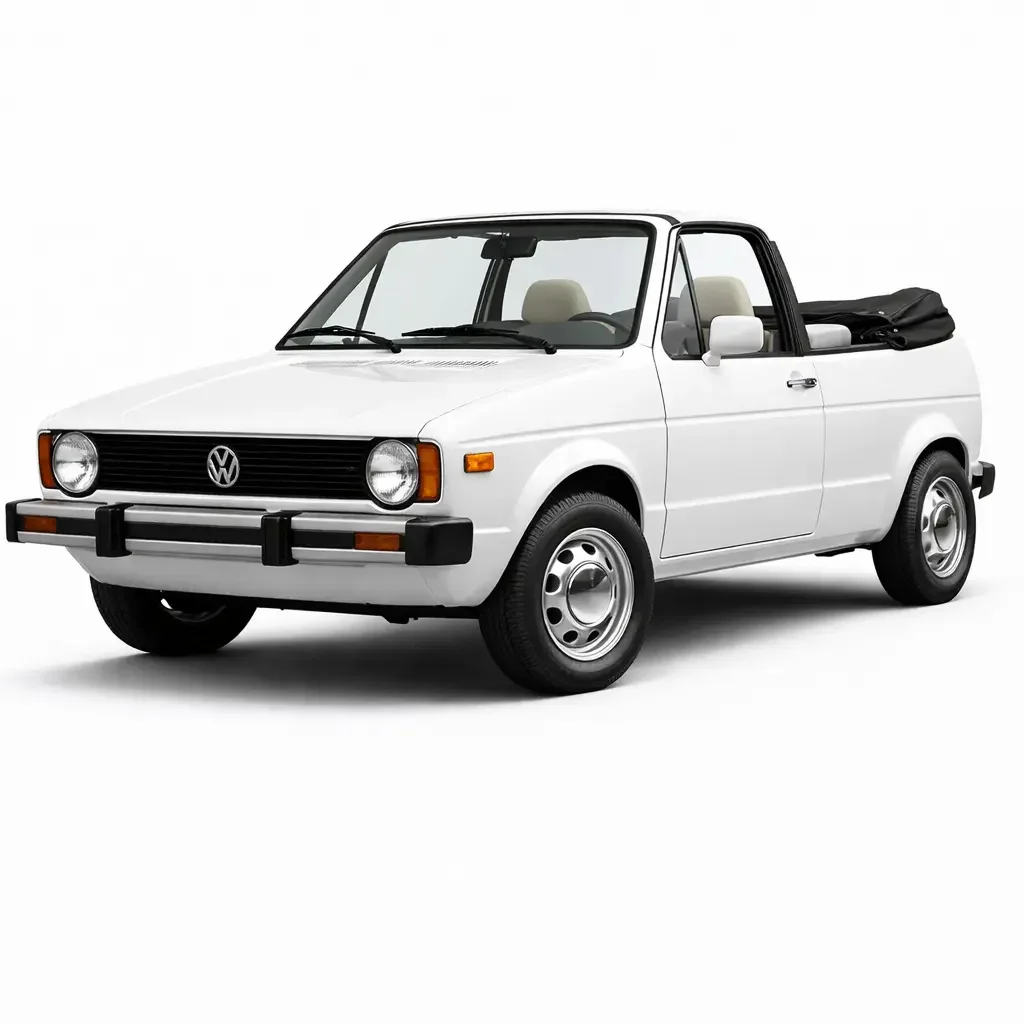
The Volkswagen Rabbit Convertible is the North American name for the Mk1 Golf Cabriolet, an open-top A1-platform vehicle built entirely by Karmann at their Osnabrück facility and sold in the United States and Canada from the 1980 model year through 1984, after which the same car continued in the North American market renamed simply as the Cabriolet through 1993. This guide covers the 1980 to 1984 Rabbit Convertible window specifically. The same platform, the same Karmann-built body architecture, and many of the same fitment principles apply across the full 1980 to 1993 production run, but the engine and trim specifications of the Rabbit Convertible years are distinct from the later Cabriolet window and are treated here as their own application.
The central catalog challenge for the Rabbit Convertible is the same one that faces any Karmann-built A1 derivative: the mechanicals and the drivetrain cross freely to the Mk1 Golf hatchback and Mk1 Jetta, but the body is a different object entirely. The Cabriolet is not a Golf hatchback with the roof removed. It was engineered from the stamping stage with different sills, an additional crossmember, a reinforced A-pillar structure, and the characteristic transverse rollover bar, and the entire body was manufactured at Karmann rather than at any Volkswagen plant. Every above-floor body panel, all glass, the convertible top and top hardware, the door assemblies, and the rear quarters are Cabriolet-specific. The flat rear lamp lenses retained from the pre-1980 Golf style throughout the entire production run, while the hatchback Rabbit updated its lamp design with the 1981 facelift, mean that rear lighting cross-references between the Convertible and the hatchback are wrong from 1981 onward.
Platform, Assembly, and Production Identity
The Rabbit Convertible is designated Typ 155 internally by Volkswagen. It sits on the A1 platform, the same chassis designation shared by the Mk1 Golf, Mk1 Jetta, Mk1 Scirocco, and Mk1 Rabbit Pickup. The official VW designation for the chassis is A1, and all of these vehicles are A1-family cars for platform-level parts purposes.
Production was handled entirely by Karmann at their Osnabrück plant from stamping through final assembly. This is not a conversion of a hatchback body; Karmann stamped the Cabriolet-specific body panels from their own tooling, welded in the reinforcements, assembled the complete bodyshell, and then received the engine, suspension, interior trim, and running gear from Volkswagen for installation. The Karmann badge appears on all Cabriolets as recognition of Karmann's complete manufacturing role. There is no such thing as a factory Karmann Edition trim; Karmann built every one of these cars, making the badge a production mark rather than a trim designation.
The 1980 to 1984 North American Rabbit Convertible was sold in two trim levels: the base Rabbit Convertible and the Rabbit Convertible L. The L trim added upgraded cloth sports seats and alloy wheels. No diesel engine was ever offered as a factory option for the Cabriolet in North America, and no diesel Cabriolet was produced for any market in meaningful volume. Any catalog entry listing a diesel application for the 1980 to 1984 Rabbit Convertible is incorrect.
The Rabbit Convertible nameplate was used from 1980 through 1984. Beginning with the 1985 model year, the same car was renamed the Cabriolet in North America and continued on the same Karmann-built Mk1 platform through April 1993. The 1980 to 1984 Rabbit Convertible and the 1985 to 1993 Cabriolet are the same vehicle type with the same body architecture. Catalog systems that separate these two windows must be careful not to apply a hard body-spec discontinuity at the 1984 to 1985 nameplate boundary, since the body did not change at that point.
Engine Specifications by Year
The North American Rabbit Convertible uses gasoline engines throughout the 1980 to 1984 window. There are two engine sub-windows divided at the 1981 model year, paralleling the engine change made across the North American Rabbit hatchback and Rabbit Pickup at the same time.
1980: 1.6L Gasoline
The 1980 model year Rabbit Convertible uses a 1.6L gasoline engine. This is the same 1.6L unit used in the 1980 North American Rabbit hatchback. Engine-internal components for this application cross to the 1980 Mk1 Golf and Mk1 Jetta gasoline applications. The fuel system uses carburetion. No K-Jetronic fuel injection was fitted to the North American Rabbit Convertible in 1980.
1981 to 1984: 1.7L Gasoline
Beginning with the 1981 model year, the Rabbit Convertible uses the 1.7L gasoline engine producing 74 horsepower, the same North America-only displacement adopted across the Rabbit hatchback and Rabbit Pickup at the 1981 model year boundary. The displacement change is a hard boundary for engine-internal components. Pistons, cylinders, connecting rods, head gaskets, and related internal hardware do not cross between the 1.6L (1980) and the 1.7L (1981 to 1984) applications. All other powertrain cross-references within the 1981 to 1984 sub-window are consistent.
The 1.7L Rabbit Convertible is carburetor-equipped through the 1980 to 1984 Rabbit Convertible window. The fuel-injected 1.7L that appeared on the 1981 Rabbit hatchback used CIS-E injection; the Rabbit Convertible in the North American market for this window is carbureted. Fuel system components must therefore be listed as carburetor application, not CIS injection. This is confirmed by the known trajectory of the Cabriolet: the 1.8L CIS-injected engine came later, from 1985 onward in the renamed Cabriolet window.
Both engine sub-windows use a four-speed or five-speed manual transmission. The transmission crosses to the contemporaneous Mk1 Rabbit and Mk1 Jetta for the same gearbox type and engine displacement. No automatic transmission was offered in the Rabbit Convertible during the 1980 to 1984 window.
The Karmann Body: Reinforcements and Unique Structure
Converting a unibody car to open-top configuration without a separate frame requires engineering compensations for the torsional rigidity that the roof structure provides in a closed body. Karmann addressed this through three principal additions to the Cabriolet bodyshell: an additional floor crossmember beneath the rear seat area, deeper and stronger body sills, and the transverse rollover bar that spans the cabin behind the front seats. All three of these elements are welded into the Cabriolet body at the stamping and assembly stage and are permanently part of the structure.
The rollover bar, often described as a basket handle due to its profile when viewed from the rear, is the most visually distinctive feature of the Mk1 Cabriolet. It is a structural A1-Cabriolet-specific component welded to the body and trimmed in matching interior material. It is not removable and has no counterpart in any A1 hatchback or notchback application. The rollover bar mounting points and associated structural reinforcements at the B-pillar area are Cabriolet-specific and do not appear in hatchback body repair documentation.
The body sills are a different profile and cross-section from the Mk1 Golf hatchback sills. Heritage Parts Centre's buying guide for the Mk1 Cabriolet specifically notes that the sills cannot be directly substituted with hatchback sill sections; modification is required if hatchback sill repair panels are used, and cabriolet-specific sill repair panels are the correct solution. The sill profile difference is a direct consequence of the depth increase Karmann incorporated to compensate for the absent roof. A catalog that lists standard Mk1 Golf sill panels as compatible with the Rabbit Convertible is supplying components that do not match the Cabriolet sill profile.
The A-pillars are reinforced relative to the hatchback. The windshield frame and the A-pillar structure are Cabriolet-specific stamped components that carry additional material at the base where they integrate with the reinforced sills. The windshield itself is the same glass as used in the Golf hatchback for the same era, making it one of the few above-floor body-area components that does cross to the A1 hatchback family.
Rear Lamp Continuity: A Critical Catalog Boundary
One of the most important and least intuitively obvious fitment facts about the Mk1 Cabriolet is its rear lamp specification. The Cabriolet retained the pre-1980 Golf rear lamp style, with the smaller, flatter lens clusters of the early Golf, throughout its entire production run from 1979 through 1993. The hatchback Rabbit, meanwhile, received larger revised taillamp clusters with the 1981 North American facelift. From 1981 onward, the Rabbit Convertible and the Rabbit hatchback use different rear lamp assemblies.
This means that for model years 1981, 1982, 1983, and 1984, a catalog that cross-references Rabbit hatchback taillamp assemblies to the Rabbit Convertible will supply the wrong lens profile. The Convertible uses the earlier-style flat lamp clusters; the hatchback uses the larger updated clusters. Both are A1-family vehicles built at the same time, but their rear lamp assemblies are not interchangeable from 1981 onward.
The rear quarter panels and the rear body section that houses the lamp assemblies are Cabriolet-specific in shape and in the lamp aperture geometry. These panels do not cross to the hatchback rear quarters regardless of model year.
Convertible Top and Top Hardware
The convertible top system is entirely Cabriolet-specific and has no cross-reference to any other A1-platform vehicle. The top fabric, the top bows, the top cables, the top boot cover, the top latches, the top frame hardware, and all associated seals and weatherstripping are unique to the Mk1 Cabriolet application. These components apply across the full Rabbit Convertible window and continue into the Cabriolet window through 1993, with sub-application notes for any changes that occurred within that span.
The rear window of the convertible top is a heated glass unit. This is an important service item: the rear window defroster grid is integral to the glass and the glass is bonded into the top fabric. Replacement of the rear window requires either replacing the entire top or performing a specialized window replacement into the existing top material. The rear glass with defroster grid is Cabriolet-specific and has no A1 hatchback cross-reference.
A significant top change occurred in 1982. The soft top design was revised to allow the folded top to sit lower and permit better rearward visibility when the top is stowed. This change altered the top bow profile and the way the top folds. Top bows and top cables for 1980 and 1981 are different from those for 1982 through 1984. A catalog that applies a single unified convertible top hardware listing across the full 1980 to 1984 window without noting the 1982 design revision will supply incompatible top frame hardware for one of the two sub-windows.
The top fabric itself spans the 1979 to 1994 Cabriolet production window as a unified application for replacement fabric purposes, with the top style being consistent enough that aftermarket suppliers treat it as a single top pattern. However, the top bow and cable hardware should be verified against the specific model year when ordering structural top frame components rather than fabric.
Doors, Glass, and Interior
The door assemblies of the Rabbit Convertible are Cabriolet-specific and do not cross to the Mk1 Golf two-door or four-door hatchback. The door shell profile is shaped for the reinforced sill structure, the door cut line differs from the hatchback, and the door glass geometry is unique to the Cabriolet due to the presence of the roll bar and the design of the rear quarter structure.
The rear side quarter windows are a particularly notable feature of the Cabriolet that does not cross to any other A1 application. These small rear quarter windows lower only partially into the rear quarter structure due to the space occupied by the rollover bar and the rear suspension components below. This design limitation, documented by multiple automotive writers including the Autopian, is an inherent characteristic of the Cabriolet body design and is relevant for catalog purposes: the rear quarter window glass, the regulators, and the window channels are Cabriolet-specific, do not roll fully into the body, and must not be crossed to Golf hatchback rear door or quarter glass.
The windshield glass is shared with the contemporaneous Mk1 Golf hatchback and crosses freely to that application. This is one of the few above-floor glass items where the A1 family cross-reference holds.
The interior door panels are Cabriolet-specific in their design and do not cross to any Golf hatchback door panel. The dashboard structure is shared with the A1 family and crosses to the Mk1 Rabbit and Jetta for the same model year, subject to the dashboard revision that occurred across the A1 family in 1981 introducing a lockable glovebox and revised center console. Seat assemblies for the base Rabbit Convertible cross broadly to other A1 applications; the upgraded sports seats of the L trim are Cabriolet-spec items.
1984 Fuel Tank and Spare Tire Change
A mid-year 1984 change introduced a larger fuel tank and a space-saver spare tire in place of the full-size spare. The fuel tank capacity increased from 40 liters to 55 liters. The space-saver spare allowed the enlarged tank to fit within the same underbody envelope. This change is relevant for catalog entries covering the fuel tank assembly, the fuel filler neck and associated hardware, the spare tire carrier, and the spare tire itself.
The 1984 model year straddles this boundary: early 1984 production used the 40-liter tank and full-size spare, while mid-year and later 1984 production used the 55-liter tank and space-saver spare. Any catalog listing for fuel tank, spare carrier, or spare tire hardware for the 1984 Rabbit Convertible should note this production split and ideally sub-qualify by production date or tank capacity rather than treating the entire 1984 model year as a single application.
Suspension and Brakes
The suspension system of the Rabbit Convertible is the A1 platform standard: front MacPherson struts, front coil springs, front lower control arms, front wheel bearings and hubs, rear torsion beam axle with trailing arms and coil-over dampers. All of these components cross to the contemporaneous Mk1 Golf hatchback, Mk1 Jetta, and Mk1 Scirocco for the same model year. The Cabriolet body does add weight relative to the hatchback due to the rollover bar and the structural reinforcements, but the suspension component geometry and specifications are consistent with the A1 family standard. Spring rates and shock absorber specifications for the Rabbit Convertible should be confirmed against Cabriolet-specific OEM part numbers before publishing a direct hatchback cross-reference, as the additional body weight may have influenced the spring and damper specification.
The brake system uses front disc and rear drum configuration, standard for the A1 family in this era. Front brake rotor, front caliper, and front brake pad cross to the Mk1 Golf hatchback and Mk1 Jetta front brake application. Rear brake drums, rear brake shoes, and rear wheel cylinders cross to the A1 family rear drum application. The brake master cylinder and brake booster cross to the A1 family for the same model year.
Cross-References That Hold
Engine-internal components cross to the contemporaneous Mk1 Golf and Mk1 Jetta by displacement and model year: 1.6L (1980) and 1.7L (1981 to 1984). Timing belt, water pump, thermostat, oil pump, camshaft, crankshaft, and all associated gaskets and seals are A1 family shared.
Carburetor and carburetor service components cross to the A1 family gasoline applications for the same engine displacement. Ignition system components, including distributor, coil, ignition module, spark plugs, and spark plug wires, cross to the A1 family by engine code and model year.
Transmission internal components cross to the A1 family four-speed and five-speed manual gearbox applications by model year. Clutch disc, pressure plate, and release bearing cross by gearbox type.
Front suspension components cross fully to the A1 family: front strut assembly, front springs (with weight caveat), front lower control arm, front wheel bearing and hub, steering rack, and tie rod ends. Front brake disc rotors, calipers, and pads cross to the A1 family front brake application. Rear brake drums, shoes, and wheel cylinders cross to the A1 family rear drum application.
Windshield glass crosses to the contemporaneous Mk1 Golf hatchback. Dashboard structure, instrument cluster, HVAC hardware, and steering column cross to the Mk1 Rabbit and Jetta for the same model year.
Electrical system components cross to the A1 family: alternator, voltage regulator, starter motor, fuse box, and wiring at the switch and module level.
Cross-References That Do Not Hold
All body panels unique to the Cabriolet do not cross to the Mk1 Golf hatchback: the reinforced sills (different profile), the A-pillar reinforcements, the door assemblies, the rear quarter panels, the rear body section and lamp apertures, and all associated body weatherstrip and seal components.
Rear taillamp assemblies from the 1981 to 1984 Mk1 Golf hatchback do not cross to the Rabbit Convertible. The hatchback received updated larger lamp clusters at the 1981 facelift; the Cabriolet retained the pre-1980 flat lamp style throughout. From 1981 onward these are different assemblies with incompatible lens geometry.
All convertible top hardware, including top bows, top cables, top latches, top boot, and the rear heated glass window, are Cabriolet-specific and do not cross to any other A1 application. Top hardware from 1980 to 1981 and from 1982 to 1984 are also different from each other due to the 1982 top redesign.
Door assemblies, door glass, and interior door panels are Cabriolet-specific and do not cross to Mk1 Golf hatchback door applications. The rear quarter window glass and regulators are Cabriolet-specific and do not cross to any A1 hatchback rear glass.
Body sill repair panels from the Mk1 Golf hatchback cannot be directly substituted for Cabriolet sill repair panels without modification to accommodate the Cabriolet's deeper sill profile.
No diesel engine application exists for the 1980 to 1984 North American Rabbit Convertible. Any catalog listing diesel engine or diesel fuel system components for this application is incorrect.
Common ACES/PIES Catalog Mistakes
1. Applying 1981 to 1984 Rabbit hatchback taillamp assemblies to the Rabbit Convertible. This is the most frequently encountered rear lighting cross-reference error for this vehicle. The hatchback received larger updated taillamp clusters at the 1981 facelift; the Cabriolet kept the pre-1980 flat lamp style through 1993. From 1981 onward, rear lamp assemblies for the hatchback and the Convertible are different components with incompatible lens profiles and mounting geometry. A unified taillamp application spanning both body styles from 1981 onward will supply wrong hardware for one of the two.
2. Listing Mk1 Golf hatchback sill repair panels as direct substitutes for Rabbit Convertible sills. The Cabriolet sill has a deeper cross-section than the hatchback sill due to the structural reinforcement required by the open-body design. Hatchback sill panels require modification to fit the Cabriolet profile. A catalog entry that does not note this incompatibility will cause collision repair and restoration customers to receive panels that do not match the aperture geometry of the Cabriolet sill.
3. Applying a single engine listing to the full 1980 to 1984 window without the 1981 displacement change. The 1980 uses a 1.6L engine; 1981 through 1984 uses the North America-only 1.7L. Internal engine components do not cross between these two displacements. The same 1981 boundary applies across the entire North American Rabbit family and must be enforced consistently in the Convertible application.
4. Listing a diesel engine or diesel fuel system application for the Rabbit Convertible. No diesel was offered as a factory option in the North American Rabbit Convertible at any point in the 1980 to 1984 window. Catalog systems that pull diesel listings from the broader Rabbit family and apply them to the Convertible body style are generating incorrect entries.
5. Using a single convertible top hardware listing across the full 1980 to 1984 window without noting the 1982 top redesign. The 1982 change to the top fold design altered the top bow profile and cable routing. Top bows and cables for 1980 to 1981 are different from those for 1982 to 1984. A unified top hardware listing that does not split at 1982 will supply incompatible structural frame components for one of the two sub-windows.
6. Not splitting the 1984 fuel tank application at the mid-year change. Early 1984 production uses a 40-liter fuel tank with a full-size spare; mid-year and later 1984 uses a 55-liter tank with a space-saver spare. A single 1984 fuel tank listing without a production date qualifier will supply the wrong tank for early or late production vehicles depending on which specification is used as the reference.
7. Crossing Mk1 Golf hatchback door assemblies or door glass to the Rabbit Convertible. Cabriolet doors are a unique shell shaped for the reinforced sill structure. The rear quarter windows are Cabriolet-specific and cannot drop fully into the body due to the rollover bar and rear suspension geometry. Any catalog that populates door or rear quarter glass listings from the Golf hatchback family will supply incompatible components.
8. Treating the Rabbit Convertible and the 1985 onward Cabriolet as entirely separate body applications for structural components. The nameplate changed in 1985 but the Karmann body architecture did not. Structural sill, rollover bar, door, and body reinforcement components that are specific to the Cabriolet architecture apply continuously from 1979 through 1993 on the Mk1 platform. A catalog that creates a hard parts discontinuity at the 1984 to 1985 nameplate boundary for structural body components will incorrectly exclude valid cross-references between the two nameplate windows.
Pre-Listing Checklist for the 1980 to 1984 Rabbit Convertible
• Engine sub-window confirmed: 1980 uses 1.6L; 1981 to 1984 uses 1.7L; all internal engine components split at 1981
• Fuel system confirmed as carburetor application for the full 1980 to 1984 North American window; no diesel application; no CIS fuel injection in this window
• Rear taillamp assemblies listed as pre-1980 Golf flat lamp style for the full 1980 to 1984 window; Rabbit hatchback 1981 onward updated lamp clusters excluded
• Convertible top hardware split at 1982: 1980 to 1981 top bow and cable profile differs from 1982 to 1984
• 1984 fuel tank noted as mid-year change: early 1984 uses 40-liter tank and full-size spare; later 1984 uses 55-liter tank and space-saver spare
• Body sill repair panels listed as Cabriolet-specific deeper profile; Mk1 Golf hatchback sill panels noted as not directly substitutable
• Door assemblies and interior door panels confirmed as Cabriolet-specific; rear quarter window glass confirmed as Cabriolet-specific partial-drop design
• Front suspension and brake components confirmed as A1 family shared with Mk1 Golf and Jetta; spring rates verified against Cabriolet OEM references before hatchback cross-reference is published
• Windshield glass confirmed as shared with contemporaneous Mk1 Golf hatchback
• Engine and powertrain cross-references confirmed against Mk1 Golf and Jetta by displacement and model year
• No 1984 to 1985 nameplate-boundary parts discontinuity applied to structural Cabriolet body components shared across the full 1979 to 1993 Mk1 Cabriolet production run
• Assembly origin confirmed as Karmann, Osnabrück, Germany
Final Take
The Rabbit Convertible is one of the more nuanced A1-family catalog applications because its platform relationship with the Golf and Jetta is deep and genuine, while its Karmann-built body creates a distinct set of structural and aesthetic components that exist only in the Cabriolet world. The powertrain, the front and rear suspension, the front brakes, the ignition system, and the dashboard all cross freely to the hatchback siblings. The body structure, doors, glass, rear lamps, sills, and convertible top hardware all require Cabriolet-specific part numbers.
The three catalog management points that require the most active attention in this window are the 1981 engine displacement change, the rear lamp divergence from the hatchback beginning in 1981, and the 1982 convertible top hardware revision. None of these is difficult to manage once the boundary is known, and knowing the boundaries is the entire purpose of a guide like this one. A parts advisor who understands that the Cabriolet kept the old-style rear lamps through 1993 will not need to look up the taillamp application each time a Rabbit Convertible comes through the counter. That knowledge lives in the catalog if the catalog was built with the boundary documented.
Disclaimer
This guide is intended for catalog research, fitment analysis, and parts advisory reference. Production specifications, option availability, and regulatory compliance requirements vary by model year, regional market, and assembly date within any given window. Always confirm application data against vehicle identification number decoding, factory build sheets, and OEM parts documentation before finalizing a listing or parts recommendation. PartsAdvisory and its contributors are not responsible for fitment errors arising from catalog data that has not been independently verified against physical vehicle inspection or official OEM sources.