
Written by Arthur Simitian | PartsAdvisory
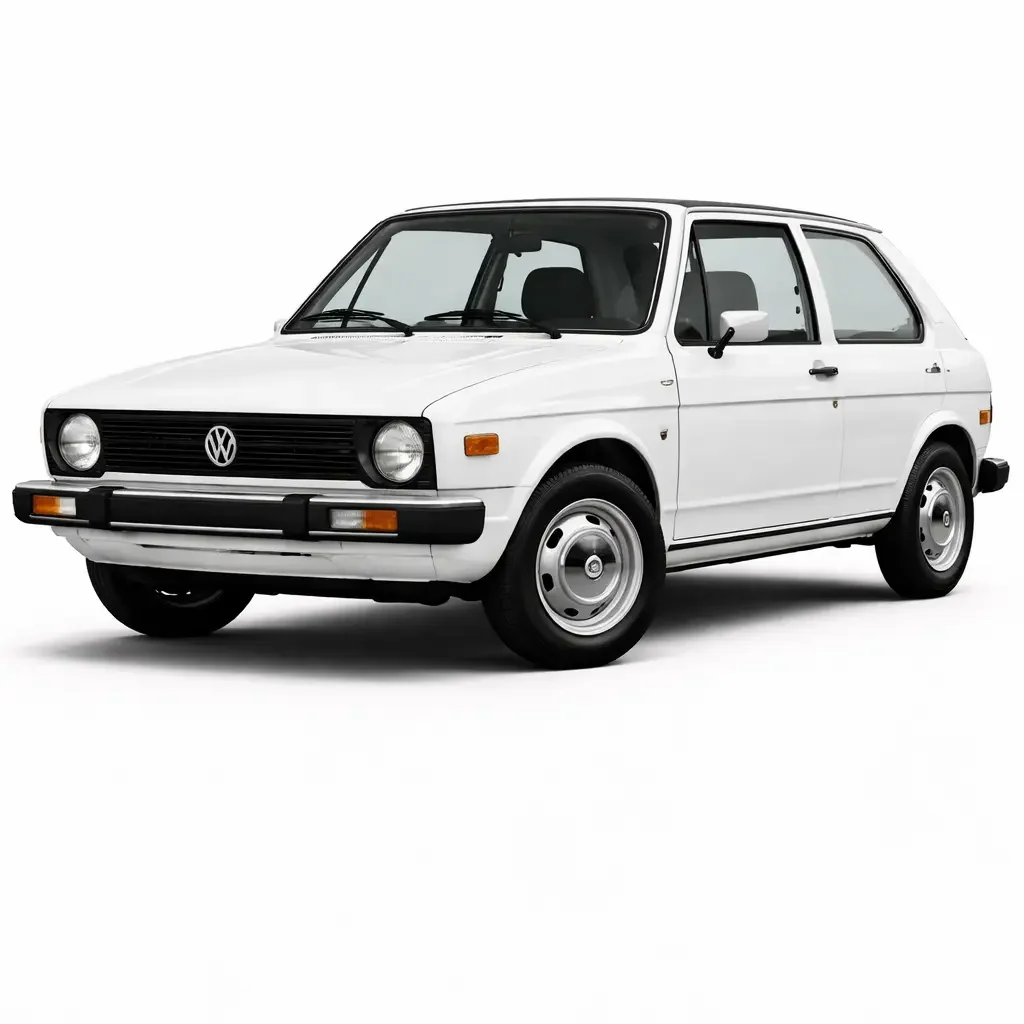
The Volkswagen Rabbit is the North American name for the Mk1 Golf, the first-generation front-wheel-drive water-cooled hatchback that replaced the Beetle as VW's primary product line. It was sold in the United States and Canada from the 1975 model year through 1984, when the North American market transitioned to the Mk2 Golf under the Golf name. Over that ten-year span the Rabbit passed through several distinct production and specification phases that are each relevant to catalog accuracy: a German-built import era from 1975 through 1977, a transition period in 1978 when the Westmoreland Pennsylvania assembly plant came online, the full Westmoreland domestic production era from 1979 through 1984, and a 1981 facelift that changed the front and rear appearance significantly enough to divide body panel cross-references.
For catalog purposes the Rabbit's complexity is concentrated in its engine history, which changed more times in ten years than almost any other VW product of the era. The gasoline engine alone went through six distinct specifications across the production window. The diesel engine went through two. The fuel delivery system changed from carburetor to K-Jetronic CIS injection and back to carburetor and then to a larger-displacement CIS unit before the GTI arrived with yet another engine entirely. Each of these transitions creates a parts catalog boundary. A guide that maps all of them precisely gives a parts advisor the ability to identify the correct application at the counter without guessing at a 1978 Rabbit's fuel system while a customer waits.
Platform and Assembly Overview
The Rabbit is an A1-platform vehicle, the first generation of Volkswagen's modern water-cooled front-wheel-drive architecture. The A1 designation covers all Mk1 Golf derivatives: the Rabbit hatchback, the Mk1 Jetta notchback, the Mk1 Scirocco coupe, the Rabbit Convertible and subsequent Cabriolet, and the Rabbit Pickup and its European Caddy descendants. All of these share a common platform architecture for suspension, steering, brakes, and drivetrain, and cross-references within the A1 family are broadly valid at the chassis and mechanical level.
Assembly origin is a relevant catalog qualifier for the Rabbit because the North American specification diverged from the European Golf in several meaningful ways as production shifted from Germany to Pennsylvania. The German-built Rabbits sold in 1975 through early 1978 used round headlamps, the European body panel design, and engines assembled and tuned in Germany to European specifications adapted for US emissions requirements. The Westmoreland-built Rabbits from 1979 onward used square sealed-beam headlamps mandated for the US market, had bumpers and body panel dimensions adapted for US safety standards, and sourced engines and gearboxes from Germany while assembling the body from locally supplied components. The 1978 model year represents a transition: early 1978 production was German-built, late 1978 production was Westmoreland-built, and the two can be distinguished by the headlamp design.
The North American Rabbit was specifically adapted from the European Golf with larger energy-absorbing bumpers, side marker lights required by Federal Motor Vehicle Safety Standards, and emissions equipment calibrated for US regulations. These adaptations mean that certain exterior body components, particularly the bumper assemblies and the front marker light housings, do not cross to European Golf Mk1 specifications even when the engine code and model year match. Catalogs that pull European Golf Mk1 body part numbers for US Rabbit applications without confirming bumper geometry and marker light apertures will supply wrong components for the North American market.
Gasoline Engine Sub-Windows
The gasoline Rabbit passes through six distinct engine specifications across the 1975 to 1984 production window. Each represents a separate parts application for all engine-internal, fuel system, and emissions hardware. A catalog that treats the Rabbit as a single gasoline application across the full window, or that uses fewer sub-windows than the six documented here, will be inaccurate for at least some model year within the window.
1975: 1.5L Carburetor (Zenith)
The 1975 Rabbit uses a 1.5L (1,457 cc) engine with a Zenith carburetor producing approximately 70 horsepower SAE net. California-sold 1975 Rabbits required a catalytic converter to meet California emissions standards; non-California vehicles did not. This California versus federal specification split applies to fuel system, exhaust, and emissions component listings for 1975. The Zenith carburetor was problematic in service and was the subject of considerable criticism in period reviews; the carburetor specification is specific to this one model year in the North American gasoline Rabbit history.
1976: 1.6L Carburetor
For 1976 the engine displacement was enlarged to 1.6L (1,588 cc), shared with the Audi Fox and Volkswagen Passat of the same era. The carburetor fuel delivery system continues. The 1.6L carburetor specification represents a single model year in the North American Rabbit history. Engine-internal components for this year cross to the Audi Fox and Passat 1.6L carburetor application.
1977: 1.6L K-Jetronic CIS (No Catalyst)
For 1977, Volkswagen replaced the carburetor with Bosch K-Jetronic continuous injection system, a mechanical fuel injection design that measures airflow through an air flow sensor plate and meters fuel continuously to the injectors. The K-Jetronic system produced approximately 78 horsepower and allowed the 1977 Rabbit to meet US emissions standards without a catalytic converter, using an EGR system instead. This is the K-basic configuration: no oxygen sensor, no catalytic converter. The 1977 Rabbit is the only year of the North American gasoline Rabbit to use K-Jetronic without a catalytic converter. All K-Jetronic fuel metering components, air flow sensor, warm-up regulator, fuel distributor, and injectors are specific to the K-basic CIS configuration and do not interchange with the K-lambda CIS components of the later 1979 to 1980 application.
1978: 1.5L Carburetor (Westmoreland Transition)
For 1978, Volkswagen reduced the displacement back to 1.5L and returned to carburetor fuel delivery. The Westmoreland assembly plant opened in April 1978, and 1978 model year production was split between German-built (early 1978, round headlamps) and Westmoreland-built (late 1978, square sealed-beam headlamps) vehicles. The engine was calibrated for approximately 71 horsepower. The return to the smaller displacement and carburetor configuration after the 1977 CIS system is one of the more unusual reversals in US Rabbit history and means that 1978 carburetor listings do not cross to 1977 CIS listings despite being from consecutive model years.
1979 to 1980: 1.6L K-Jetronic CIS with Lambda (Catalyst)
From 1979, the 1.6L displacement was restored and K-Jetronic CIS returned, but now in the K-lambda configuration: with an oxygen sensor, catalytic converter, and an oxygen sensor control unit. This is a fundamentally different fuel control system from the 1977 K-basic CIS despite using similar hardware nomenclature. The oxygen sensor, the oxygen sensor control unit, and the catalytic converter are new components that did not exist in the 1977 application. The 1979 to 1980 sub-window represents the first Westmoreland-era fuel injected Rabbit. The transition from round to square headlamps in 1980 marks the full adoption of the Westmoreland front end design. Fuel system components for this window must be listed as K-lambda CIS specification with oxygen sensor and catalyst.
1981 to 1984: 1.7L CIS (and 1982 Special Value Carburetor)
For 1981, the displacement was enlarged to 1.7L (1,715 cc), a North America-only specification not used in any other market. This engine produces approximately 74 to 78 horsepower and continues the K-lambda CIS fuel injection system. The 1.7L is internally different from the 1.6L in bore and stroke dimensions, requiring separate piston, cylinder, connecting rod, and head gasket listings. This sub-window runs through 1984 as the standard gasoline Rabbit specification.
A notable exception within this sub-window is the mid-1982 Special Value Rabbit, a stripped entry-level model that reinstated carburetor fuel delivery to reduce the retail price. This carburetor application within an otherwise CIS window is a sub-application qualifier that must appear in catalog entries for 1982 Rabbit fuel system components. A listing that applies CIS fuel system parts to all 1982 Rabbits without the Special Value carbureted sub-application note will supply wrong fuel delivery components for that trim.
The Rabbit GTI: 1983 to 1984
The Rabbit GTI was sold in the United States for the 1983 and 1984 model years, representing the North American arrival of the Golf GTI performance variant that had been available in Europe since 1976. The US-market Rabbit GTI uses the JH engine code: a 1.8L (1,781 cc) four-cylinder with K-Jetronic CIS injection producing approximately 90 horsepower. The JH engine was enlarged from the 1.6L European GTI specification and used lighter pistons, larger valves, a higher compression ratio, and a free-flow exhaust relative to the standard Rabbit engines.
The GTI also differs from the standard Rabbit in suspension specification. The GTI uses stiffer springs and shock absorbers, lower ride height, a front anti-roll bar, a rear anti-roll bar, and wider wheels compared to the standard Rabbit. Suspension components for the GTI must be listed under GTI-specific part numbers and must not be crossed to the standard Rabbit suspension without confirming spring rate and shock absorber compatibility.
The GTI was assembled at Westmoreland from components sourced from Mexico, Canada, Germany, and the US, following the multi-source supply chain established for the Pennsylvania plant. The JH 1.8L engine is a distinct A1-family engine that does not cross to the 1.7L standard Rabbit engine in any internal component. Total US GTI production for both years combined was approximately 30,000 units.
Diesel Engine Sub-Windows
The diesel Rabbit was introduced at mid-year 1977 and was sold through 1984. Like the gasoline Rabbit, the diesel has a displacement change that divides its production window into two sub-windows.
Mid-1977 to 1980: 1.5L Diesel (German-Built)
The diesel Rabbit launched at mid-year 1977 with a 1.5L indirect injection diesel engine producing approximately 48 to 49 horsepower. These early diesel Rabbits were built in Germany and remained German-built through 1979, with US diesel production transferring to Westmoreland in 1980. The 1.5L diesel uses the Bosch VE rotary injection pump. Glow plugs, injectors, injection pump, and all fuel system components are specific to the 1.5L pre-chamber diesel specification.
1981 to 1984: 1.6L Diesel
For 1981, the diesel engine was upgraded to 1.6L (1,588 cc) and output increased to approximately 52 horsepower. This change is contemporaneous with the 1981 gasoline engine enlargement and the 1981 body facelift. The 1.6L diesel continues through 1984. Engine-internal components, including pistons, cylinders, connecting rods, and head gasket, are specific to the 1.6L diesel specification and do not cross to the 1.5L diesel application. The injection pump, injectors, and glow plugs should be confirmed against the specific displacement before cross-referencing between the two diesel sub-windows.
The diesel Rabbit uses a five-speed manual transmission as standard, with the fifth gear marked E for Economy, consistent with the diesel application in the Rabbit Pickup. This five-speed specification is the qualifier that separates diesel transmission component listings from the four-speed standard Rabbit gasoline transmission listings within the same model year.
The 1981 Facelift: Body Panel and Lighting Boundaries
The 1981 model year introduced a significant facelift to the North American Rabbit, affecting front and rear body and lighting. The most visible changes were wraparound turn signals integrated into revised front fenders replacing the separate bump-mounted side markers, and larger revised taillamp clusters replacing the earlier smaller units. The front bumper design was also updated with chunkier plastic construction to meet updated US impact standards.
This facelift creates a hard boundary in the body panel catalog. Front fenders, front marker and turn signal lenses, front bumper assemblies, and rear taillamp assemblies are not interchangeable between the 1975 to 1980 and 1981 to 1984 sub-windows. A catalog that applies a single fender or taillamp listing to the full 1975 to 1984 Rabbit window will supply the wrong profile and mounting geometry for one of the two body generations.
The 1981 facelift also included interior revisions: a revised dashboard with a lockable glovebox and an updated center console. Interior trim listings for dashboard components and center console pieces must similarly split at 1981.
Headlamp Change: Round to Square
The North American Rabbit used round headlamps through the German-built era and into early Westmoreland production. The transition to square sealed-beam headlamps is associated with the Westmoreland era and occurred at or around the 1980 model year, with the 1981 facelift completing the square-lamp front end design with the wraparound turn signals. For practical catalog purposes, round headlamp listings apply to the 1975 to 1979 North American Rabbit, and square sealed-beam headlamp listings apply from 1980 onward.
The European Golf Mk1 used round headlamps throughout the full Mk1 production run in its home market. This means that for headlamp assemblies, the US Rabbit and European Golf are on different specifications from 1980 onward, and catalogs that cross European Golf headlamp listings to the 1980 to 1984 US Rabbit will supply round European headlamp assemblies for a vehicle that uses square sealed beams.
Suspension and Brakes
The Rabbit uses MacPherson strut front suspension with coil springs and a rear torsion beam axle with trailing arms and coil-over rear dampers. These are A1-platform standard components that cross freely to the contemporaneous Mk1 Jetta, Mk1 Scirocco, and European Golf Mk1 for the same model year at the geometry and structural component level. Front strut assemblies, front control arms, front wheel bearings, steering rack, and tie rod ends are all valid A1 family cross-references.
An important Westmoreland-era qualification applies to spring and shock absorber specifications. The Westmoreland plant under James McLernon's management from 1978 to 1982 softened the Rabbit's suspension relative to German specification, changing spring rates and shock absorber valving to suit what McLernon perceived as American consumer preferences for a softer ride. German management and VW purists objected, and for the 1983 model year the Westmoreland plant reverted to stiffer suspension specifications closer to the original German calibration. Spring and shock absorber listings for the 1979 to 1982 Westmoreland Rabbit should be confirmed against Westmoreland-specific OEM part numbers rather than assumed to match the European Golf spring and damper specifications, which reflect the stiffer German calibration throughout.
The brake system uses front disc and rear drum configuration as A1-platform standard. Front brake rotor, front caliper, and front brake pads cross to the A1 family. Rear brake drums, shoes, and wheel cylinders cross to the A1 family rear drum application. The GTI received larger front brake rotors and revised caliper specification as part of its performance package; GTI front brake components must be listed under GTI-specific applications and must not be crossed to the standard Rabbit front brake listings without confirming rotor diameter.
Body Panel Cross-References Within the A1 Family
The Rabbit hatchback shares significant body panel overlap with the Mk1 Jetta notchback for all forward body panels: the front clip including front fenders, hood, front bumper, front lighting, and cowl structure are identical between the Rabbit and Jetta for the same model year and specification. This is one of the most useful A1 family cross-references because the Jetta was widely sold and parts availability through Jetta channels often supplements Rabbit-specific supply.
The Mk1 Scirocco shares the A1 platform mechanicals but uses Karmann-built body panels that are Scirocco-specific for the entire body above the floor pan. Front Scirocco body panels do not cross to the Rabbit. The Rabbit Convertible shares front body panels with the standard Rabbit up through the windshield frame but uses Karmann-specific reinforced sills and a unique rear body structure. The Rabbit Pickup shares the Rabbit front body and cab structure but uses a unique rear body from behind the front doors.
The Rabbit hatchback's rear hatch, rear quarter panels, rear bumper, and taillamp assemblies are Rabbit-specific and do not cross to the Jetta, which uses a trunk lid and notchback rear panel structure in place of the hatchback opening.
Cross-References That Hold
Engine-internal components cross to the Mk1 Jetta and Mk1 Scirocco by engine code and displacement for the same model year. The 1.6L gasoline applications in Europe (Golf, Jetta, Scirocco, Audi Fox) share engine-internal components with the US Rabbit 1.6L applications where the engine code matches. The 1.7L and 1.8L JH applications are North America-specific in displacement but cross to other A1-family vehicles that received the same engine codes.
Front suspension and front brake components cross to the Mk1 Jetta, Mk1 Scirocco, and European Golf Mk1 for the same model year at the geometry and structural level. Rear suspension components cross to the A1 family rear torsion beam application.
Timing belt, water pump, thermostat, alternator, starter motor, ignition system components, and clutch disc and pressure plate cross to the A1 family by engine code and model year. The diesel injection pump, injectors, and glow plugs cross to the Mk1 Jetta diesel for the same displacement and model year.
Forward body panels, including front fenders, hood, front bumper, and all front lighting, cross to the Mk1 Jetta for the same model year and specification window, including the pre-1981 and post-1981 facelift boundaries.
Cross-References That Do Not Hold
European Golf Mk1 headlamp assemblies do not cross to the 1980 to 1984 North American Rabbit. The European Golf uses round headlamps throughout the Mk1 production run; the US Rabbit uses square sealed-beam headlamps from 1980 onward.
European Golf Mk1 bumper assemblies do not cross to the North American Rabbit. The US market requires larger energy-absorbing bumpers that are dimensionally different from the European Golf units.
Pre-1981 front fenders, turn signal lenses, and taillamp assemblies do not cross to 1981 to 1984 applications. The 1981 facelift changed the fender profile for the wraparound turn signal, the front bumper design, and the taillamp cluster dimensions. These are hard boundaries with incompatible mounting geometry.
Fuel system components from different engine sub-windows do not cross between sub-windows. K-basic CIS components (1977) do not cross to K-lambda CIS components (1979 to 1984) despite using similar hardware nomenclature. Carburetor components from 1975 to 1976 and 1978 do not cross to CIS injection components from any other year. The 1.5L gasoline engine internals do not cross to the 1.6L or 1.7L engine internals. The 1.5L diesel internals do not cross to the 1.6L diesel internals.
GTI front brake components, suspension springs, and shock absorbers must not be crossed to standard Rabbit components without part number confirmation, as the GTI uses performance-calibrated specifications that differ from the standard Rabbit.
Mk1 Scirocco body panels do not cross to the Rabbit hatchback above the floor pan. Scirocco body is Karmann-built and Scirocco-specific. The Rabbit hatchback rear hatch and rear quarter panels do not cross to the Mk1 Jetta, which uses a notchback trunk structure.
Common ACES/PIES Catalog Mistakes
1. Treating the full 1975 to 1984 gasoline Rabbit as a single fuel system application. The gasoline Rabbit has six distinct fuel system specifications: the 1975 Zenith carburetor, the 1976 Solex-type carburetor on the 1.6L, the 1977 K-basic CIS without catalyst, the 1978 carburetor on the 1.5L, the 1979 to 1980 K-lambda CIS with catalyst on the 1.6L, and the 1981 to 1984 K-lambda CIS on the 1.7L. No single fuel system listing is valid for more than a few of these years, and the 1977 CIS application is unique in the US Rabbit history in not using a catalytic converter. A catalog that applies one fuel system to the full decade will generate returns on fuel system components for almost every customer.
2. Crossing K-basic and K-lambda CIS components between the 1977 and 1979 to 1984 applications. Both use the K-Jetronic CIS name and share hardware terminology, but the K-basic system lacks an oxygen sensor and oxygen sensor control unit while the K-lambda system includes both. These are different fuel control architectures that require separate listings for warm-up regulator, fuel distributor, oxygen sensor, and oxygen sensor control unit.
3. Applying European Golf Mk1 headlamp assemblies to the 1980 to 1984 North American Rabbit. The European Golf Mk1 uses round headlamps throughout its production run. The North American Rabbit uses square sealed-beam headlamps from 1980 onward. A catalog that sources headlamp assemblies from the European Golf Mk1 for the US Rabbit application will supply round headlamp hardware for a vehicle that uses square sealed beams.
4. Applying a single body panel and lighting application to the full 1975 to 1984 window without noting the 1981 facelift boundary. Front fenders, turn signal lenses, front bumpers, and rear taillamp clusters all changed at the 1981 facelift. Components from the 1975 to 1980 body do not fit the 1981 to 1984 body for these items. A unified body panel listing spanning the full window will supply the wrong profile for half the vehicles in the window.
5. Applying standard Rabbit suspension spring and shock absorber listings to the GTI without noting the GTI-specific performance specification. The GTI uses stiffer springs, different shock absorber valving, and lower ride height compared to the standard Rabbit. GTI suspension components must be listed separately and must not be crossed to the standard Rabbit suspension without part number confirmation.
6. Applying 1.5L diesel components to 1.6L diesel applications or vice versa. The diesel engine changed displacement at the 1981 model year, the same boundary as the gasoline engine change. Engine-internal components including pistons, cylinders, and head gasket do not cross between the 1.5L and 1.6L diesel specifications. A single diesel application entry across the full 1977 to 1984 window will supply wrong internal components for one of the two sub-windows.
7. Omitting the mid-1982 Special Value Rabbit carburetor sub-application. The 1981 to 1984 Rabbit window uses CIS fuel injection as the standard system. However, the mid-1982 Special Value Rabbit was produced with carburetor fuel delivery to reduce its retail price. A 1982 Rabbit fuel system listing that does not acknowledge this carbureted variant will supply CIS components to a carbureted vehicle.
8. Applying European Golf Mk1 bumper assemblies to the North American Rabbit. The US market requires energy-absorbing bumpers that are dimensionally larger and differently mounted from the European Golf bumper assemblies. European bumper cross-references for the US Rabbit will supply components that do not match the North American bumper mounting geometry.
Pre-Listing Checklist for the 1975 to 1984 Rabbit
• Gasoline engine sub-window confirmed: 1975 (1.5L carb Zenith), 1976 (1.6L carb), 1977 (1.6L K-basic CIS no cat), 1978 (1.5L carb), 1979 to 1980 (1.6L K-lambda CIS with cat), 1981 to 1984 (1.7L K-lambda CIS); mid-1982 Special Value carb variant noted
• Diesel engine sub-window confirmed: mid-1977 to 1980 (1.5L, German-built through 1979), 1981 to 1984 (1.6L Westmoreland); diesel transmission confirmed as five-speed
• GTI application (1983 to 1984) confirmed as JH 1.8L engine with separate suspension, brake, and fuel system listings from standard Rabbit
• 1981 facelift boundary enforced for front fenders, turn signal lenses, front bumper, and rear taillamp assemblies; pre-1981 and post-1981 are separate body applications
• Headlamp application confirmed: round for 1975 to 1979, square sealed-beam for 1980 to 1984; European Golf Mk1 round headlamp excluded from 1980 onward US Rabbit listings
• Assembly origin noted: German-built 1975 to 1977, transition 1978, Westmoreland 1979 to 1984; suspension spring and shock specifications for 1979 to 1982 Westmoreland confirmed against Westmoreland-specific OEM references
• US market bumper assemblies confirmed as North American energy-absorbing specification; European Golf bumper listings excluded
• Front body panel cross-references to Mk1 Jetta confirmed for same model year and facelift window; rear hatch and rear quarter panels listed as Rabbit hatchback-specific
• K-basic (1977) and K-lambda (1979 to 1984) CIS applications confirmed as separate listings; warm-up regulator, oxygen sensor, and oxygen sensor control unit listed only for K-lambda
• California versus federal emissions specification noted for 1975 model year (California required catalyst; federal did not)
Final Take
No other North American VW product in this series requires as many distinct engine sub-windows as the Rabbit. Six gasoline specifications and two diesel specifications across ten model years is a catalog management challenge that has no analog elsewhere in the Mk1 Golf family. Every other A1-platform guide in this series, the Rabbit Pickup, the Rabbit Convertible, the Safari, covers a vehicle with simpler engine progressions. The Rabbit hatchback is the one that absorbed the full complexity of VW's engine strategy for the North American market as it navigated carburetor problems, emissions regulations, fuel crises, and the transition to domestic production.
The reward for getting the sub-windows right is that the A1 platform is extraordinarily well-documented and well-supplied. The front suspension, brakes, and powertrain components cross to the Jetta, Scirocco, and European Golf, giving the Rabbit the broadest supply network of any vehicle in the Mk1 family. Resolving the engine year qualifier correctly is the key that unlocks all of that supply chain for the customer at the counter.
Disclaimer
This guide is intended for catalog research, fitment analysis, and parts advisory reference. Production specifications, option availability, and regulatory compliance requirements vary by model year, regional market, and assembly date within any given window. Always confirm application data against vehicle identification number decoding, factory build sheets, and OEM parts documentation before finalizing a listing or parts recommendation. PartsAdvisory and its contributors are not responsible for fitment errors arising from catalog data that has not been independently verified against physical vehicle inspection or official OEM sources.