
Volkswagen Rabbit Pickup (1980 to 1983): Caddy Fitment Guide
Written by Arthur Simitian | PartsAdvisory
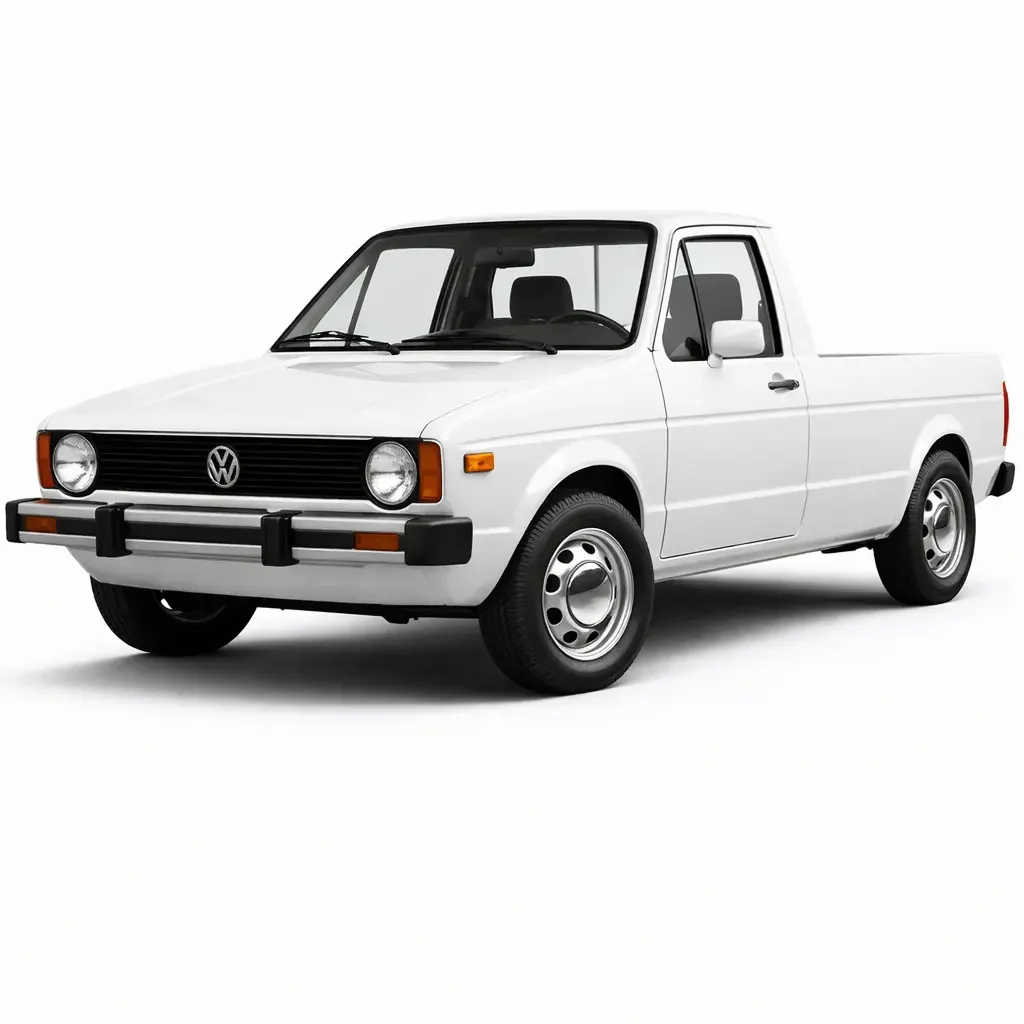
The Volkswagen Rabbit Pickup is a compact front-wheel-drive unibody truck built at the Volkswagen Westmoreland Assembly Plant in New Stanton, Pennsylvania, and sold in the United States for the 1980 through 1983 model years. In Canada it was sold from 1981 through 1983. Elsewhere in the world, particularly after 1982, the same basic vehicle was known as the Volkswagen Caddy, a name never used in North America where Caddy is culturally associated with Cadillac. The Rabbit Pickup has the distinction of being one of only two front-wheel-drive compact pickups sold in the United States during its era, sharing that unusual classification with the Dodge Rampage and Plymouth Scamp.
The fitment story for the Rabbit Pickup is organized by a single spatial rule that, once understood, resolves most catalog questions: from the firewall forward, the Rabbit Pickup is essentially a Mk1 Golf and Jetta, and cross-references to those vehicles hold for the engine, drivetrain, front suspension, front brakes, electrical system, and dashboard. From the firewall rearward, everything is unique to the Pickup. The rear suspension is a transverse leaf spring arrangement found on no other water-cooled VW. The rear brakes use 200mm drums borrowed from the Audi 4000. The cargo bed, rear body structure, exhaust routing, and taillamp assemblies are all pickup-specific. A catalog that does not enforce this spatial boundary will supply wrong rear suspension, wrong rear brake hardware, and wrong body components on every rearward service call.
Platform, Assembly, and Production Context
The Rabbit Pickup is built on the Volkswagen Group A1 platform, the same architecture underpinning the Mk1 Golf, the Mk1 Jetta, the Mk1 Scirocco, and the Mk1 Cabriolet. It is a front-engine, front-wheel-drive unibody vehicle with a 1.83-meter cargo bed. The wheelbase is slightly longer than the Rabbit hatchback to accommodate the extended body. The vehicle was conceived by Volkswagen of America's engineering team and production was assigned to the Westmoreland plant specifically to circumvent the 25 percent Chicken Tax tariff applied to imported light trucks, qualifying the pickup for the lower passenger car import duty by assembling it domestically.
Production ran from the 1980 model year through 1983. Sales peaked at over 37,000 units in 1981 before falling sharply to approximately 2,072 units in 1982 as fuel prices stabilized and the initial diesel efficiency appeal faded against stiffening competition from Japanese compact trucks. US production concluded in 1983. The stamping tooling was subsequently shipped to South Africa, where Mk1 Golf production continued as the Citi Golf until 2009, and some Pickup tooling traveled to Sarajevo where European Caddy production ran until 1992. Worldwide first-generation Typ 14 production totaled more than 207,000 vehicles across all markets.
Two trim levels were offered in the US market: LX and Sportruck. The LX was the standard work-oriented trim and the Sportruck was a appearance package adding two-tone paint and sport graphics. Mechanical specifications were shared between the two trims.
Engines: The Gasoline and Diesel Split
The Rabbit Pickup is offered with gasoline and diesel engine options across the 1980 to 1983 window. Both families change at the 1981 model year boundary, making 1981 the critical year qualifier for all engine-specific component listings. A catalog that does not subdivide at 1981 will supply wrong engine components for either the 1980 single-year sub-window or the 1981 to 1983 sub-window depending on which specification is used as the reference.
Gasoline Engines
The 1980 model year Rabbit Pickup uses a 1.6L gasoline engine. Beginning with the 1981 model year, the gasoline engine is enlarged to a 1.7L unit producing 74 to 78 horsepower depending on the source and test methodology. This 1.7L engine is an iteration used only in North America. The displacement change from 1.6L to 1.7L means that pistons, cylinders, connecting rods, head gaskets, and related engine-internal components are not interchangeable between 1980 and 1981 onward gasoline applications. The 1.7L gasoline engine carried on through 1983. Carburetor-equipped versions were standard on the gasoline Pickup throughout the North American run; the fuel-injected 1.7L that appeared on the 1981 Rabbit hatchback was not the configuration used in the Pickup.
The gasoline Pickup uses a four-speed manual transmission throughout the 1980 to 1983 window. No five-speed manual and no automatic transmission was offered with the gasoline engine. Clutch disc, pressure plate, and transmission internal components for the gasoline Pickup cross to the contemporaneous Mk1 Rabbit hatchback and Mk1 Jetta for the same engine displacement and gearbox configuration.
Diesel Engines
The 1980 model year Rabbit Pickup diesel uses a 1.5L unit producing approximately 48 horsepower. Beginning with the 1981 model year, the diesel is upgraded to a 1.6L unit producing 52 horsepower. The 1.6L diesel continued through 1983. This displacement change parallels the transition that occurred in the Rabbit hatchback diesel at the same time. As with the gasoline engine, the 1981 boundary divides the diesel engine window into a one-year 1.5L sub-window and a three-year 1.6L sub-window, and engine-internal components do not cross between them.
The diesel Pickup is equipped with a five-speed manual transmission, making it the only Rabbit Pickup configuration with a fifth gear. The fifth gear is labeled E for Economy on the shifter, consistent with the economy-focused positioning of the diesel drivetrain. The five-speed gearbox is a meaningful catalog qualifier: clutch assemblies, transmission internals, and gearshift components differ between the four-speed gasoline application and the five-speed diesel application. A catalog that does not split transmission component listings by engine type and gearbox count will supply wrong transmission hardware.
Diesel injection pump, injectors, glow plugs, fuel filter, and all diesel-specific fuel system components cross to the contemporaneous Mk1 Rabbit diesel hatchback and Mk1 Jetta diesel for the same displacement. The diesel Pickup uses the same mechanical indirect injection system as those siblings. No VW diesel fuel system component is unique to the Pickup unless the part interacts with the unique rearward body or exhaust routing of the Pickup body.
Rear Suspension: The Leaf Spring Architecture
The rear suspension of the Rabbit Pickup is the most structurally distinctive feature of the vehicle from a catalog perspective, and the most common source of cross-reference errors. Every other A1-platform vehicle in the Volkswagen lineup, including the Mk1 Golf, Mk1 Jetta, Mk1 Scirocco, and Mk1 Cabriolet, uses a rear beam axle with coil springs. The Rabbit Pickup uses transverse leaf springs instead of coil springs. This architecture was adopted to provide the increased payload capacity and load-carrying compliance required of a pickup truck, with a spring rate of approximately 75 pounds per inch suited to variable cargo loads.
The leaf spring assemblies, spring hangers, spring mounts, and associated rear axle beam hardware are unique to the Rabbit Pickup and have no cross-reference to any other A1-platform vehicle. The rear shock absorbers mount differently from the hatchback siblings due to the different geometry of the leaf spring rear end. Rear shock absorbers for the Rabbit Pickup must be listed under Pickup-specific part numbers and must not be crossed to the Rabbit hatchback or Jetta rear shock applications, which serve a coil-spring rear beam architecture.
The front suspension is fully shared with the A1 platform siblings. Front MacPherson struts, front coil springs, front control arms, front wheel bearings, front hubs, steering rack, and tie rod assemblies all cross freely to the Mk1 Golf and Mk1 Jetta for the same model year. The front suspension of the Rabbit Pickup is A1-standard and requires no special qualification beyond model year.
Brakes: Audi 4000-Derived Rear Drums
The Rabbit Pickup uses front disc and rear drum brakes. The front disc rotors, front calipers, and front brake pads cross directly to the contemporaneous Mk1 Golf and Mk1 Jetta front brake application. Front brake hardware is fully A1-family shared.
The rear brakes are not shared with the standard A1 family. The Rabbit Pickup uses 200mm rear brake drums sourced from the Audi 4000, adopted to provide the braking capacity appropriate for a vehicle carrying up to 1,100 pounds of payload. The standard A1 rear drum used on the Mk1 Golf and Jetta is a different diameter and a different design. Rear brake drums, rear brake shoes, rear wheel cylinders, and rear brake backing plates for the Rabbit Pickup must be listed under Pickup-specific or Audi 4000-derived part numbers. Cross-referencing standard Mk1 Golf or Jetta rear drum hardware to the Rabbit Pickup will supply dimensionally incorrect components.
The brake master cylinder and brake booster cross to the A1 family Mk1 Rabbit and Jetta for the same model year. The dual-circuit hydraulic system architecture is shared with the hatchback siblings and the master cylinder application is consistent with the rest of the A1 family.
Body Panels and the Firewall Rule
The single most practical piece of catalog knowledge for the Rabbit Pickup is the firewall rule, which was articulated clearly in the VW Caddy enthusiast community: the Rabbit Pickup is, for parts purposes, essentially the same as the four-door Mk1 Rabbit or Mk1 Jetta from the rear of the front seats forward. Everything forward of that point shares the A1 platform architecture. Everything aft of the front seats is unique to the Pickup.
Forward of the Firewall: A1-Shared Components
The front fenders, hood, front bumper, headlamp assemblies, grille, windshield glass, windshield wiper assemblies, dashboard structure, instrument cluster, HVAC components, steering column, front door assemblies, front door glass, and front seat hardware are shared with the Mk1 Rabbit and Mk1 Jetta for the same model year. This is a broad set of components that makes the front half of the Rabbit Pickup well-supported by the deep parts supply chains established for the Mk1 Golf family.
The 1981 model year introduced a front-end facelift to the North American Westmoreland Rabbit, adding wraparound turn signals integrated into the front fenders and revised larger taillights. This facelift applied simultaneously to the Rabbit Pickup. Front fender, headlamp housing, and turn signal lens listings must therefore split at 1981, and the 1980 Rabbit Pickup uses the pre-facelift front fender without the wraparound indicator recess.
Aft of the Firewall: Pickup-Specific Components
The A-pillar rear structure, the B-pillar, the rocker panels aft of the A-pillar, the cab rear wall, the cargo bed structure and floor, the cargo bed sills, the rear quarter panels, the rear bumper, the taillamp assemblies, the rear glass, and all associated weatherstrip and seal components are unique to the Rabbit Pickup body. None of these components cross to the Mk1 Golf hatchback, the Mk1 Jetta notchback, the Mk1 Scirocco, or the Mk1 Cabriolet. The Pickup body is a distinct stampings set that exists only for the Typ 14 Rabbit Pickup and its Caddy descendants.
The rear window glass, often called the cab glass or rear cab window, is Pickup-specific and does not cross to the hatchback rear window. The Pickup rear window is an upright rear-cab design integrated into the pickup cab structure, not the sloped hatchback glass of the Golf.
Exhaust System
The exhaust system of the Rabbit Pickup is unique to the model and does not cross to the Mk1 Golf or Jetta. The routing from the catalytic converter rearward must navigate beneath the extended cargo bed structure, producing a different pipe length, routing geometry, and hanger mounting configuration from the hatchback or notchback A1 siblings. The exhaust manifold and front pipe cross to the A1 family by engine code and model year, but the mid-pipe, resonator, and muffler assembly are Pickup-specific. Tectonics of Oregon is documented as one of the specialized manufacturers producing Rabbit Pickup exhaust systems, underscoring that this is a component category requiring Pickup-specific sourcing rather than A1 family cross-referencing.
Electrical System and Lighting
The Rabbit Pickup's electrical system architecture is shared with the A1 platform family. The alternator, voltage regulator, starter motor, ignition system, and fuse box cross to the Mk1 Rabbit and Jetta for the same engine code and model year. The wiring harness routing differs from the hatchback due to the extended body, but individual electrical components at the switch and module level are A1-family shared.
The North American Rabbit Pickup uses square 4x6-inch halogen sealed-beam headlamps, matching the square headlamp design of the Westmoreland-built Rabbit hatchback adopted when production moved to Pennsylvania in 1980. European Caddy models, by contrast, used round 7-inch H4 headlights with front turn signals mounted in the front bumper. This is a meaningful difference for any catalog that groups North American Rabbit Pickup and European Caddy applications together: headlamp assemblies are not interchangeable between the two market specifications.
The taillamp assemblies are Pickup-specific and do not cross to any A1 hatchback or notchback application. The Pickup taillamps are integrated into the rear quarters of the cab structure in a pickup-specific arrangement. The 1981 facelift revised the taillamp design alongside the front-end changes; listings for taillamp assemblies should reflect the 1980 pre-facelift and 1981 to 1983 post-facelift sub-windows.
Cross-References That Hold
Engine-internal components cross to the contemporaneous Mk1 Rabbit and Mk1 Jetta by engine code and displacement: all 1.6L gasoline (1980), all 1.7L gasoline (1981 to 1983), all 1.5L diesel (1980), and all 1.6L diesel (1981 to 1983). This covers pistons and cylinders, crankshaft, camshaft, valvetrain, timing belt, water pump, oil pump, thermostat, and all associated gaskets and seals.
Diesel fuel system components, including injection pump, injectors, glow plugs, fuel filter, and fuel lines to the engine, cross to the Mk1 Rabbit diesel and Mk1 Jetta diesel for the same displacement and model year. Gasoline carburetor components cross to the Mk1 Rabbit gasoline for the same displacement and model year.
Front suspension components cross fully to the A1 family: front strut assembly, front coil springs, front control arm, front wheel bearing and hub, steering rack, and inner and outer tie rod ends. Front brake disc rotors, front calipers, and front brake pads cross to the Mk1 Golf and Jetta front brake application.
Clutch assembly components cross by gearbox type: four-speed gasoline clutch disc, pressure plate, and release bearing cross to the Mk1 Rabbit four-speed application; five-speed diesel clutch components cross to the Mk1 Rabbit diesel five-speed application.
Forward body panels and interior components cross to the Mk1 Rabbit for the same model year: front fenders (split at 1981 for the wraparound indicator facelift), hood, front bumper, dashboard, instrument cluster, HVAC controls and hardware, front door assemblies, front door glass, and windshield glass.
The exhaust manifold and front pipe cross to the A1 family by engine code. The brake master cylinder and booster cross to the A1 family by model year.
Cross-References That Do Not Hold
Rear suspension components from any A1 hatchback or notchback do not fit the Rabbit Pickup. The hatchback rear beam uses coil springs. The Pickup uses transverse leaf springs. Rear coil springs, rear beam coil spring perches, and associated coil-spring rear suspension components have no application in the Pickup.
Rear brake drums and rear brake shoes from the Mk1 Golf or Mk1 Jetta do not fit the Rabbit Pickup. The Pickup uses 200mm Audi 4000-derived rear drums; the standard A1 rear drums are a different diameter. Rear wheel cylinders and backing plates from the Golf or Jetta rear drum application are also not compatible.
The rear half of the exhaust system, from mid-pipe rearward, does not cross to the Mk1 Golf or Jetta exhaust application. The routing and dimensions are Pickup-specific.
All body panels aft of the front doors are Pickup-specific. The cargo bed, rear quarter panels, cab rear wall, rear bumper, and taillamp assemblies do not cross to any A1 hatchback or notchback. The rear window glass is Pickup-specific and does not cross to the Golf hatchback rear glass.
European Caddy headlamp assemblies do not cross to North American Rabbit Pickup headlamp assemblies. The European Caddy uses round 7-inch H4 lamps; the North American Rabbit Pickup uses square 4x6-inch sealed beams. Any catalog that groups European Caddy and North American Rabbit Pickup into a single lighting application will supply incompatible headlamp hardware.
The 1.6L gasoline engine components from 1980 do not cross to the 1.7L gasoline from 1981 onward for internal engine parts. The 1.5L diesel from 1980 does not cross to the 1.6L diesel from 1981 onward for internal engine parts. These engine transitions are hard boundaries for pistons, cylinders, connecting rods, head gaskets, and related internal hardware.
Common ACES/PIES Catalog Mistakes
1. Applying Mk1 Golf or Jetta rear suspension components to the Rabbit Pickup. The Pickup rear suspension uses transverse leaf springs, not coil springs. This is the highest-frequency cross-reference error for this vehicle and occurs when catalog systems pull rear suspension listings from the A1 family without filtering for the Pickup body style. Rear coil springs, rear beam coil perches, and rear shock absorbers from the Golf or Jetta rear end do not fit the Pickup and will produce a vehicle with incorrect rear suspension geometry and load capacity if installed.
2. Crossing standard A1 rear brake drums to the Rabbit Pickup. The Pickup uses 200mm Audi 4000-sourced rear drums. The standard A1 Golf and Jetta rear drum is a different diameter. A catalog that lists Golf rear drum shoes, drums, and wheel cylinders for the Rabbit Pickup rear brake application will supply components that do not physically fit.
3. Applying a single engine listing across the full 1980 to 1983 window without the 1981 displacement change. Both the gasoline and diesel engines changed displacement at the 1981 model year: gasoline from 1.6L to 1.7L, diesel from 1.5L to 1.6L. A catalog that uses a single engine application for all four model years will supply wrong pistons, cylinders, and internal components for whichever displacement is used as the reference.
4. Failing to split transmission component listings by fuel type. The gasoline Pickup uses a four-speed manual; the diesel Pickup uses a five-speed manual. A unified gearbox listing that does not distinguish between the four-speed and five-speed applications will supply clutch assemblies, shift linkage hardware, and transmission internals from the wrong gearbox type.
5. Listing Golf or Jetta mid-pipe, resonator, and muffler assemblies for the Rabbit Pickup exhaust. The Pickup exhaust routing aft of the front pipe is unique. Golf and Jetta exhaust mid and rear sections do not fit the Pickup routing geometry and hanger locations. The exhaust manifold and front pipe may cross by engine code, but everything rearward requires Pickup-specific sourcing.
6. Grouping European Caddy and North American Rabbit Pickup into a single headlamp application. The North American Rabbit Pickup uses square 4x6-inch sealed-beam headlamps. European Caddy models use round 7-inch H4 headlights. The headlamp assemblies, housings, and associated wiring are not interchangeable between the two market specifications. Any catalog that uses a single headlamp listing for both markets will supply wrong lighting hardware to one specification or the other.
7. Applying cargo bed, rear quarter panel, rear bumper, taillamp, or rear cab window listings from the Mk1 Golf hatchback. None of these components cross between the hatchback and the Pickup body. The cab rear wall, bed structure, and rear body panels are Pickup-specific stampings. A catalog that generates rear body suggestions from Mk1 Golf hatchback listings will supply incompatible panels for every rearward body repair application.
8. Not splitting the 1980 pre-facelift and 1981 to 1983 post-facelift front fender and taillamp applications. The 1981 model year facelift introduced wraparound turn signals integrated into the front fenders and revised larger taillamps. A unified front fender or taillamp listing across the full 1980 to 1983 window will supply the wrong lens profile and mounting geometry for one of the two sub-windows.
Pre-Listing Checklist for the 1980 to 1983 Rabbit Pickup
• Engine sub-window confirmed: 1980 uses 1.6L gasoline or 1.5L diesel; 1981 to 1983 uses 1.7L gasoline or 1.6L diesel; all internal engine listings split at 1981
• Transmission confirmed by fuel type: gasoline uses four-speed manual; diesel uses five-speed manual; clutch and gearbox listings split accordingly
• Rear suspension listed as Pickup-specific transverse leaf spring; Mk1 Golf and Jetta coil-spring rear suspension components excluded
• Rear brake drums and shoes listed as 200mm Audi 4000-derived; standard A1 rear drum diameter components excluded
• Front suspension and front brake components confirmed as A1-family shared, crossing to Mk1 Golf and Jetta
• 1981 facelift boundary noted for front fenders with wraparound turn signals and revised taillamps; 1980 uses pre-facelift design
• Forward body and interior components listed as A1-family shared with Mk1 Rabbit
• All body panels aft of the front doors listed as Pickup-specific; no Mk1 Golf hatchback body cross-references applied for rear body, bed, or cab structure
• Exhaust mid-pipe, resonator, and muffler listed as Pickup-specific; exhaust manifold and front pipe cross to A1 family by engine code
• Headlamp assemblies confirmed as North American square 4x6-inch sealed-beam specification; European Caddy round H4 headlamp cross-references excluded
• Assembly origin confirmed as Westmoreland Assembly Plant, New Stanton, Pennsylvania
Final Take
The Rabbit Pickup is a vehicle that rewards the firewall rule and punishes catalogs built purely by model family. The A1 platform shared with the Mk1 Golf and Jetta makes the entire front half of the vehicle well-supported by parts supply chains that have served those vehicles for decades. The leaf spring rear suspension, the Audi 4000 rear drums, the unique exhaust routing, and the Pickup-specific rear body stampings are the four areas where those family cross-references stop working, and they map cleanly to specific catalog categories: rear springs, rear brakes, exhaust mid and rear section, and all rearward body panels.
The 1981 engine displacement changes on both the gasoline and diesel side add a year qualifier that must be managed at the engine component level. The 1981 facelift adds a body qualifier at the front fender and taillamp level. Everything else in the catalog is either a clean A1 cross-reference or a clean Pickup-specific listing, and experienced parts advisors working this vehicle know the boundaries instinctively. The purpose of this guide is to make those boundaries equally clear in the catalog data so that service calls do not end in the wrong rear drum diameter arriving in a box.
Disclaimer
This guide is intended for catalog research, fitment analysis, and parts advisory reference. Production specifications, option availability, and regulatory compliance requirements vary by model year, regional market, and assembly date within any given window. Always confirm application data against vehicle identification number decoding, factory build sheets, and OEM parts documentation before finalizing a listing or parts recommendation. PartsAdvisory and its contributors are not responsible for fitment errors arising from catalog data that has not been independently verified against physical vehicle inspection or official OEM sources.