
Written by Arthur Simitian | PartsAdvisory
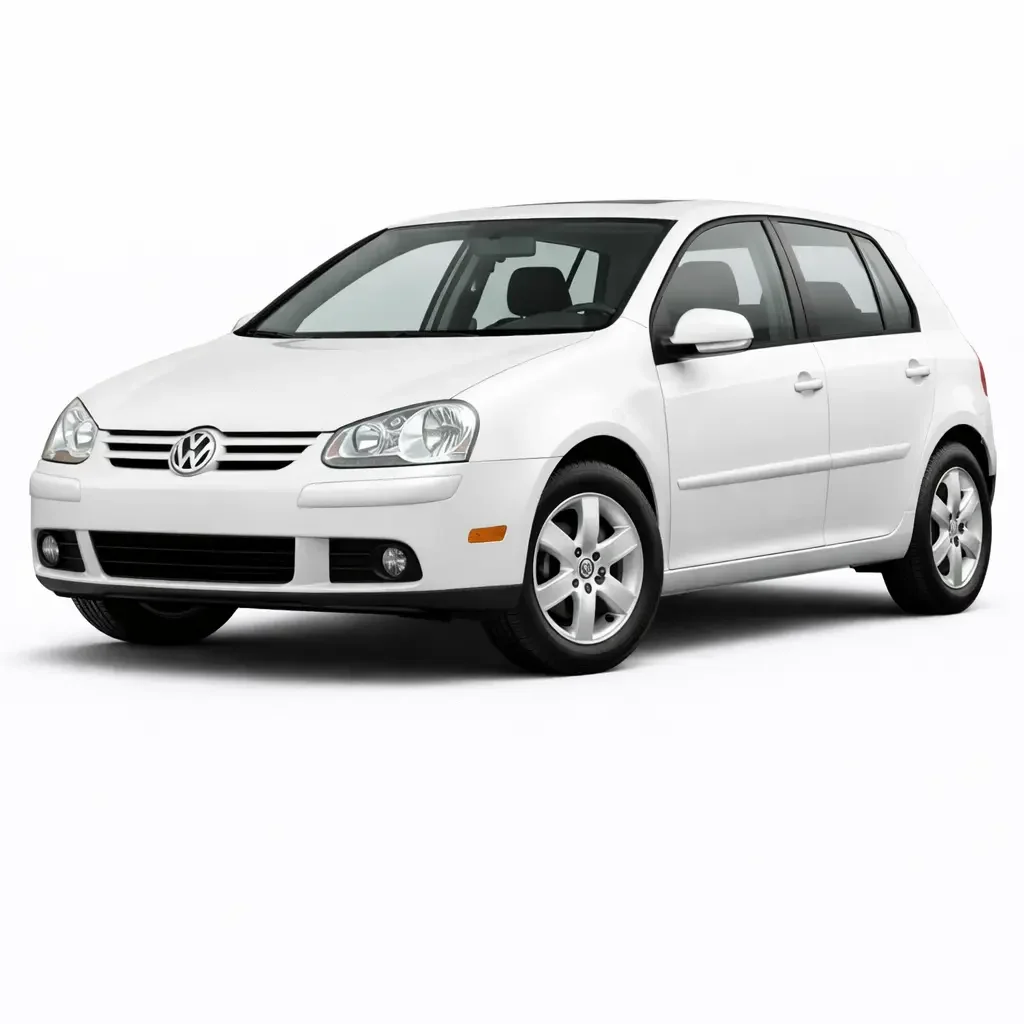
The Volkswagen Rabbit returned to the North American market in 2006 as the brand's reintroduction of the Golf nameplate under its classic name, following a 22-year absence of the Rabbit badge. The 2006 to 2009 Rabbit is the North American market version of the Mk5 Golf, designated internally as the Typ 1K and built on the PQ35 platform. The nameplate reverted to Golf beginning with the 2010 model year when the Mk6 arrived. This guide covers the 2006 through 2009 Rabbit window specifically.
For catalog purposes the Rabbit is a straightforward single-engine vehicle with one meaningful sub-window boundary at the 2008 model year. The 2.5L inline-five is the only engine available in the North American Rabbit throughout the entire production window, but it changed engine codes and underwent significant engineering revisions at the 2008 model year in ways that affect ECU compatibility, wiring harness, MAF sensor presence, and timing system components. A catalog that treats the 2006 to 2009 2.5L as a single unified engine application will supply wrong engine management components for approximately half the vehicles in the window.
Platform, Assembly, and Window Identity
The Rabbit is built on the Volkswagen Group A5 (PQ35) platform, designated Typ 1K internally. The PQ35 platform underpins a broad family of Volkswagen Group products from this era including the Mk5 Golf, Mk5 Jetta, Mk5 Golf Variant (Jetta SportWagen in North America), Volkswagen Eos, Audi A3 Mk2, and early Tiguan. All of these vehicles share the same floor pan geometry, front suspension architecture, rear multilink suspension, and brake system foundation, making PQ35-to-PQ35 cross-references broadly reliable for chassis and mechanical components.
All North American Rabbits in this window were built in Germany at the Wolfsburg plant. The vehicle is front-wheel drive. The wheelbase is 101.5 inches and overall length is approximately 165.8 inches. The North American Rabbit uses the same body dimensions and platform architecture as the European Golf Mk5, with North American-specific bumper assemblies adapted for US federal safety standards, US-market headlamp and taillamp assemblies, and the North American-specific 2.5L engine rather than the European engine menu.
The Rabbit was sold in two-door and four-door hatchback configurations across the full 2006 to 2009 window. Both configurations were available from the 2006 model year launch. The two-door uses front doors and a rear hatch without rear door apertures in the body; the four-door adds rear door openings in the body structure. These are different body stampings with different door count and door aperture configurations. Rear door assemblies, rear door glass, rear door weatherstrip, and rear door hardware are four-door-specific and do not cross to the two-door body. Catalog entries for door components must specify the body configuration.
The Rabbit nameplate was retired for the 2010 model year when the Mk6 Golf arrived and Volkswagen standardized the Golf name globally in North America. The 2010 Golf Mk6 uses an updated version of the PQ35 platform and shares significant architecture with the Rabbit, but headlamps, taillamps, front and rear fascias, and interior trim changed at the Mk5 to Mk6 transition. The 2009 Rabbit and the 2010 Golf are separate ACES windows for body and lighting components.
The 2.5L Engine: Two Distinct Sub-Windows
The 2.5L inline-five cylinder engine is the only engine offered in the North American Rabbit across the full 2006 to 2009 window. No diesel was ever offered. The GTI, sold alongside the Rabbit as a separate model under the GTI nameplate (not Rabbit GTI), used the 2.0T FSI turbocharged four-cylinder and is not part of this Rabbit guide. The 2.5L is a 20-valve dual-overhead-cam inline-five producing 150 horsepower in 2006 and 2007, and 170 horsepower from 2008 onward. The engine displacement is 2,480 cc.
2006 to 2007: Engine Codes BGP and BGQ (150 hp)
The 2006 and 2007 Rabbit uses the BGP or BGQ engine code. BGP is the Tier II Bin 5 ULEV emissions specification and uses two oxygen sensors. BGQ is the Tier II Bin 2 SULEV emissions specification and uses three oxygen sensors. The two engine codes are mechanically identical in all other respects and share the same internal engine components, the same fuel system, and the same timing chain architecture. The distinction between BGP and BGQ is emissions certification tier and oxygen sensor count only. For all fuel system, internal engine, and drivetrain component listings, BGP and BGQ can be grouped as a single 2006 to 2007 2.5L application. For oxygen sensor and catalytic converter listings, the emissions tier must be noted because the three-sensor BGQ application uses a different sensor count from the two-sensor BGP.
The BGP and BGQ engines use a mass airflow (MAF) sensor in the intake tract as part of the engine management system. The ECU calibration is the earlier generation and the wiring harness configuration reflects the MAF-equipped system. These are important markers for identifying the sub-window when a customer's engine code is not immediately available.
2008 to 2009: Engine Codes CBTA and CBUA (170 hp)
Beginning with the 2008 model year, the 2.5L engine was updated to the CBTA (ULEV, two oxygen sensors) and CBUA (SULEV, three oxygen sensors) engine codes. The power output increased to 170 horsepower and torque to 177 lb-ft. Beyond the power improvement, the CBTA and CBUA engines incorporate several meaningful engineering changes from the BGP and BGQ that create catalog incompatibilities between the two sub-windows.
The most significant engineering differences between the BGx and CBxA engines are the elimination of the MAF sensor, a revised ME17 ECU generation, a different engine wiring harness, and timing chain improvements that addressed known issues with the earlier engine. The MAF deletion means that the air intake sensor arrangement and intake wiring are different between the two sub-windows. The wiring harness incompatibility means that ECU, MAF sensor, and wiring harness listings from the 2006 to 2007 sub-window absolutely must not be crossed to the 2008 to 2009 sub-window, and vice versa.
The timing chain in the CBxA engines received design improvements over the BGx engines. This is not merely a calibration update; the timing chain kit, tensioner, and guide rail components for the CBTA and CBUA should be confirmed against CBxA-specific part numbers and must not be assumed to carry forward from the BGP and BGQ timing chain specifications. Catalogs that list a single unified timing chain application for the full 2006 to 2009 2.5L window risk supplying BGx-spec timing hardware to CBxA engines with improved chain architecture.
Internal engine components that do not involve the engine management system, wiring, or timing architecture generally share the same specifications between BGx and CBxA. Gaskets, seals, bearings, water pump, thermostat, and valve train hardware should be confirmed at the part number level but are likely to cross between sub-windows for purely mechanical components. Head gasket sets, however, are more likely to be application-specific due to potential differences in deck surface preparation for the revised power output.
Transmissions
Two transmission options are available in the North American Rabbit: a five-speed manual and a six-speed Tiptronic automatic. These are the same transmissions used in the contemporaneous Mk5 Jetta 2.5L application and cross-references hold between the Rabbit and Jetta for both gearbox types.
The six-speed automatic is the 09G Aisin-sourced unit used across several PQ35-platform vehicles. Transmission fluid for this unit must follow the specification documented in VW service literature; no DSG fluid specification applies because the 09G is a conventional torque-converter automatic, not a dual-clutch unit. The GTI and other Mk5 Golf models in Europe used the DSG dual-clutch transmission, but the North American Rabbit does not. A catalog that lists DSG fluid or DSG service components for the Rabbit is incorrect.
Clutch disc, pressure plate, release bearing, and clutch hydraulic master and slave cylinder for the five-speed manual application cross to the Mk5 Jetta five-speed manual application for the 2.5L engine. All manual transmission drivetrain components should be confirmed by VIN to ensure the correct sub-application is identified, particularly for the 2008 onward vehicles where the engine revision may have affected clutch specification.
Suspension and Brakes
The Rabbit uses MacPherson strut front suspension and an independent multilink rear suspension, the PQ35-platform standard architecture that replaced the rear torsion beam of the earlier A1 and A2 Golf generations. Front strut assemblies, front lower control arms, front wheel bearings and hubs, front subframe, steering rack, and tie rod ends cross to the contemporaneous Mk5 Jetta and the European Mk5 Golf for the same model year.
A xenon headlamp sub-application qualification applies to front control arm listings. Forum and technical documentation confirms that two versions of the front lower control arm exist on the PQ35 platform: one for vehicles equipped with xenon headlamps, which use an auto-leveling sensor that mounts to the front control arm, and one for vehicles without xenon headlamps. A catalog entry for the front lower control arm must note this distinction. Pulling a control arm from a non-xenon vehicle for a xenon-equipped Rabbit, or vice versa, will either lack the sensor mounting provision or have an unused provision, and the leveling system will not function correctly on the xenon vehicle.
The rear multilink suspension components cross to the Mk5 Jetta and European Mk5 Golf. Rear shock absorbers, rear coil springs, rear trailing arm bushings, and rear lateral links are PQ35-family shared components.
Four-wheel disc brakes with ABS are standard across the full 2006 to 2009 window. Front vented disc rotors, front calipers, front brake pads, rear solid disc rotors, rear calipers, and rear brake pads cross to the Mk5 Jetta 2.5L application. The brake master cylinder and ABS modulator cross to the PQ35 family by year. Electronic Stabilization Program (ESP) was optional on early models and became standard for the 2009 model year. ESC and ABS module listings should note the 2009 standard fitment change.
Body Panel Cross-References: Rabbit, Jetta, and GTI
The PQ35-family body panel sharing is well-documented and operates on several levels. Wikipedia's Golf Mk5 article confirms that the Mk5 Jetta shared the front fascia, front fender panels, and front doors with the Golf Variant (Jetta SportWagen). The standard Mk5 Jetta sedan uses the same front body clip as the Rabbit hatchback and Golf: identical front fenders, hood, and front door assemblies. This means that front fender, hood, and front door shell cross-references between the Rabbit and Mk5 Jetta are valid.
The Mk5 GTI, sold in North America as a separate GTI model, shares the same body as the Rabbit hatchback. The GTI uses the same front doors, the same rear hatch, and the same body structure as the Rabbit, with GTI-specific front fascia and bumper design, GTI-specific headlamp assemblies, and GTI-specific rear apron. The GTI and Rabbit front fascias and headlamps are not interchangeable. Body panels behind the front fascia, including front fenders, doors, rear quarter panels, and rear hatch, cross freely between the Rabbit and the GTI for the same body configuration (two-door or four-door).
The European Golf Mk5 uses North American-equivalent body panels for all structural elements but may differ in headlamp and taillamp assemblies due to different market lighting regulations. European Golf Mk5 headlamp assemblies with the European beam pattern are not valid substitutes for North American Rabbit headlamp assemblies. Taillamp assemblies should also be confirmed against market specification before applying a European Golf cross-reference to the North American Rabbit.
The Volkswagen Eos is built on the PQ35 platform and shares underbody architecture with the Rabbit, but the Eos body is entirely unique with no cross-references to Rabbit body panels. The Jetta SportWagen shares front body panels with the Rabbit but uses a unique wagon body aft of the B-pillar.
No Diesel: A Critical Catalog Note
No diesel engine was offered in the North American Rabbit at any point during the 2006 to 2009 window. Tightening US emissions regulations caused VW to pause diesel availability in the North American market, and the Rabbit was launched and sold exclusively with the 2.5L gasoline five-cylinder throughout its production life. The contemporaneous Mk5 Jetta TDI was briefly available in the US through 2006 before being pulled for the same emissions compliance reasons, but the Rabbit TDI was never sold.
Catalogs built from the European Golf Mk5 parts database, which includes 1.9L TDI and 2.0L TDI diesel applications, must not apply those diesel engine listings to the North American Rabbit. Any catalog entry showing a TDI, diesel injection pump, diesel fuel filter, glow plug, or diesel-specific fuel system component under the North American Rabbit application is incorrect. The 2.5L gasoline engine is the only application.
The GTI: A Sibling, Not a Trim Level
In the 2006 to 2009 era, the GTI is sold in North America as a standalone model under the GTI nameplate, not as a Rabbit GTI or a Rabbit trim level. This is a meaningful catalog distinction. The GTI uses the 2.0T FSI turbocharged four-cylinder engine (engine code AXX or BPY depending on the specific year and sub-variant) producing 200 horsepower, a six-speed manual or six-speed DSG dual-clutch transmission, sport-tuned suspension with lower ride height, larger vented front brake rotors, different front fascia with the GTI-signature red stripe through the grille, and sport seats.
For catalog purposes, the GTI and the Rabbit share: front fenders, hood, front doors, rear hatch, rear quarter panels, front windshield, and rear glass for the same body configuration. They do not share: front fascia and bumper, headlamp assemblies, engine, engine management, transmission (five-speed or six-speed automatic in Rabbit versus six-speed manual or DSG in GTI), suspension spring and shock absorber specifications, or front brake rotor diameter.
A catalog that treats the 2006 to 2009 GTI as a trim variant of the Rabbit and applies GTI engine or suspension listings to base Rabbit applications will generate wrong parts for powertrain, brake, and suspension service calls. The GTI must be maintained as a separate model application in the catalog, not as a sub-application of the Rabbit.
PQ35 Family Cross-References
The PQ35 platform cross-reference family for the Rabbit is broad and well-supplied. For all chassis, suspension, and brake components, the primary cross-reference is the Mk5 Jetta 2.5L for the same model year range. This covers front strut assemblies, front control arms, front wheel bearings, steering rack, tie rods, rear multilink suspension components, all four disc brake rotors, calipers, and pads, ABS system, and brake master cylinder.
For engine components, the 2.5L cross-reference family includes the Mk5 Jetta 2.5L and the New Beetle 2.5L for the same engine code (BGP/BGQ for 2006 to 2007; CBTA/CBUA for 2008 to 2009). Timing belt, timing chain, water pump, thermostat, oil pump, alternator, starter motor, spark plugs, ignition coils, and all routine maintenance components cross within this family by engine code.
For body panels, front fenders, hood, and front door structural shells cross to the Mk5 Jetta. Rear hatch, rear quarter panels, and rear bumper are Rabbit hatchback-specific and do not cross to the Jetta notchback, which uses a trunk lid and different rear body structure.
The HVAC system, including blower motor, evaporator, heater core, expansion valve, compressor, and associated lines, crosses to the Mk5 Jetta and European Golf Mk5 for the same model year. Electrical system components including the alternator, battery, fuse box, and BCM cross to the PQ35 family for the same year and engine code.
Cross-References That Do Not Hold
ECU, engine wiring harness, and MAF sensor listings from the 2006 to 2007 BGx sub-window do not cross to the 2008 to 2009 CBxA sub-window. The MAF was deleted for 2008 and the wiring harness and ECU generation changed. These are incompatible engine management components between the two sub-windows despite both using the same 2.5L inline-five displacement.
Timing chain, tensioner, and guide rail listings should be confirmed against engine-code-specific references before applying a BGx listing to a CBxA application. The timing chain design was revised between the two sub-windows.
GTI engine, transmission, suspension spring and shock, and front brake components do not cross to the Rabbit. The GTI is a separate model with distinct engine and drivetrain specifications.
No diesel application exists for the North American Rabbit. European Golf Mk5 TDI engine listings must not be applied to the Rabbit ACES application.
Rear door assemblies, rear door glass, and rear door hardware from the four-door Rabbit do not apply to the two-door Rabbit, which has no rear door openings in the body. Two-door rear quarter panels and rear side glass are different from four-door rear door and quarter panel assemblies.
Jetta SportWagen rear body panels do not cross to the Rabbit hatchback. The SportWagen shares front body panels with the Rabbit but uses a unique wagon rear body structure.
The 2010 onward Golf Mk6 is a separate ACES window. Front and rear fascias, headlamps, and taillamps changed at the Mk5 to Mk6 transition. A catalog that extends 2009 Rabbit body panel listings into the 2010 Golf will supply wrong lighting and fascia components.
Common ACES/PIES Catalog Mistakes
1. Applying a single 2.5L engine management application to the full 2006 to 2009 window. The BGP and BGQ engines (2006 to 2007) differ from the CBTA and CBUA engines (2008 to 2009) in ECU generation, wiring harness, MAF sensor presence, and timing chain specification. ECU, MAF sensor, wiring harness, and timing chain listings must split at the 2008 model year. A unified 2.5L application entry spanning all four years will supply wrong engine management components for the vehicles on one side of the 2008 boundary.
2. Applying diesel engine or diesel fuel system listings to the North American Rabbit. No diesel was ever offered in the North American Rabbit. European Golf Mk5 TDI application data pulled into the Rabbit ACES entry will generate TDI glow plugs, diesel injection pump listings, and diesel fuel filter entries for a vehicle that has only ever had a gasoline engine.
3. Treating the GTI as a trim level of the Rabbit and sharing engine, transmission, and suspension listings between the two. The 2006 to 2009 GTI is a separate model, not a Rabbit trim. The GTI uses the 2.0T FSI engine, a six-speed manual or DSG, GTI-specific front fascia, and different suspension and brake specifications. All GTI mechanical components require separate application entries from the Rabbit.
4. Applying a single front lower control arm listing without noting the xenon headlamp sub-application. Vehicles with factory xenon headlamps use a front lower control arm with a mounting provision for the headlamp auto-leveling sensor. Vehicles without xenon use a control arm without that provision. A unified control arm listing without this qualifier will supply incompatible arms to roughly half the Rabbit population depending on original option specification.
5. Applying rear door, rear door glass, or rear quarter panel listings uniformly across both two-door and four-door body configurations. The two-door Rabbit has no rear door apertures. Rear door assemblies, rear door glass, and rear door weatherstrip apply only to the four-door configuration. A catalog that does not split at body configuration will generate rear door returns on two-door vehicles with every order.
6. Extending 2009 Rabbit body panel and lighting listings into the 2010 Golf Mk6 window. The Mk6 introduced new headlamps, taillamps, and front and rear fascias. These are different components from the Mk5 Rabbit equivalents. A catalog that rolls the Rabbit body application forward into the 2010 Golf will supply Mk5 headlamps and fascia panels for a Mk6 vehicle at every collision repair call.
7. Applying DSG transmission fluid or DSG service components to the Rabbit. The North American Rabbit uses the 09G conventional torque-converter automatic, not a DSG dual-clutch unit. DSG service procedures, DSG fluid specifications, and DSG mechatronic unit listings do not apply. This error occurs when catalog systems source service information from the GTI or European Golf Mk5 that does offer DSG, and apply it to the Rabbit without filtering by transmission type.
8. Applying European Golf Mk5 headlamp assemblies to the North American Rabbit without confirming market specification. European Golf Mk5 headlamps may use beam pattern geometry calibrated for right-hand traffic that differs from North American specifications, and the mounting and lens design for European-market xenon versus North American sealed-beam or projector headlamp assemblies may differ. Market-of-origin must be confirmed before applying European Golf headlamp cross-references to the North American Rabbit.
Pre-Listing Checklist for the 2006 to 2009 Rabbit
• Engine sub-window confirmed: 2006 to 2007 uses BGP or BGQ (150 hp, MAF equipped, earlier ECU); 2008 to 2009 uses CBTA or CBUA (170 hp, MAF deleted, ME17 ECU, revised timing chain)
• Engine management components (ECU, wiring harness, MAF sensor) split at 2008; no cross-application between BGx and CBxA sub-windows
• Timing chain and tensioner listings confirmed against engine-code-specific OEM references; BGx and CBxA timing hardware not assumed interchangeable
• No diesel application for North American Rabbit; European Golf Mk5 TDI listings excluded
• GTI maintained as a separate model application; GTI engine, transmission, suspension, and brake listings not applied to Rabbit
• Transmission confirmed: 5-speed manual or 6-speed Tiptronic automatic (09G); DSG fluid and service procedures excluded
• Front lower control arm sub-application noted for xenon versus non-xenon headlamp fitment
• Body configuration (two-door or four-door) confirmed for all door, rear quarter, and door glass listings
• ESP standard fitment noted for 2009 model year; optional for 2006 to 2008
• Rear hatch, rear quarter panels, and rear bumper confirmed as Rabbit hatchback-specific; no Jetta notchback rear body cross-references
• 2009 Rabbit and 2010 Golf Mk6 confirmed as separate ACES windows for body and lighting
• Assembly origin confirmed as Wolfsburg, Germany
Final Take
The 2006 to 2009 Rabbit is one of the simpler catalog windows in this series in structural terms: one platform, one engine family, no major body changes across the production run. The complexity is concentrated in exactly one place, and it is a place that is easy to overlook precisely because it involves an engine that has the same name and the same displacement across all four model years. The BGx to CBxA transition at the 2008 model year is not a displacement change or an intake type change in the obvious sense. It is an architecture change inside an otherwise unchanged 2.5L inline-five package. The MAF deletion and the ECU and wiring harness revision are invisible to anyone who is not specifically looking for them, and that invisibility is exactly why catalog entries that ignore the boundary generate returns.
The PQ35 platform is deeply cross-referenced with the Mk5 Jetta, providing strong parts availability for chassis, suspension, brakes, and engine maintenance components. The Rabbit benefits from the Jetta's much higher North American sales volume, which means supplier coverage built around the Jetta serves the Rabbit's service needs effectively. The catalog work is to ensure that the 2.5L engine code split is maintained, the diesel exclusion is enforced, and the GTI is never conflated with the Rabbit in the powertrain section. Everything else is the standard PQ35 family cross-reference that the Jetta and Golf supply chain has been establishing since 2005.
Disclaimer
This guide is intended for catalog research, fitment analysis, and parts advisory reference. Production specifications, option availability, and regulatory compliance requirements vary by model year, regional market, and assembly date within any given window. Always confirm application data against vehicle identification number decoding, factory build sheets, and OEM parts documentation before finalizing a listing or parts recommendation. PartsAdvisory and its contributors are not responsible for fitment errors arising from catalog data that has not been independently verified against physical vehicle inspection or official OEM sources.