
Written by Arthur Simitian | PartsAdvisory
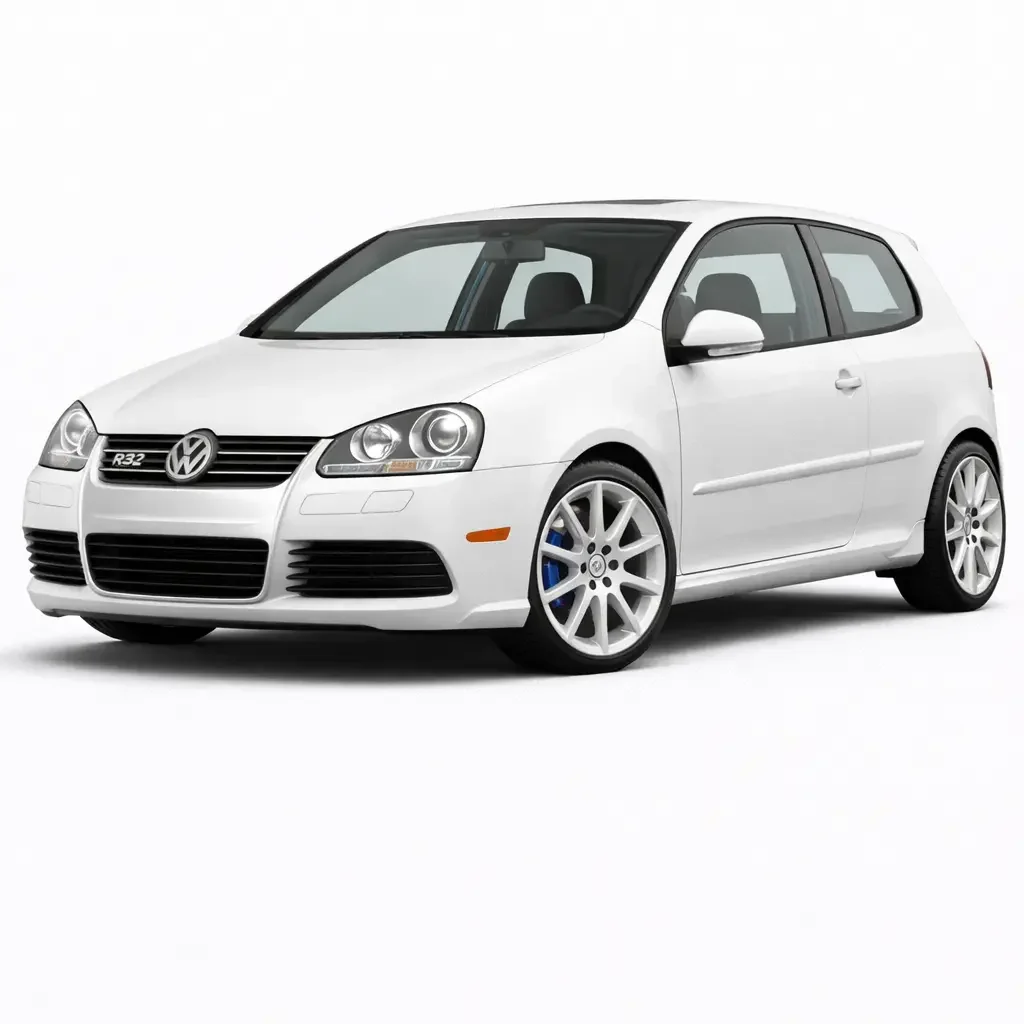
The Volkswagen R32 is a limited-production performance hatchback based on the Mk4 Golf platform, built for the European market as a 2003 model year vehicle and sold in the United States and Australia as a 2004 model year vehicle. It was the halo product of the Mk4 Golf generation, positioned above the GTI in every dimension: more power, all-wheel drive, independent rear suspension, larger brakes, aluminum front suspension components, and a naturally aspirated 3.2L VR6 engine shared with the first-generation Audi TT quattro. Total worldwide production reached approximately 12,000 units, with approximately 5,000 allocated to North America.
For catalog purposes the R32 is one of the most distinctly specified variants in the entire Mk4 family. It shares a roof, glass, doors, and basic body structure with the standard Mk4 Golf. Nearly everything else is unique, cross-referenced to the Audi TT rather than to the standard Golf or GTI, or is R32-exclusive with no equivalent in any other Golf variant. A catalog that treats the R32 as a well-equipped Golf GTI will generate returns on rear suspension, rear brakes, front suspension, exhaust, and engine management components with every service call. The purpose of this guide is to map precisely what crosses to the Golf and GTI, what crosses to the Audi TT, and what belongs solely to the R32.
Production Identity and Market Windows
The Mk4 R32 was announced at the Worthersee GTI Treffen event in Austria in May 2002 and entered European production later that year as a 2003 model year vehicle. Due to strong enthusiast demand that exceeded initial projections, Volkswagen extended production and committed to a North American sales run for model year 2004. The US allocation of approximately 5,000 units was sold exclusively as a 2004 model. All US-market R32s came with a six-speed manual transmission; the DSG dual-clutch gearbox that was available in European markets was not offered in North America.
The ACES window for this vehicle is 2003 to 2004, but in practice most North American service calls will involve 2004 model year vehicles. The European 2003 model year R32 and the North American 2004 model year R32 are mechanically identical with the exception of transmission availability, emissions calibration, and minor market-specific equipment differences such as the standard sunroof on US models and standard xenon headlamps on European models. For mechanical components, parts listings built against the 2004 US specification are generally accurate for both market years.
The R32 nameplate returned on the Mk5 Golf platform for the 2008 model year in North America. That vehicle is a separate application. The Mk4 R32 and the Mk5 R32 share the 3.2L VR6 engine family by name and general architecture, but the Mk5 version uses an updated intake manifold, produces 250 PS rather than 241 PS, and is built on the entirely different PQ35 platform. No mechanical component cross-references apply between the Mk4 and Mk5 R32 variants except at the broadest engine-family level.
Engine: 3.2L VR6 and Its Audi TT Cross-Reference
The R32 is powered by a 3,189 cc (3.2L) naturally aspirated 24-valve dual-overhead-cam narrow-angle V6 engine, known internally as the VR6. The engine code is BFH for European production and BML for North American production. The engine produces 241 PS (238 horsepower) at 6,250 rpm and 320 Nm (236 lb-ft) at 2,800 rpm. It requires premium (91-octane or higher) gasoline. The VR6 architecture uses a single cylinder head spanning both rows of cylinders at a 15-degree included angle between them, making the engine considerably shorter than a conventional V6 and allowing it to fit in the Golf's transversely mounted engine bay.
The most critical cross-reference fact for the R32 engine is its relationship to the first-generation Audi TT quattro. The BFH and BML engines are closely related to the Audi TT 3.2L quattro engine and share significant architecture with it. Engine-internal components including timing chain assembly, cylinder head hardware, valvetrain components, oil pump, water pump, and many gaskets and seals carry valid cross-references to the Audi TT 3.2 quattro (engine code BHE) application. The Audi TT parts supply chain is a valuable supplement to R32-specific parts sourcing precisely because both vehicles used closely related engines.
The timing chain and timing chain tensioner are a documented service category for the R32 VR6. The timing chain is prone to stretch over time, and the tensioner design is a known wear item. These components are among the highest-frequency service parts for this engine. Any catalog entry for timing chain and tensioner on the R32 should note the Audi TT 3.2 cross-reference and should distinguish the R32 BFH/BML engine from the older 2.8L 12-valve VR6 used in the standard Mk4 Golf VR6 variant. The 2.8L 12-valve and 3.2L 24-valve VR6 are related engine families but their timing chain and tensioner specifications are different.
The R32 engine does not cross to the standard Mk4 Golf VR6 engine (engine code AFP or AUE) in any internal component. The 2.8L 12-valve VR6 uses different pistons, a different cylinder head, different valvetrain geometry, and a different timing system. A catalog that groups all Mk4 Golf VR6 engine internal components together under a single VR6 listing will supply wrong components for R32 service calls.
Transmission and 4Motion Drivetrain
All North American R32s use a six-speed manual transmission. This is the 02M gearbox unit, a high-performance six-speed that was also used in the GTI 337 Edition and 20th Anniversary Edition GTI. Transmission internal components and clutch assemblies cross to those limited-edition GTI applications for the 02M gearbox. The standard Mk4 Golf GTI used a five-speed 02J gearbox, which is a different unit entirely. Gearbox service parts for the R32 must be specified as 02M six-speed applications and must not be crossed to the five-speed 02J from the standard GTI.
The 4Motion all-wheel drive system is Haldex-based and operates as an on-demand AWD system, primarily directing power to the front wheels under normal conditions and engaging the rear axle as traction demand increases. The rear axle and rear floor pan of the R32 are shared with the Audi TT 8N quattro, not with the standard Mk4 Golf. This is a fundamental structural fact with major catalog implications. All rear drivetrain components, the rear differential, rear driveshafts, rear CV joints, and the Haldex coupling unit itself cross to the Audi TT quattro application, not to any standard Mk4 Golf or GTI rear axle application. The standard Mk4 Golf uses a torsion beam rear axle with no rear differential, no rear driveshafts, and no AWD capability. None of those components are present on the R32.
The Haldex coupling unit requires its own maintenance service: the Haldex filter and Haldex fluid are standalone service items for the coupling assembly and are not the same as the rear differential fluid or the front axle fluid. Catalog entries for Haldex service components must be listed under R32 and Audi TT quattro applications and must not be omitted on the assumption that the service is covered by standard differential or gearbox fluid listings.
Front driveshafts and front CV joints do cross to the Audi TT quattro front axle application more so than to the standard Mk4 Golf front driveshaft, due to the different front suspension geometry the R32 uses (covered in the next section). VIN confirmation is the recommended practice before finalizing any driveshaft cross-reference.
Front Suspension: Aluminum Arms and the Audi TT Spindle
The R32 front suspension is MacPherson strut architecture nominally shared with the Mk4 Golf platform, but the specific components differ from the standard Golf and GTI in meaningful ways. The front lower control arms are cast aluminum rather than the steel units used in the standard Golf and GTI. These aluminum arms are sourced from and cross-reference to the Mk1 Audi TT, not to the standard Mk4 Golf. The aluminum arms provide reduced unsprung weight and a different ball joint geometry that is integral to the R32 and TT suspension setup.
The front spindle (hub carrier) on the R32 is also sourced from the Audi TT specification and differs from the standard Mk4 Golf spindle. The TT-spec spindle provides different wheel bearing geometry and a different mounting relationship between the hub and the brake caliper. This spindle difference is important for two reasons: first, front wheel bearing and hub assemblies must be confirmed against R32 or Audi TT specifications rather than standard Mk4 Golf specifications; second, the larger 334mm brake rotors fitted to the R32 physically require the TT-spec spindle and caliper mounting geometry and cannot be fitted to the standard Golf spindle.
The front anti-roll bar sway bar link mounts on the R32 attach to the strut body itself, as on the Audi TT, rather than to the lower control arm as on the standard Mk4 Golf. This means that sway bar links, sway bar end links, and the sway bar itself are not interchangeable with the standard Mk4 Golf front sway bar hardware. Sway bar service components must be listed under R32 or Audi TT front end specifications.
Front spring rates are considerably higher on the R32 than on the standard Golf or GTI due to the performance suspension specification. The ride height is approximately 20mm lower than the standard Golf. Front strut shock absorber valving is specific to the R32 setup. A catalog that lists standard Mk4 Golf or GTI front springs and shock absorbers as compatible with the R32 without confirming the spring rate specification will supply components that alter the vehicle's handling geometry and ride height.
Rear Suspension: Independent Multilink, Not Torsion Beam
The rear suspension of the R32 is the single most important catalog differentiator between this vehicle and every other Mk4 Golf variant sold in North America. The standard Mk4 Golf, all Jetta variants, the New Beetle, and the standard GTI all use a torsion beam rear axle, a semi-independent design that has been the Golf's rear architecture since the original Mk1. The R32 does not use this system. It uses a fully independent multilink rear suspension with coil springs, individual rear shock absorbers, and a rear subframe, all derived from the Audi TT 8N quattro platform.
Wolf and Mare's R32 buyer resource notes this directly: all two-wheel-drive Mk4 VWs, whether Golf, GTI, or Jetta, had a torsion beam rear axle. The R32 was the only Mk4 Golf to use a fully independent rear suspension. This distinction matters in absolute terms for parts sourcing: no rear suspension component from the standard Mk4 Golf, GTI, or Jetta rear axle assembly applies to the R32. Rear shock absorbers, rear springs, rear control arms, rear trailing arms, rear lateral links, and the entire rear subframe are R32 and Audi TT quattro-specific items. The rear torsion beam and its associated hardware from the standard Golf simply do not exist in the R32.
Rear control arm cross-references go to the Audi TT quatrro application. Multiple aftermarket suspension vendors, including Gruven Parts and MEAN STREET, market their R32 rear control arm products as fitting both the Mk4 R32 and the Mk1 Audi TT, confirming the OEM cross-reference relationship. Any catalog entry for R32 rear suspension components should carry the Audi TT quattro as the primary cross-reference application.
Brakes: R32 and Audi TT 3.2 Specification
The R32 brake system is unique within the Mk4 Golf family and is specified identically to the Audi TT 3.2 quattro. Front brakes use 334mm x 32mm vented two-piece directional rotors with twin-piston calipers (32mm and 42mm pistons) finished in gloss blue paint. Rear brakes use 256mm x 22mm vented rotors with single-piston (38mm) calipers. This specification is confirmed across multiple Mk4 brake reference guides in the enthusiast community.
The 334mm front rotor diameter is the largest OEM front rotor ever fitted to a Mk4 Golf-platform vehicle. It is significantly larger than the 312mm front rotor on the GTI 337 Edition and 20th Anniversary Edition, which are themselves the largest GTI brake upgrade, and substantially larger than the 288mm front rotor on the standard Mk4 GTI. A catalog that substitutes 312mm or 288mm front rotor listings for the R32 front brake application will supply dimensionally wrong rotors that will not fit the twin-piston caliper carrier geometry.
The twin-piston front calipers on the R32 are unique to the R32 and Audi TT 3.2 within the Mk4 Golf family. All other Mk4 Golf variants use single-piston front calipers. A catalog that crosses a single-piston caliper from the GTI or standard Golf to the R32 front brake application will supply the wrong caliper for the twin-piston R32 specification.
The rear 256mm vented disc brake specification is shared with the Audi TT AWD and the GTI 337 Edition and 20th Anniversary Edition rear brake application. The standard Mk4 Golf and standard GTI use 232mm solid rear rotors. Any catalog that crosses the 232mm solid rear rotor from the standard Golf or GTI to the R32 will supply the wrong rotor diameter and the wrong rotor design (solid versus vented) for the R32 rear brake application.
Brake pad listings for the R32 must specify the twin-piston front caliper application and the vented rear disc application. Pads listed for the single-piston GTI front caliper will not fit the twin-piston R32 caliper regardless of rotor diameter.
Body Panels: What Crosses to the Golf and What Does Not
The R32 body is built on the Mk4 Golf body structure. The roof, A-pillars, B-pillars, windshield glass, rear glass, and door aperture geometry are all shared with the standard Mk4 Golf. Front door assemblies, door glass, front door weatherstrip, and rear door assemblies on the three-door version all cross to the Mk4 Golf for the same body configuration.
The following exterior components are R32-specific and do not cross to the standard Mk4 Golf or GTI: the front bumper cover and fascia with R32-specific lower intake openings, the rear bumper cover and fascia with the R32-specific dual-exhaust apertures, the side skirts, the rear hatch spoiler, the 18-inch OZ Aristo or Ronal alloy wheels, and the dual-tip exhaust system. All of these components require R32-specific part numbers and will not fit the standard Golf or GTI body without modification.
The front fenders on the R32 cross to the standard Mk4 Golf fenders. The hood crosses to the standard Mk4 Golf hood. Headlamp assemblies on the North American R32 are the standard Mk4 Golf Mk4 headlamp units; European R32 models were equipped with xenon headlamps, which require a different housing and are not interchangeable with the standard halogen units fitted to US vehicles without also replacing the ballast and leveling components.
The exhaust system of the R32 is a dual-tip configuration entirely different from the single-tip exhaust of the Mk4 Golf and GTI. The exhaust manifold, downpipe, catalytic converter, mid-pipe, and rear muffler are all R32-specific. No cross-reference from the standard Mk4 Golf or GTI exhaust system applies. Cross-references go to the Audi TT 3.2 exhaust system for upstream components shared with the engine.
Interior and Standard Equipment
The R32 was equipped as a fully loaded vehicle with a standard equipment level that exceeded any other Mk4 Golf variant offered in North America. Climatronic automatic climate control was standard. König sport seats with R32 logo embroidery were standard. A power sunroof was standard on all US-market R32s. The dashboard and instrument cluster are shared with the broader Mk4 Golf platform and cross to the standard Mk4 Golf for the same generation of instrument cluster.
The König sport seat assemblies are R32-specific and do not cross to the standard GTI or Golf seat units. Seat upholstery, seat foam, and seat frame components should be listed under R32-specific application codes. HVAC components, including the Climatronic control head, blower motor, evaporator, and heater core, cross to the broader Mk4 Golf Climatronic application.
Cross-Reference Summary
Crosses to Mk4 Golf and Jetta
The following cross to the standard Mk4 Golf platform: roof and A/B-pillar body structure, front and rear door assemblies and glass, front fenders, hood, windshield glass, rear glass, dashboard structure and instrument cluster, Climatronic HVAC components (shared with Climatronic-equipped Golf/Jetta), steering column, power window motors and regulators, and door lock assemblies.
Crosses to Audi TT and/or Audi TT 3.2 quattro
The following cross to the Audi TT platform: front aluminum lower control arms (Mk1 Audi TT), front spindle and hub carrier (Mk1 Audi TT), front sway bar and end links (Mk1 Audi TT specification), rear independent multilink suspension arms and subframe (Audi TT quattro), rear differential and driveshafts (Audi TT quattro), Haldex coupling unit and its service items (Audi TT quattro), 334mm front brake rotors and twin-piston front calipers (shared with Audi TT 3.2), 256mm vented rear brake rotors and calipers (shared with Audi TT AWD), and engine-internal components including timing chain, tensioner, valvetrain, and head-related hardware (Audi TT 3.2L VR6).
R32-Specific (No Cross-Reference)
The following are specific to the R32 with no standard Golf or direct Audi TT cross-reference: the front bumper cover and R32 fascia, the rear bumper cover and dual-exhaust fascia, the side skirts, the rear hatch spoiler, the dual-tip exhaust mid-pipe and muffler, the König R32 sport seats, and the 18-inch OZ Aristo or Ronal alloy wheels.
Common ACES/PIES Catalog Mistakes
1. Applying torsion beam rear suspension components to the R32. The standard Mk4 Golf and GTI use a torsion beam rear axle. The R32 uses a fully independent multilink rear suspension shared with the Audi TT quattro. No torsion beam component applies to the R32. Rear spring, rear shock absorber, and rear suspension bushing listings from the standard Golf, GTI, or Jetta rear axle application will supply entirely wrong hardware for the R32's multilink rear end.
2. Crossing the 2.8L 12-valve VR6 engine internals to the R32. The R32 uses the 3.2L 24-valve VR6 (BFH/BML). The standard Mk4 Golf VR6 uses the 2.8L 12-valve VR6 (AFP). These are related but different engines with different displacement, different cylinder head, different valvetrain, and different timing systems. A catalog that groups all Mk4 Golf VR6 engines together will supply wrong internal components for R32 engine service.
3. Applying 288mm or 312mm front brake rotors and single-piston calipers to the R32. The R32 uses 334mm two-piece vented front rotors with twin-piston calipers. No other Mk4 Golf variant uses this brake specification. Substituting GTI or GTI 337 Edition front brake components will supply rotors that are too small and calipers with the wrong piston count.
4. Applying 232mm solid rear rotors and single-piston rear calipers from the standard GTI to the R32. The R32 uses 256mm vented rear rotors. The standard Mk4 Golf and GTI use 232mm solid rear discs. The rotor diameter is wrong and the rotor design (solid versus vented) is wrong. Rear brake pad listings must also specify the R32 vented-rear-disc caliper, not the solid-disc caliper from the standard Golf.
5. Omitting Haldex coupling fluid and filter as a maintenance service category. The Haldex unit in the 4Motion AWD system requires its own service schedule with its own fluid and filter. This is separate from the front gearbox/transmission fluid and separate from any rear differential fluid listing. A catalog that does not include Haldex fluid and Haldex filter as distinct service items for the R32 will be missing a required maintenance category.
6. Listing five-speed 02J gearbox components for the R32. The R32 uses the six-speed 02M gearbox. The standard Mk4 GTI uses the five-speed 02J. These are different transmissions. Clutch disc, pressure plate, transmission fluid, and all internal gearbox components are specific to their respective gearbox codes and are not interchangeable.
7. Applying standard Mk4 Golf front control arm listings to the R32. The R32 uses aluminum front lower control arms from the Audi TT specification. These differ from the standard Golf steel control arms in material, weight, geometry, and ball joint specification. The sway bar end link mounting point is on the strut rather than the control arm on the R32 and Audi TT setup, which means the arms themselves differ in mounting provisions.
8. Extending the R32 application to the Mk5 R32. The 2004 Mk4 R32 and the 2008 Mk5 R32 share the VR6 name and engine family but are built on different platforms (Mk4 versus PQ35), use different engine codes (BFH/BML versus BUB), and have entirely different suspension, brakes, transmission, and body. Any catalog that links the two R32 generations as a cross-platform application will generate wrong parts for either platform.
Pre-Listing Checklist for the 2003 to 2004 R32
• Engine confirmed as 3.2L 24-valve VR6, engine code BFH (European) or BML (North American); no cross-reference to 2.8L 12-valve VR6 engine internals
• Timing chain and tensioner listed under BFH/BML engine codes with Audi TT 3.2 cross-reference; not crossed to 2.8L Golf VR6
• Transmission confirmed as six-speed 02M manual for North American market; five-speed 02J from standard GTI excluded
• 4Motion AWD drivetrain components (rear differential, rear driveshafts, Haldex coupling) cross-referenced to Audi TT quattro; no cross-reference to standard FWD Mk4 Golf rear axle
• Haldex fluid and Haldex filter listed as separate maintenance service categories
• Front lower control arms confirmed as aluminum Audi TT specification; standard Mk4 Golf steel arms excluded
• Front sway bar and end links confirmed as strut-mounted Audi TT specification; standard control-arm-mounted Golf sway bar hardware excluded
• Rear suspension confirmed as independent multilink (Audi TT quattro derived); torsion beam rear axle components from standard Golf/GTI/Jetta excluded entirely
• Front brakes confirmed as 334mm two-piece vented rotors with twin-piston calipers; 288mm or 312mm single-piston GTI caliper listings excluded
• Rear brakes confirmed as 256mm vented rotors; 232mm solid rotor listings from standard Golf/GTI excluded
• R32-specific body components listed with R32-only part numbers: front fascia, rear fascia with dual-exhaust apertures, side skirts, hatch spoiler, dual-tip exhaust
• Mk4 R32 and Mk5 R32 confirmed as separate applications; no cross-platform engine or mechanical cross-reference between the two generations
Final Take
The Mk4 R32 is the most distinctly specified variant in the Mk4 Golf family and demands its own catalog identity separate from the GTI or standard Golf in nearly every mechanical category. The three cross-reference destinations that matter most are the Audi TT 3.2 quattro for the engine, the Audi TT quattro for the rear axle and AWD drivetrain, and the Audi TT Mk1 for the front suspension components. The standard Mk4 Golf is the correct reference for doors, glass, roof structure, and dashboard. The R32-specific catalog is front and rear fascias, side skirts, spoiler, exhaust, seats, and wheels.
The enthusiast parts market for the R32 is mature and well-documented. The Audi TT parts supply chain, which is substantially deeper than the R32-specific supply chain due to much higher TT production volumes, serves the R32 effectively for engine internals, rear axle components, suspension arms, and front brakes. Understanding that relationship is the most practically useful catalog insight for this vehicle: when an R32-specific part number is unavailable or backordered, the Audi TT 3.2 or Audi TT quattro cross-reference is often the fastest path to the correct component.
Disclaimer
This guide is intended for catalog research, fitment analysis, and parts advisory reference. Production specifications, option availability, and regulatory compliance requirements vary by model year, regional market, and assembly date within any given window. Always confirm application data against vehicle identification number decoding, factory build sheets, and OEM parts documentation before finalizing a listing or parts recommendation. PartsAdvisory and its contributors are not responsible for fitment errors arising from catalog data that has not been independently verified against physical vehicle inspection or official OEM sources.