
Volkswagen R32 (2008): Mk5 Golf VR6 4Motion Fitment Guide
Written by Arthur Simitian | PartsAdvisory
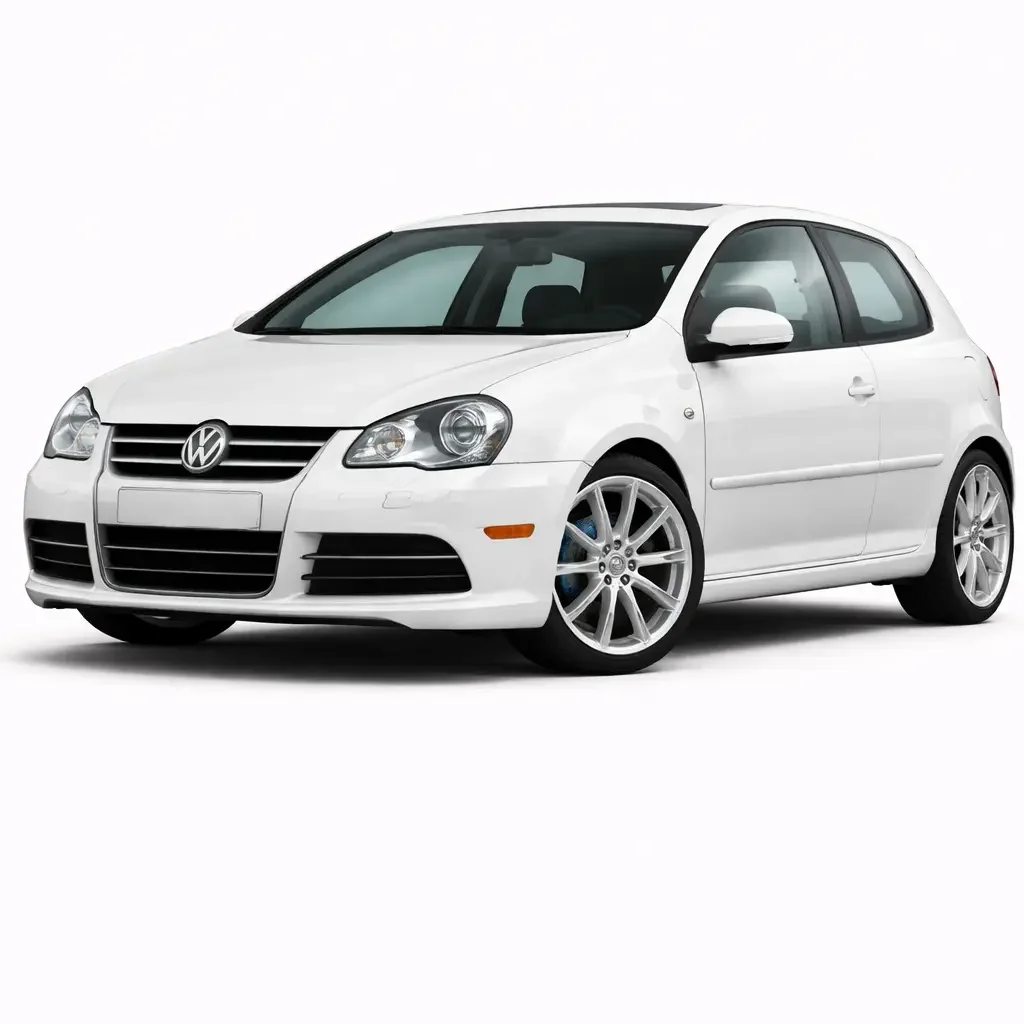
The 2008 Volkswagen R32 is the North American version of the Mk5 Golf R32, a limited-production performance hatchback built on the PQ35 platform and sold in the United States as a single model year with approximately 5,000 units. It is the second generation of the R32 nameplate, following the Mk4-based R32 that was sold as a 2004 model year in the US. The two generations share the R32 name and VR6 engine family, but they are built on entirely different platforms with substantially different catalog profiles. This guide covers the 2008 Mk5 R32 exclusively.
The Mk5 R32 is a more platform-integrated vehicle than its predecessor. Where the Mk4 R32 required a completely different rear axle, floor pan, and front suspension sourced from the Audi TT in order to accommodate the AWD drivetrain, the Mk5 R32 sits on a platform already designed to support AWD variants. The PQ35 architecture underpins the Audi A3 3.2 quattro, the Audi TT Mk2 3.2, and the Volkswagen Eos, all of which share significant drivetrain and suspension hardware with the R32. The result for catalog purposes is a vehicle that is more closely related to the Mk5 Rabbit and GTI in its suspension and structural architecture than the Mk4 R32 was to its era's Golf, while still carrying brake and drivetrain specifications entirely distinct from those siblings.
Platform, Production, and Window Identity
The Mk5 R32 is built on the Volkswagen Group A5 (PQ35) platform, the same architecture as the Mk5 Golf, Mk5 Jetta, Mk5 Rabbit, Mk5 GTI, Volkswagen Eos, Audi A3 (8P), and Audi TT Mk2 (8J). The PQ35 was designed from the outset to support AWD variants through the Haldex coupling system, which eliminates the need for the floor pan modifications and rear axle borrowing from the Audi TT that characterized the Mk4 R32.
The Mk5 R32 went on sale in Europe in September 2005. Volkswagen released the US-market version as a 2008 model year with a production allocation of approximately 5,000 units, each with its production sequence number laser-etched on the steering wheel. The R32 was sold only as a three-door hatchback in North America. No five-door or wagon variant was offered. The vehicle was built in Germany at Wolfsburg.
The Mk4 R32 (2004 model year, BFH/BML/BJS engine codes) and the Mk5 R32 (2008 model year, BUB engine code) are entirely separate ACES applications. They share the R32 nameplate and VR6 engine family designation but use different platforms, different engine codes with different internal specifications, different transmission types, different suspension architectures, and different brake specifications. No mechanical component crosses between the two R32 generations.
Engine: 3.2L VR6, Engine Code BUB
The Mk5 R32 uses the 3.2L 24-valve dual-overhead-cam VR6 engine with the BUB engine code, producing 250 PS (247 hp) at 6,300 rpm and 320 Nm (236 lb-ft) of torque from 2,500 to 3,000 rpm. The power increase of 10 PS over the Mk4 R32 (241 PS) comes from a reworked intake manifold with variable geometry that improves high-rpm breathing. The BUB is the same engine code used in the contemporaneous Audi A3 3.2 quattro (8P) and certain Audi TT 3.2 variants (8J), making those the primary engine cross-reference siblings for this application.
The BUB engine differs from the Mk4 R32 engine codes in several documented ways. The compression ratio is lower at 10.75 to 1 versus 11.25 to 1 on the Mk4 BFH. The exhaust camshaft profile differs. The cam position sensors are a different generation, described in the R32 owner community as grey units on BUB engines versus black on the earlier BFH, BHE, and BDB codes. The crankshaft is forged and carries the same part number as the Mk4 unit according to community sources, but all other internal specifications should be confirmed against BUB-specific part numbers before applying a Mk4 R32 cross-reference to internal engine components.
The timing chain and timing chain tensioner are the primary service reliability category for the BUB engine, as they were for the Mk4 BFH. These components should be listed under BUB-specific part numbers and cross-referenced to the Audi A3 3.2 (8P) and Audi TT 3.2 (8J) BUB applications. The Audi parts supply chain is generally broader and more cost-competitive than the R32-specific supply channel for engine internals.
The 2.5L five-cylinder engine (BGP, BGQ, CBTA, CBUA) used in the Mk5 Rabbit does not cross to the R32 in any component. The engine families are completely different architectures. Any catalog that groups the Rabbit and R32 engine applications together produces wrong engine parts for all engine-specific service calls.
Transmission: DSG Only, the Reversal from Mk4
The Mk5 R32 is equipped exclusively with the six-speed DSG dual-clutch gearbox in the North American market. No manual transmission option was offered. This is the direct reversal of the Mk4 R32's North American specification, which was manual-only with no DSG option. Catalogs that were built for the Mk4 R32 with manual transmission service components must not carry those listings forward to the Mk5 R32 DSG application.
The DSG unit in the R32 is the 02E six-speed dual-clutch transaxle. This unit contains two sets of gears arranged concentrically, with two clutch packs and two output shafts that allow pre-selection of the next gear before the current gear releases. The 02E transmission requires DSG-specific service fluid, not conventional automatic transmission fluid, and not manual gearbox oil. The DSG filter and fluid are service items that must be listed as distinct catalog entries.
The 02E DSG unit used in the R32 crosses to the Audi A3 3.2 quattro (8P) and Audi TT 3.2 (8J) DSG applications, as these vehicles use the same powertrain and transmission combination. DSG mechatronic unit, DSG clutch packs, DSG fluid, and DSG filter cross-references should include these Audi applications alongside the R32 VW application.
The Mk5 Rabbit and GTI that were sold alongside the R32 offered either a five-speed manual or a six-speed Tiptronic conventional automatic. Neither of those transmission types is the DSG. A catalog that applies Tiptronic ATF fluid or manual gearbox oil to the R32 transmission service application is supplying the wrong fluid for the DSG. DSG service requires its own proprietary fluid specification.
4Motion AWD: Haldex Coupling and Drivetrain Cross-References
The 4Motion AWD system uses a Haldex coupling unit to distribute torque between the front and rear axles on demand. Under normal driving conditions the system primarily drives the front wheels and transfers torque rearward as wheel speed differential or throttle demand increases. The Haldex unit can transfer up to 100 percent of available torque to the rear wheels in maximum engagement. The system includes an electronic differential lock function not present in the Mk4 R32.
The Haldex coupling is a standalone service item with its own fluid and filter specification. The Haldex filter and Haldex-specific fluid must be listed as separate maintenance categories from the DSG fluid, front differential fluid, and rear differential fluid. This is a common omission in catalog entries for AWD Volkswagen Group vehicles. Any R32 application entry that does not include the Haldex filter and fluid as distinct service items is incomplete.
Haldex service components and the rear differential assembly cross to the Audi A3 3.2 quattro (8P) and Audi TT 3.2 quattro (8J), which use the same drivetrain configuration. Rear driveshafts and rear CV joints likewise cross to these Audi applications. The 034Motorsport and similar performance parts vendors explicitly list their R32 drivetrain components as fitting the MkV R32 together with the 8P Audi A3 and 8J Audi TT quattro, confirming this cross-reference at the aftermarket level.
Suspension: PQ35 Architecture with R32-Specific Tuning
The Mk5 R32 uses the standard PQ35 suspension architecture shared broadly with the Mk5 Rabbit and GTI: MacPherson struts at the front and a subframe-mounted four-link independent rear setup. This is a fundamentally different situation from the Mk4 R32, which required Audi TT aluminum front control arms and a completely different rear floor pan and multilink rear axle borrowed from the Audi TT quattro. On the Mk5 platform, the same basic suspension architecture supports both front-wheel-drive and AWD variants without floor pan modifications.
Front lower control arms on the Mk5 R32 are steel units that cross broadly to the Mk5 GTI and Audi A3 3.2 applications within the PQ35 family. The front spindle and hub carrier are PQ35-standard and do not require the Audi TT-specific spindle replacement that was mandatory on the Mk4 R32. Front wheel bearing and hub assemblies cross to the PQ35 family by application.
While the architecture is shared, the R32 suspension is sport-tuned with firmer damping, higher spring rates, and lowered ride height compared to the Mk5 Rabbit and GTI. Velocity Journal's 2008 R32 road test confirms the R32 weighs 3,547 lbs, substantially more than the GTI due to the VR6 engine and AWD system, requiring the stiffer spring and damper specification to manage the added mass. Spring and shock absorber part numbers for the R32 must be confirmed against R32-specific OEM references and should not be assumed to match the Rabbit or GTI spring and damper part numbers despite the shared platform architecture.
Front and rear sway bars on the R32 are larger in diameter than the Rabbit and GTI units. Front sway bar end links on the PQ35 platform are broadly shared across the family at the structural attachment level, with specific diameter sway bars being the R32-differentiating element. Sway bar replacement should specify R32 diameter specifications. Bushings, end links, and related hardware at the attachment points cross to the PQ35 family including Audi A3 8P applications.
Brakes: 345mm Front and 310mm Rear
The Mk5 R32 brake specification is larger than the Mk5 GTI and entirely different from the Mk5 Rabbit. Front brakes use 345mm x 30mm vented rotors with single-piston floating calipers. Rear brakes use 310mm x 22mm vented rotors. This is confirmed by the VW Vortex Mk5 platform brake specification thread, which lists the Audi S3, Audi TT 3.2, and VW R32 as sharing this 345mm front and 310mm rear specification within the PQ35 platform family.
The cross-reference relationship for the Mk5 R32 brakes is clearly to the Audi A3 3.2 quattro (8P) and Audi TT 3.2 (8J). Forum documentation confirms that the 345mm front brake setup from the Audi A3 3.2 is a direct bolt-on to any PQ35 chassis vehicle with 18-inch or larger wheels, and that the carriers, calipers, and rotors share part numbers between the R32 and A3 3.2 with only caliper paint color as a differentiator. The R32 calipers were finished in a grey color specific to the R32, while Audi versions may differ in finish.
The Mk5 GTI uses 312mm front vented rotors with single-piston calipers and 286mm solid rear rotors. Neither the front nor the rear GTI brake specification crosses to the R32. A catalog that substitutes 312mm GTI front rotor listings for the R32 will supply rotors that are 33mm too small in diameter, and the caliper carrier geometry for 312mm rotors will not accommodate 345mm discs. The rear 286mm solid rotor from the GTI similarly does not fit the R32 rear brake setup, which uses 310mm vented rotors.
The Mk5 Rabbit uses even smaller brakes than the GTI: 280mm front vented and 256mm rear solid on base specification, rising to 288mm front on higher specification. Neither of these crosses to the R32 in any dimension. A catalog that applies Rabbit brake listings to the R32 will be wrong on rotor diameter, rotor design (solid vs. vented rear), and caliper specification for every single brake order.
Brake pad listings must also distinguish R32 from GTI and Rabbit applications. The R32 front pad for the 345mm single-piston application (part number 1K0698151B) is a different part from the GTI front pad for the 312mm single-piston application (1K0698151C). Applying GTI pad listings to the R32 front application will supply pads that are dimensionally incorrect for the larger caliper carrier.
Body Panels: What the R32 Shares and What It Does Not
The Mk5 R32 is sold exclusively as a three-door hatchback in North America. It shares the PQ35 body structure with the Mk5 GTI and Rabbit for the roof, windshield, A-pillars, B-pillars, and door aperture geometry. The front door assemblies and door glass on the three-door R32 cross to the three-door Mk5 GTI and three-door Mk5 Rabbit. The rear hatch and rear hatch glass cross to the three-door Mk5 Golf/Rabbit/GTI application.
The R32-specific exterior components that do not cross to the Rabbit or GTI are the front bumper cover and fascia featuring the R32 tri-port lower intake design, the rear bumper cover with dual center-exit exhaust apertures, the side skirts, the rear spoiler, and the 18-inch R32-specific alloy wheels. Velocity Journal's R32 road test specifically describes the brushed trim, tri-port lower fascia, twin center exhaust, and specific 18-inch alloys as the exterior distinguishing elements versus the GTI.
The front fascia design of the Mk5 R32 echoes the Jetta styling treatment of the era, and contemporary reviews noted the visual similarity to the Jetta as a minor criticism of the R32's differentiation. For catalog purposes this is a reminder that the front fascia is R32-specific despite resembling other VW products; it uses R32-specific part numbers and does not cross to the GTI or Jetta fascia assemblies.
The front fenders are shared with the three-door Mk5 Golf family and cross to the Mk5 Rabbit and GTI three-door applications for the same model year. The hood crosses to the Mk5 Golf family. All structural body-in-white components including the windshield glass, rear side glass, and door glass cross to the Mk5 platform within the three-door body configuration.
Standard Equipment and Interior
The Mk5 R32 was fully equipped as standard. Xenon headlamps were standard on the US-market R32, unlike the Mk5 Rabbit and GTI where xenon was optional or unavailable. Xenon headlamps require a different housing from the standard halogen or projector units; the ballast, ignition module, and leveling components are unique to the xenon application. Headlamp assemblies must be specified as xenon-equipped R32 units and not crossed to standard halogen Rabbit or GTI headlamp assemblies.
The sunroof was standard on US-market R32s. Sport seats with R32 headrest embroidery and machine-turned metallic interior trim were standard. The DSG transmission presented the driver with a configurable information display showing DSG mode and trip computer data, an instrument cluster feature not present in the Rabbit.
The Climatronic automatic climate control system, power windows, heated front seats, and a full complement of safety electronics including ABS, ESP, traction control, brake assist, and electronic brake force distribution were all standard. The ESP system shares its architecture with the PQ35 platform ESP used across the Mk5 Golf family.
Cross-Reference Summary
Crosses to Audi A3 3.2 (8P) and Audi TT 3.2 (8J)
Engine-internal components under BUB engine code, including timing chain and tensioner, camshaft hardware, intake manifold, and engine management sensors. DSG 02E transmission internal components and service items. Haldex coupling unit and service items (fluid and filter). Rear differential and rear driveshafts. Front 345mm x 30mm brake rotors, caliper carriers, and calipers. Rear 310mm x 22mm brake rotors and calipers. These cross-references are confirmed by aftermarket vendors including 034Motorsport, which explicitly lists fitment for MkV R32 and 8P/8J Audi A3/TT across its entire R32 drivetrain and transmission product line.
Crosses to Mk5 Rabbit and GTI (PQ35 Family)
Body structure and glass including roof, A-pillars, B-pillars, windshield glass, front door assemblies and glass, rear hatch and rear hatch glass (three-door configuration). Front lower control arms and front suspension geometry components at the structural level. Front fenders and hood. Steering rack, tie rod ends, and steering column. Climatronic HVAC system components. Electrical system modules at the BCM, ABS, and ESP level where shared by PQ35 platform.
R32-Specific (No Cross-Reference)
Front bumper cover and tri-port fascia, rear bumper cover with dual center-exit exhaust apertures, side skirts, rear spoiler, R32-specific 18-inch alloy wheels, dual center-exit exhaust system, R32 sport seat assemblies with embroidery, machine-turned metallic interior trim, and xenon headlamp assemblies with associated ballast and leveling hardware.
Common ACES/PIES Catalog Mistakes
1. Grouping the 2008 Mk5 R32 and 2004 Mk4 R32 into a single R32 application. These are different platform vehicles with different engine codes (BUB versus BFH/BJS), different transmission types (DSG only versus manual only in North America), different brake dimensions, and different suspension architectures. No mechanical component crosses between them. A catalog that treats both R32 generations as a single application will supply wrong parts for virtually every service category.
2. Applying Mk5 Rabbit or GTI front brake rotor listings to the R32. The Rabbit uses 280mm or 288mm front rotors. The GTI uses 312mm front rotors. The R32 uses 345mm front rotors. These are incompatible dimensions with different caliper carrier geometry. Substituting the GTI or Rabbit rotor for the R32 front application will produce a rotor that cannot be engaged by the R32 caliper carrier and will not fit within the wheel space properly.
3. Applying GTI solid rear brake listings to the R32. The GTI uses 286mm solid rear discs. The R32 uses 310mm vented rear discs. The rotor diameter is wrong, the rotor design (solid versus vented) is wrong, and the caliper specification is different. A unified GTI and R32 rear brake listing will generate wrong parts for both models if it uses either model's specification as the common application.
4. Omitting DSG fluid and DSG filter as distinct service items. The R32 uses the 02E DSG, not a conventional automatic or manual transmission. DSG service requires its own proprietary fluid and its own filter assembly. A catalog that does not include these items specifically for the R32 will have no service entries for the transmission's primary scheduled maintenance requirement.
5. Applying Tiptronic ATF or manual gearbox oil to the R32 DSG application. The Mk5 Rabbit uses a 6-speed Tiptronic automatic and a 5-speed manual. The R32 uses the 02E DSG dual-clutch. These are fundamentally different transmission types with incompatible fluid specifications. Supplying Tiptronic ATF or conventional manual gearbox oil to an 02E DSG will damage the dual-clutch pack assemblies.
6. Omitting Haldex coupling service categories. The Haldex unit requires its own filter and fluid on a service schedule independent from the DSG. A catalog entry for the R32 that covers DSG fluid and conventional brake service without including the Haldex filter and Haldex fluid as standalone items is missing a required AWD maintenance category.
7. Applying BFH or BML Mk4 R32 engine component listings to the BUB Mk5 R32. The BUB has a lower compression ratio, different exhaust camshaft, different generation cam position sensors, and a different intake manifold from the Mk4 codes. While the crankshaft may share a part number, other internal engine specifications differ and must be confirmed under BUB-specific applications before any Mk4 R32 engine cross-reference is published.
8. Applying halogen headlamp assemblies from the Rabbit or GTI to the R32 xenon application. The US-market R32 has standard xenon headlamps. The xenon housing, ballast, ignition module, and leveling motor are specific to the xenon system and are not interchangeable with the halogen headlamp assemblies used in the standard Rabbit. A catalog that sources R32 headlamp assemblies from the Rabbit application will supply halogen units for a vehicle equipped with xenon.
Pre-Listing Checklist for the 2008 R32
• Platform confirmed as PQ35 (Typ 1K), Mk5 Golf generation; application entirely separate from Mk4 R32
• Engine confirmed as 3.2L VR6 BUB engine code, 250 hp; no cross-reference to Mk4 BFH/BJS engine codes without specific part number confirmation; BUB cross-references to Audi A3 3.2 (8P) and Audi TT 3.2 (8J)
• Transmission confirmed as DSG 02E dual-clutch only; no manual option; DSG fluid and DSG filter listed as separate service categories; Tiptronic ATF and manual gearbox oil excluded
• Haldex coupling fluid and filter listed as standalone maintenance categories distinct from DSG and differential fluids
• Front brakes confirmed as 345mm x 30mm vented with single-piston calipers; 312mm GTI and 280/288mm Rabbit front rotor listings excluded; Audi A3 3.2 and TT 3.2 confirmed as brake cross-reference
• Rear brakes confirmed as 310mm x 22mm vented; GTI 286mm solid rear listings excluded
• Suspension spring and shock absorber part numbers confirmed against R32-specific OEM references; R32 sport tune specification not assumed to match Rabbit or GTI spring rates
• Body configuration confirmed as three-door only; front door and hatch glass crosses to three-door Mk5 Golf family; R32-specific fascias, side skirts, spoiler, and exhaust listed under R32-only part numbers
• Xenon headlamp assemblies listed as R32-standard; halogen Rabbit/GTI headlamp assemblies excluded
• 2008 Mk5 R32 and 2004 Mk4 R32 confirmed as entirely separate applications; no mechanical cross-references between generations
• Assembly origin confirmed as Wolfsburg, Germany
Final Take
The Mk5 R32 is a more catalog-approachable vehicle than the Mk4 R32 precisely because the PQ35 platform was designed for AWD from the ground up. Where the Mk4 required Audi TT floor pan and suspension surgery to accommodate the AWD drivetrain, the Mk5 R32 uses the same MacPherson and four-link architecture as the Mk5 GTI with the AWD components layered in. This makes the PQ35 family cross-reference much more reliable for structural and chassis components than it was on the Mk4 platform.
The catalog work for this vehicle concentrates in three categories: the brakes that are substantially larger than any other Mk5 Golf variant, the DSG that is the only transmission type available and requires its own service fluid, and the Haldex coupling that is a standalone maintenance item often omitted from AWD vehicle catalog entries. Get those three right, source engine internals through the Audi A3 3.2 cross-reference when R32-specific supply is limited, and the rest of the catalog follows from the well-documented PQ35 platform family.
Disclaimer
This guide is intended for catalog research, fitment analysis, and parts advisory reference. Production specifications, option availability, and regulatory compliance requirements vary by model year, regional market, and assembly date within any given window. Always confirm application data against vehicle identification number decoding, factory build sheets, and OEM parts documentation before finalizing a listing or parts recommendation. PartsAdvisory and its contributors are not responsible for fitment errors arising from catalog data that has not been independently verified against physical vehicle inspection or official OEM sources.