
Volkswagen Polo (2003–2009): Mk4 9N and 9N3 Fitment Guide
Written by Arthur Simitian | PartsAdvisory
The fourth-generation Volkswagen Polo carries the internal designation Typ 9N in its original form and Typ 9N3 after the May 2005 facelift. Launched at the Frankfurt Motor Show in September 2001 and made available in early 2002, it was produced through to 2009 in most markets. This guide covers the window from 2003 through 2009 — the mature 9N years and the complete 9N3 run — which is the period of highest surviving fleet density and greatest catalog demand.
The Polo Mk4 was not sold in the United States during this period. It is a European and global market vehicle. The guide therefore reflects European market specifications and the engine codes, brake sizes, and body configurations relevant to those markets. The platform is shared with the SEAT Ibiza Mk3 (6L), SEAT Córdoba Mk2 (6L), and Škoda Fabia Mk1 and Mk2, making those vehicles the primary cross-reference family for mechanical parts across the range.
The central catalog challenge on this generation is the large number of engine codes assigned to what appear to be the same displacement. The 1.4-litre petrol engine alone carries codes AUA, BBY, BKY, AUB, BBZ, AXU, and BUD across the full production window, each representing a different power output, valve configuration, or fuel system type. The 1.4 TDI diesel spans AMF, BAY, BNM, BWB, BNV, and BMS. Without engine code confirmation, no fuel system, ignition, timing, or engine management component listing for this vehicle can be considered accurate.
Platform, Designations, and the 9N / 9N3 Boundary
The Polo Mk4 rides on the PQ24 platform, Volkswagen Group's small-car architecture of the early 2000s. The platform is shared across the Volkswagen Group with the SEAT Ibiza 6L, SEAT Córdoba 6L, and Škoda Fabia Mk1 and Mk2, making those three vehicles valid mechanical cross-references for chassis components. This shared platform is wider and longer than the previous Polo 6N2 generation, bringing the Mk4 Polo's external dimensions close to those of the second-generation Golf.
The production designations that matter for catalog work are 9N (2002 to May 2005) and 9N3 (May 2005 to 2009). The 9N2 designation refers to the notchback saloon derivative produced for export markets outside Europe; it was built in Brazil and imported to European markets in limited numbers. The 9N2 is mechanically related to the 9N hatchback but carries different body panels aft of the B-pillar and is a distinct application for all rear body, glass, and boot/trunk components. For markets where only the hatchback was sold, the 9N2 is not a relevant application.
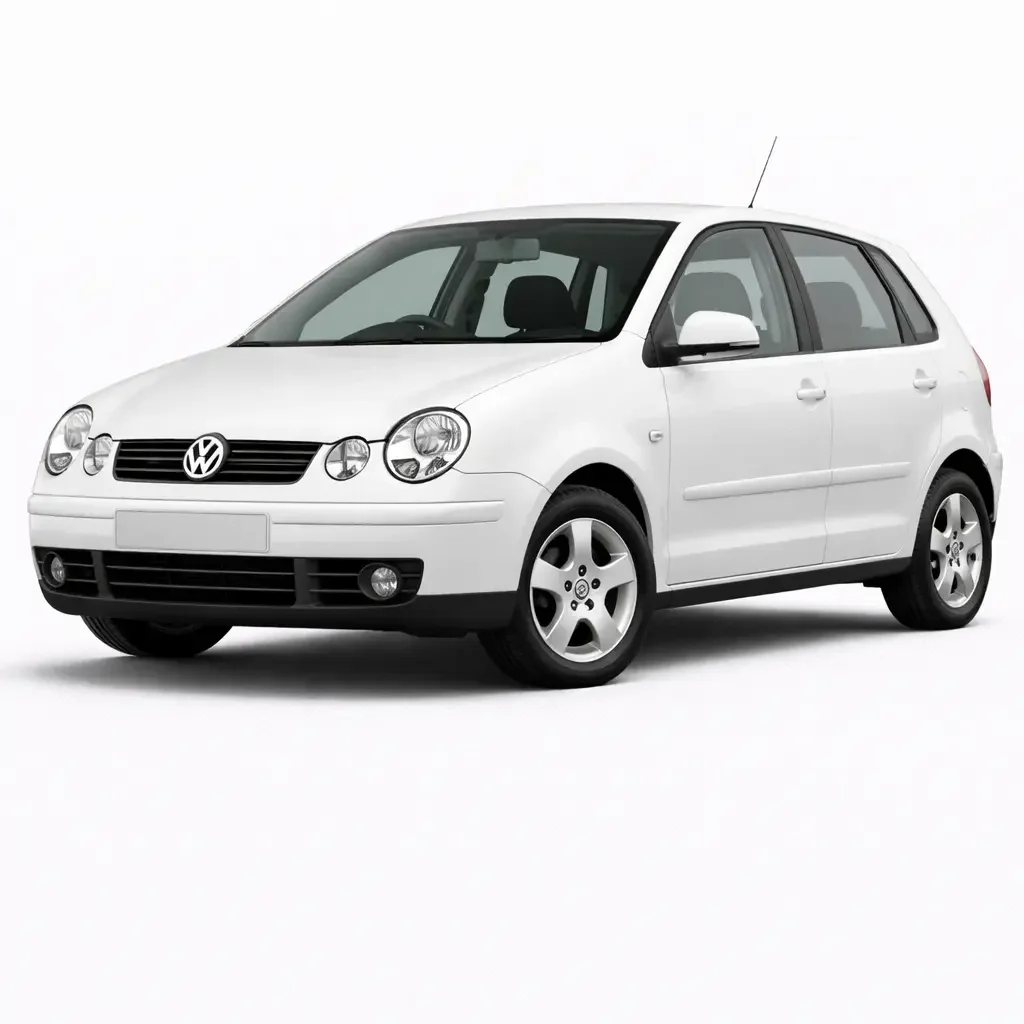
The May 2005 facelift from 9N to 9N3 changed every external body panel forward of the A-pillars. The 9N used quad round headlamps in the style of the contemporary Lupo. The 9N3 replaced these with a single-unit composite headlamp design inspired by the Golf Mk5 and Passat B6, incorporating a new bonnet, new front wings, a new front slam panel, and a new front bumper cover. The rear of the 9N3 received new tail lamp clusters and a revised tailgate. The UK-Polos.net community confirms that the 9N to 9N3 conversion requires a new slam panel as the fundamental structural piece, not just a headlamp swap. All forward body panels and closures are therefore 9N-specific or 9N3-specific and cannot be interchanged between the two designations.
Below the skin, the 9N and 9N3 are mechanically the same vehicle on the same platform with the same suspension geometry, the same brake mounting points, the same driveshaft and wheel bearing specifications for equivalent engine applications, and the same transmission architecture. Community consensus at UK-Polos.net states that approximately 99 percent of mechanical parts fit across both designations. Engine codes changed at the facelift for some applications, but the mechanical parts within those applications are often equivalent. The critical rule is: confirm engine code first, then apply the mechanical cross-references. Do not confirm by body designation alone.
Petrol Engine Codes: 1.2, 1.4, 1.6, and 1.8T
1.2L Three-Cylinder
The 1.2L petrol engine is a three-cylinder unit available in two distinct valve configurations across the 9N and 9N3 windows. In the 9N, engine code AWY is the six-valve SOHC version producing 55 PS, and BMD is a revised six-valve unit also at 55 PS. Engine code AZQ is the twelve-valve DOHC variant producing 64 PS in the 9N. In the 9N3 window, the codes BMD (54 PS) and BBM (60 PS) cover the six-valve family, while BME (64 PS) and BZG (70 PS) cover the twelve-valve family. The six-valve and twelve-valve variants are different engines with different cylinder heads, different camshaft configurations, different timing chains, and different ignition patterns. A single 1.2L Polo catalog entry that does not split by valve count and engine code will supply wrong cylinder head components, wrong timing chain kits, and wrong ignition coil packs for the majority of 1.2L service calls. The 1.2L AZQ and related codes are known within the Polo community for timing chain jump issues, making timing chain kit listings a high-demand service item that requires engine code precision.
1.4L Four-Cylinder Petrol
The 1.4L petrol family is the widest engine code spread in the Polo Mk4 catalog. In the 9N window, engine code AUA, BBY, and BKY all represent the eight-valve 75 PS version; AUB and BBZ are the sixteen-valve 100 PS versions; and AXU is the 1.4L FSI direct injection unit at 85 PS. In the 9N3 window, BKY continues the 75 PS application, BUD is the updated 80 PS eight-valve unit, and BBZ continues the 100 PS sixteen-valve. The FSI designation on AXU is significant: FSI engines use direct injection and require a high-pressure fuel pump and a separate high-pressure fuel rail not present in the port-injected variants. A catalog that groups AXU with AUA or BKY under a generic 1.4L petrol Polo entry will supply port injection fuel system components for a direct injection application every time.
The eight-valve codes (AUA, BBY, BKY, BUD) share a timing belt drive and cross-reference to each other and to the equivalent SEAT Ibiza 6L 1.4L eight-valve applications under matching codes. The sixteen-valve codes (AUB, BBZ) similarly cross to the SEAT Ibiza 6L 1.4L sixteen-valve and Škoda Fabia 1.4L sixteen-valve applications. Coil pack geometry and ignition system architecture differ between the eight-valve and sixteen-valve variants and must not be merged.
1.6L Petrol (9N3 Only)
The 1.6L petrol engine with engine code BAH producing 100 PS was introduced in the 9N3 window. It did not exist in the 9N. A catalog that opens a 1.6L petrol Polo application before May 2005 is wrong. The BAH is a four-cylinder sixteen-valve unit sharing architecture with the broader Volkswagen Group 1.6L petrol family. It cross-references to the SEAT Ibiza 6L 1.6L 100 PS application and to the Škoda Fabia Mk2 1.6L application under the same engine code.
1.8T Five-Valve GTI (9N3 Only, Engine Code BJX)
The Polo GTI of this generation was introduced late in 2005 as an exclusively 9N3 application. It uses a 1.8L turbocharged twenty-valve petrol engine with engine code BJX producing 150 PS, which is the same engine family used across the Mk4 Golf GTI range and in the Audi A6 of the era as noted by Wikipedia's Polo article. No GTI was available on the 9N platform at any point in this generation. A catalog entry that assigns GTI engine or brake components to any 9N-designation Polo is incorrect.
The GTI Cup Edition uses engine code BBU producing 179 PS from the same 1.8T block with revised calibration. This is a limited production variant and carries distinct part numbers for the engine management and fuel system components that were recalibrated for the higher output. Cup Edition listings must not be merged with standard BJX GTI listings at the engine management or fuelling level.
Diesel Engine Codes: 1.4 TDI, 1.9 SDI, and 1.9 TDI
1.4 TDI Three-Cylinder
The 1.4 TDI is a three-cylinder diesel unit using unit injectors, available across both 9N and 9N3 windows with a series of engine code revisions. In the 9N, code AMF produces 75 PS and code BAY is a revised 75 PS variant introduced mid-9N production. In the 9N3, code BNM produces 68 PS or 70 PS depending on calibration, BWB is a 70 PS update, and BNV produces 80 PS. The BlueMotion variant uses engine code BMS producing 80 PS with a variable geometry turbocharger, which is the key distinguishing hardware difference from the other 1.4 TDI codes. The UK-Polos.net forum confirms that the AMF, BNM, BWB, and BNV share the same fundamental block, head, and injectors, with ECU calibration as the primary power output differentiator. The BlueMotion BMS has a different turbocharger and a longer gearbox ratio and must be treated as a separate application for turbocharger and transmission listings.
The 1.4 TDI codes cross to the SEAT Ibiza 6L 1.4 TDI, Škoda Fabia 1.4 TDI, and Audi A2 1.4 TDI applications under matching engine codes, as these vehicles share the same engine unit across the PQ24 platform family. The cross-reference for turbocharger and injector listings is valid under matching codes; the BMS BlueMotion variable geometry turbocharger is distinct from the wastegate units used in AMF, BNM, BWB, and BNV.
1.9 SDI (9N Only, Engine Code ASY)
The 1.9 SDI is a naturally aspirated four-cylinder diesel with engine code ASY producing 64 PS. It was available in the 9N window (from late 2001 through early 2005 per diesel engine Wikipedia data). The SDI uses the same 1,896 cc block as the 1.9 TDI but has no turbocharger, different fuel system pressure, and a different injection pump. A catalog that assigns 1.9 TDI turbocharger or intercooler listings to the ASY SDI will produce components for an application that has no forced induction. The ASY was discontinued before or at the 9N to 9N3 facelift and should not appear in 9N3 catalog entries.
1.9 TDI Four-Cylinder: ATD, AXR, ASZ, BLT, BMT
The 1.9 TDI family spans the full production window in multiple output variants. Engine codes ATD and AXR both produce 100 PS (74 kW) and use the PD unit injector system. ATD was the primary 9N code; AXR was a revised 100 PS code appearing from mid-2005, continuing into the 9N3 as BMT. The diesel Wikipedia engine database confirms ATD and AXR for the Polo Mk4 from November 2001 onward, with BMT as the 9N3 continuation code. These three codes are closely related in terms of mechanical parts but carry different part numbers for the unit injectors and ECU calibration.
Engine codes ASZ and BLT represent the high-output 130 PS 1.9 TDI, which uses a six-speed manual gearbox as opposed to the five-speed used with all other 9N diesel applications. The 130 PS ASZ and BLT are also the threshold applications for the 288mm front brake disc specification, discussed in the brakes section below. ASZ and BLT are the highest-output applications in the 9N and 9N3 diesel range and must be maintained as distinct catalog entries from the 100 PS ATD/AXR/BMT applications at the gearbox, brake, and engine management level.
Brakes: Disc Size Is Engine-Code Dependent
Front brake disc diameter on the Polo Mk4 is not uniform across the engine range and cannot be determined from the body style or model year alone. The standard front disc diameter for the majority of 9N and 9N3 engine applications is 256mm vented. The 288mm front disc is reserved for the high-output applications, specifically the 1.9 TDI 130 PS engine codes ASZ and BLT, and the 1.8T GTI engine code BJX. The UK-Polos.net brake specification thread confirms 256mm as the standard fitment and 288mm as limited to ASZ, BLT, and by implication the GTI.
The caliper casting on 256mm front applications is marked FS11 or FS111 on the outer face, visible through the wheel spokes. This marking is a physical diagnostic tool for confirming disc size before ordering. A catalog that assigns 256mm front discs to a 130 PS TDI or GTI application, or that assigns 288mm discs to a 1.2L or entry-level 1.4L application, will produce dimensionally incompatible components that cannot be installed on the vehicle without caliper carrier changes.
The rear brake configuration varies by specification level. The majority of 9N and 9N3 models use rear drums. Rear disc brakes were fitted to higher-specification models including the GTI and certain 130 PS TDI applications. A single Polo brake catalog entry that applies rear disc listings across all engine applications will generate wrong rear brake components for drum-equipped vehicles, and vice versa. Engine code confirmation followed by trim-level or specification confirmation is required before rear brake type can be determined.
Brake cross-references to the SEAT Ibiza 6L and Škoda Fabia Mk1 are valid at the caliper, disc, and pad level for matching engine code applications. The shared PQ24 platform and shared engine families mean that brake components specified by engine code on the Polo Mk4 will carry the same part numbers on those vehicles under equivalent engine applications.
Suspension: Platform-Shared Architecture and GTI Tuning
The Polo Mk4 suspension uses MacPherson struts at the front and a torsion beam at the rear across all 9N and 9N3 engine applications. This architecture is shared with the SEAT Ibiza 6L, SEAT Córdoba 6L, and Škoda Fabia Mk1/Mk2 and cross-references freely to those vehicles at the strut, spring, and control arm level within matching engine weight classes.
The GTI suspension specification is 15mm lower than the standard Polo suspension, confirmed by the UK-Polos.net forum. Spring and damper rates are stiffer than standard. GTI springs and dampers are physically compatible with standard 9N3 strut housings and rear beam mounting points, meaning GTI suspension components will fit a standard 9N3, but the spring and damper rate specifications are different. A catalog that assigns standard Polo spring rates to the GTI will list the wrong spring specification for the sport application.
The CrossPolo (known in some markets as Polo Fun, Polo Dune, or Polo Soho) is a crossover-styled five-door variant available on both the 9N and 9N3 platforms. It features a raised ride height, body cladding, and roof rails but no AWD at any specification level. The CrossPolo uses a higher suspension specification than the standard Polo but shares the same strut and beam architecture. Spring part numbers for the CrossPolo must be confirmed against the raised-ride-height specification and must not be assumed to match either the standard Polo or the GTI spring rates.
CrossPolo and GTI: Variant-Specific Catalog Entries
The CrossPolo is a styling variant only. It was available on the 9N from 2003 and continued on the 9N3. Despite its raised suspension and off-road styling cues, it was never offered with four-wheel drive. Any catalog entry that assigns AWD drivetrain components to the CrossPolo is incorrect. Front-wheel drive is the only drivetrain configuration for every CrossPolo built in this generation.
The GTI is exclusive to the 9N3 and was not available until late 2005 after the facelift was introduced in May 2005. The GTI-specific catalog entries include the BJX or BBU engine application, the 288mm front brake disc with associated caliper and pad specifications, the GTI-sport lowered spring and damper assemblies, the GTI-specific front fascia with lower air intake, GTI side skirts, and GTI rear spoiler. None of these components cross to the standard 9N3 hatchback exterior. The GTI's larger front disc also means that the GTI uses a different front hub and knuckle specification to accommodate the larger caliper carrier — confirming that brake, hub, and knuckle listings must be kept strictly separated between GTI and non-GTI applications.
Platform Cross-References: SEAT Ibiza 6L and Škoda Fabia
The SEAT Ibiza Mk3 (6L) and SEAT Córdoba Mk2 (6L) share the PQ24 platform with the Polo 9N and 9N3 and use many of the same engine codes across the petrol and diesel ranges. The Škoda Fabia Mk1 and Mk2 are also platform siblings. These cross-references are valid for front suspension components (struts, spring seats, control arms, wheel bearings, front hubs), brake components (caliper bodies, caliper carriers, rotor specifications) under matching engine codes, clutch components under matching engine and transmission codes, and cooling system components under matching engine codes.
The cross-reference is not valid for external body panels, which are unique to each nameplate's design. Headlamps, tail lamps, bonnet, front wings, front bumper, and rear bumper are Polo-specific parts and do not cross to the Ibiza or Fabia body panels despite the shared platform architecture. The 9N and 9N3 headlamp assemblies are each unique within the Polo range and do not cross between the two designations, as established in the body sections above.
Engine oil filter, air filter, and fuel filter listings follow engine code and cross freely between Polo, Ibiza, Fabia, and in the case of the 1.4 TDI, the Audi A2 application under matching engine codes. This makes the broader VAG platform family a useful supply alternative when Polo-branded service parts face supply constraints.
Common ACES/PIES Catalog Mistakes
1. Treating all 1.4L petrol Polo Mk4 applications as a single entry. The 1.4L petrol family spans eight-valve port injection (AUA, BBY, BKY, BUD), sixteen-valve port injection (AUB, BBZ), and FSI direct injection (AXU). These are different fuel delivery architectures with different high-pressure fuel pumps, different injector types, and different manifolds. Assigning port injection fuel system components to the FSI AXU application, or vice versa, will produce wrong parts for every fuel system order against that code.
2. Merging the 1.2L six-valve and twelve-valve applications. The AWY and BMD six-valve engines share a SOHC cylinder head and a three-cylinder timing chain layout that is different from the AZQ and BME twelve-valve DOHC cylinder head. Valve stem seals, camshaft components, timing chain kits, and cylinder head gaskets are all different between the six-valve and twelve-valve 1.2L codes. A unified 1.2L entry will produce wrong cylinder head parts for whichever valve configuration is not the default in that listing.
3. Assigning 288mm front brake discs to standard engine applications. The 288mm front disc specification is correct only for the 1.9 TDI 130 PS ASZ and BLT engine codes and for the GTI BJX application. All other engine applications in this generation use 256mm front discs with different caliper carriers. Supplying 288mm discs to a 1.4L or 100 PS TDI application will deliver rotors that are 32mm too large in diameter and physically incompatible with the 256mm caliper carrier.
4. Applying GTI catalog entries to the 9N pre-facelift window. The Polo GTI of this generation was introduced exclusively with the 9N3 facelift from late 2005. A catalog that opens a GTI engine, brake, or suspension entry for the 9N period (2002 to May 2005) is applying a variant that did not exist. There was no Polo GTI sold between the discontinuation of the Mk3 GTI at the 9N's launch and the reintroduction with the 9N3.
5. Using 9N forward body panel listings for 9N3 applications. The May 2005 facelift changed the bonnet, front wings, front headlamps, front slam panel, front bumper, rear tail lamps, and rear tailgate. These are not interchangeable between 9N and 9N3. A headlamp, bonnet, or wing listed for a 9N that is applied to a 9N3 will not physically fit the 9N3's front end geometry.
6. Assigning turbocharger listings to the 1.9 SDI ASY application. The SDI is a naturally aspirated diesel with no turbocharger. It uses the same 1,896 cc block as the 1.9 TDI family but has no forced induction. A catalog that applies 1.9 TDI turbocharger or intercooler listings to the ASY will supply components for a non-existent boost system. The SDI was discontinued at or before the 9N3 facelift and should not appear as an active application in any 9N3 catalog entry.
7. Assigning AWD drivetrain components to the CrossPolo. Despite its raised suspension and off-road appearance cues, the CrossPolo was never offered with four-wheel drive in any market. Front-wheel drive is the only drivetrain configuration for the entire CrossPolo production run. Prop shaft, rear differential, and rear driveshaft listings do not apply to this variant.
8. Using a single 1.4 TDI entry for all codes without distinguishing the BlueMotion BMS application. The BMS BlueMotion 1.4 TDI uses a variable geometry turbocharger and a longer gearbox ratio, making it distinct from the AMF, BNM, BWB, and BNV applications which use wastegate turbos. A unified 1.4 TDI listing will supply the wrong turbocharger type for the BlueMotion application on every order.
9. Applying 1.9 TDI 100 PS gearbox specifications to the 130 PS application. The 130 PS ASZ and BLT use a six-speed manual gearbox while all other 9N diesel variants use a five-speed. Clutch disc diameter, clutch cover, and gearbox oil capacity differ between the five-speed and six-speed units. A unified 1.9 TDI gearbox listing will generate the wrong clutch and transmission specifications for one of the two output levels.
Pre-Listing Checklist for the 2003–2009 Polo Mk4
• Platform confirmed as PQ24; SEAT Ibiza 6L, SEAT Córdoba 6L, and Škoda Fabia Mk1/Mk2 confirmed as platform cross-reference siblings for mechanical components under matching engine codes
• Designation confirmed as 9N (to May 2005) or 9N3 (May 2005 onward); forward body panel, headlamp, tail lamp, and tailgate listings separated by designation; mechanical listings confirmed by engine code regardless of designation
• 1.2L valve configuration confirmed: six-valve (AWY, BMD, BBM) versus twelve-valve (AZQ, BME, BZG) are distinct applications for all cylinder head, timing, and ignition components
• 1.4L petrol injection type confirmed: port injection eight-valve (AUA, BBY, BKY, BUD) versus port injection sixteen-valve (AUB, BBZ) versus FSI direct injection (AXU) are distinct applications for all fuel system components
• 1.4 TDI turbocharger type confirmed: variable geometry (BMS BlueMotion) is a distinct application from wastegate (AMF, BAY, BNM, BWB, BNV); gearbox ratio confirmed separately for BMS
• 1.9 TDI output confirmed: 100 PS (ATD, AXR, BMT) uses five-speed gearbox; 130 PS (ASZ, BLT) uses six-speed gearbox; six-speed clutch and gearbox listings must not merge with five-speed applications
• Front disc size confirmed by engine code: 256mm for all standard applications; 288mm for ASZ, BLT, and GTI BJX only; caliper and carrier listings follow disc size
• Rear brake type confirmed by application: rear drums for standard models; rear discs for GTI and high-spec 130 PS TDI
• GTI confirmed as 9N3 only from late 2005; GTI entries not applicable to any 9N application; GTI-specific front and rear body panels, lowered suspension, and larger brakes listed as GTI-exclusive applications
• CrossPolo confirmed as FWD only throughout production; no AWD drivetrain listings applicable; raised suspension specification distinct from both standard Polo and GTI spring rates
• 1.9 SDI ASY confirmed as 9N only and naturally aspirated; no turbocharger or intercooler listings applicable; SDI not carried into 9N3 catalog entries
Final Take
The Polo Mk4 is a high-volume European vehicle with a parts catalog that rewards precision and punishes generalisation. The range looks simple from the outside — a small hatchback in two body designations across seven years — but contains more engine code variation than many larger platforms manage across an entire generation. The 1.4L petrol family alone spans three different fuel delivery architectures under codes that differ by a single letter, and the brake disc diameter cannot be read from the body or year without first knowing the engine code.
The 9N to 9N3 facelift boundary is mechanically transparent for the most part — a useful fact for catalog builders who need to confirm that undercar parts cross between the two designations. The body panel boundary at that same May 2005 date is a hard stop: nothing forward of the A-pillar transfers, and neither does the rear tail lamp cluster or tailgate. Keeping those two boundaries clearly distinct — mechanical continuity, body panel discontinuity — is the practical summary of what separates a well-structured Polo Mk4 catalog from one that generates incorrect orders.
Disclaimer
This guide is intended for catalog research, fitment analysis, and parts advisory reference. Production specifications, option availability, and regulatory compliance requirements vary by model year, regional market, and assembly date within any given window. Always confirm application data against vehicle identification number decoding, factory build sheets, and OEM parts documentation before finalizing a listing or parts recommendation. PartsAdvisory and its contributors are not responsible for fitment errors arising from catalog data that has not been independently verified against physical vehicle inspection or official OEM sources.