
Written by Arthur Simitian | PartsAdvisory
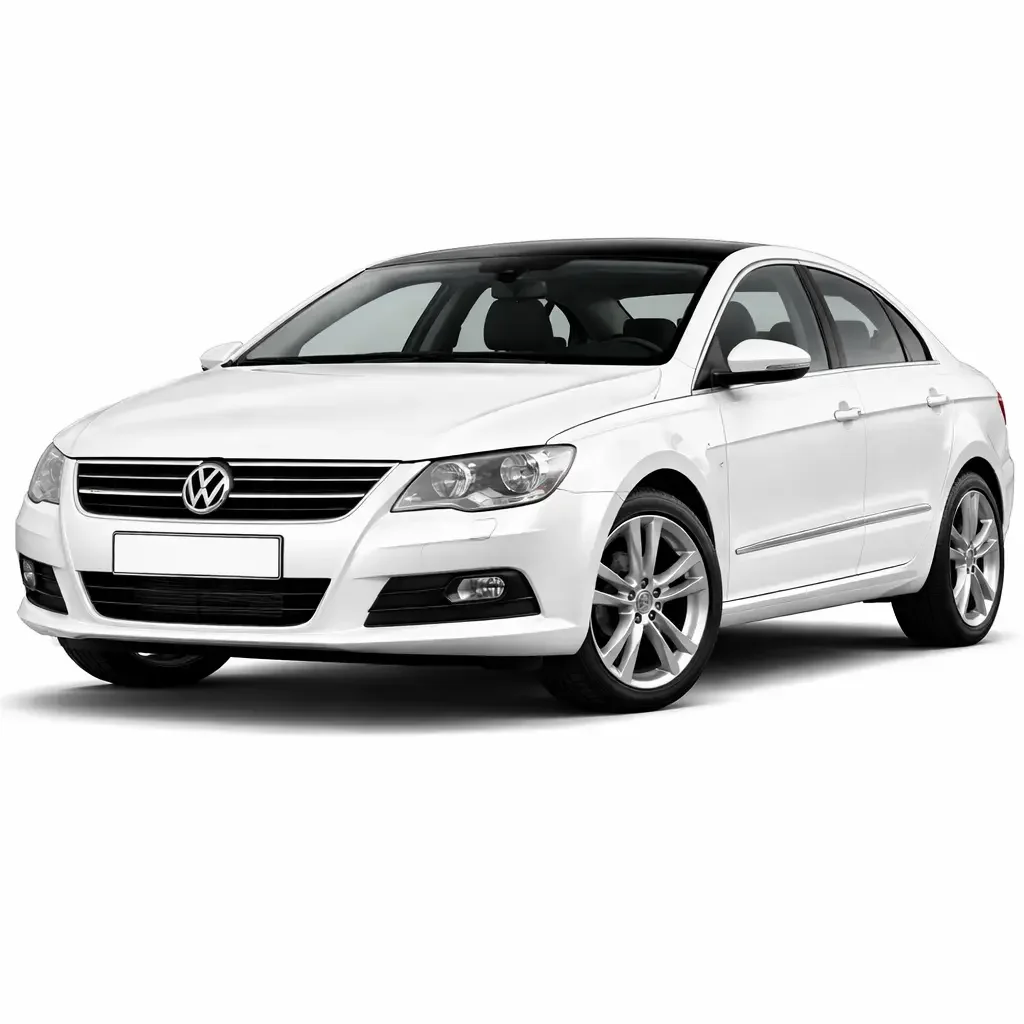
The Volkswagen Passat CC sold in North America from the 2009 through 2012 model years is a four-door coupe variant of the B6 Passat family, built on a derivative of the PQ46 platform and sharing its wheelbase, core powertrains, and most of its undercar architecture with the contemporary Passat sedan. It debuted at the 2008 North American International Auto Show in Detroit and entered North American dealerships for the 2009 model year. In North America the vehicle was sold from the outset as simply the CC, dropping the Passat prefix that was retained in European and other global markets. Volkswagen described the CC designation as standing for Comfort Coupe, a reference to the coupe-like roofline applied to what is structurally a four-door sedan with a trunk.
The 2012 model year marks the end of the pre-facelift generation covered in this guide. Production of the facelifted CC started in January 2012, with a revised front and rear end that brought the car in line with Volkswagen's then-current design language. The nameplate changed globally at that point from Passat CC to simply Volkswagen CC, aligning with the naming convention already in use in North America. From a catalog standpoint, the 2012 model year is a boundary year that requires care: vehicles built before the January 2012 production change carry pre-facelift front and rear body components, while vehicles built during or after carry facelift-specification front and rear components. This guide addresses the pre-facelift application.
This guide covers the North American market specifically. The European Passat CC shared the same platform and powertrain architecture but offered a broader engine range including 1.8 TSI and 2.0 TDI variants that were not sold in North America during this window, and the European VR6 was paired with a DSG transmission rather than the conventional automatic used on the North American VR6. Those distinctions are addressed in the engine and transmission sections below.
Platform: PL45 Plus, PQ46 Derivative, and the Relationship to the B6 Passat
The Passat CC was engineered using an evolution of the B6 Passat's PQ46 platform, sometimes referred to as PL45+ in recognition of the modifications made to accommodate the CC's different body architecture. The CC shares the Passat's wheelbase exactly at 2,710 mm (approximately 106.7 inches), but the overall body is 27 mm longer, 50 mm lower, and 36 mm wider than the Passat sedan. These dimensional differences arise entirely from changes to the front and rear overhangs and to the roofline geometry; the floorpan and wheelbase are unchanged.
The transverse engine layout carried over from the B6 Passat is central to understanding the CC's drivetrain architecture. Unlike the previous B5 Passat, which used a longitudinal engine layout, the B6 and CC use transverse-mounted engines driving the front wheels as standard, with the optional 4Motion system using a Haldex rear differential to distribute torque to the rear axle. This transverse layout dictates the drivetrain component family for the entire CC application, and it means that none of the longitudinally oriented drivetrain components from earlier Passat generations cross to the CC.
Despite the shared platform, the CC and the B6 Passat sedan do not share body panels. Almost every external body panel on the CC is different from the Passat sedan. The hood, front fenders, front bumper, headlamps, doors, roof, rear quarters, taillamps, rear bumper, and trunk lid are all CC-specific components. The shared wheelbase and floorpan make undercar mechanical components the primary cross-reference family between the CC and the B6 Passat, not body components. A catalog that cross-references CC exterior body panels to B6 Passat sedan panels will generate wrong components on every body order placed against such an entry.
The CC's body is approximately 31 mm longer than the Passat sedan, with that additional length distributed between the front and rear overhangs rather than the passenger compartment. The sloping trunk lid reduces cargo capacity relative to the Passat sedan by approximately 40 litres despite the longer overall body. The frameless door windows are unique to the CC within the VW lineup of this period and are a defining structural detail: frameless glass requires different sealing systems, different regulator geometry, and different door assembly specifications from framed glass doors on the Passat sedan. Door glass, door seals, and window regulator components from the Passat sedan do not cross to the CC.
North American Lineup: Trim Structure 2009 Through 2012
The North American CC lineup was organized around four trim levels throughout most of the pre-facelift window: Sport, Luxury, VR6 Sport, and VR6 4Motion. The engine choice drove the upper trim boundary, and the drivetrains split cleanly between the 2.0T four-cylinder applications and the VR6 six-cylinder applications.
2009: Launch Year, Four Trims, Conventional Automatic on 2.0T
For the 2009 model year the CC launched with the Sport, Luxury, VR6 Sport, and VR6 4Motion trim levels. The 2.0T Sport was the base entry, available with a six-speed manual transmission or a conventional six-speed automatic with Tiptronic. The 2.0T Luxury was automatic only. Both VR6 trims were paired exclusively with the conventional six-speed automatic. The VR6 4Motion was the only all-wheel-drive configuration in the lineup. All CCs for 2009 were configured as four-passenger vehicles, with two individual bucket seats in the rear rather than a conventional three-person bench.
The Sport trim was the only configuration that omitted leather upholstery, a panorama sunroof, and front and rear obstacle detection as standard equipment. A Technology Package adding navigation and a rearview camera was available across all trims except the base Sport.
2010: DSG Replaces Conventional Automatic on 2.0T, Three-Seat Rear Bench Added
The 2010 model year brought two significant changes. On 2.0T models equipped with automatic transmission, Volkswagen replaced the conventional six-speed Tiptronic automatic with a six-speed DSG dual-clutch automated manual gearbox. This is the most consequential catalog boundary within the pre-facelift window for transmission-related components. The 2009 2.0T automatic used the 09G conventional torque-converter automatic. From 2010, the 2.0T automatic used the 02E DSG unit. These are fundamentally different transmission architectures: the 09G is a traditional hydraulic automatic with a torque converter, while the 02E DSG is a dual-clutch automated manual. Transmission internal components, fluid specifications, mechatronic units, and service procedures are entirely different between the two units. Any transmission component listing for a 2.0T automatic CC must confirm the model year before the 09G or 02E designation is applied.
The VR6 4Motion continued with the conventional six-speed automatic throughout the pre-facelift window. The VR6 in the North American market was not paired with the DSG at any point during this period. European markets used the DSG with the VR6, but the North American VR6 used the conventional automatic throughout. A catalog that assigns DSG components to the North American VR6 4Motion is applying a European transmission configuration to a market-specific application in which it was never used.
The second 2010 change was the addition of a three-position rear bench seat alongside the continued availability of the two individual rear bucket seat configuration. A center rear seating position with a third seatbelt was added. This change affects rear seat assembly specifications, rear seat belt hardware, and rear interior trim panels. A catalog entry covering both 2009 and post-2010 CC rear interior components must account for this seating change when it affects component geometry.
2011: No Mechanical Changes
The 2011 model year was a carryover from 2010. No mechanical changes were introduced. Components confirmed for the 2010 model year application cross to 2011 without revision.
2012: Facelift Boundary, Nameplate Change
The 2012 model year is where the pre-facelift generation ends. The facelift was presented at the Los Angeles Auto Show in late 2011 and production began in January 2012. The revised front and rear end brought new headlamp units with LED daytime running lights, a new front bumper and grille, and new taillamp clusters and rear bumper. The roofline, doors, glass, and midsection body panels were unchanged at the facelift. Volkswagen dropped the Passat prefix globally for the facelifted model, aligning all markets with the CC-only naming convention already used in North America.
Because production of the facelift started in January 2012, the 2012 model year contains both pre-facelift and facelift build dates. A catalog entry that assigns pre-facelift front and rear body components uniformly to all 2012 model year CCs will generate wrong components for vehicles assembled after the January 2012 production transition. Headlamp housings, front bumper assemblies, taillamp clusters, and rear bumper assemblies must be confirmed against build date or VIN-decoded production information rather than model year alone for 2012 applications.
Engines: 2.0T and 3.6 VR6, North America Only
The North American CC received two engine options throughout the pre-facelift window. No diesel engine was offered in North America on the CC at any point. No 1.8 TSI was offered in North America on the CC in this period. Both of these engine families were available in European markets but were not sold in North American CC applications during the 2009-2012 window.
2.0T Four-Cylinder
The 2.0-litre turbocharged four-cylinder from the EA888 engine family produces 200 hp at 5,100 rpm and 207 lb-ft of torque in North American specification. It is the base powertrain for the Sport and Luxury trim levels and is the only engine offered with a manual transmission. The six-speed manual was available on the Sport trim only; all other 2.0T configurations used an automatic transmission, which changed from the 09G conventional unit to the 02E DSG unit at the 2010 model year as described above.
The 2.0T EA888 engine in the CC application crosses to the B6 Passat 2.0T and to the Golf GTI of the same generation at the engine internal service component level, including timing chain components, water pump, thermostat, spark plugs, oil filter, and air filter. These cross-references hold within the same EA888 engine generation and apply to both manual and automatic transmission applications, as the engine specification is unchanged across transmission types.
The 2.0T in the CC is transversely mounted, consistent with the PQ46-derived platform. Any engine component listed for a longitudinally mounted VW Group 2.0T application does not cross to the CC. This distinction is relevant when working from parts catalogs that cover both the older longitudinal Passat B5 family and the transverse B6 and CC family; mounting orientation affects accessory drive geometry, oil pan configuration, and cooling system routing.
3.6 VR6
The 3.6-litre VR6 FSI direct-injection six-cylinder produces 280 hp at 6,200 rpm and 265 lb-ft of torque at 2,750 rpm in North American specification. It is available in two configurations in North America: the VR6 Sport with front-wheel drive, and the VR6 4Motion with all-wheel drive. Both VR6 configurations use the conventional six-speed automatic transmission with Tiptronic, designated 09M. The 09M used with the VR6 is derived from the same Aisin platform as the 09G used with the 2.0T automatic, but it incorporates modifications to handle the VR6's greater torque output. The 09G and 09M are not interchangeable; transmission internal components, fluid filter size, and torque converter specifications differ between the two units.
The VR6 engine is identified externally by two chrome exhaust tailpipes on VR6 Sport models and by the additional drivetrain noise characteristic of the 4Motion system on VR6 4Motion models. VR6 Sport models use front-wheel drive and share the same front drivetrain layout as the 2.0T models, with a different halfshaft specification to accommodate the VR6's torque output. VR6 halfshafts must not be cross-referenced to 2.0T halfshaft applications.
The 3.6 VR6 FSI engine in the CC application crosses to the B6 Passat 3.6 VR6 at the engine internal service component level. Timing chain components, spark plugs, oil filter, and fuel filter cross between the CC VR6 and the B6 Passat VR6 within matching engine build specifications. The European market VR6 in the CC produced 295 to 299 hp depending on the specification year and was paired with the DSG transmission, distinguishing it from the North American application at both the power output level and the transmission type.
Drivetrains: FWD and 4Motion, and What Crosses Between Them
All 2.0T CC applications in North America are front-wheel drive. The VR6 Sport is also front-wheel drive. Only the VR6 4Motion uses all-wheel drive, and that drivetrain uses the Haldex second-generation system as the rear torque distribution mechanism, consistent with the B6 Passat 4Motion application.
The Haldex unit, rear differential, rear driveshaft, and rear halfshafts are exclusive to the VR6 4Motion and do not apply to any front-wheel-drive CC application. A catalog that treats the VR6 Sport and VR6 4Motion as a unified drivetrain application will assign 4Motion rear drivetrain components to a front-wheel-drive vehicle on every rear drivetrain order placed against a merged entry.
The 4Motion AWD system on the CC uses the same Haldex generation and overall architecture as the B6 Passat 4Motion from the same period. Haldex unit service components, rear differential fluid specifications, and rear driveshaft assemblies cross between the CC VR6 4Motion and the B6 Passat 3.6 4Motion within the same drivetrain generation. This cross-reference holds at the undercar level and represents one of the most reliable shared component families between the two vehicles.
Front suspension geometry is shared between the FWD and AWD CC applications because the front suspension mounting points are identical. Front strut assemblies, front control arms, front wheel bearings, and front hubs cross between VR6 4Motion and both front-wheel-drive configurations within the same engine weight category. The VR6 4Motion front suspension must be confirmed against the appropriate engine weight specification when cross-referencing to 2.0T applications, as the heavier VR6 front end may carry a different spring rate or strut specification from the lighter 2.0T front end.
The CC Body vs the Passat Sedan: What Crosses and What Does Not
The most persistent catalog error on the CC application is the cross-referencing of body components between the CC and the B6 Passat sedan. The shared platform and wheelbase, combined with the similar overall proportion of the two vehicles, leads researchers to treat them as body-sharing siblings when they are not. Almost every external body panel is CC-specific.
Components that do not cross between the CC and the B6 Passat sedan under any circumstance include the hood, front fenders, front bumper assembly, headlamp housings, front grille, all four door assemblies, door glass, door seals, window regulators, the roof panel, rear quarter panels, rear bumper assembly, taillamp clusters, and the trunk lid. The door assemblies deserve specific attention: the CC's frameless windows are a structural characteristic of the door design. The window frame that surrounds the glass on the Passat sedan is absent on the CC, which uses a seal system that mates the glass directly to the roof aperture and the B-pillar. This fundamental difference in door construction means no door or door glass component from the Passat sedan will fit the CC door aperture.
Components that do cross between the CC and the B6 Passat at matching engine and generation specifications include undercar mechanical items: front suspension components, front brake rotors and calipers, front wheel bearings, front hubs, engine service components within matching engine specifications, transmission service components within matching transmission type designations, steering rack, Haldex and rear drivetrain components on 4Motion variants, and exhaust components from the catalytic converter rearward within matching engine specifications.
Windscreen glass is one exterior glazing item that crosses between the CC and the B6 Passat. Despite the different rooflines, the windscreen opening geometry and the glass dimensions are shared between the two vehicles at the same generation level. This is a confirmed cross-reference and represents the primary glazing component shared between the two body styles.
Suspension: Sport-Tuned Standard, Adaptive Chassis Control on VR6 4Motion
All North American CCs are equipped with a sport-tuned suspension as standard, with a lower ride height and wider track compared to the B6 Passat sedan. The lower ride height and wider track are part of the CC's structural specification and are not a trim-level option; every CC in this window rides lower and wider than the Passat regardless of trim level.
Adaptive Chassis Control, designated DCC by Volkswagen, was standard equipment on the VR6 4Motion and offered three damper settings: Normal, Sport, and Comfort. DCC was not standard on 2.0T models in this pre-facelift window for North America. A catalog entry listing DCC-equipped suspension components, including the electronically adjustable damper units and the DCC control module, must be flagged as VR6 4Motion-specific and not applied uniformly across all pre-facelift CC applications.
Suspension cross-references between the CC and the B6 Passat at matching engine and equipment level hold at the front axle for strut cartridges, spring rates, and control arms. The rear suspension geometry is also shared at the platform level. However, because the CC's sport-tuned suspension uses different spring rates and damper calibration from the standard B6 Passat sedan suspension, the spring and damper specifications must be confirmed against the CC-specific application rather than assumed to be identical to the standard Passat sedan specification. The same component family applies, but the calibration differs.
Common ACES/PIES Catalog Mistakes
The first and most consequential error is cross-referencing CC exterior body panels to B6 Passat sedan panels. The hood, fenders, doors, bumpers, headlamps, taillamps, trunk lid, and roof are all CC-specific. No exterior body panel forward of the windscreen and aft of the windscreen on the CC fits the B6 Passat sedan apertures. A unified body panel listing that does not distinguish between the two body styles will generate wrong components on every body order.
The second error is applying a single automatic transmission application to all 2.0T CC models without separating the 2009 conventional automatic from the 2010 and later DSG. The 2009 2.0T automatic used the 09G conventional torque-converter unit. From 2010, the 2.0T automatic used the 02E DSG dual-clutch unit. These are different transmission families with different internal components, different fluid specifications, different mechatronic hardware, and different service intervals. A transmission component confirmed for the 2009 09G application does not cross to the 2010-2012 02E DSG application.
The third error is applying DSG transmission components to the North American VR6 4Motion. The VR6 in North America used the conventional 09M automatic throughout the pre-facelift window. The European VR6 used the DSG. A catalog that assigns DSG components to the North American VR6 application is applying a European transmission specification to a market where it was never used.
The fourth error is treating the VR6 Sport and VR6 4Motion as a unified drivetrain application. The VR6 Sport is front-wheel drive only. The VR6 4Motion adds the Haldex rear differential, rear driveshaft, rear halfshafts, and the DCC suspension as standard. Rear drivetrain components, Haldex service items, and DCC damper units listed for the 4Motion do not apply to the VR6 Sport.
The fifth error is applying door assemblies or door glass from the B6 Passat sedan to the CC. The CC uses frameless door windows, a construction that requires entirely different door sealing systems, different window regulators, and different glass edge profiles from the framed windows of the Passat sedan. No Passat sedan door glass or door assembly fits the CC door aperture.
The sixth error is treating the 2012 model year as a uniform pre-facelift application. Production of the facelifted CC started in January 2012. Vehicles built before that date carry pre-facelift headlamps, front bumper, taillamps, and rear bumper. Vehicles built after carry facelift-specification components. Front and rear body components for 2012 CC applications must be confirmed against build date or VIN production data, not assumed to be uniform across the model year.
The seventh error is applying diesel or 1.8 TSI engine component listings to North American CC applications. The TDI diesel and 1.8 TSI were European market engines that were not offered in North America on the CC in the 2009-2012 window. Fuel system components, injectors, exhaust components, and engine management hardware for these engines do not apply to any North American CC application.
The eighth error is applying the B6 Passat sedan's standard suspension spring rates or damper specifications to the CC application. The CC used a sport-tuned suspension with lower ride height and wider track as standard across the entire lineup. Spring rate and damper calibration on the CC differ from the standard Passat sedan suspension even where the component families and mounting geometries overlap. CC-specific spring and damper specifications must be confirmed before any suspension service component is listed as a cross-reference to the standard Passat sedan.
The ninth error is applying VR6 halfshaft listings to 2.0T applications or vice versa. The VR6's greater torque output requires a heavier-duty halfshaft specification from the 2.0T front halfshaft. Halfshaft components must be confirmed against the engine application before any cross-reference between the two powertrain families is published.
The tenth error is assigning 2009 rear interior components uniformly to all pre-facelift CC applications. The 2009 model year used two individual rear bucket seats with no center position. From 2010, a three-seat rear bench with a center rear position was added as an option. Rear seat assemblies, rear seatbelt hardware, and rear interior trim components must be confirmed against the seating configuration before being applied across the full 2009-2012 window.
Pre-Listing Checklist for the 2009-2012 Passat CC
Market confirmed as North America; diesel TDI and 1.8 TSI engine applications excluded as European-only variants not offered in this market during this window.
Engine confirmed as 2.0T four-cylinder or 3.6 VR6; engine service components confirmed as engine-specific and not merged across the two powertrain families; VR6 halfshaft listings confirmed as not crossing to 2.0T applications.
Transmission confirmed by model year and engine: 2009 2.0T automatic uses 09G conventional automatic; 2010-2012 2.0T automatic uses 02E DSG dual-clutch unit; 2.0T manual uses six-speed manual (Sport trim only); VR6 uses 09M conventional automatic throughout the pre-facelift window in North America; DSG listings excluded from all North American VR6 applications.
Drivetrain confirmed as FWD for 2.0T Sport, 2.0T Luxury, and VR6 Sport; AWD via Haldex for VR6 4Motion only; rear drivetrain components, Haldex service items, and rear halfshafts confirmed as VR6 4Motion-specific and excluded from all FWD applications.
Body panel cross-references to B6 Passat sedan confirmed as not applicable; all exterior body components including hood, fenders, doors, bumpers, headlamps, taillamps, and trunk lid confirmed as CC-specific; windscreen glass confirmed as valid cross-reference between CC and B6 Passat sedan.
Door glass and door assembly components confirmed as CC-specific due to frameless window construction; Passat sedan framed-window door components excluded from all CC door listings.
Suspension confirmed as sport-tuned specification with lower ride height and wider track across all CC trim levels; spring rates and damper calibration confirmed as CC-specific and not identical to standard B6 Passat sedan suspension; DCC adaptive damper components confirmed as VR6 4Motion-specific and not applied to 2.0T applications.
Rear seating configuration confirmed: 2009 model year uses two individual rear bucket seats with no center position; from 2010, three-seat rear bench available as an option; rear seat assemblies and rear interior trim confirmed against seating configuration before cross-referencing across model years.
2012 model year confirmed as a production boundary year; pre-facelift front and rear body components (headlamps, front bumper, taillamps, rear bumper) applicable to vehicles built before January 2012 only; facelift body components applicable to vehicles built from January 2012 onward; build date or VIN production data required before assigning 2012 front or rear body listings.
Undercar mechanical cross-references to B6 Passat confirmed as valid at matching engine, transmission, and drivetrain specifications; front suspension, front brakes, steering, and engine service components cross between the CC and the B6 Passat within matching powertrain and drivetrain configurations.
Final Take
The 2009-2012 Passat CC is a vehicle whose catalog complexity is substantially underestimated by its surface similarity to the B6 Passat sedan. The shared wheelbase and floorpan create a legitimate and extensive cross-reference family at the undercar level, and that shared foundation encourages researchers to extend the cross-reference further into body and interior components where it does not hold. The frameless windows alone are sufficient to disqualify every door and door glass listing from the Passat sedan. Almost every exterior panel is different. The suspension is calibrated differently. The rear seating changed mid-window. The 2.0T transmission changed generation mid-window. And the 2012 model year contains two different front and rear body specifications depending on build date.
The single most useful catalog practice for this application is to treat the undercar and the body as two entirely separate cross-reference universes. For undercar mechanical components, the B6 Passat is a valid and reliable cross-reference within matching powertrain and drivetrain specifications. For body, glass, door hardware, and exterior trim, the CC has no meaningful cross-reference to the Passat sedan, and every component in those categories must be confirmed against CC-specific OEM part numbers. The 2009-to-2010 transmission change on the 2.0T automatic is the second most important single boundary to establish, because it affects the largest share of the fleet: most 2.0T CCs in service will be automatic, and the transmission family they carry depends entirely on whether the vehicle is a 2009 or a 2010 and later model.
Disclaimer
This guide is intended for catalog research, fitment analysis, and parts advisory reference. Production specifications, option availability, and regulatory compliance requirements vary by model year, regional market, and assembly date within any given window. Always confirm application data against vehicle identification number decoding, factory build sheets, and OEM parts documentation before finalizing a listing or parts recommendation. PartsAdvisory and its contributors are not responsible for fitment errors arising from catalog data that has not been independently verified against physical vehicle inspection or official OEM sources.