
Written by Arthur Simitian | PartsAdvisory
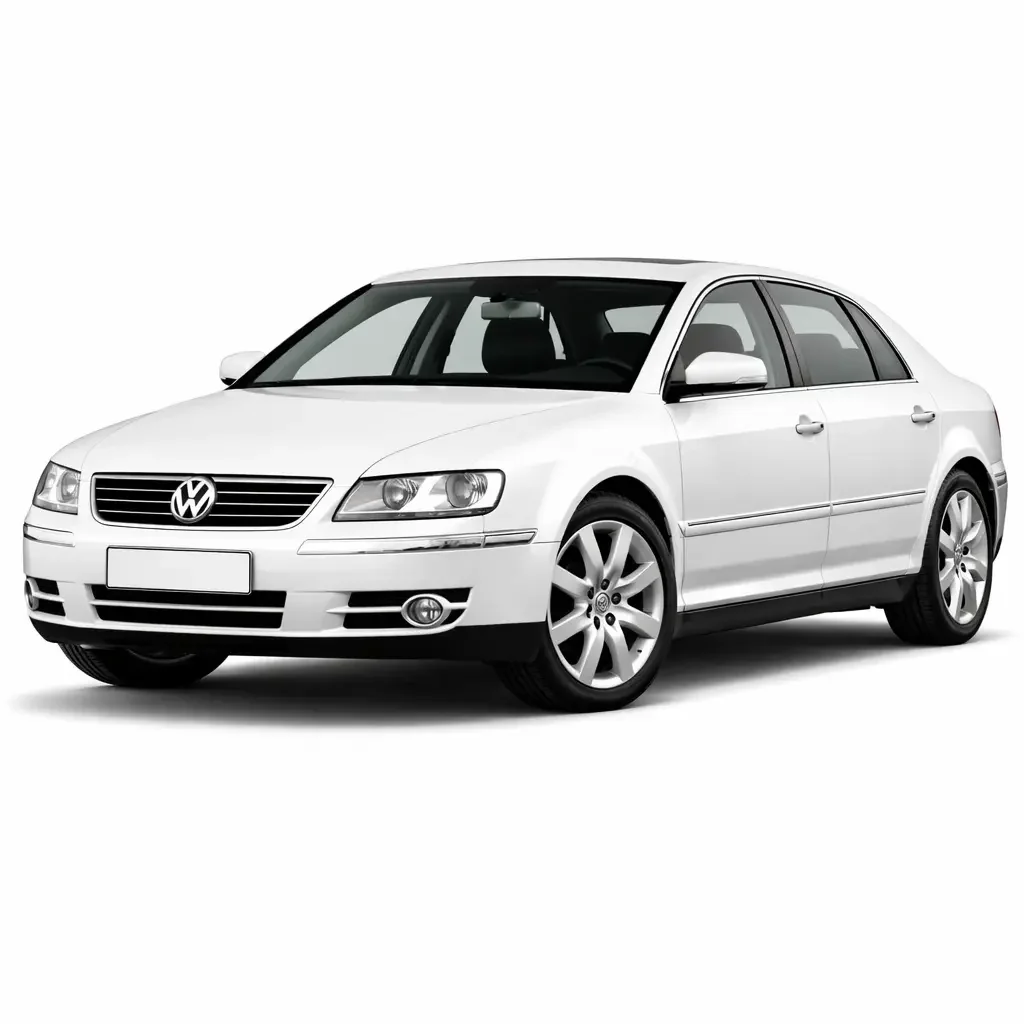
The Volkswagen Phaeton sold in North America from 2004 through 2006 is the only window in which this vehicle was available in the United States and Canada. Introduced at the 2002 Geneva Motor Show and brought to North American dealerships for the 2004 model year, the Phaeton represented Volkswagen's attempt to compete directly with the Mercedes-Benz S-Class and BMW 7 Series under its own badge. Sales ended after the 2006 model year following disappointing volume: 1,433 units were sold in the United States in 2004 and only 820 in 2005, after which Volkswagen announced the North American market exit. The vehicle continued in global production until March 2016.
From a catalog and fitment perspective, the Phaeton's North American window is compact in years but dense in application complexity. The platform it rides on is shared with the Bentley Continental GT and Bentley Continental Flying Spur, and its powertrains overlap with the Audi A8. The North American lineup was narrowed to two engines from a broader global range, and within that narrow lineup, two wheelbase lengths, two seating configurations, and two transmission specifications create a matrix of application splits that a catalog treating all 2004-2006 Phaetons as a single entry will get wrong on a significant share of orders. This guide addresses the platform identity, the North American engine and wheelbase split, the 2005 model year changes, the air suspension architecture, the seating configuration differences, the cross-reference relationship to the Audi A8, and the catalog mistakes most likely to generate wrong parts on the Phaeton application.
Platform and Construction: D1, Not D3
The Phaeton uses the Volkswagen Group D1 platform, a variant of the broader Volkswagen D platform designated internally as Typ 3D. The D1 variant is shared with the Bentley Continental GT and the Bentley Continental Flying Spur, and it is differentiated from the other D platform application, the Audi A8, in a critical structural respect: the Phaeton and Bentley variants use all-steel body construction, while the Audi A8 uses the all-aluminum Audi Space Frame chassis. This means that despite sharing certain mechanical systems, including automatic transmissions and some engines, the Phaeton body and structural components are not interchangeable with Audi A8 body or structural components. A catalog that treats the Phaeton and A8 as body-sharing siblings will generate wrong body panels, wrong glass, and wrong structural components on any body order.
The Phaeton was hand-assembled at the Transparent Factory, known in German as the Glaserne Manufaktur, in Dresden. The body was fabricated and painted separately at the Volkswagen works in Zwickau and transported approximately 100 kilometres to Dresden for final assembly. This hand-assembly process means that production tolerances and assembly sequences differ from conventional high-volume VW production lines, a fact relevant when working with trim and interior component fitment that depends on precise cavity dimensions.
The D1 platform carries the Phaeton's longitudinal engine layout, Torsen-based 4motion permanent all-wheel drive, and the Adaptive Air Suspension with Continuous Damping Control system developed by Continental Teves. The platform was unchanged throughout the 2004-2006 North American window. No platform revision occurred within this three-year sales period.
North American Engine Restriction: V8 and W12 Only
The global Phaeton was offered with a range of engines spanning from a 3.2-litre V6 through a 5.0-litre V10 TDI diesel. North America received none of these. Vehicles manufactured for sale in the North American market were restricted to two engines: the 4.2-litre V8 and the 6.0-litre W12. Both were electronically limited to 210 km/h (approximately 130 mph) for the North American market. The V10 TDI diesel, which was available in European markets throughout this window, was never offered in the United States or Canada on the Phaeton.
The 3.2-litre V6, which was the entry-level European and global engine and the only powertrain available with front-wheel drive during the 2003 and 2004 model years on the global application, was also never offered in North America. Any catalog entry that lists the 3.2-litre V6 or the 5.0-litre V10 TDI as engine applications for the North American 2004-2006 Phaeton is applying global market powertrains to a market-specific configuration in which they were never sold. Fuel system components, engine management components, exhaust components, and engine internal parts listed for the V6 or V10 TDI do not apply to any North American Phaeton.
The 4.2-Litre V8
The 4.2-litre naturally aspirated V8 is the base and most common North American Phaeton engine. It produces 335 hp at 6,500 rpm and 317 lb-ft of torque, and it is paired with a six-speed Tiptronic automatic transmission with manual-shift capability. The V8 is shared with the Audi A8 4.2 application from the same period, and engine internal service components including timing chain components, water pump, spark plugs, and oil filter cross between the Phaeton V8 and the Audi A8 4.2 within the same engine generation and specification. The V8 Phaeton in North America came standard with 17-inch alloy wheels. It also featured two chrome exhaust tailpipes and laminated glass for all windows, distinguishing it from the V6-equipped global variants.
The 6.0-Litre W12
The 6.0-litre W12 is the top-specification North American Phaeton engine. It produces approximately 420 hp in North American specification and is paired with a five-speed automatic transmission, not the six-speed unit used with the V8. This transmission difference is a critical catalog distinction: the W12 Phaeton and the V8 Phaeton use different transmissions with different internal components, different shift programs, and different fluid specifications. A transmission component listed for the V8 six-speed does not cross to the W12 five-speed, and vice versa. A catalog that lists a single transmission application for all 2004-2006 Phaetons without engine and transmission qualification will generate wrong transmission components on every order that does not match the catalog default.
The W12 engine architecture is unusual and warrants specific catalog attention. The W12 is constructed from two narrow-angle VR6 engines joined at the crankshaft, producing a W configuration rather than a conventional V. The W12 shares this architecture and, in turbocharged form, its basic engine family with the Bentley Continental GT and Continental Flying Spur. The Phaeton W12 is naturally aspirated; it does not use the twin-turbocharger system of the Bentley applications. Engine internal components must not be cross-referenced between the naturally aspirated Phaeton W12 and the turbocharged Bentley W12. Turbocharger-specific components, intercoolers, and boosted fuel system calibration from the Bentley do not apply to the Phaeton W12, and the Phaeton W12's naturally aspirated fuel system components do not apply to the Bentley.
The W12 Phaeton came with 18-inch alloy wheels of a different design from the V8's 17-inch wheels, four chrome exhaust tailpipes compared to the V8's two, and laminated glass for all windows as standard. The W12's exterior exhaust count is a straightforward visual identifier of the engine application and is relevant for any exhaust system component listing.
Wheelbase: SWB and LWB Are Different Vehicles at the Rear
The North American Phaeton was available in two wheelbase configurations. The standard wheelbase, referred to as SWB, has a wheelbase of 2,881 mm (approximately 113.4 inches) and an overall length of 5,055 mm (approximately 199 inches). The long wheelbase, referred to as LWB, has a wheelbase of 3,001 mm (approximately 118.1 inches) and an overall length of 5,120 mm (approximately 201.6 inches). The LWB was introduced for the 2004 model year globally, which coincides with the North American sales launch.
The SWB and LWB share the same front body structure, the same front doors, the same hood, the same front fenders, the same front bumper, the same windscreen, and the same A-pillar geometry. Forward of the B-pillar, the two wheelbase variants are the same vehicle and forward body components cross freely between them.
Aft of the B-pillar, the LWB has an extended rear body section accommodating the additional 120 mm of wheelbase. The rear doors on the LWB are visibly longer than those on the SWB, which is the most immediately apparent exterior difference between the two. Rear door glass, rear door assemblies, rear quarter glass, and rear body panels are wheelbase-specific. An SWB rear door does not fit the LWB aperture, and an LWB rear door does not fit the SWB aperture. A catalog that lists a single rear door assembly for all 2004-2006 Phaetons without wheelbase qualification will generate wrong rear door components for whichever configuration is not the catalog default.
The LWB's extended rear cabin provided rear passenger legroom measured at up to 1,214 mm (approximately 47.8 inches). The LWB was available exclusively with all-wheel drive throughout the North American window. The SWB was also all-wheel drive in the North American market, as the front-wheel-drive 3.2 V6 configuration that offered FWD on global markets was not sold in North America. For the North American market, all Phaetons in the 2004-2006 window were 4motion all-wheel drive regardless of wheelbase or engine.
Seating Configurations: Four-Seat and Five-Seat Are Different Interior Applications
Each North American Phaeton powertrain was available in two seating configurations: the standard five-seat layout with a bench-style rear seat, and a four-seat layout with two individual rear seats separated by a full-length center console. The four-seat configuration is the more common choice on luxury applications and changes the rear interior substantially.
In the five-seat version, front seats adjust 12 ways electrically. In the four-seat version, the individual rear seats have 10-way electrical adjustment and the front seats are upgraded to 18-way adjustment with memory function for three driver profiles. The four-seat configuration also adds seat heating at all four seating positions and includes ventilation at the rear positions. The rear center console in the four-seat layout is a substantial structural component that occupies the transmission tunnel and houses additional storage and controls not present in the five-seat version.
Rear seat assemblies, rear center console assemblies, rear door trim panels, and rear interior trim components differ between the four-seat and five-seat configurations. A catalog entry that does not distinguish between four-seat and five-seat interior applications will generate wrong rear seat assemblies, wrong center console components, and wrong rear trim panels on interior orders.
The W12 four-seat configuration included seat ventilation and a massage module at the rear positions as standard, in addition to seat heating. These features require specific seat assemblies with integrated ventilation and massage hardware that are not present in the V8 four-seat or either five-seat configuration. A W12 four-seat rear seat assembly cannot be cross-referenced to a V8 four-seat rear seat assembly; the seating and trim specification at the W12 level is distinct from the V8 level even within the same seating configuration.
The 2005 Model Year Changes: What the Annual Update Added
The 2004 model year Phaeton arrived in North American dealerships without a significant pre-sale update. For the 2005 model year, Volkswagen made changes that created catalog distinctions within the three-year North American window. Edmunds documented these changes at the time of the 2005 model year launch: the update included a new-style front grille, soft-close doors, active cruise control as standard, and standard cell phone preparation on the W12 (optional on the V8). The V8 model also received revised 18-inch alloy wheels as an available upgrade and additional wood trim options including Myrtle and Walnut.
The front grille change is the most catalog-relevant exterior distinction within the window. A 2004 Phaeton front grille assembly is not the same part as a 2005 or 2006 front grille assembly. A catalog that treats the front grille as a single application across all three model years will generate the wrong grille for either the 2004 vehicles or the 2005-2006 vehicles. The grille opening, mounting geometry, and styling differ between the pre-update 2004 unit and the revised 2005 unit. This boundary must be confirmed before any front grille listing is published for the North American Phaeton.
Soft-close door mechanisms were added for the 2005 model year. A 2004 Phaeton door latch assembly and door check strap assembly differ from the 2005 and 2006 units if the soft-close actuator is integrated into the door assembly. Door latch components and door actuator components must be confirmed against the model year before any door hardware listing is finalized.
Active cruise control, referred to in Volkswagen documentation as Automatic Distance Regulator (ADR), became standard for the 2005 model year. The 2004 Phaeton may or may not have been equipped with ADR depending on the individual vehicle. ADR components, including the radar sensor, cruise control module, and associated wiring, must be flagged as standard equipment from the 2005 model year and as optional equipment for the 2004 model year.
For 2006, available documentation indicates no major changes were introduced. The 2006 model year carried the 2005 specification without revision. The 2006 was the final year of North American sales, and Volkswagen had already announced the market exit before 2006 production reached dealers.
Air Suspension: Standard Architecture, Engine-Weight Calibration Differences
All North American Phaetons use the Continental Teves four-corner Adaptive Air Suspension with Continuous Damping Control as standard equipment. This system is one of the Phaeton's defining engineering features and represents the first application of a four-corner air suspension with continuously variable semi-active damper control in the luxury segment. The system adjusts damping force on each wheel independently within approximately 10 to 15 milliseconds and automatically adjusts vehicle height based on speed, load, and driver input.
The air suspension architecture is the same across all North American Phaeton configurations. All variants use air struts at all four corners with integrated CDC dampers. The fundamental air strut construction and the ride height control module are shared across the application range. However, the calibration of the system, and the physical tuning of the components, differs between the V8 and W12 applications because of the significant weight difference between the two drivetrains. The W12 Phaeton is substantially heavier than the V8 Phaeton at the front axle due to the larger engine mass, and the front air strut specification reflects this weight difference. A front air strut confirmed for the V8 application must not be assumed to cross to the W12 application without verification of the spring rate and damper calibration specific to the heavier W12 powertrain.
Wheelbase does not significantly affect air strut specification: the front struts are the same between SWB and LWB, and the rear struts are the same between SWB and LWB, because the ride height targets and load distribution at each axle are driven by powertrain weight and passenger load rather than by the body length behind the B-pillar. This means air suspension cross-references within a given engine application are valid between SWB and LWB, while cross-references across engine applications require verification.
The 2004 model year air strut part numbers differ from 2005 and 2006 in some positions. Forum documentation from Phaeton owners indicates that 2004-specification front struts were identified as a separate design from the revised units introduced for the 2005 model year. This distinction should be confirmed against OEM part number documentation before any front air strut listing is published for the 2004 application.
Brakes: Standard Specification and the W12 Distinction
All North American Phaetons use four-wheel disc brakes as standard, with ventilated discs at the front and solid or ventilated discs at the rear depending on application level. The brake system includes ABS, Electronic Brakeforce Distribution, Anti-Slip Regulation traction control, Electronic Differential Lock, Engine Braking Control, and Brake Assist as standard equipment across the entire range.
The brake rotor specification differs between the V8 and W12 applications at the front axle. The W12's greater vehicle weight and higher engine output require a larger front rotor diameter and a different caliper specification from the V8 application. Front brake rotors and front calipers must not be merged between the V8 and W12 applications. A catalog that uses a single front brake rotor listing for all 2004-2006 Phaetons will generate wrong front rotor dimensions for whichever powertrain is not the catalog default.
Rear brake specifications are common across the V8 and W12 applications in the North American window. Rear rotor and rear caliper listings can be shared between the two powertrains within the same model year range, subject to confirmation against OEM part number documentation. Brake pad specifications also differ between front and rear positions and between V8 and W12 at the front, and must be separated accordingly in any catalog entry.
Cross-Reference Family: Audi A8 Overlap and Its Limits
The Phaeton's relationship to the Audi A8 is real and documentable at the mechanical level but is frequently overstated in catalog practice. The two vehicles share certain systems because they both use D platform derivatives and were developed during the same period within the Volkswagen Group. Specifically, the automatic transmission families, the 4.2-litre V8 engine, and some suspension geometry principles are shared between the Phaeton and the contemporaneous Audi A8 D3.
Engine internal service components for the 4.2-litre V8, including timing chain kits, water pump, thermostat housing, spark plugs, oil filter, and fuel filter, cross between the Phaeton V8 and the Audi A8 4.2 within the same engine build specification. These cross-references are valid and represent the most reliable shared component family between the two vehicles.
What does not cross between the Phaeton and the Audi A8 is any body component, any glass, any structural component, any door assembly, and any exterior trim item. The Phaeton uses all-steel body construction on the D1 platform variant. The Audi A8 uses the aluminum Audi Space Frame on the D3 platform variant. These are different body materials, different construction methods, different body pressing geometries, and different glass dimensions. A fender, door, hood, bumper, headlamp housing, or body panel from the Audi A8 will not fit the Phaeton body, and Phaeton body components will not fit the A8. Any catalog that cross-references Phaeton body components to Audi A8 applications is applying aluminum-body components to a steel-body vehicle or vice versa.
The Bentley Continental GT and Continental Flying Spur share the D1 platform with the Phaeton and use steel body construction like the Phaeton, making the platform match closer than it is with the A8. However, the Bentley bodywork is entirely different from the Phaeton bodywork, and no exterior body component crosses between the Phaeton and either Bentley. The Bentley W12 uses twin turbochargers while the Phaeton W12 is naturally aspirated, so W12 engine components must not be cross-referenced between the Phaeton and Bentley applications.
Suspension geometry principles on the D1 platform are shared at the design level, and some suspension components may cross between the Phaeton and the Audi A8 at the undercar level. Front control arm geometry and front hub design have documented similarities. These cross-references require OEM part number confirmation rather than platform-level assumption, because the Phaeton's significantly greater weight relative to the A8, with the Phaeton being approximately 545 lb heavier than the comparable A8L 4.2 quattro, affects suspension component ratings even where the geometry is similar.
Common ACES/PIES Catalog Mistakes
The first and most consequential error is applying a single engine application to all 2004-2006 Phaetons without separating V8 from W12. The V8 and W12 are different engine families with different displacements, different cylinder configurations, different engine management systems, different exhaust systems with different tailpipe counts, different transmission pairings, and different front brake specifications. Engine internal components, fuel system components, exhaust components, and front brake components listed for the V8 will not fit the W12, and W12-specific components will not fit the V8.
The second error is applying a single transmission application to all 2004-2006 Phaetons. The V8 uses a six-speed Tiptronic automatic. The W12 uses a five-speed automatic. These are different units with different internal components, different fluid capacities, different shift programs, and different mounting configurations. A transmission component listed for the V8 six-speed cannot be cross-referenced to the W12 five-speed.
The third error is applying a single rear door assembly or rear door glass listing to all 2004-2006 Phaetons without distinguishing SWB from LWB. The LWB rear door is longer than the SWB rear door and has different glass geometry, different hinge positions, and different sealing profiles. An SWB rear door will not fit the LWB aperture, and an LWB rear door will not fit the SWB aperture.
The fourth error is applying a single rear seat assembly or rear interior trim listing to all 2004-2006 Phaetons without distinguishing the four-seat configuration from the five-seat configuration. The four-seat layout uses individual rear seats with different upholstery mounting, different adjustment mechanisms, and different trim panel integration from the five-seat bench arrangement. The four-seat rear center console is a distinct component not present in the five-seat layout. Interior components from the four-seat configuration cannot be cross-referenced to the five-seat layout.
The fifth error is applying a single front grille listing across all three model years. The 2005 model year brought a revised front grille design. A 2004 front grille does not match the 2005 and 2006 specification. A catalog that assigns one grille part number to all three model years will generate the wrong grille for approximately one third of the fleet depending on the year distribution of vehicles in service.
The sixth error is applying V6 or V10 TDI engine component listings to the North American Phaeton. The 3.2-litre V6 and 5.0-litre V10 TDI were global market engines that were never offered in North America. Fuel injectors, fuel pumps, exhaust components, and engine management components listed for these engines do not apply to any North American Phaeton application.
The seventh error is cross-referencing Phaeton body panels or glass to Audi A8 applications. The Phaeton uses all-steel body construction on the D1 platform variant. The Audi A8 uses aluminum Audi Space Frame construction on the D3 platform variant. These are different body materials and different body geometries. No exterior body panel, door assembly, glass, or structural body component crosses between the Phaeton and Audi A8.
The eighth error is cross-referencing naturally aspirated Phaeton W12 engine components to turbocharged Bentley Continental GT or Flying Spur W12 components. The Phaeton W12 and Bentley W12 share a base architecture but differ in forced induction configuration. Turbocharger assemblies, intercoolers, boosted fuel injectors, and boost-specific engine management components from the Bentley do not apply to the naturally aspirated Phaeton W12.
The ninth error is applying V8 front air strut listings to W12 applications without confirming the spring rate and damper calibration. The W12 Phaeton's greater front axle weight requires a different front air strut specification from the V8. A front air strut confirmed for the V8 must be verified against W12-specific OEM part numbers before being listed as a shared application.
The tenth error is treating the 2004 model year as mechanically identical to the 2005 and 2006 model years for front grille, door latch hardware, and active cruise control components. The 2005 update introduced a revised grille, soft-close door mechanisms, and standard ADR cruise control. The 2004 application predates these changes, and components specific to the post-update specification do not apply to 2004 vehicles.
Pre-Listing Checklist for the 2004-2006 Phaeton
Market confirmed as North American; global-only engine variants including the 3.2-litre V6 and 5.0-litre V10 TDI excluded from all North American application listings.
Engine confirmed as 4.2-litre V8 (six-speed Tiptronic) or 6.0-litre W12 (five-speed automatic); engine internal components, exhaust components, fuel system components, and front brake components separated by engine application and not merged across V8 and W12.
Transmission confirmed as six-speed for V8 applications and five-speed for W12 applications; transmission internal components not cross-referenced between the two units.
Wheelbase confirmed as SWB (2,881 mm wheelbase) or LWB (3,001 mm wheelbase); rear door assemblies, rear door glass, rear quarter glass, and rear body panels confirmed as wheelbase-specific and not cross-referenced between configurations.
Seating configuration confirmed as four-seat or five-seat; rear seat assemblies, rear center console, and rear interior trim confirmed as configuration-specific and not merged between the two layouts.
W12 four-seat rear seat assemblies confirmed as including integrated ventilation and massage modules not present in V8 four-seat or either five-seat application; W12 four-seat rear seat assemblies not cross-referenced to V8 four-seat units.
Model year confirmed for front grille and door latch hardware: 2004 uses the original grille and standard door latches; 2005 and 2006 use the revised grille and soft-close door mechanisms. Active cruise control (ADR) confirmed as optional for 2004 and standard from 2005.
Front air strut specification confirmed as engine-specific rather than wheelbase-specific; V8 front air strut listings not applied to W12 applications without OEM part number verification; 2004 air strut part numbers verified against 2005-2006 specification before cross-referencing.
Front brake rotors and front calipers confirmed as engine-specific; V8 front brake components not cross-referenced to W12 applications.
Body panel, glass, and structural component cross-references to Audi A8 excluded; Phaeton uses all-steel D1 platform construction, Audi A8 uses aluminum D3 platform construction, and no body component crosses between the two vehicles.
W12 engine component cross-references to Bentley Continental GT or Flying Spur excluded; Phaeton W12 is naturally aspirated, Bentley W12 is turbocharged, and turbocharger-related components do not cross.
All Phaetons in the North American 2004-2006 window confirmed as 4motion all-wheel drive; front-wheel-drive application listings excluded as the FWD 3.2 V6 configuration was a global-only variant not available in North America.
Final Take
The 2004-2006 Phaeton is one of the most application-complex three-year windows in the Volkswagen lineup, not because it spans multiple generations or platform changes, but because the combination of two wheelbase lengths, two engines, two transmissions, two seating configurations, and a mid-window annual update creates a product matrix with more distinct applications than many vehicles accumulate across a decade of production. A catalog that treats this window as a single homogeneous application will routinely generate wrong components at nearly every product category: wrong transmission, wrong rear doors, wrong rear seats, wrong front grille, wrong front brakes, wrong front air struts, and wrong engine components.
The most consequential single distinction is the V8 versus W12 engine split, because it drives differences in transmission, front brakes, front air suspension tuning, exhaust configuration, and interior appointment level simultaneously. A researcher who correctly separates V8 from W12 throughout the application profile will resolve the majority of fitment errors on this vehicle in a single step. The wheelbase split is the second most consequential distinction, because it drives rear door and rear body component differences that affect a large share of body and glass orders.
The relationship to the Audi A8 is real at the engine and transmission level and stops entirely at the body. Remembering that the Phaeton is a steel-body D1 vehicle and the A8 is an aluminum-body D3 vehicle is the single most useful structural fact for avoiding body component cross-reference errors on this application. The Phaeton shares an engine family and some mechanical underpinnings with the A8, and it shares a platform variant and body material with the Bentley, but it is not body-interchangeable with either. Catalog work on the Phaeton rewards researchers who track both the engine application and the wheelbase configuration consistently across every product category, because the fitment errors on this vehicle concentrate precisely in the gap between those two variables.
Disclaimer
This guide is intended for catalog research, fitment analysis, and parts advisory reference. Production specifications, option availability, and regulatory compliance requirements vary by model year, regional market, and assembly date within any given window. Always confirm application data against vehicle identification number decoding, factory build sheets, and OEM parts documentation before finalizing a listing or parts recommendation. PartsAdvisory and its contributors are not responsible for fitment errors arising from catalog data that has not been independently verified against physical vehicle inspection or official OEM sources.