
Written by Arthur Simitian | PartsAdvisory
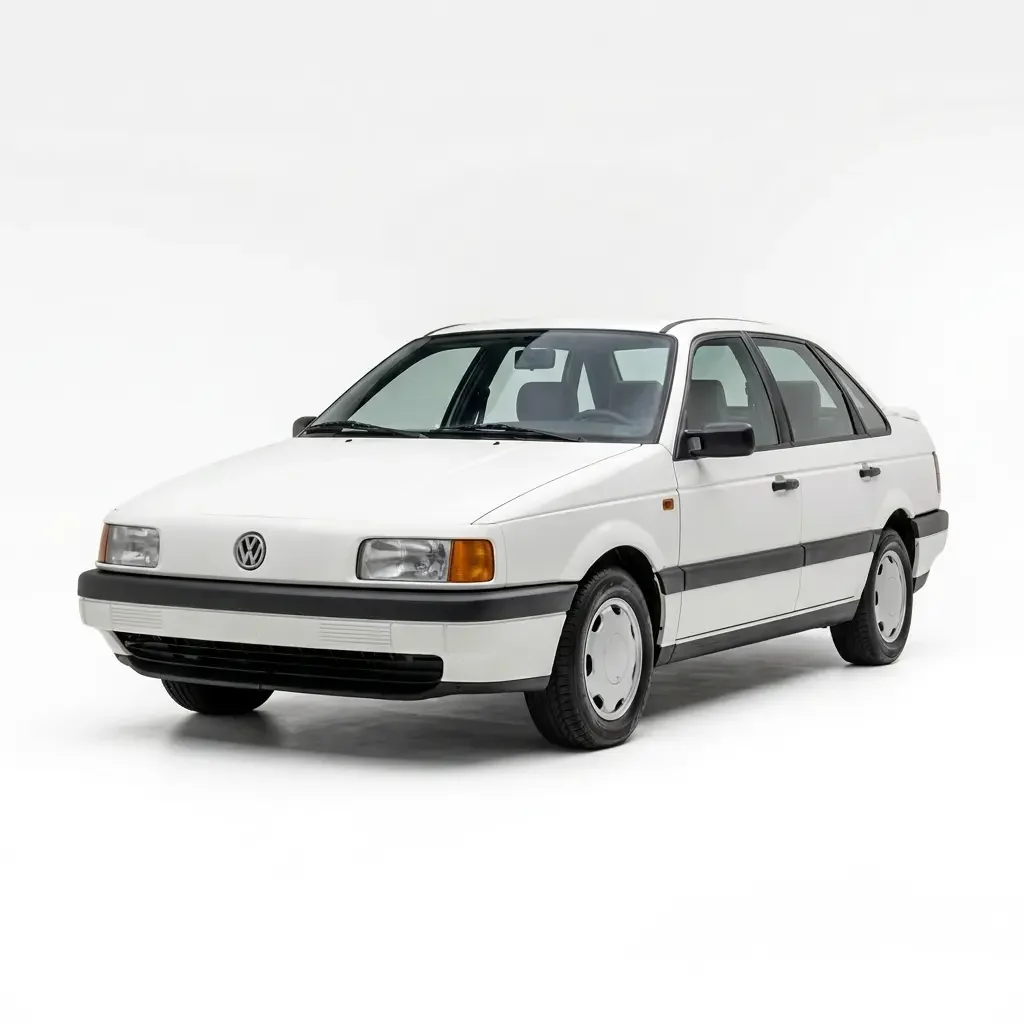
The Volkswagen Passat sold in North America from 1990 through 1994 spans two platform designations within a single body generation. The B3, introduced in North America for the 1990 model year, was a complete departure from the preceding Quantum (which was the B2 Passat sold in the United States under a different name), and the first time the Passat nameplate was used in the United States. The B4, introduced in Europe in late 1993, was not a new model but a comprehensive facelift of the B3 that revised every external body panel except the roof and glass. In the United States, the B4 did not reach dealerships until the 1995 model year, meaning the American 1994 model year was the final B3 year. In Canada, the B4 arrived for the 1994 model year, making 1994 a B4 year in Canada and a B3 year in the United States simultaneously.
This guide addresses the North American 1990-1994 window as a unified fitment challenge, with the B3 and B4 body boundary as its central catalog event. It covers the A2-derived platform, the transverse engine layout and its implications for the cross-reference family, the engine splits across the 2.0-litre 16-valve four-cylinder and the 2.8-litre VR6, the sedan and wagon body configurations, the Syncro all-wheel-drive system and its rear suspension distinction, and the Canada-specific applications that differ from the United States lineup. The companion to the B2 Quantum generation and the successor B5 Passat are not covered here; this guide addresses the Typ 35i generation sold in North America during this window only.
Platform: A2-Derived, Transverse, and the Break from Audi
The B3 Passat was the first Passat generation built on a platform developed independently by Volkswagen rather than shared with a contemporary Audi model. The B1 and B2 generations had shared their platforms with Audi saloons of the same period, giving those Passats a longitudinal engine layout. The B3 used an enlarged version of the A2 platform developed for the Golf Mk2, extended in all directions to accommodate the Passat's larger body. This platform is internally designated Typ 35i and is shared with the Corrado, the Jetta Mk2 in stretched form, and the SEAT Toledo of the same period.
The switch to the A2-derived platform meant a switch to a transverse engine layout. Every engine in the B3 and B4 Passat is mounted transversely across the engine bay, driving the front wheels as standard. This is a critical catalog distinction from the B5 Passat that followed, which returned to a longitudinal engine layout on the PL45 platform shared with the Audi A4. No engine component, drivetrain component, or transmission from the longitudinal B5 Passat crosses to the transverse B3 or B4 Passat, and vice versa. Any catalog that bridges the B3/B4 generation and the B5 generation without flagging this layout change will generate wrong drivetrain components on cross-generation orders.
The A2-derived platform carried MacPherson strut front suspension and a torsion beam rear axle on front-wheel-drive models. Syncro all-wheel-drive models used a different rear suspension architecture with an independent trailing arm setup rather than the torsion beam, a distinction covered in the Syncro section of this guide. The platform wheelbase is 2,550 mm (approximately 100.4 inches), shared with the Corrado and the Golf Mk2 in its stretched configuration. Front suspension components, front wheel bearings, and front brake geometry cross freely between the B3 Passat, the B4 Passat, and the Golf Mk2 and Jetta Mk2 families within matching engine and equipment specifications.
The B3 and B4 Body Boundary: What Is the Same and What Is Not
The B3-to-B4 facelift is one of the most extensively documented body transitions in the Volkswagen catalog literature because of how many panels changed while the underlying structure remained identical. Every external body panel on the B4 is different from the B3, with two explicit exceptions: the roof panel and the glasshouse. The roof pressing, windscreen glass, rear window glass, and door glass dimensions are shared between the B3 and B4. All other exterior panels are generation-specific.
The most immediately recognizable exterior change is the addition of a radiator grille to the B4. The B3 used a grille-free front end with a bottom breather intake, a styling choice that earned comparisons to older rear-engined Volkswagens and positioned the B3 visually at odds with the grille-equipped Golf and Jetta of the same era. The B4's facelift explicitly addressed this by introducing a slatted radiator grille, a new front bumper, new headlamp housings, new front fenders that blended with the new grille and lamp geometry, new hood pressing, and a completely redesigned rear end with larger taillamp clusters, a new rear bumper, and a revised trunk lid. The side body character lines were also revised from the B3's distinctive creases to smoother B4 surfacing.
For catalog purposes the B3-to-B4 boundary means the following. A front fender confirmed for the B3 does not fit the B4 front end structure. A hood confirmed for the B3 does not fit the B4 hinges and latch. Headlamp housings, front bumper assemblies, rear bumper assemblies, taillamp clusters, and trunk lids are all generation-specific. Windscreen glass, all door glass, and the roof panel cross between B3 and B4 because those components are physically unchanged at the facelift. Door assemblies themselves carry some complexity: the door outer skins changed with the B4 restyling, but the inner door structure, hinges, and mounting geometry are shared at the platform level, meaning door hardware, window regulators, and door latch assemblies generally cross between B3 and B4 at matching body style and side position, even though the outer door skin does not.
In the interior, the B3 and B4 share the same basic dashboard structure and instrument cluster layout. The B4 added dual front airbags and pyrotechnic seatbelt pre-tensioners as standard equipment, items absent from the B3. Interior trim panels and front seats cross freely between B3 and B4. The B4 added a center console storage bin and two cupholders in the cabin that are absent from the B3, where the area between the front seats was open. Dashboard assemblies, while visually similar, differ at the airbag equipment level: a B3 dashboard without an airbag aperture is not the same assembly as a B4 dashboard with the airbag housing integrated. This interior boundary must be accounted for in any dashboard or steering wheel listing that spans the two generations.
The B3 also introduced automatic motorized front seatbelt presenters on early North American models, a passive restraint system required by US regulations of the period. The B4, equipped with driver and passenger airbags as standard, eliminated the motorized seatbelt system. Seatbelt assembly components from the B3 passive restraint configuration do not cross to the B4, and the airbag system components of the B4 do not apply to the B3.
North American Lineup Year by Year: 1990 Through 1994
1990 and 1991: Single GL Trim, 2.0 16v Only, Sedan and Wagon
The B3 Passat launched in the United States for the 1990 model year in a single trim level, the GL, powered exclusively by the 2.0-litre 16-valve four-cylinder producing 134 hp. Both the four-door sedan and the five-door station wagon were available from launch. No VR6, no Syncro, and no lower trim existed in the United States for 1990 or 1991. The 2.0 16-valve engine carried the engine code 9A and used Digifant fuel injection. Both five-speed manual and four-speed automatic transmissions were available from launch.
In Canada for 1990 and 1991, the GL was also the sole trim, but the Canadian market would later diverge with additional powertrain options not offered in the United States.
1992: CL Added for Sedan, VR6 Arrives in GLX
For the 1992 model year a lower-priced CL trim was added in the United States, available only as a sedan. The CL used the same 2.0-litre 16-valve engine as the GL but stripped certain equipment. The CL was sedan-only; no CL wagon was offered.
More significantly, 1992 was the first year the 2.8-litre VR6 was available in the United States, arriving in the top-specification GLX trim. The GLX was available in both sedan and wagon configurations. The VR6 launched with distributor ignition in the 1992 and early 1993 production runs before transitioning to coil-pack ignition later in the 1993 model year. This ignition system change within the 1993 model year is a specific catalog distinction covered in the VR6 engine section below.
In Canada for 1992, the G60 Syncro became available, exclusively as a wagon and exclusively in Canada. Approximately 200 examples were sold across the 1992 and 1993 model years before the G60 Syncro was discontinued. This is covered in the Canada-specific section.
1993: GLS Replaces CL, VR6 Continues, B3 Final Year in the US
For the 1993 model year the United States CL trim was replaced by the better-equipped GLS, also sedan-only. The GLX VR6 continued in both body styles. The 1993 model year was the final B3 year for the United States market, and the final year of 2.0 16-valve availability in the United States. After 1993 the four-cylinder was discontinued in the American lineup and only the VR6 GLX continued for 1994.
Canada's 1993 lineup included the G60 Syncro for the final year as well as a 1.9-litre turbo-diesel option at 75 hp, neither of which was offered in the United States.
1994: VR6 GLX Only in the United States, B4 Arrives in Canada
The 1994 model year in the United States was exclusively the VR6 GLX, still on the B3 body, in both sedan and wagon configurations. No four-cylinder was available. This is the final North American model year addressed by this guide in the United States.
In Canada, 1994 was the first year of the B4 generation, arriving with the VR6 only, with the 2.0-litre four-cylinder joining in 1995. The Canadian B4 for 1994 therefore carried the revised B4 exterior with the new grille and restyled panels, while the American 1994 Passat still wore the grille-free B3 exterior. A catalog entry that assigns a single exterior body panel to all 1994 North American Passats without separating the United States B3 specification from the Canadian B4 specification will generate wrong panels for one of the two markets on every body order.
Engines: 2.0-Litre 16-Valve and 2.8-Litre VR6
2.0-Litre 16-Valve Four-Cylinder
The 2.0-litre 16-valve four-cylinder is the only engine offered in the United States for the 1990 through 1993 model years on all non-VR6 trims. It carries the engine code 9A and produces 134 hp in North American specification with Digifant fuel injection. The 9A is a naturally aspirated DOHC 16-valve unit and is not the same engine as the 2.0-litre 8-valve unit (code 2E) offered in European and some Canadian B4 applications. The 9A 16-valve and the 2E 8-valve share displacement but differ in head design, valve train, camshaft specification, fuel system, and power output. Cylinder head components, valve train components, and fuel injection components must not be cross-referenced between the 9A and 2E applications.
The 9A engine in the Passat B3 is also used in the Corrado 16v and the Jetta GLI of the same period. Timing belt, water pump, spark plugs, oil filter, and fuel filter cross between the B3 Passat 9A, the Corrado 16v 9A, and the Jetta GLI 9A within the same engine generation. This is a confirmed and reliable cross-reference family for the 9A engine service components and represents the broadest undercar component pool for the four-cylinder B3 Passat.
The 2.0 16v was available with both the five-speed manual transmission (code 02A in later terminology) and the four-speed automatic with Tiptronic. These are different transmission families; transmission internal components do not cross between the manual and automatic applications.
2.8-Litre VR6
The 2.8-litre VR6 arrived in the North American B3 Passat for the 1992 model year in the GLX trim. The VR6 is a narrow-angle six-cylinder engine with a single cylinder head covering both banks, allowing it to fit in an engine bay sized for an inline-four. In the B3 and early B4 Passat, the VR6 uses the same AAA engine code as in the Golf VR6 and Corrado VR6 of the same period, making engine internal cross-references valid between those applications within matching build specifications.
The VR6 in the 1992 and early 1993 North American Passat used distributor-based ignition. During the 1993 model year production run, Volkswagen transitioned the VR6 to coil-pack ignition. This change occurred mid-model-year and is not aligned to a clean annual boundary. A 1993 VR6 Passat may carry either distributor ignition or coil-pack ignition depending on its production date. Ignition system components including the distributor cap, rotor, distributor housing, and coil pack are specific to the ignition type and must not be cross-referenced between the two specifications. Any ignition component listing for the 1993 VR6 Passat must account for this mid-year production split rather than assigning a single ignition specification to all 1993 model year vehicles.
The VR6 was paired exclusively with the five-speed manual transmission as standard on the GLX. A four-speed automatic was optional on the VR6 GLX. The VR6 used a different transmission code from the four-cylinder applications; the VR6 five-speed carries greater torque capacity and is not interchangeable with the four-cylinder five-speed at the internal component level.
Cross-references for the VR6 engine service components extend to the Golf VR6 and the Corrado VR6. Timing chain components on the early VR6 are a documented concern: the timing chain guide rails on early VR6 engines produced through approximately the 1995 model year were known to develop cracks or wear that could cause chain noise or failure if ignored. This affects the B3 and 1994 B4 VR6 Passat applications equally. Timing chain guide listings for these applications must specify the correct replacement guide rail specification; the original guide rail design is the one at risk and the replacement specification differs from the original.
The front brake rotors on the VR6 GLX are larger than those on the 2.0 16v GL and GLS applications. The VR6 GLX uses 280 mm front rotors while the four-cylinder applications use smaller front rotors. Front rotor and front caliper listings must be confirmed against engine and trim application and not merged between VR6 and four-cylinder applications.
Body Styles: Sedan and Wagon
Both the four-door sedan and the five-door station wagon were available throughout the North American B3 window with one exception: the lower CL and GLS trims for 1992 and 1993 were sedan-only. The GL and GLX trims offered both body styles in all years they were available.
The sedan and wagon share the same front body structure, the same front doors, the same A-pillar and B-pillar geometry, the same front fenders, the same hood, the same headlamps, and the same front and rear suspension mounting geometry. Forward of the C-pillar, the two body styles are the same vehicle.
Aft of the C-pillar they are entirely different. The wagon has an extended roof, different rear quarter panels, a different rear hatch, different rear glass, different rear lamp clusters, and a different rear bumper from the sedan. The sedan's trunk lid, rear quarter panels, and taillamp clusters do not cross to the wagon. The wagon's rear hatch and rear lamp assemblies do not cross to the sedan. Any catalog that assigns a single rear body listing to both the sedan and wagon will generate wrong components on all rear body orders for one body style.
Rear suspension coil spring rates differ between the sedan and wagon on front-wheel-drive applications. The wagon carries greater rear load capacity and uses stiffer rear springs calibrated for that load range. Rear spring listings for the sedan must not be cross-referenced to the wagon, and wagon rear spring rates must not be applied to sedan applications. Front suspension components cross freely between the sedan and wagon because the front end geometry and weight distribution are the same for both body styles at matching engine specifications.
Syncro AWD: Rear Suspension Architecture and Drivetrain Distinction
The Syncro all-wheel-drive system was available on the B3 Passat wagon in North America, though its availability differed significantly between the United States and Canada. In the United States, the only Syncro application documented for this window was the 2.0-litre front-wheel-drive wagon upgraded to Syncro specification, available in limited numbers. In Canada, the Syncro wagon was more broadly available, and the 1992-1993 G60 Syncro was a Canada-exclusive configuration using the supercharged 1.8-litre G60 engine paired with the Syncro drivetrain.
The Syncro system uses a viscous coupling to distribute torque to the rear axle when front-wheel slip is detected. It is a reactive system that operates primarily in front-wheel drive until the viscous coupling engages the rear driveshaft. The rear differential and rear driveshaft are specific to the Syncro application and do not exist on front-wheel-drive Passats.
The most important catalog distinction created by the Syncro system is the rear suspension architecture. Front-wheel-drive B3 and B4 Passats use a torsion beam rear axle with coil springs and telescopic shock absorbers. Syncro Passats use an independent trailing arm rear suspension with coil springs, a fundamentally different design that accommodates the rear differential and halfshaft geometry required by the all-wheel-drive system. The rear shock absorbers, rear springs, rear wheel bearings, rear axle geometry, and rear hub assemblies on a Syncro Passat are all different from the front-wheel-drive Passat. Rear suspension components from a front-wheel-drive B3 or B4 Passat will not fit a Syncro application, and Syncro rear suspension components will not fit a front-wheel-drive Passat.
The Syncro was almost always applied to the wagon body style. A sedan Syncro was technically possible within the platform architecture but was extremely rare in the North American market. Any Syncro suspension listing for the North American window should default to the wagon body style unless VIN documentation confirms a sedan Syncro application.
The Canada-Specific Applications: G60 Syncro and Diesel
Canada received two powertrain configurations during this window that were never offered in the United States and represent catalog applications that must be flagged as Canada-only to prevent misapplication to United States fleet entries.
The 1.8-litre G60 supercharged engine was available in Canada on the Syncro wagon for the 1992 and 1993 model years, with approximately 200 examples sold. The G60 uses a Roots-type supercharger driven by the engine and produces approximately 158 to 160 hp in this application. The G60 engine code is PG or a variant thereof and carries specific supercharger components, a specific intake manifold, a specific fuel system calibration, and a specific cooling system setup that differs from every other engine in the B3 Passat family. Supercharger assemblies, supercharger belts, charge cooler components, and G60-specific fuel system components are exclusive to the G60 application and do not cross to the 2.0 16v or VR6. The G60 Syncro was also the only Passat in the North American B3 window to combine the supercharged engine with the Syncro rear drivetrain and independent rear suspension.
The 1.9-litre turbo-diesel was offered in Canada for the 1993 model year (the B3's final year in Canada) with 75 hp. This engine carries the AAZ code and uses a conventional pre-chamber indirect injection diesel design. It is not the later TDI direct injection diesel that appeared in the B4 for some markets in 1994 and in the United States B4 from 1996. Fuel system components, injection pump, glow plugs, and turbocharger for the AAZ turbo-diesel are specific to that engine and must not be cross-referenced to TDI diesel applications. Any catalog entry that lists a diesel application for the 1993 Canadian Passat must confirm the AAZ specification rather than defaulting to TDI components.
No diesel was offered in the United States on the B3 Passat during any model year of the 1990-1994 window. The United States received the TDI only with the B4, and only from the 1996 model year. A catalog entry assigning diesel components to a United States B3 Passat is assigning an engine that was never sold in that market.
Cross-Reference Family: Golf Mk2, Corrado, and Jetta Mk2
The A2-derived platform of the B3 and B4 Passat creates a legitimate and broad cross-reference family with the Golf Mk2, Golf Mk3, Jetta Mk2, Jetta Mk3, and the Corrado. The front suspension MacPherson strut geometry, front wheel bearing specification, front brake architecture, steering rack design, and engine service components for the 9A and VR6 engines all cross between the Passat B3/B4 and these related applications at matching engine and equipment specifications.
The Corrado is a particularly close mechanical relative. The Corrado VR6 and the B3/B4 Passat VR6 share the AAA engine, the same front suspension geometry, and the same brake architecture at the front axle. VR6 engine service components, front suspension components, and front brake components cross freely between the Corrado VR6 and the B3 and B4 Passat VR6 within the same specification. The Corrado 16v and the B3 Passat 9A 16v share the 9A engine family and the same front platform, creating the same depth of cross-reference for four-cylinder engine service and front chassis components.
What does not cross between the Passat B3/B4 and the Golf Mk2, Golf Mk3, or Corrado is any body component. The Passat has a unique body that shares no exterior panel geometry with any of these related vehicles. Windscreen glass dimensions on the Passat differ from those of the Golf and Jetta. Door assemblies, rear body panels, bumpers, and glass are all Passat-specific. The cross-reference family for the B3/B4 Passat is an undercar family, not a body family.
Common ACES/PIES Catalog Mistakes
The first and most consequential error is applying a single front body panel listing to both the B3 and B4 without separating them by generation. Every front exterior panel changed at the B3-to-B4 facelift. Hood, front fenders, headlamps, front bumper, and grille are all generation-specific. For the United States market, the B3 covers 1990 through 1994 and the B4 does not begin until 1995. For Canada, the B4 begins in 1994. A catalog that assigns a single front body application to 1993 and 1994 United States Passats and 1994 Canadian Passats without separating B3 from B4 by market will generate wrong panels for the Canadian 1994 fleet.
The second error is applying a single rear body panel listing to both the sedan and wagon. The B3 and B4 sedan and wagon share nothing aft of the C-pillar. Rear quarter panels, rear hatch or trunk lid, taillamp clusters, and rear bumpers are all body-style-specific. A merged sedan and wagon rear body listing will generate wrong rear body components on every order for the less-represented body style.
The third error is applying front-wheel-drive rear suspension components to Syncro applications. The front-wheel-drive Passat uses a torsion beam rear axle. The Syncro uses an independent trailing arm rear suspension to accommodate the rear differential. Rear shocks, rear springs, rear wheel bearings, and rear axle components listed for the front-wheel-drive application will not fit the Syncro.
The fourth error is applying B3 dashboard components with passive restraint seatbelt apertures to B4 applications, or applying B4 airbag-equipped dashboard assemblies to B3 applications. The B3 used motorized passive restraint seatbelts in the United States. The B4 eliminated these and added dual front airbags. Dashboard assemblies, steering wheels with airbag provisions, and seatbelt assemblies differ between the two generations.
The fifth error is applying VR6 front brake components to four-cylinder applications. The VR6 GLX uses larger front brake rotors than the four-cylinder GL and GLS applications. Front rotor diameter and front caliper specification must be confirmed against the engine application before any front brake listing is assigned.
The sixth error is assigning G60 engine components or G60 Syncro drivetrain components to United States Passat applications. The G60 Syncro was Canada-only, with approximately 200 examples built. No G60 Passat was offered in the United States. G60 supercharger components, G60 intake and fuel system components, and G60 Syncro rear drivetrain components do not apply to any United States Passat application in this window.
The seventh error is assigning diesel engine components to United States B3 Passat applications. No diesel was offered in the United States on the B3 generation. The 1.9-litre turbo-diesel was Canada-only for the 1993 model year. TDI components from the later B4 or B5 generations also do not apply to the B3 diesel, which used the pre-chamber AAZ indirect injection design rather than the TDI direct injection system.
The eighth error is applying a single ignition system listing to all 1993 VR6 Passat applications. The VR6 transitioned from distributor ignition to coil-pack ignition during the 1993 model year production run, not at a clean annual boundary. A 1993 VR6 Passat may carry either ignition specification. Distributor, distributor cap, rotor, and coil pack listings for 1993 must be flagged as production-date-dependent and not applied as a uniform specification to all 1993 model year vehicles.
The ninth error is cross-referencing B3 or B4 Passat body panels to Golf Mk2 or Jetta Mk2 body panels on the basis of platform sharing. The A2-derived platform creates a mechanical undercar cross-reference family but not a body cross-reference. No exterior panel, door assembly, glass item, or bumper crosses between the Passat and the Golf or Jetta.
The tenth error is applying B5 Passat drivetrain or engine components to B3 or B4 Passat applications. The B5 Passat uses a longitudinal engine layout on the PL45 platform. The B3 and B4 use a transverse layout on the A2-derived platform. These are different engine orientations with different accessory drive geometry, different oil pan configurations, different transmission families, and different driveshaft geometry. No drivetrain component from the B5 crosses to the B3 or B4.
Pre-Listing Checklist for the 1990-1994 Passat
Generation confirmed as B3 (1990-1994 United States; 1990-1993 Canada) or B4 (1994 Canada only in this window); forward exterior body panels separated by generation and not cross-referenced between B3 and B4; windscreen glass and door glass confirmed as crossing between B3 and B4.
Market confirmed as United States or Canada; G60 Syncro and 1.9 turbo-diesel confirmed as Canada-only applications and excluded from United States listings; VR6 and 2.0 16v confirmed as the only United States powertrains in this window; no diesel offered in the United States on the B3.
Engine confirmed as 2.0 16v (9A code, 134 hp, available 1990-1993 United States) or 2.8 VR6 (AAA code, available from 1992 in the United States and Canada); engine service components confirmed as crossing to Golf Mk2/Mk3 and Corrado at matching engine specifications; 9A and AAA not cross-referenced to each other.
Body style confirmed as sedan or wagon; rear body panels, rear glass, rear lamp assemblies, and rear bumpers confirmed as body-style-specific and not cross-referenced between sedan and wagon; front body components confirmed as crossing between sedan and wagon within matching generation and engine application.
Drivetrain confirmed as front-wheel-drive or Syncro AWD; Syncro rear suspension confirmed as independent trailing arm architecture; front-wheel-drive torsion beam rear suspension components excluded from all Syncro applications; Syncro rear differential, rear driveshaft, and rear halfshaft components confirmed as Syncro-specific and excluded from front-wheel-drive applications.
VR6 front brake specification confirmed as larger (280 mm front rotors) than four-cylinder application; front brake components not cross-referenced between VR6 and four-cylinder applications.
1993 VR6 ignition system confirmed as either distributor or coil-pack based on production date; distributor ignition components and coil-pack ignition components flagged as mutually exclusive and not combined in a single 1993 VR6 listing.
Airbag and passive restraint seatbelt systems confirmed as generation-specific: B3 uses motorized passive restraint seatbelts in the United States; B4 uses dual front airbags; dashboard assemblies and steering wheel specifications confirmed as generation-specific at the airbag equipment boundary.
CL and GLS trims confirmed as sedan-only; no CL or GLS wagon exists in the North American lineup; wagon body style confirmed as available on GL and GLX trims only.
Rear spring specification confirmed as body-style-specific for front-wheel-drive applications; wagon rear springs use higher spring rate than sedan rear springs and must not be cross-referenced between body styles.
Final Take
The 1990-1994 Passat represents a window whose catalog complexity comes from two overlapping distinctions that are easy to miss separately and compounding when missed together. The first is the B3-to-B4 body boundary, which in the United States falls cleanly at the 1994-to-1995 model year line but in Canada falls within the 1994 model year itself. A catalog that treats all 1994 North American Passats as a single application ignores a market-specific body generation boundary that affects every front and rear exterior panel on the vehicle.
The second is the Syncro rear suspension distinction, which is not a superficial drivetrain difference but a fundamental change in rear axle architecture. The torsion beam rear of the front-wheel-drive Passat and the independent trailing arm rear of the Syncro are mechanically unrelated at the component level despite sharing a platform. A researcher who assumes the rear suspension crosses between FWD and Syncro applications will generate wrong rear components on every Syncro order placed against a merged rear suspension entry.
The 9A and VR6 engine cross-references to the Golf Mk2/Mk3 and Corrado families are the most stable and reliable part of this application. Once the generation, body style, engine, and drivetrain are correctly separated, the undercar service components for both engines are among the most thoroughly documented in the VW Group catalog literature of the period, and the cross-references to the Corrado and Golf families hold consistently across the entire window without exception.
Disclaimer
This guide is intended for catalog research, fitment analysis, and parts advisory reference. Production specifications, option availability, and regulatory compliance requirements vary by model year, regional market, and assembly date within any given window. Always confirm application data against vehicle identification number decoding, factory build sheets, and OEM parts documentation before finalizing a listing or parts recommendation. PartsAdvisory and its contributors are not responsible for fitment errors arising from catalog data that has not been independently verified against physical vehicle inspection or official OEM sources.