
Volkswagen Passat (2020-2022): Final NMS Generation Fitment Guide for North America
Written by Arthur Simitian | PartsAdvisory
The Volkswagen Passat sold in North America for the 2020, 2021, and 2022 model years is the final production window of the New Midsize Sedan platform that entered service with the 2012 model year. The 2020 model arrived at dealerships in the fall of 2019 and introduced an extensive exterior reskin that changed every body panel except the roof, along with an interior redesign and a torque increase on the 2.0-litre TSI engine. The 2021 and 2022 model years carried over unchanged mechanically, with only trim level adjustments in each year. The final vehicle rolled off the Chattanooga, Tennessee assembly line in December 2021 as a 2022 model year unit, ending eleven years of NMS production at that facility.
For catalog purposes, the 2020 through 2022 window is mechanically uniform. There is one engine, one transmission, one drivetrain architecture, and one body style across all three years. The only catalog-relevant changes within this window are trim level discontinuations in 2021 and 2022 that affect equipment-level component listings such as seat type and infotainment hardware, and the introduction of the Limited Edition trim in 2022. There are no powertrain, suspension, or body structure changes within the 2020 through 2022 window itself.
The primary catalog significance of this window lies in its boundary with the preceding 2016 through 2019 NMS body generation. The 2020 reskin replaced nearly every exterior body component in a scope that exceeded even the 2016 mid-cycle restyle, and body component listings for the two windows must be maintained as entirely separate applications. This guide addresses both the internal structure of the 2020 through 2022 window and its relationship to the preceding generation.
This guide addresses the United States market throughout. No AWD option was offered on the NMS at any point in its production history, and the 2020 through 2022 window is no exception.
Platform Continuity: Same NMS Architecture Throughout
The 2020 through 2022 Passat continues on the NMS platform, the same purpose-built North American architecture that underpinned the vehicle since 2012. The wheelbase of 2,803 mm (110.4 inches) is unchanged from the 2012 through 2019 generation. The MacPherson front suspension and four-link independent rear suspension carried over without geometry changes. The front and rear subframe mounting points, front wheel bearings, front brake architecture, and rear suspension pickup points are all continuous with the 2016 through 2019 application.
The 2020 reskin added 1.7 inches to the overall vehicle length, growing from 191.9 inches to 193.6 inches. This growth came from extended front and rear overhangs, not from a wheelbase change. The longer overhangs mean the front bumper cover and rear bumper cover are dimensionally different from the 2016 through 2019 bumper covers even before accounting for the new styling. A front or rear bumper confirmed for a 2016 through 2019 application does not fit the 2020 through 2022 application for both dimensional and styling reasons.
The underbody structural components, floor rails, rocker panels, and body pillars are continuous from the preceding generation into the 2020 through 2022 window. The platform itself was not changed; only the skin applied over it was replaced. This means that any chassis or underbody component confirmed for the 2016 through 2019 NMS crosses freely to the 2020 through 2022 application within matching specifications, while any exterior body panel confirmed for the 2016 through 2019 NMS does not.
The NMS platform remains distinct from the MQB platform used in the contemporary Golf Mk8, Jetta Mk7, and European B8 Passat throughout the 2020 through 2022 window. The 2020 reskin did not introduce any MQB architecture. MQB suspension, brake, steering, or body components do not apply to any NMS application at any model year.
The 2020 Body Reskin: Scope and Catalog Implications
Volkswagen described the 2020 Passat as carrying only the roof panel from the preceding generation. This description is consistent with the extent of the exterior changes as confirmed in official VW press documentation and independent comparison reviews. Every panel listed below changed for 2020 and must be treated as a 2020-and-later-specific application with no crossover to the 2016 through 2019 NMS.
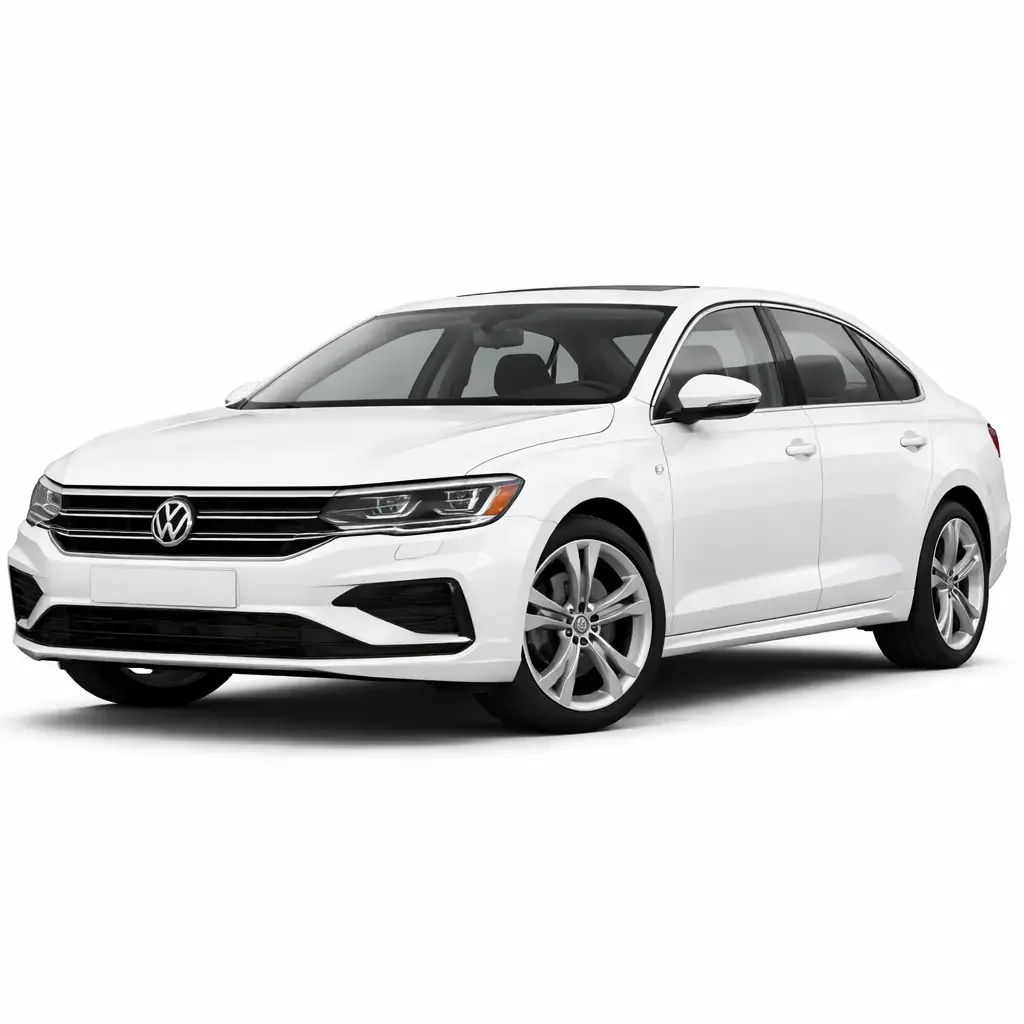
The hood changed to a new design with a pronounced tornado line and reshaped leading edge. The front fenders changed in their character line profile and integration with the new headlamp housings. The headlamp assemblies are entirely new units with slim LED optical elements and a chrome connecting brow that bridges across the grille opening. The grille assembly is new, larger, and more upright than the 2016 through 2019 design. The front bumper cover is dimensionally longer and carries a different lower fascia shape. The front door outer skins carry a new character line that runs unbroken from the front fender through the rear quarter. The rear door outer skins share this new character line. The rear quarter panel profile changed at the rear window junction, where the greenhouse was straightened to give the body a more coupe-like roofline. The trunk lid changed completely, with a smaller integrated lip spoiler and a recessed rear license plate area replacing the protruding license plate surround of the earlier generation. The rear bumper cover is new and dimensionally longer. The taillamp assemblies are new units with a different internal graphic.
The roof panel is the only confirmed carryover exterior component. Because the roof panel is unchanged, the A-pillar, B-pillar, and C-pillar pressings at the roof joint are also continuous. The windscreen opening dimensions are unchanged, making the windscreen glass itself a continuous application across the 2016 through 2022 full window despite the body reskin. Front door glass and rear door glass opening dimensions are also continuous, as the door opening geometry was not altered even though the outer door skins changed.
The practical catalog consequence is that the NMS exterior body component window is split into three distinct generations: 2012 through 2015 (pre-first-restyle), 2016 through 2019 (post-first-restyle), and 2020 through 2022 (post-reskin). A hood, fender, headlamp, front bumper, trunk lid, rear bumper, or taillamp listed without a generation-specific year range is an incomplete application. Glass, windscreen, and roof panel applications are continuous across broader ranges but still require model year confirmation for trim-level equipment differences in glass heating elements and camera integration on certain applications.
The R-Line trim carries a unique front bumper for the 2020 through 2022 generation, as it did in the 2016 through 2019 generation. The R-Line front bumper has distinctive C-shaped air intake openings in gloss black and vertical chrome grille stripes that are not shared with the SE or Limited Edition trims. An aftermarket or OEM front bumper confirmed for the 2020 through 2022 SE does not cross to the 2020 through 2022 R-Line, and vice versa. This trim-level split on the front bumper is a separate distinction from the generation split described above and must be tracked independently.
Engine: 2.0-Litre TSI DDSA Throughout
The 2020 through 2022 Passat uses a single engine in all trims and all model years: the 2.0-litre turbocharged four-cylinder TSI carrying the DDSA engine code, within the EA888 Gen3B family. This is the same engine code introduced in the 2018 NMS when the 1.8 TSI CPKA was replaced by the 2.0 TSI. The 2020 model year applied a calibration change that increased the torque rating from 184 lb-ft to 207 lb-ft without a change to the engine code, the engine hardware, or the horsepower figure of 174 hp. This torque increase is a software and mapping revision and does not create a component-level catalog split within the DDSA application.
The DDSA is an EA888 Gen3B engine, which is a refined variant of the EA888 Gen3 family used in the CPKA and CPRA applications of the 2014 through 2017 NMS. The Gen3B designation reflects changes to the valvetrain, the Miller cycle combustion approach at partial load, and the intake system architecture compared to the Gen3 base specification. The Gen3B uses a secondary air injection system in the North American NMS application that is not present in all other EA888 Gen3 applications. This secondary air injection hardware is DDSA-specific in the NMS context and must not be assumed to cross to the CPKA or CPRA applications of the earlier NMS, which use a different intake and emissions architecture. A secondary air injection pump, secondary air injection valve, or associated vacuum hardware confirmed for the DDSA must be listed as a DDSA-specific application.
The DDSA uses a timing chain, consistent with the EA888 family throughout its NMS application history beginning with the CPKA in 2014. No timing belt application exists for any NMS powertrain. Any timing belt kit or timing belt tensioner listed for a 2020 through 2022 NMS Passat is assigning components that do not exist on this vehicle.
The DDSA retains the electromechanical power steering introduced with the CPKA in 2014. There is no hydraulic power steering in the 2020 through 2022 NMS. A hydraulic power steering pump, hydraulic steering rack, or power steering fluid listing applied to any 2020 through 2022 NMS application is wrong.
The DDSA uses regular-grade gasoline. No premium fuel requirement exists for this application. A fuel system component or injector cleaning recommendation tied to premium-grade fuel is not applicable to the 2020 through 2022 NMS.
The DDSA is the only engine available in all three model years of this window. There is no optional engine, no diesel, and no VR6 in the 2020 through 2022 lineup. The VR6 was discontinued after the 2018 model year and was not offered in the 2019, 2020, 2021, or 2022 NMS. A VR6 engine component, VR6 DSG component, or VR6-specific exhaust listing applied to any application within this window is assigning hardware from an engine that was not available.
Within the broader EA888 family, the DDSA shares some engine service components with other EA888 Gen3 and Gen3B applications in the VW Group. Oil filter, spark plugs, and coil pack specifications may cross to certain other EA888 applications but must be confirmed at the part number level. The secondary air injection system and the North American emissions hardware are NMS-specific and do not cross to European EA888 applications.
Transmission: 6-Speed Automatic Only Throughout
The 2020 through 2022 Passat uses a single transmission in all trims and all model years: the six-speed conventional automatic, designated 09G in VW internal coding, the Aisin TF-60SN-based unit. This is the same transmission family used with the 2.5-litre and 1.8 TSI in earlier NMS generations and with the 2.0 TSI DDSA from 2018 onward.
No manual transmission was offered in the 2020 through 2022 NMS. No DSG dual-clutch transmission was offered. No other automatic was offered. The 09G is the only transmission in this window, across all trims and all three model years. A DSG fluid, DSG filter, or DSG mechatronic listing for any 2020 through 2022 NMS application is assigning components from a transmission that was not installed.
The 2022 model year did not introduce the 8-speed automatic that was available on other contemporary VW Group models. Official documentation confirms that the NMS was deliberately not updated to the 8-speed unit during the 2020 reskin or in any subsequent year. The six-speed 09G remained the sole automatic throughout the final production run.
Transmission service components for the 09G in this application are continuous with the 2018 and 2019 NMS 2.0 TSI DDSA applications. A transmission pan, transmission filter, or transmission fluid confirmed for the 2018 or 2019 NMS 2.0 TSI automatic crosses to the 2020 through 2022 application within the same 09G specification.
Trim Structure: Progressive Contraction Across Three Years
The 2020 model year launched with four trim levels: S, SE, R-Line, and SEL. The S was the base trim with cloth seating and standard LED lighting. The SE added leatherette seating, a sunroof, and expanded driver assistance technology. The R-Line replaced the SE's standard front bumper with its own distinctive styling unit and added 19-inch wheels, side sill extensions, and a rear valance. The SEL was the top trim with leather seating, a Fender audio system, and parking sensors.
For 2021, the SEL trim was discontinued. The 2021 lineup consisted of S, SE, and R-Line only. The R-Line took over as the effective top-specification trim for most equipment purposes, though it carries a sport-oriented package rather than a luxury-oriented one. Leather seating was not available in the 2021 lineup following the SEL discontinuation until the 2022 Limited Edition addressed this.
For 2022, the S trim was discontinued and the Limited Edition trim was introduced. The 2022 lineup consisted of SE, R-Line, and Limited Edition. The Limited Edition was produced in a confirmed quantity of 1,973 units, referencing the year the Passat nameplate was introduced in Europe, and was offered in four colors with set production counts per color. The Limited Edition added leather seating, 18-inch unique alloy wheels, power-folding mirrors with black caps, a hands-free power trunk release, heated rear outboard seats, front and rear parking sensors, park assist, and adaptive headlights. The Limited Edition did not carry the R-Line's paddle shifters or rear spoiler.
The trim contraction across the three years has direct catalog consequences for seat-specific components. A leather seat component confirmed for the 2020 SEL does not cross to a 2021 application because no leather-seat trim existed in 2021. A leather seat component confirmed for the 2022 Limited Edition is limited to that specific trim and does not cross to the 2022 SE or R-Line. Seat foam, seat heater elements, seat covers, and seat track assemblies that are trim-level-specific must be confirmed against the trim as well as the model year before an application is assigned.
The Fender audio system was available on the 2020 SEL and on the 2022 R-Line and Limited Edition. It was not standard on the 2021 lineup at any trim level. Audio system components including amplifiers, speakers, and subwoofers that are Fender-specific must be confirmed as Fender-equipped applications before assignment.
The 2022 R-Line carries steering-wheel-mounted paddle shifters. The 2022 SE and Limited Edition do not. The 2021 R-Line similarly carried paddle shifters as part of its package. The 2020 SEL also had paddle shifters. Paddle shifter switch assemblies and steering column clock spring units that interact with the paddle shifter circuit must be confirmed as paddle-shifter-equipped applications before assignment.
Relationship to the 2016 Through 2019 NMS: Body Split Summary
The body component relationship between the 2016 through 2019 NMS and the 2020 through 2022 NMS can be summarized precisely. The following components do not cross between the two windows under any circumstance: hood, front fenders, headlamp assemblies, grille assembly, front bumper cover and lower structure, front door outer skins, rear door outer skins, rear quarter panel skins, trunk lid, rear bumper cover, taillamp assemblies. All of these changed for 2020 and are window-specific.
The following components cross freely between the 2016 through 2019 and 2020 through 2022 windows within matching specifications: front subframe assembly, front control arms, front wheel bearings, front strut assemblies, front springs, front brake rotors and calipers, rear subframe assembly, rear control arms, rear wheel bearings, rear shock absorbers, rear springs, rear brake rotors and calipers, windscreen glass, front door glass, rear door glass, and roof panel.
The powertrain from 2018 and 2019, which used the same DDSA engine code and 09G transmission as the 2020 through 2022 window, crosses at the engine and transmission service component level. Oil filter, spark plugs, coil packs, and 09G transmission fluid and filter confirmed for the 2018 or 2019 application cross to the 2020 through 2022 application within matching specifications. Secondary air injection hardware must be confirmed as DDSA-specific before any cross-reference to non-DDSA applications is published.
The 1.8 TSI CPKA application from 2014 through 2017 does not cross to the DDSA application at the fuel system, injection system, or intake hardware level, despite both being EA888 family engines. The CPKA and DDSA have different intake manifold designs, different secondary air injection architecture, and different engine management calibration. Cross-references between CPKA and DDSA applications require individual part number confirmation.
Common ACES/PIES Catalog Mistakes
The first error is applying 2016 through 2019 NMS exterior body components to 2020 through 2022 applications. The hood, fenders, headlamps, front bumper, front doors, rear doors, trunk lid, rear bumper, and taillamps all changed for 2020. A single NMS application spanning 2016 through 2022 for any of these components is wrong and must be split at the 2019-to-2020 boundary.
The second error is applying windscreen, front door glass, or rear door glass listings as generation-specific when they are in fact continuous across the 2016 through 2022 window. The glasshouse was not changed in the 2020 reskin. A glass application that splits at 2019-to-2020 for these items is creating a false boundary.
The third error is applying VR6 engine components, VR6 DSG fluid, or VR6 exhaust hardware to any 2020 through 2022 application. The VR6 was discontinued after 2018 and was not offered in the 2019, 2020, 2021, or 2022 NMS.
The fourth error is applying DSG transmission components to any 2020 through 2022 application. The 09G conventional automatic is the only transmission in this window. DSG fluid, DSG filter, and DSG mechatronic do not apply.
The fifth error is applying a timing belt kit or timing belt service components to any 2020 through 2022 application. The EA888 Gen3B DDSA uses a timing chain throughout.
The sixth error is applying hydraulic power steering components to any 2020 through 2022 application. The NMS has used electromechanical steering since 2014 and the 2020 through 2022 window is no exception.
The seventh error is applying secondary air injection components from the CPKA or CPRA 1.8 TSI application to the DDSA 2.0 TSI application. The Gen3B DDSA uses a different secondary air injection architecture from the Gen3 CPKA and CPRA. These are not interchangeable.
The eighth error is applying an 8-speed automatic transmission component to any NMS application. The NMS used the 6-speed 09G throughout its entire production run from 2012 through 2022. An 8-speed automatic was never installed on any North American NMS.
The ninth error is applying leather seat components to 2021 S, SE, or R-Line applications. The SEL was discontinued for 2021 and no leather-seat trim existed in the 2021 lineup. Leather seat components for the 2021 model year apply only if a Limited Edition is incorrectly anticipated, which it was not: the Limited Edition was a 2022-only trim.
The tenth error is applying R-Line front bumper components to SE or Limited Edition applications of the same year, or vice versa. The R-Line carries a distinct front bumper with unique styling elements that are not shared with other trims in the same model year. This trim-specific bumper split exists across the 2016 through 2022 NMS window and must be maintained in the 2020 through 2022 generation as well.
The eleventh error is treating the Limited Edition as a full production trim with open application. The Limited Edition was produced in a confirmed quantity of 1,973 units for the 2022 model year only. It does not exist in the 2020 or 2021 lineup. Equipment-specific components confirmed for the Limited Edition, including its unique 18-inch wheel design, power-folding mirror caps, and hands-free trunk release actuator, apply only to 2022 Limited Edition applications.
The twelfth error is applying DDSA engine service components from the 2020 through 2022 window to 1.8 TSI CPKA or CPRA applications from 2014 through 2017 on the basis of shared EA888 family designation. The Gen3B DDSA and Gen3 CPKA differ in intake system design and secondary air injection architecture. Family-level cross-references must be confirmed at the part number level.
Pre-Listing Checklist for the 2020-2022 Passat
Platform confirmed as NMS, sedan only, FWD only; no AWD, no wagon, no MQB component applies to any application in this window.
Engine confirmed as 2.0 TSI DDSA EA888 Gen3B throughout all three model years and all trim levels; no VR6, no TDI, no 1.8 TSI applies; timing chain confirmed as the only timing drive system.
Transmission confirmed as 6-speed conventional automatic 09G throughout all three model years and all trim levels; no DSG, no manual, no 8-speed automatic applies.
Body component generation confirmed as 2020-2022 for hood, front fenders, headlamps, grille, front bumper, front door outer skins, rear door outer skins, rear quarter panel skins, trunk lid, rear bumper, and taillamps; none of these cross to the 2016-2019 NMS generation.
Windscreen, front door glass, and rear door glass confirmed as continuous across the 2016-2022 NMS window; no generation split applies to these components.
Chassis and underbody components confirmed as continuous with the 2016-2019 NMS within matching specifications; front and rear suspension, front and rear brakes, and front subframe components cross between generations freely.
Front bumper application confirmed as R-Line-specific or non-R-Line before assignment; R-Line front bumper does not cross to SE or Limited Edition, and vice versa.
Trim level confirmed before assigning seat-type-specific components; leather seat components apply only to 2020 SEL and 2022 Limited Edition; leatherette seat components apply to SE in all three years; cloth seat components apply to S in 2020 and 2021 only.
Fender audio system confirmed as present before assigning Fender-specific audio components; Fender audio was standard on 2020 SEL, 2022 R-Line, and 2022 Limited Edition; it was not available on the 2021 lineup at any trim.
Limited Edition confirmed as 2022 only, 1,973 units total; Limited Edition-specific components including unique 18-inch wheels, power-folding mirror caps, and hands-free trunk actuator apply only to confirmed 2022 Limited Edition applications.
DDSA secondary air injection components confirmed as DDSA-specific and not cross-referenced to CPKA or CPRA 1.8 TSI applications on the basis of EA888 family designation alone.
Final Take
The 2020 through 2022 NMS window is the simplest powertrain catalog entry in the entire Passat NMS production run. One engine, one transmission, one drivetrain, one body style, three model years. The mechanical complexity that defined the earlier years of the NMS, the engine family changes, the TDI discontinuation, the VR6 arc from 2012 through 2018, the manual transmission, is entirely absent here. Every application in this window is a 2.0 TSI with a six-speed automatic in front-wheel drive, and the only variables are trim level and model year.
The body component boundary with the 2016 through 2019 generation is the primary catalog challenge this window presents. The scope of the 2020 reskin, described by Volkswagen itself as replacing everything except the roof, is broader than the 2016 mid-cycle restyle and broader than most mid-generation updates in any vehicle series covered in these guides. A catalog system that carries a single exterior body application across the full 2016 through 2022 NMS window for any panel other than the roof, the windscreen, or the door glass will produce wrong fits for a large portion of that application range. The generation split at 2019-to-2020 for exterior panels is the most consequential single boundary in the entire 2020 through 2022 post.
The trim contraction from four trims in 2020 to three in 2021 to three again in 2022 but with different members is a secondary challenge that affects equipment-level component listings more than mechanical component listings. For most mechanical service applications, the three-year window is treated as a single uniform application with model year and trim confirmation only where seat type, audio system, or exterior styling hardware requires it.
Disclaimer
This guide is intended for catalog research, fitment analysis, and parts advisory reference. Production specifications, option availability, and regulatory compliance requirements vary by model year, regional market, and assembly date within any given window. Always confirm application data against vehicle identification number decoding, factory build sheets, and OEM parts documentation before finalizing a listing or parts recommendation. PartsAdvisory and its contributors are not responsible for fitment errors arising from catalog data that has not been independently verified against physical vehicle inspection or official OEM sources.