
Written by Arthur Simitian | PartsAdvisory
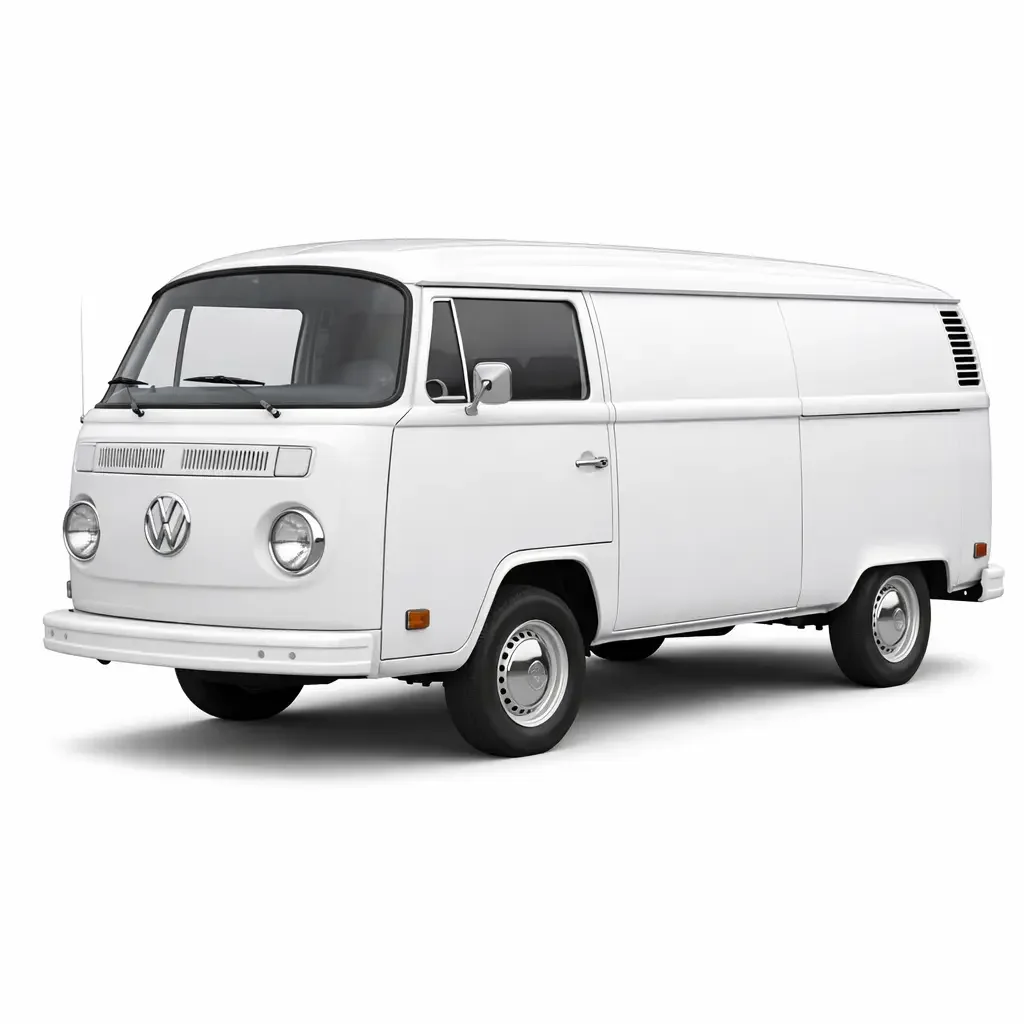
The Volkswagen Panel sold in North America from the 1973 through 1979 model years is the cargo van body style of the second-generation Type 2, known among enthusiasts as the T2b or Late Bay. It shares its platform, running gear, engine, and transmission with all other T2b body styles sold in the same window: the nine-passenger Bus, the Kombi, the Westfalia Camper, and the single-cab and double-cab Pickup. For catalog work, the Panel designation identifies the body style, not a separate vehicle. All mechanical components, suspension parts, brake hardware, engine service items, and transmission components confirmed for one T2b body style apply equally to all others within matching engine and transmission specifications, with the exception of body-specific items such as the sliding side door, rear cargo doors, and glass.
The T2b is a forward-control, rear-engine, rear-wheel-drive vehicle built on an 2,400 mm (94.5-inch) wheelbase. The engine sits behind the rear axle in the tail of the vehicle, driving the rear wheels through a transaxle mounted directly ahead of it. This layout is the defining architectural fact for catalog work because it governs every aspect of drivetrain component orientation, exhaust routing, cooling system architecture, and suspension geometry. No component from a front-engine vehicle crosses to the T2b at the drivetrain or cooling level without individual confirmation, and no component from the T3 Vanagon or later Transporter generations crosses to the T2b despite the shared nameplate and similar commercial application.
The 1973 through 1979 window contains four engine-level catalog boundaries driven by the Type 4 engine displacement progression and the introduction of fuel injection and electronic ignition. These boundaries do not align with clean annual model year cuts in every case and require production date or engine code confirmation on certain components. This guide addresses the United States market throughout. Canadian applications follow the same engine and transmission specifications as the United States for the T2b within this window.
Platform: Type 2 T2b, Rear Engine, Rear-Wheel Drive
The T2b platform uses a torsion bar front axle with king pins and linking arms, a design carried forward from the Type 1 Beetle heritage. The front suspension is independent on each side with transverse torsion bars. The rear suspension uses independent half-shaft axles with constant velocity joints, replacing the swing axle of the first-generation T1. This CV-joint rear axle was introduced with the T2 in 1967 and eliminates the severe camber changes that characterized the earlier swing axle design. The rear CV joints, rear axle shafts, and rear wheel bearings are specific to the T2 platform and do not cross to Type 1 Beetle applications, which retained the swing axle throughout their production run.
Front disc brakes were introduced on the T2 for the 1971 model year. All T2b vehicles in the 1973 through 1979 window use front disc brakes. The rear brakes are drums throughout the window. A brake component confirmed for the pre-1971 T2a with front drums does not apply to any T2b all applications.
The steering is a worm-and-sector design, with the steering box mounted ahead of the front axle in the nose of the vehicle. The forward-control body places the driver directly above the front axle with no engine ahead of him, which means the steering geometry and column length are specific to the T2 forward-control layout and share nothing with the Type 1 Beetle or Type 3 sedan.
The wheelbase of 2,400 mm is identical between the T2b and the T1 that preceded it in North American sales, but the two generations are not dimensionally interchangeable in body components. The T2b body is longer, wider, and heavier than the T1, and no exterior panel from the T1 crosses to the T2b.
The T2b was replaced in North America by the T3, known as the Vanagon, beginning with the 1980 model year. The T3 is a completely different platform with a different body structure, different suspension geometry, different engine mounting arrangement, and different drivetrain layout. Despite being colloquially called the Bus or Camper in succession, the T3 shares no mechanical component with the T2b at the chassis, engine, or transmission level.
Body Styles on the T2b Platform: Panel Vs the Rest
The Panel Van is distinguished from the other T2b body styles by the absence of side windows behind the B-pillar and the presence of two rear cargo doors instead of the rear hatch or tailgate found on the Bus. The Panel carries no passenger seats in its cargo area as delivered from the factory, though the cargo floor, cargo wall panels, and rear door hardware are body-style-specific components that do not cross to the Bus or Kombi.
The sliding side door is shared between the Panel, Kombi, and Bus body styles as a common component. The sliding door assembly, sliding door roller hardware, and sliding door latch mechanism cross between these body styles within matching production date ranges. The Pickup body styles do not share the sliding door configuration of the van variants.
The windscreen, front door glass, and front door assemblies are shared across all T2b body styles. A front door confirmed for a 1976 Bus crosses to a 1976 Panel within matching production specifications. Rear body glass, rear door assemblies, and rear quarter glass are body-style-specific and do not cross between Panel, Bus, Kombi, and Pickup configurations.
The Westfalia Camper is built on the Bus body style with interior conversion hardware added by Westfalia at a separate facility after leaving the VW assembly line. The Camper's pop-up roof, interior cabinetry, and sleeping conversion hardware are Westfalia-specific and are not VW catalog items in the conventional sense. The mechanical components beneath the Camper are identical to the Bus and cross freely to the Panel within matching specifications.
Engine Architecture: Type 4 Air-Cooled Flat-Four
All T2b vehicles sold in the United States from 1973 onward use the Type 4 engine family. The Type 4 is an air-cooled overhead-valve flat-four engine developed originally for the Volkswagen 411 and 412 passenger cars. It differs fundamentally from the Type 1 engine used in the Beetle and in European-market T2b vehicles: the Type 4 uses a horizontally opposed layout with the cooling fan driven off the end of the crankshaft rather than mounted vertically above the engine as in the Type 1. The Type 4's pancake profile and end-mounted fan arrangement require different engine tin, different cooling ducting, different engine lid, and different engine compartment dimensions than the Type 1. A cooling tin, engine lid, or thermostat housing confirmed for a Type 1 engine does not cross to a Type 4 installation.
The Type 4 engine family is also found in the Porsche 914 (1970 through 1976) and the Porsche 912E (1976). Components from these Porsche applications share the same engine family and cross to the T2b within matching engine code specifications at the internal engine level. Cylinder heads, pistons, connecting rods, crankshaft, and camshaft components confirmed for a same-displacement Porsche 914 application may cross to the T2b, but the engine tin, cooling components, intake manifold, and fuel system hardware are vehicle-specific and must be confirmed individually.
The Type 4 engine in the T2b went through four displacement and specification changes during the 1973 through 1979 window, each creating a distinct catalog boundary.
Engine Progression Year by Year
1973: 1700cc, Dual Carburetor (CB and CD)
The 1973 model year uses the 1679cc Type 4 engine, commonly referred to as the 1700. Two engine codes apply: CB for the manual transmission application and CD for the automatic transmission application. Both produce 66 hp at SAE gross ratings. Both use dual Solex 34 PDSIT-2 and 34 PDSIT-3 carburetors mounted on separate intake manifolds serving each cylinder bank. The dual carburetor layout means the intake manifold, carburetor bodies, carburetor linkage, and choke system are all specific to this application and do not cross to the later fuel-injected engines.
The automatic transmission application in 1973 is the first year an automatic was offered on the T2b. The CD engine code identifies a 1700cc engine built specifically for automatic transmission use, with different internal balancing and torque converter compatibility specifications from the CB manual application. A component confirmed for the CD automatic application must be confirmed to also fit the CB manual application before the listings are merged.
The 1973 model year is also the first year of the T2b square-profile bumpers and the relocated front turn indicators mounted above the headlights in the fresh air grille. These are the defining exterior identification points for the 1973-and-later T2b versus the 1972-and-earlier T2a. A front valance, front bumper, or turn signal assembly confirmed for a T2a application does not fit the 1973 or later T2b.
1974: 1800cc, Dual Carburetor (AW)
For 1974 the engine displacement increased to 1795cc, referred to as the 1800. The engine code is AW for both manual and automatic transmission applications. The increase in displacement was achieved through a larger bore and required a different cylinder and piston set from the 1700. Carburetor throat size was also increased alongside the engine displacement change. A carburetor confirmed for the 1973 1700cc application does not cross to the 1974 1800cc application without confirming the carburetor throat dimension and jetting specification match.
The 1974 model year also brought a larger clutch to accommodate the increased torque of the 1800cc engine. A clutch disc or pressure plate confirmed for the 1973 1700cc manual application must be confirmed against the 1974 specification before it is applied to a 1974 manual application. The 1974 manual transmission also received different gear ratios from the 1973 unit. A transmission internal component listed generically for the T2b four-speed manual must confirm production year before it is assigned to a specific application.
The brake vacuum booster was enlarged for 1974 to improve braking feel with the heavier 1800cc powertrain. A brake booster confirmed for the 1973 application does not cross to the 1974 application.
1975: 1800cc, Bosch L-Jetronic Fuel Injection (AP)
For 1975 the carburetor system was replaced by Bosch L-Jetronic electronic fuel injection for the United States market. The engine code is AP for the fuel-injected 1800cc application. The L-Jetronic system uses an airflow meter, electronic control unit, and electrically actuated fuel injectors to deliver fuel, replacing the mechanical carburetor entirely. This change affects every fuel system component at the service level: there is no carburetor, no choke, no accelerator pump, and no carburetor float in an AP engine. A carburetor confirmed for the 1973 or 1974 application does not apply to any 1975 or later T2b sold in the United States.
At the same time the fuel system changed, the 1975 model year also saw the windshield wiper switch moved from the dashboard to a stalk on the steering column, a new steering column design, and changes to the rear engine access door hinges. These interior and body changes create sub-year catalog boundaries for switch, wiper, and column components.
The 1975 model year is also a one-year-only application for cab door design: the front cab door style used in 1975 differs from both the 1974 and 1976 designs due to a change in the door hinge configuration. A front door confirmed specifically for 1974 or 1976 production does not cross to the 1975 application for the door skin and hinge assembly. This is the most practically consequential body-level catalog boundary within the 1973 through 1979 window and must be tracked as a discrete 1975-only application for the front doors.
1976 Through 1977: 2000cc, Fuel Injection (GD)
For 1976 the engine displacement increased again to 1970cc, referred to as the 2000. The engine code is GD. This is the largest displacement offered in the T2b for the United States and produces 67 hp at DIN rating, approximately 72 hp SAE net. The increase from 1800cc to 2000cc required different cylinders, pistons, and cylinder heads from the 1800cc application. A cylinder or piston confirmed for the 1975 AP 1800cc application does not cross to the GD 2000cc application.
The GD engine retains Bosch L-Jetronic fuel injection from the AP application. Fuel injectors, the airflow meter, and the fuel pressure regulator may cross between the AP and GD applications within matching specifications, but must be confirmed at the part number level because the larger displacement engine operates at different fuel delivery requirements.
The cab door design introduced for 1976 continued through 1979 without further change. Front door components confirmed for the 1976 model year cross to 1977 through 1979 within matching specifications.
The 1976 and 1977 GD applications share the same engine code. Components confirmed for 1976 production cross to 1977 within matching specifications, with one exception: the engine access door deck lid hinges changed during this production span and must be confirmed against the build date rather than the model year alone for deck lid-specific components.
1978 Through 1979: 2000cc, Electronic Ignition (GD and GE)
For 1978 the 2000cc GD engine received two significant changes that create catalog boundaries within the ongoing GD application. First, hydraulic valve lifters replaced the mechanical valve lifters used in all prior T2b engines. This eliminates periodic valve adjustment as a service interval and means that mechanical lifter components, valve adjustment shims, and pushrod specifications from pre-1978 engines do not apply to 1978 or later GD production. A valve train component listed generically for the GD engine must confirm the 1978 hydraulic lifter change before it is applied to either pre-1978 or 1978-and-later production.
Second, 1978 was the first year for electronic ignition on the T2b, using a Hall effect sensor and digital controller to replace the contact breaker points used in all prior years. This eliminates the conventional distributor points, condenser, and timing-by-points service from the 1978 and later application. A distributor points set, condenser, or points-style ignition component applied to a 1978 or later T2b is assigning components from an ignition system that was not installed. Conversely, an electronic ignition pickup, Hall effect sensor, or digital ignition controller does not apply to any T2b built before the 1978 model year.
The 1978 model year also brought sliding side windows to the front cab doors, replacing the swing vent windows of earlier production. A front door glass assembly or vent window frame confirmed for 1977 or earlier production does not cross to 1978 or later production.
The 1979 model year introduced a catalytic converter into the exhaust system for United States vehicles, the first year of catalytic converter fitment on the T2b. This creates an exhaust system catalog boundary at the 1978-to-1979 model year line. A muffler, exhaust pipe, or heat exchanger confirmed for a 1978 application does not apply to a 1979 application without confirming that the catalytic converter and its associated exhaust routing are accounted for. The 1979 California-market application additionally received a closed-loop oxygen sensor and feedback fuel control system, the GE engine code, using revised cylinder heads with square exhaust ports. The GD code continued for 49-state 1979 production, while GE identifies California-specific 1979 production. An oxygen sensor, feedback control unit, or square-port cylinder head confirmed for the GE California application does not cross to the GD 49-state 1979 application.
The 1979 model year is also the final year of T2b production in Germany. European production ceased in August 1979 to allow the T3 to begin production at the Hannover plant. North American market 1979 T2b vehicles were built from the remaining German production run.
Transmission: Four-Speed Manual and Three-Speed Automatic
The T2b was available throughout the 1973 through 1979 window with a four-speed manual transmission or a three-speed automatic transmission. The automatic was introduced for the 1973 model year and is only available paired with the Type 4 engine. No automatic transmission was offered with any Type 1 engine configuration on the T2.
The four-speed manual carries the VW transmission code 002 throughout the window, with variant codes indicating the specific gear ratio set used in each production period. The gear ratios changed for 1974 alongside the engine displacement increase. A transmission component listed for the 002 manual must confirm the production year before the gear ratio specification is treated as identical across the window.
The three-speed automatic carries the VW transmission code 003 throughout the window, with variant codes including NB (1974), NC and ND (1975), and NF (1979). The three-speed automatic uses a conventional torque converter, not a dual-clutch system. It is a different architecture from any automatic used in later Volkswagen products and shares no service component with the watercooled transmissions used in the Golf, Jetta, or Passat families. Transmission fluid, filter, and valve body specifications are specific to the 003 automatic and must not be cross-referenced to any later VW automatic application.
For 1979 the manual transmission code changed from 002 to 091, reflecting the final-year gearbox revision. A manual transmission component confirmed for the 002 application of 1973 through 1978 must confirm compatibility with the 091 before it is applied to the 1979 application.
No five-speed manual, no four-speed automatic, and no dual-clutch transmission was available at any point in the T2b North American window.
Fuel and Ignition System Boundaries: A Summary
The fuel and ignition system splits within this window are the most consequential catalog boundaries for service components. They can be summarized as three clean cuts.
The first cut is at 1974-to-1975. Carburetors are the fuel delivery system for 1973 and 1974. Bosch L-Jetronic electronic fuel injection is the fuel delivery system for 1975 through 1979. No carburetor applies to any 1975 or later US-market T2b. No fuel injector or airflow meter applies to any 1973 or 1974 application.
The second cut is at 1977-to-1978. Contact breaker points ignition is the ignition system for 1973 through 1977. Electronic Hall effect ignition is the system for 1978 and 1979. Distributor points, condenser, and timing adjustment procedures based on point gap apply only to 1973 through 1977. Electronic ignition pickup, Hall sensor, and digital ignition controller apply only to 1978 and 1979.
The third cut is at 1978-to-1979 for the exhaust system. The catalytic converter is present in 1979 and absent in 1973 through 1978. Exhaust components must account for this hardware difference at the 1979 boundary.
Cross-Reference Family: Porsche 914 and Type 4 Engine Sharing
The Type 4 engine family is shared between the T2b and the Porsche 914 (1970 through 1976) and the Porsche 912E (1976). The internal engine components of the Type 4, including the crankcase, crankshaft, camshaft, connecting rods, pistons, cylinders, cylinder heads, and valve train hardware, cross between these applications within matching displacement and engine code specifications.
The 1700cc Type 4 used in the T2b 1973 application corresponds to the engine used in the Porsche 914 1.7 of 1970 through 1973. The 1800cc Type 4 used in the T2b 1974 and 1975 applications corresponds to the engine used in the Porsche 914 1.8 of 1973 through 1976. The 2000cc Type 4 used in the T2b 1976 through 1979 applications corresponds to the engine used in the Porsche 912E of 1976.
These internal engine cross-references are limited to the engine case and its contents. The cooling tin, engine lid, intake manifold, fuel system hardware, ignition hardware, and exhaust manifolds are vehicle-specific and do not cross between the T2b and the Porsche applications. A cooling tin confirmed for a Porsche 914 does not fit the T2b engine compartment layout, and vice versa.
Some aftermarket catalog systems list Type 4 internal engine parts under both VW Bus and Porsche 914 applications as a single shared listing. This cross-reference is correct at the case and internal component level but must not be extended to ancillary engine hardware without individual confirmation.
Common ACES/PIES Catalog Mistakes
The first error is applying carburetor components to 1975 or later US-market T2b applications. The L-Jetronic fuel injection system replaced the carburetor entirely for the 1975 model year in the United States. No carburetor, choke, accelerator pump, or carburetor float applies to any 1975 through 1979 T2b sold in the United States.
The second error is applying electronic ignition components to 1977 or earlier T2b applications. Contact breaker points ignition was used through the 1977 model year. A Hall effect sensor or digital ignition controller does not apply to any T2b built before the 1978 model year.
The third error is applying distributor points and condenser to 1978 or later T2b applications. Electronic ignition replaced the contact breaker points for 1978. No points-style ignition component applies to any 1978 or 1979 T2b.
The fourth error is applying mechanical valve lifter components to 1978 or later GD engine applications. Hydraulic valve lifters were introduced for 1978 production. Adjustment shims, mechanical lifter bodies, and valve gap specifications from pre-1978 engines do not apply to 1978 or later production.
The fifth error is applying 1979 exhaust components to 1978 or earlier applications, or vice versa. The catalytic converter was introduced for 1979. Mufflers and exhaust pipes confirmed for 1979 California or 49-state applications are not the same assemblies as those used in 1973 through 1978.
The sixth error is applying GE California-specific components to GD 49-state 1979 applications. The GE engine code identifies California-specification 1979 production with a closed-loop feedback fuel system, an oxygen sensor, and square-port cylinder heads. The GD 49-state 1979 application does not use these components.
The seventh error is treating the 1975 front cab door as interchangeable with 1974 or 1976 doors. The 1975 cab door is a one-year-only design. Front door skins, hinge assemblies, and door glass for 1975 production must be listed as 1975-specific and not merged with adjacent years.
The eighth error is applying 1977 or earlier front door glass to 1978 or later production. Sliding side windows replaced swing vent windows in the front cab doors for 1978. A vent window assembly confirmed for 1977 or earlier does not fit the 1978 or later door configuration.
The ninth error is applying a 002-coded manual transmission component to the 1979 091-coded gearbox, or vice versa. The final-year 1979 gearbox uses the 091 code and received revisions from the 002 used in 1973 through 1978. Internal components must be confirmed against the specific code before a listing is shared across the window.
The tenth error is treating the T2b Panel as a mechanically distinct vehicle from the T2b Bus, Kombi, or Camper for mechanical component purposes. All T2b body styles share the same engine, transmission, suspension, and brake architecture. A spark plug, oil filter, or wheel bearing confirmed for the Bus crosses to the Panel within matching production specifications. Body-specific components such as the rear cargo doors, rear glass, and cargo floor panels are Panel-specific, but nothing in the running gear is.
The eleventh error is applying T3 Vanagon components to the T2b on the basis of shared commercial application. The T3 entered North American production for the 1980 model year as an entirely different platform with different suspension geometry, different engine mounting, and different body structure. No T3 mechanical component crosses to the T2b, and no T2b mechanical component crosses to the T3.
The twelfth error is applying Type 1 Beetle engine cooling, intake, or ignition components to the Type 4 engine in the T2b on the basis of shared air-cooled architecture. The Type 4 engine uses an end-mounted fan and different cooling tin, different intake arrangement, and different accessory drive layout from the Type 1. Type 1 engine service hardware is Type 1-specific and does not cross to the Type 4.
The thirteenth error is applying T2a components from before 1973 to T2b applications. The 1973 model year introduced the square-profile bumpers, the relocated high-mount front turn indicators, and the enlarged engine compartment for the Type 4. A front valance, front bumper, or turn signal assembly confirmed for 1972 or earlier production does not fit the 1973 or later T2b.
Pre-Listing Checklist for the 1973-1979 Panel
Platform confirmed as Type 2 T2b, rear-engine, rear-wheel drive, forward control; no front-engine component, no T3 Vanagon component, and no Type 1 Beetle engine hardware applies to any T2b application.
Engine confirmed as Type 4 air-cooled flat-four in the correct displacement for the model year: 1700cc CB or CD in 1973, 1800cc AW in 1974, 1800cc AP in 1975, 2000cc GD in 1976 through 1978 and 1979 49-state, 2000cc GE in 1979 California.
Fuel system confirmed as dual carburetor for 1973 and 1974 only, and as Bosch L-Jetronic electronic fuel injection for 1975 through 1979; no carburetor component applies to any US-market 1975 or later T2b.
Ignition system confirmed as contact breaker points for 1973 through 1977, and as Hall effect electronic ignition for 1978 and 1979; no points component applies to any 1978 or later T2b.
Valve train confirmed as mechanical lifters for 1973 through 1977, and as hydraulic lifters for 1978 and 1979; valve adjustment hardware and shim specifications confirmed as mechanical-lifter-specific before any pre-1978 listing is applied.
Exhaust system confirmed as non-catalytic for 1973 through 1978, and as catalytic for 1979; exhaust component listings confirmed as year-specific at the 1978-to-1979 boundary.
For 1979, market confirmed as California GE or 49-state GD before oxygen sensor, feedback control unit, or square-port cylinder head is assigned.
Transmission confirmed as four-speed manual 002 (1973 through 1978), four-speed manual 091 (1979), or three-speed automatic 003 (all years); no five-speed, no modern VW automatic, and no dual-clutch transmission applies to any T2b application.
Front cab door application confirmed as 1975-only, or as 1976-through-1979, before door skin or hinge assembly is assigned; 1975 front doors do not cross to any adjacent year.
Front door glass confirmed as swing vent window for 1973 through 1977, or as sliding side window for 1978 and 1979; vent window assembly does not cross to 1978 or later configuration.
Body-style-specific components confirmed as Panel-specific (rear cargo doors, cargo floor, rear glass) before any cross-reference to Bus, Kombi, or Camper rear body hardware is published; front doors, sliding side door, windscreen, and all mechanical components confirmed as shared across T2b body styles within matching specifications.
Porsche 914 cross-references confirmed as valid at the internal engine case and component level only; cooling tin, intake manifold, fuel system, and ignition hardware confirmed as T2b-specific and not crossed to Porsche applications.
Final Take
The 1973 through 1979 T2b Panel window is defined almost entirely by engine progression rather than body change. The body reached its final form in 1974 and changed only in minor detail thereafter, with the one-year-only 1975 front door and the 1978 sliding door glass as the only body-level catalog boundaries of practical significance within the window. Everything else that matters for catalog work happens in the engine bay and the ignition system.
The three-cut summary covers the most serviceable component categories: carburetors out after 1974, points out after 1977, catalytic converter in for 1979. A catalog that tracks these three annual transitions correctly will handle the majority of engine service component listings for the T2b without error. The harder boundary to track is the 1978 hydraulic lifter change within the ongoing GD engine code, because it requires a build date or engine serial number check rather than a clean model year cut. Any GD valve train listing that does not distinguish pre-1978 mechanical from 1978-and-later hydraulic is an incomplete application.
The architectural separation from both the Type 1 Beetle and the T3 Vanagon is worth reiterating because both of those vehicles share Volkswagen branding and, in the case of the T3, share the commercial van role directly. The Type 4 engine in the T2b is not a development of the Type 1. The T3 that replaced the T2b is not a development of the T2b. These are three distinct mechanical architectures that share a name and a general shape and nothing else in the catalog.
Disclaimer
This guide is intended for catalog research, fitment analysis, and parts advisory reference. Production specifications, option availability, and regulatory compliance requirements vary by model year, regional market, and assembly date within any given window. Always confirm application data against vehicle identification number decoding, factory build sheets, and OEM parts documentation before finalizing a listing or parts recommendation. PartsAdvisory and its contributors are not responsible for fitment errors arising from catalog data that has not been independently verified against physical vehicle inspection or official OEM sources.